


Last Updated on January 13, 2026 by Nurseslab.in Editorial Team
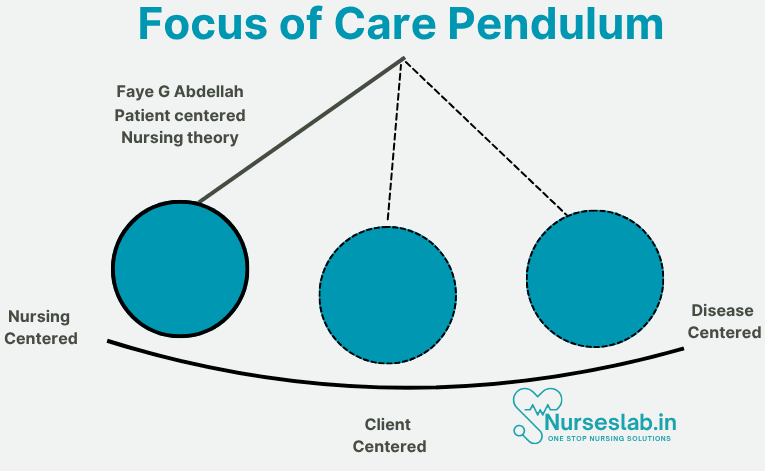
Faye Glenn Abdellah’s Patient-Centered Nursing Theory, also known as the 21 Nursing Problems Theory, revolutionized nursing by shifting the focus from disease-centered care to a holistic, patient-centered approach. Her framework emphasizes understanding and addressing the total health needs of individuals physical, emotional, and social.
Life Story of Faye G Abdellah
Dr. Faye Glenn Abdellah (1919–2017) was a pioneering nurse theorist, researcher, educator, and public health leader whose work transformed nursing from a disease-centered to a patient-centered discipline. Her legacy spans clinical innovation, military service, and groundbreaking theory development.
Early Life & Education
- Born March 13, 1919, in New York City.
- Witnessed the Hindenburg disaster in 1937, which inspired her to pursue nursing.
- Earned her RN diploma from Fitkin Memorial Hospital School of Nursing (now Ann May School of Nursing).
- Completed BSN (1945), MA in Physiology (1947), and EdD in Education (1955) from Teachers College, Columbia University2.
Career & Contributions
- Served in the U.S. Public Health Service for 40 years, including active duty during the Korean War.
- Became the first nurse and woman to serve as Deputy Surgeon General of the United States (1981–1989).
- Founded and served as Dean of the Graduate School of Nursing at the Uniformed Services University of the Health Sciences (USUHS).
- Developed the Patient Assessment of Care Evaluation (PACE) system, still used to evaluate healthcare quality.
- Advocated for home care, long-term care planning, and gerontological nursing decades before they became mainstream.
Twenty-One Nursing Problems Theory
Abdellah’s theory reframed nursing as a problem-solving profession focused on meeting patient needs. Key elements include:
- 21 Nursing Problems grouped into:
- Basic needs
- Sustenal care
- Remedial care
- Restorative care
- Emphasized nursing diagnosis, scientific inquiry, and holistic care.
- Influenced nursing curricula and practice globally.
Honors & Legacy
| Honor | Organization | Year |
|---|---|---|
| Living Legend | American Academy of Nursing | 1994 |
| Inductee | National Women’s Hall of Fame | 2000 |
| Hall of Fame | American Nurses Association | 2012 |
| Rear Admiral Rank | U.S. Public Health Service | First nurse to achieve it |
- Authored over 150 publications, translated into multiple languages.
- Received 12 honorary doctorates and 50+ academic awards.
Core Concepts of Abdellah’s Theory
- Human Needs Framework: Nursing care is structured around 21 identified problems, categorized into:
- Basic Care Needs (e.g., nutrition, hydration, elimination)
- Sustenance Needs (e.g., sleep, safety, infection prevention)
- Remedial Needs (e.g., emotional support, communication)
- Restorative Needs (e.g., rehabilitation, self-care)
- Problem-Solving Approach: Nurses assess, diagnose, plan, implement, and evaluate care based on patient-specific problems.
- Patient-Centered Care: Emphasizes individualized care, empathy, and understanding of the patient’s unique context.
Ten Steps in the Nursing Process
- Develop a comprehensive care plan
- Learn to know the patient
- Sort relevant data
- Make generalizations
- Identify therapeutic plan
- Test generalizations
- Validate conclusions
- Observe and evaluate over time
- Explore family reactions
- Reflect on nurse’s feelings
Assumptions
Assumptions were related to
- change and anticipated changes that affect nursing;
- the need to appreciate the interconnectedness of social enterprises and social problems;
- the impact of problems such as poverty, racism, pollution, education, and so forth on health care delivery;
- changing nursing education
- continuing education for professional nurses
- development of nursing leaders from under reserved groups
Abdellah and colleagues developed a list of 21 nursing problems. They also identified 10 steps to identify the client’s problems. 11 nursing skills to be used in developing a treatment typology
11 Nursing Skills
- Observation of health status
- Skills of communication
- Application of knowledge
- Teaching of patients and families
- Planning and organization of work
- Use of resource materials
- Use of personnel resources
- Problem-solving
- Direction of work of others
- Therapeutic use of the self
- Nursing procedure
The 21 Nursing Problems
Abdellah categorized these into three domains:
| Category | Focus |
|---|---|
| Physical | Hygiene, comfort, activity, safety, nutrition, elimination, oxygenation, fluid balance, sensory function |
| Emotional | Feelings, reactions, communication, emotional illness |
| Sociological | Interpersonal relationships, community resources, spiritual needs |
These problems guide nurses in assessing and addressing comprehensive patient needs, not just symptoms.
Application of Faye Abdellah’s Patient-Centered Nursing Theory
1. Assessment
- Collect comprehensive data about the patient’s physical, emotional, sociological, and spiritual needs.
- Identify actual and potential health problems based on the 21 Nursing Problems outlined by Abdellah.
2. Nursing Diagnosis
- Classify patient problems into overt (obvious) and covert (hidden) problems.
- Formulate nursing diagnoses that address health needs or difficulties impacting the patient’s overall well-being.
3. Planning
- Develop a problem-solving nursing care plan targeting priority patient needs.
- Establish short-term and long-term goals to resolve identified problems and promote holistic care.
4. Intervention
- Implement nursing actions that address the 21 Nursing Problems, which include:
- Meeting basic physical needs (oxygenation, nutrition, elimination, activity, and safety)
- Providing therapeutic measures for emotional, social, and spiritual well-being
- Assisting in the maintenance of health and prevention of complications
- Ensure nursing care is individualized and patient-centered.
5. Evaluation
- Continuously evaluate the patient’s response to nursing interventions.
- Determine if the identified problems are resolved or minimized.
- Modify the care plan as needed to achieve optimal health and independence.
This structured approach highlights holistic, problem-solving, and patient-focused care, which is the core of Abdellah’s Nursing Theory. Philosophy program. She retired as Founding Dean in 2002.
Case Scenario 1: Patient with Community-Acquired Pneumonia
Scenario:
Mr. L, 45 years old, is admitted with community-acquired pneumonia. He presents with shortness of breath, cough with sputum, and fatigue. He is anxious about his health and requires assistance with basic care.
Possible Nursing Diagnosis (Based on Abdellah’s 21 Nursing Problems):
- Impaired gas exchange related to alveolar inflammation and secretions.
- Ineffective airway clearance related to retained secretions.
- Anxiety related to illness and hospitalization.
Nursing Interventions:
- Monitor respiratory rate, oxygen saturation, and lung sounds regularly.
- Administer oxygen therapy and bronchodilators as prescribed.
- Encourage deep breathing, coughing, and adequate fluid intake to loosen secretions.
- Provide emotional reassurance and clear information to reduce anxiety.
- Evaluate respiratory improvement and anxiety reduction.
Case Scenario 2: Postoperative Patient After Abdominal Surgery
Scenario:
Mrs. K, 52 years old, underwent abdominal surgery for a bowel obstruction. She reports incisional pain, has limited mobility, and expresses fear of moving due to pain. She needs assistance with hygiene and ambulation.
Possible Nursing Diagnosis (Based on Abdellah’s 21 Nursing Problems):
- Acute pain related to surgical incision.
- Self-care deficit (bathing and mobility) related to postoperative discomfort.
- Risk for impaired skin integrity related to limited mobility.
Nursing Interventions:
- Administer analgesics as prescribed and assist with positioning for comfort.
- Assist with hygiene needs and gradual mobilization to promote independence.
- Encourage early ambulation to prevent complications like DVT and pneumonia.
- Inspect skin regularly and use pressure-relieving devices if needed.
- Evaluate pain relief, mobility improvement, and skin condition.
REFERENCES
- Ortiz MR. Best Practices in Patient-Centered Care: Nursing Theory Reflections. Nurs Sci Q. 2021 Jul;34(3):322-327. doi: 10.1177/08943184211010432. PMID: 34212801. https://pubmed.ncbi.nlm.nih.gov/34212801/
- Kwame, A., Petrucka, P.M. A literature-based study of patient-centered care and communication in nurse-patient interactions: barriers, facilitators, and the way forward. BMC Nurs 20, 158 (2021). https://doi.org/10.1186/s12912-021-00684-2
- McCance T, McCormack B. The Person-centred Nursing Framework: a mid-range theory for nursing practice. J Res Nurs. 2025 Mar 13:17449871241281428. doi: 10.1177/17449871241281428. Epub ahead of print. PMID: 40093819; PMCID: PMC11907491.
- Hande K. Leveling evidence-based practice across the nursing curriculum. J Nurse Pract. 2017;13(1):e17-22.
- Mackey A and Bassendowski S. The history of evidence-based practice in nursing education and practice. J Prof Nurs. 2017;33(1):51-55.
- Flood LS and Robinia K. Bridging the gap: Strategies to integrate classroom and clinical learning. Nurse Educ Pract. 2014;14(4):329-332.
Stories are the threads that bind us; through them, we understand each other, grow, and heal.
JOHN NOORD
Connect with “Nurses Lab Editorial Team”
I hope you found this information helpful. Do you have any questions or comments? Kindly write in comments section. Subscribe the Blog with your email so you can stay updated on upcoming events and the latest articles.


