


Last Updated on January 29, 2026 by Nurseslab.in Editorial Team
Data collection is a critical step in the research process, involving gathering information to analyze, interpret, and make informed conclusions. Data collection methods vary depending on the research goals, study design, and resources available, and may include quantitative or qualitative techniques. Effective data collection ensures accurate, reliable, and valid data that supports meaningful insights.
Data Collection
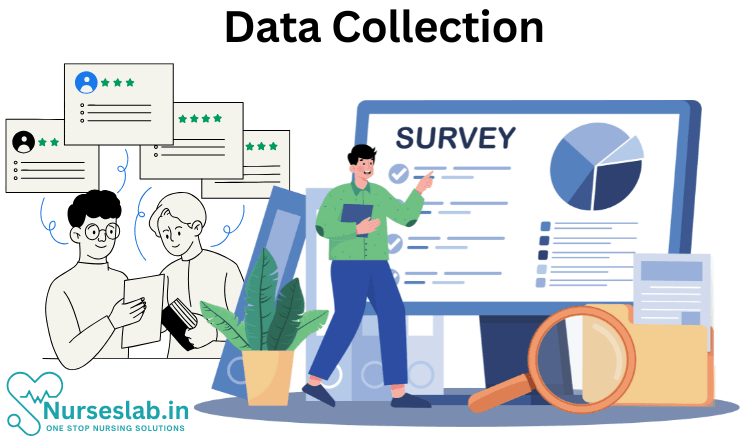
Data collection is the systematic process of gathering information from various sources to answer research questions, test hypotheses, and evaluate outcomes. It involves selecting the right method to obtain relevant data for a specific study. Proper data collection is essential for the credibility and validity of research findings.
Understanding Data Collection Methods
Data collection methods encompass a variety of techniques and tools for gathering quantitative and qualitative data. These methods are integral to the data collection and ensure accurate and comprehensive data acquisition.
Quantitative data collection methods involve systematic approaches, such as
- Numerical data,
- Surveys, polls and
- Statistical analysis
- To quantify phenomena and trends.
Conversely, qualitative data collection methods focus on capturing non-numerical information, such as interviews, focus groups, and observations, to delve deeper into understanding attitudes, behaviors, and motivations.
Combining quantitative and qualitative data collection techniques can enrich organizations’ datasets and gain comprehensive insights into complex phenomena.
Types of Data in Research
Data can be broadly classified into two categories: Primary Data and Secondary Data.
- Primary Data: Data collected directly by the researcher for the first time, tailored specifically to the study’s objectives. Examples include surveys, interviews, and experiments.
- Secondary Data: Data collected previously by other researchers or institutions, used for purposes different from its original collection. Examples include government reports, historical records, and previously published studies.
Data can also be divided into Quantitative Data (numerical data, which can be measured and analyzed statistically) and Qualitative Data (non-numerical data, which provides descriptive information about experiences, feelings, and opinions).
Types of Data Collection Methods
1. Surveys and Questionnaires
- Definition: Surveys and questionnaires involve asking a set of questions to a target audience, either in person, by mail, online, or over the phone.
- Types: Surveys can be structured (fixed response options) or unstructured (open-ended responses).
- Advantages: Cost-effective, efficient for collecting large amounts of data.
- Example: A customer satisfaction survey to assess user experience with a product.
2. Interviews
- Definition: Interviews are a qualitative data collection method involving direct interaction between the interviewer and respondent. They can be structured, semi-structured, or unstructured, depending on the study.
- Types: Structured (fixed questions), semi-structured (some flexibility), unstructured (free-flowing conversation).
- Advantages: Provides in-depth insights, allows for probing questions.
- Example: An interview with a healthcare provider to understand patient challenges and care practices.
3. Focus Groups
- Definition: Focus groups are a qualitative data collection method involving a small group discussion guided by a moderator to gather participants’ views on a specific topic.
- Advantages: Offers diverse perspectives, helps identify trends or common themes.
- Example: Conducting a focus group with parents to discuss concerns about remote learning.
4. Observations
- Definition: Observation involves systematically watching and recording behavior, events, or conditions as they occur in natural or controlled settings.
- Types: Participant observation (researcher actively engages) and non-participant observation (researcher does not interact).
- Advantages: Provides contextually rich data, ideal for studying behaviors in real-time.
- Example: Observing classroom dynamics to assess teacher-student interaction.
5. Experiments
- Definition: Experiments are controlled studies where researchers manipulate one or more variables to observe their effect on other variables. This method is common in scientific and psychological research.
- Advantages: Provides causal relationships, highly controlled and replicable.
- Example: Testing the effects of a new drug on patient recovery rates in a clinical trial.
6. Case Studies
- Definition: A case study is an in-depth investigation of a single instance or group, exploring complex issues within real-life contexts. It is commonly used in social sciences, psychology, and business.
- Advantages: Provides detailed, contextualized insights.
- Example: Conducting a case study on a successful business to understand its growth strategies.
7. Document and Content Analysis
- Definition: This method involves analyzing existing documents, texts, images, or media content to identify patterns, trends, and meanings.
- Advantages: Useful for studying historical or pre-existing data, non-intrusive.
- Example: Analyzing news articles to study media portrayal of climate change.
8. Online Data Collection (Digital Tools)
- Definition: Online data collection methods include using digital tools, platforms, and analytics software to gather data from online activities, behaviors, and interactions.
- Advantages: Efficient for collecting data from large and diverse audiences, especially for web-based studies.
- Example: Collecting data on consumer preferences through website analytics.
Importance of Data Collection Methods
Data collection methods play a crucial role in the research process as they determine the quality and accuracy of the data collected. Here are some major importance of data collection methods.
- Quality and Accuracy: The choice of data collection technique directly impacts the quality and accuracy of the data obtained. Properly designed methods help ensure that the data collected is error-free and relevant to the research questions.
- Relevance, Validity, and Reliability: Effective data collection methods help ensure that the data collected is relevant to the research objectives, valid (measuring what it intends to measure), and reliable (consistent and reproducible).
- Bias Reduction and Representativeness: Carefully chosen data collection methods can help minimize biases inherent in the research process, such as sampling or response bias. They also aid in achieving a representative sample, enhancing the findings’ generalizability.
- Informed Decision Making: Accurate and reliable data collected through appropriate methods provide a solid foundation for making informed decisions based on research findings. This is crucial for both academic research and practical applications in various fields.
- Achievement of Research Objectives: Data collection methods should align with the research objectives to ensure that the collected data effectively addresses the research questions or hypotheses. Properly collected data facilitates the attainment of these objectives.
- Support for Validity and Reliability: Validity and reliability are essential to research validity. The choice of data collection methods can either enhance or detract from the validity and reliability of research findings. Therefore, selecting appropriate methods is critical for ensuring the credibility of the research.
Choosing the Right Data Collection Method
Selecting a data collection method depends on several factors:
- Research Objectives: Whether the study aims to test hypotheses, describe a phenomenon, or explore a topic in depth.
- Type of Data: Quantitative or qualitative, depending on the data’s nature and how it will be analyzed.
- Resources and Budget: The availability of time, finances, and resources.
- Population and Sample Size: Whether the study involves a large population or a specific, smaller group.
- Reliability and Validity: Ensuring that the chosen method produces accurate, consistent, and valid data.
Examples of Data Collection in Different Fields
- Education
- Surveys: Collecting feedback from students on course satisfaction.
- Observation: Observing classroom interactions to assess teaching methods.
- Case Studies: Studying the impact of specific teaching strategies on student performance.
- Healthcare
- Interviews: Conducting interviews with patients to understand healthcare needs.
- Experiments: Running clinical trials to test new treatments.
- Focus Groups: Gathering healthcare providers’ perspectives on a new policy.
- Marketing
- Online Data Collection: Analyzing website analytics to understand customer behavior.
- Surveys: Conducting customer satisfaction surveys post-purchase.
- Content Analysis: Examining social media posts to study brand reputation.
- Psychology
- Experiments: Testing theories on behavior through controlled experiments.
- Case Studies: Investigating a rare psychological condition in detail.
- Focus Groups: Understanding group dynamics or attitudes towards mental health interventions.
REFERENCES
- Bhandari, P. (2023, June 21). Data Collection | Definition, Methods & Examples. Scribbr. Retrieved November 4, 2025, from https://www.scribbr.com/methodology/data-collection/
- Creswell, J. W., & Creswell, J. D. (2018). Research Design: Qualitative, Quantitative, and Mixed Methods Approaches. SAGE Publications.
- Kumar, R. (2018). Research Methodology: A Step-by-Step Guide for Beginners. SAGE Publications.
- Emma David, Data Collection Methods: Definition, Types & Examples, Updated : 12 Feb, 2025, https://www.proprofssurvey.com/blog/data-collection-methods/
- Flick, U. (2014). An Introduction to Qualitative Research. SAGE Publications.
Stories are the threads that bind us; through them, we understand each other, grow, and heal.
JOHN NOORD
Connect with “Nurses Lab Editorial Team”
I hope you found this information helpful. Do you have any questions or comments? Kindly write in comments section. Subscribe the Blog with your email so you can stay updated on upcoming events and the latest articles.


