


Last Updated on January 10, 2026 by Nurseslab.in Editorial Team
Explore how AI is transforming nursing: demystify smart technologies that assist with decision-making, documentation, and patient monitoring. Learn how nurses can harness AI to improve outcomes, reduce stress, and lead innovation—bridging compassionate care with digital intelligence.
Introduction
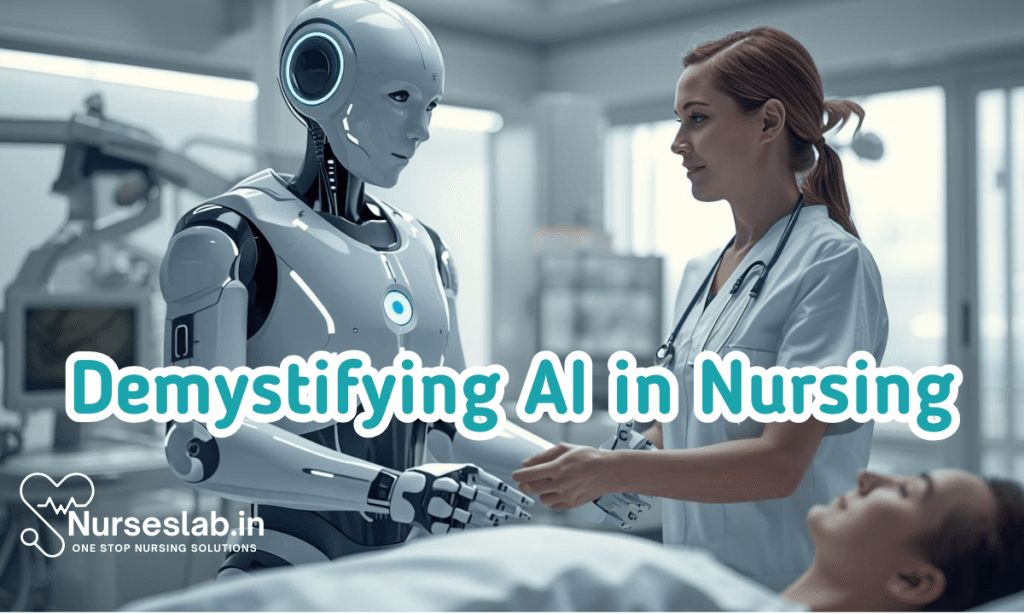
Artificial intelligence (AI) is rapidly transforming industries across the globe, and healthcare is no exception. Within nursing, AI has sparked both excitement and apprehension, with claims ranging from revolutionary improvements in patient care to fears of nurses being replaced by machines. As nurses, healthcare professionals, and students, it is crucial to understand what AI truly offers, dispelling myths and exploring its actual applications, limitations, and the potential future impact on nursing practice.
Common Myths About AI in Nursing
Myth 1: AI Will Replace Nurses and Lead to Job Loss
One of the most persistent myths surrounding AI in nursing is the fear that technology will render the profession obsolete. Headlines often sensationalise the capabilities of Artificial intelligence (AI), suggesting that machines will soon take over clinical roles, resulting in widespread job loss among nurses. In reality, Artificial intelligence (AI) is designed to augment nursing practice, not replace it. While automation can handle repetitive administrative tasks, the complex, compassionate, and context-driven nature of nursing care remains firmly in the hands of humans.
Myth 2: AI Can Replicate Human Empathy and Care
Another common misconception is that AI systems can replicate the empathy, emotional intelligence, and nuanced judgement that nurses provide. While Artificial intelligence (AI) can analyse vast amounts of data, predict patient outcomes, and even interact using natural language, it lacks the ability to truly understand and respond to the emotional, psychological, and cultural needs of patients. The therapeutic relationship between nurse and patient relies on human connection, which Artificial intelligence (AI) cannot authentically duplicate.
Myth 3: AI Is Infallible and Unbiased
Some believe that AI, being a product of advanced mathematics and programming, is immune to error and bias. However, Artificial intelligence (AI) systems are only as reliable as the data they are trained on and the algorithms that guide their operation. If the data is incomplete, biased, or unrepresentative, Artificial intelligence (AI) can perpetuate and even amplify existing disparities in healthcare. Nurses must remain vigilant, understanding that Artificial intelligence (AI) tools require oversight and critical evaluation.
Myth 4: AI Is Too Complex for Nurses to Use
There is a perception that AI technologies are overly complicated and inaccessible to nurses who may not have specialised training in computer science or data analysis. In truth, many AI-powered tools are designed to be user-friendly, integrating seamlessly into existing workflows. Training and professional development opportunities are increasingly available to help nurses adapt and thrive in an AI-enhanced environment.
Realities of AI in Nursing – Current Applications
Patient Monitoring and Early Warning Systems
AI has made significant inroads in patient monitoring by analysing vital signs, laboratory results, and other clinical data to detect early signs of deterioration. Machine learning algorithms can alert nurses to subtle changes in a patient’s condition, facilitating timely interventions and potentially improving outcomes. For instance, AI-driven predictive models can identify patients at risk of sepsis or cardiac events, enabling proactive care that saves lives.
Clinical Decision Support
AI-powered clinical decision support systems (CDSS) assist nurses in making informed choices at the bedside. These tools can synthesise vast amounts of medical literature, patient histories, and real-time data to provide evidence-based recommendations. While the final decision rests with the nurse, AI enhances their ability to deliver safe, effective, and personalised care.
Administrative and Documentation Support
Nursing involves substantial administrative work, from charting patient information to managing schedules and resources. Artificial intelligence (AI) technologies automate routine documentation, appointment scheduling, and inventory management, freeing nurses to focus more on direct patient care. Natural language processing (NLP) enables voice-to-text documentation, reducing the time spent on paperwork and minimising errors.
Remote and Virtual Care
Telehealth platforms increasingly incorporate Artificial intelligence (AI) to triage patient queries, monitor chronic conditions, and support remote consultations. For nurses working in rural or underserved areas, AI-powered tools extend the reach of healthcare, ensuring timely access to medical advice and interventions.
Education and Professional Development
AI-driven simulation platforms offer nurses realistic training scenarios, adapting to individual learning needs and providing instant feedback. These tools help nurses build clinical skills, practise decision-making, and stay updated with best practices, all within a safe, controlled environment.
Limitations and Challenges of AI in Nursing
Technological Boundaries
Despite impressive advancements, AI in nursing is not without its limitations. Many algorithms require large, high-quality datasets to function effectively, which may not always be available in real-world settings. Integration with existing hospital information systems can be complex, and technical issues such as interoperability and data security remain significant hurdles.
Ethical and Legal Considerations
The use of Artificial intelligence in healthcare raises important ethical questions about patient privacy, consent, and data ownership. Nurses must ensure that AI tools comply with legal and regulatory frameworks, safeguarding sensitive patient information. There is also the risk that over-reliance on AI could erode professional autonomy or lead to de-skilling if critical thinking is not actively maintained.
Bias and Inequality
AI systems can inadvertently perpetuate biases present in their training data, leading to unequal treatment of patients based on factors such as age, gender, socioeconomic status, or ethnicity. Nurses must be aware of these risks and advocate for inclusive, representative data practices. Ongoing monitoring and evaluation are essential to ensure AI supports equitable care.
Human-AI Collaboration Challenges
Effective integration of AI into nursing practice requires a collaborative approach, balancing the strengths of technology with human expertise. There may be resistance to change, concerns about job security, and uncertainty about how best to use AI tools. Continuous education, transparent communication, and involvement in AI development can help nurses adapt to these changes.
The Human Element – The Irreplaceable Role of Nurses
Empathy and Compassion
At the heart of nursing lies empathy, compassion, and the ability to connect with patients on a deeply personal level. While AI can provide recommendations and automate tasks, it cannot comfort a patient facing a frightening diagnosis, offer reassurance to anxious families, or advocate for vulnerable individuals. The therapeutic presence and emotional support that nurses provide are irreplaceable.
Clinical Judgement and Experience
Nursing involves complex decision-making that draws on experience, intuition, and contextual understanding. AI can assist by providing data-driven insights, but it cannot replicate the nuanced judgement required in dynamic clinical environments. Nurses interpret information within the broader context of each patient’s unique needs, values, and circumstances.
Communication and Advocacy
Nurses serve as advocates for their patients, navigating complex healthcare systems, and ensuring that each individual receives appropriate, dignified care. Effective communication, cultural competence, and ethical reasoning are essential aspects of nursing practice that AI cannot replace. Technology should support – not supplant – these vital roles.
Future Impact – Emerging Trends and Preparing for an AI-Integrated Future
Emerging Trends in AI for Nursing
The future of AI in nursing promises exciting advancements, including enhanced predictive analytics, personalised medicine, and intelligent virtual assistants. Wearable devices and remote monitoring tools will enable nurses to track patient health in real time, offering proactive interventions and continuous care beyond the hospital setting. AI-driven research will accelerate the discovery of new treatments and best practices.
Potential Advancements
As AI technology evolves, nurses can expect more sophisticated tools for diagnosis, care planning, and patient engagement. Virtual reality (VR) and augmented reality (AR) platforms will offer immersive training experiences, while AI-powered chatbots may provide 24/7 support for routine enquiries and follow-up care. These innovations have the potential to enhance efficiency, safety, and patient satisfaction.
Preparing Nurses for the Future
To thrive in an AI-integrated healthcare environment, nurses must embrace ongoing education and professional development. Familiarity with digital tools, data literacy, and interdisciplinary collaboration will become increasingly important. Nursing curricula should incorporate AI-related competencies, equipping future nurses with the skills to critically evaluate and effectively use technology in practice.
Ethical Leadership and Advocacy
Nurses have a vital role to play in shaping the ethical use of AI in healthcare. By participating in policy discussions, advocating for patient-centred algorithms, and ensuring transparency in AI deployment, nurses can help guide technology towards enhancing – rather than undermining – the values of compassion, equity, and patient safety.
Conclusion
Artificial intelligence is neither a panacea nor a threat to the nursing profession; it is a powerful tool that, when thoughtfully integrated, can enhance care delivery, improve patient outcomes, and support nurses in their multifaceted roles. Dispelling myths, understanding real-world applications, recognising limitations, and preparing for future trends will empower nurses to engage confidently with AI.
As the healthcare landscape continues to evolve, nurses must remain at the forefront, championing both technological innovation and the irreplaceable human touch that defines their practice. By embracing informed engagement with AI, the nursing profession can continue to grow, adapt, and serve patients with excellence in a rapidly changing world.
REFERENCES
- Bodur, G., Cakir, H., Turan, S. et al. Artificial intelligence in nursing practice: a qualitative study of nurses’ perspectives on opportunities, challenges, and ethical implications. BMC Nurs 24, 1263 (2025). https://doi.org/10.1186/s12912-025-03775-6
- Wei Q, Pan S, Liu X, Hong M, Nong C, Zhang W. The integration of AI in nursing: addressing current applications, challenges, and future directions. Front Med (Lausanne). 2025 Feb 11;12:1545420. https://pmc.ncbi.nlm.nih.gov/articles/PMC11850350/
- Robert N. How artificial intelligence is changing nursing. Nurs Manage. 2019 Sep;50(9):30-39. doi: 10.1097/01.NUMA.0000578988.56622.21. PMID: 31425440; PMCID: PMC7597764.
- Salwa Hassanein, Artificial intelligence in nursing: an integrative review of clinical and operational impacts, Front. Digit. Health, 07 March 2025, https://www.frontiersin.org/journals/digital-health/articles/10.3389/fdgth.2025.1552372/full
Stories are the threads that bind us; through them, we understand each other, grow, and heal.
JOHN NOORD
Connect with “Nurses Lab Editorial Team”
I hope you found this information helpful. Do you have any questions or comments? Kindly write in comments section. Subscribe the Blog with your email so you can stay updated on upcoming events and the latest articles.


