


Last Updated on January 13, 2026 by Nurseslab.in Editorial Team
Explore the concept of a transcultural society: where diverse cultures interact, adapt, and coexist to form inclusive social systems. Transculturalism fosters mutual respect, shared values, and global citizenship—shaping identity, healthcare delivery, and education in multicultural environments.
Introduction
In the increasingly interconnected world of the 21st century, societies are no longer defined by rigid cultural borders. The rapid pace of globalisation, the proliferation of digital communication, widespread migration, and economic integration have led to the emergence of transcultural societies—communities where diverse cultures intersect, interact, and influence one another.
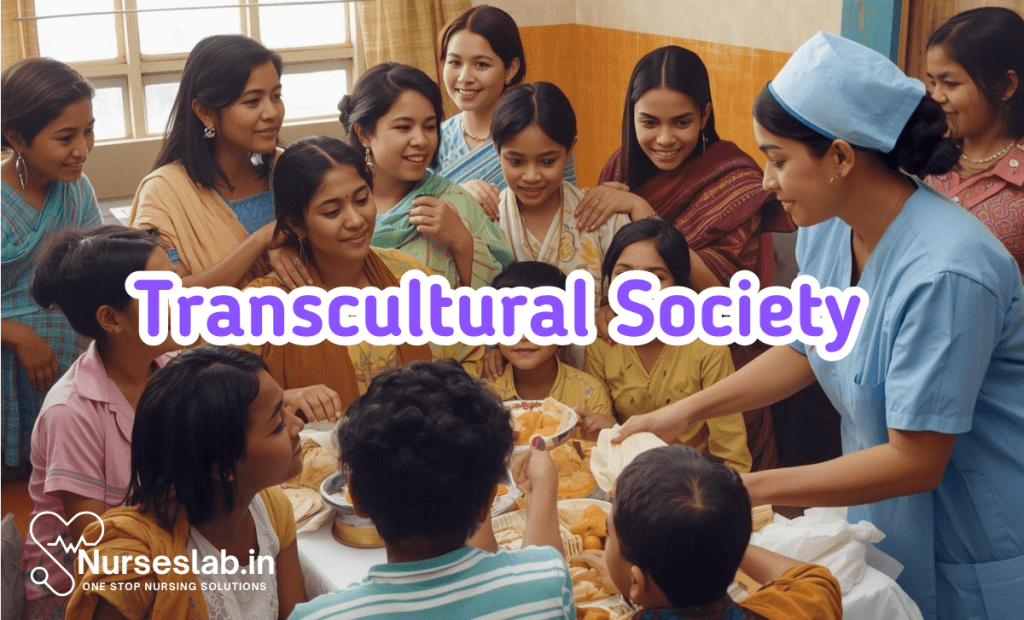
Concept of Transcultural Society
Defining Transculturalism
Transculturalism refers to the phenomenon wherein individuals and groups transcend their own cultural boundaries, engaging with and integrating elements from various cultures. Unlike multiculturalism—which emphasises the coexistence of distinct cultures within a shared space—transculturalism goes a step further, promoting fluid exchanges and hybridisation among cultures. In a transcultural society, cultural identities are not static; rather, they are continuously negotiated and reshaped through interaction, adaptation, and fusion.
The term “transcultural” was popularised by Cuban scholar Fernando Ortiz in the early 20th century, who described it as a process of convergence and transformation, opposed to mere acculturation or assimilation. Transculturalism encompasses not only the blending of cultural practices but also the formation of new values, beliefs, and worldviews that emerge from ongoing cultural dialogue.
Key Features of Transcultural Societies
- Cultural Fluidity: Identities and practices are not fixed; individuals often embody multiple cultural influences, sometimes simultaneously.
- Intercultural Communication: Regular and meaningful interactions across cultural boundaries foster understanding and innovation.
- Hybridisation: New cultural forms, languages, cuisines, and art emerge from the fusion of different traditions.
- Shared Spaces: Public and private spaces reflect cultural diversity, evident in architecture, festivals, marketplaces, and educational institutions.
- Negotiation of Values: Societal norms and laws are shaped by ongoing negotiation among groups with differing cultural perspectives.
Distinguishing Transculturalism from Related Concepts
While transculturalism, multiculturalism, and interculturalism all address the interaction among cultures, they differ in emphasis and outcomes. Multiculturalism tends to focus on preserving distinct cultural identities within a pluralistic framework, often advocating tolerance and coexistence. Interculturalism emphasises dialogue and cooperation among cultures, seeking common ground while respecting differences. Transculturalism, in contrast, spotlights the transformative process by which cultures meet, merge, and produce new forms, often blurring boundaries and creating hybrid identities.
Formation of Transcultural Societies
Historical Perspective
The formation of transcultural societies is not a new phenomenon. Historical examples abound where trade, conquest, migration, and colonisation have produced transcultural spaces. Ancient port cities like Alexandria, Constantinople, and Calicut were melting pots of Greek, Roman, Persian, Arab, Jewish, and Indian cultures. The Silk Road facilitated exchanges between East Asian, Central Asian, Middle Eastern, and European societies, leading to the cross-pollination of art, language, and religion.
In India, transculturalism can be traced back to the arrival of Aryans, Greeks, Persians, and later Mughals and British. The subcontinent’s history is replete with cultural synthesis—be it in cuisine, language, music, or religious philosophy. The emergence of Indo-Islamic architecture, the evolution of Hindustani classical music, and the syncretic traditions of Sufism exemplify transcultural processes.
Modern Drivers of Transculturalism
In contemporary times, several factors have accelerated the formation of transcultural societies:
- Globalisation: Economic integration has led to increased cross-border movement of goods, services, people, and ideas. Global brands, entertainment, and technology have permeated local cultures, creating new hybrid forms.
- Migration and Diaspora: Large-scale migration—whether for work, education, or refuge—has brought diverse populations into contact. Diasporic communities maintain links with their home cultures while adapting to host societies, resulting in unique transcultural identities.
- Digital Communication: The internet and social media facilitate instant global connectivity, allowing people to interact with cultural content from all corners of the world. Online communities transcend geography, fostering new forms of cultural expression.
- Education and Research: International academic exchanges, study-abroad programmes, and collaborative research promote intercultural understanding and the sharing of knowledge.
- Tourism: Increasing international travel exposes individuals to new cultures, customs, and ideas, encouraging open-mindedness and adaptation.
Processes of Transcultural Formation
The evolution of a transcultural society involves several interconnected processes:
- Contact: Initial interaction occurs through migration, trade, media, or education.
- Exchange: Individuals and groups share cultural practices, knowledge, and values, often adopting elements from one another.
- Adaptation: Cultural traits are modified to fit new contexts, leading to hybridisation.
- Negotiation: Conflicts and misunderstandings may arise, requiring dialogue and compromise to establish common norms.
- Institutionalisation: Transcultural norms and practices become embedded in social institutions, policies, and public life.
Indian Context: Transculturalism in Practice
India, with its long history of pluralism and cultural exchange, is a prime example of transcultural society. The mixing of Dravidian, Indo-Aryan, Persian, Turkic, European, and indigenous influences has produced a rich tapestry of cultural forms. Bollywood cinema, for instance, draws upon Western, Middle Eastern, and regional Indian motifs. Indian cuisine features ingredients and techniques from across Asia, Europe, and Africa. English, Hindi, and regional languages coexist, often blending in daily conversation. Festivals like Diwali, Eid, Christmas, and Navroz are celebrated by people of different backgrounds, reflecting transcultural values.
Problems in Transcultural Societies
Identity Crisis and Psychological Challenges
One of the most significant issues in transcultural societies is the sense of identity crisis. Individuals may find it challenging to reconcile multiple cultural affiliations, leading to confusion, alienation, or loss of cultural heritage. Young people growing up in transcultural environments may experience pressure to conform to conflicting norms, resulting in psychological stress and weakened self-esteem.
For diaspora communities, the struggle to maintain original cultural practices while adapting to the host society can create tension within families and communities. Generational gaps often widen as younger members embrace new cultural forms, while elders seek to preserve traditions.
Social Integration and Cohesion
Transcultural societies must address the challenge of social integration. While diversity can be enriching, it may also result in fragmentation and lack of cohesion. Prejudices, stereotypes, and xenophobia can emerge, undermining social harmony. Differences in language, religion, and customs can hinder effective communication and mutual understanding.
In India, regional, linguistic, and religious diversity sometimes manifests as communal tension or ethnic strife. The 1984 anti-Sikh riots, the Babri Masjid controversy, and periodic caste-based violence illustrate how transcultural interactions can turn contentious if not managed sensitively.
Cultural Appropriation and Loss
Hybridisation in transcultural societies can sometimes result in cultural appropriation—the adoption of cultural elements by dominant groups without proper acknowledgment or respect. This can lead to the commodification and distortion of minority cultures, eroding their authenticity and value.
Moreover, rapid globalisation can threaten indigenous languages, art forms, and knowledge systems. The dominance of global media and consumer culture may marginalise local traditions, leading to cultural homogenisation and loss of diversity.
Economic Inequality and Marginalisation
Economic disparities often accompany transcultural processes. Migrant and minority groups may face discrimination in employment, education, and access to resources, resulting in social exclusion. In urban India, for instance, migrants from rural or tribal areas may struggle to adapt to city life, encountering prejudice and limited opportunities.
Global economic integration has also produced uneven benefits, with wealth and power concentrated among certain groups or regions. This can fuel resentment and conflict, particularly when transcultural interactions are perceived as threatening local livelihoods.
Legal and Political Challenges
Transcultural societies must grapple with complex legal and political issues. Citizenship laws, language policies, and minority rights are contentious areas requiring careful negotiation. Governments may struggle to accommodate diverse cultural practices within a unified legal framework, leading to disputes over personal law, education, or religious freedom.
In India, the debate over the Uniform Civil Code, reservations for Scheduled Castes and Tribes, and language policies in education reflect these challenges. Balancing national unity with cultural pluralism remains an ongoing policy dilemma.
Educational Challenges
Education systems in transcultural societies must equip students with skills for intercultural communication, critical thinking, and empathy. However, curriculum design often struggles to reflect multiple cultural perspectives, leading to biases or gaps in knowledge. Teachers may lack training in transcultural pedagogy, and students from minority backgrounds can feel excluded or misunderstood.
In multicultural classrooms, language barriers and cultural misunderstandings may impede learning. Addressing these issues requires inclusive policies and ongoing professional development.
Health and Well-being
Transcultural societies encounter unique health challenges. Migrant populations may face barriers to accessing healthcare due to language, cultural beliefs, or legal status. Traditional health practices may conflict with biomedical models, complicating diagnosis and treatment. Mental health issues, such as depression and anxiety, can be exacerbated by social isolation or discrimination.
Addressing these challenges requires culturally competent healthcare services, community engagement, and policies that promote equity and inclusion.
Addressing the Problems: Strategies and Solutions
Promoting Intercultural Dialogue
Building a transcultural society requires ongoing dialogue among different groups. Community forums, intercultural festivals, and educational programmes can foster mutual understanding. Media and the arts play a critical role in bridging gaps and celebrating diversity.
Inclusive Policies and Legal Frameworks
Governments must develop policies that protect minority rights, promote social integration, and ensure equitable access to resources. Anti-discrimination laws, affirmative action, and multicultural education can help address inequality and foster cohesion.
Strengthening Education and Critical Thinking
Curricula should reflect diverse cultural perspectives, teaching students to appreciate differences and challenge stereotypes. Teacher training in intercultural competence, language support, and inclusive pedagogy are essential for effective education in transcultural societies.
Supporting Cultural Preservation
While embracing transculturalism, societies must also safeguard indigenous cultures, languages, and traditions. Cultural preservation initiatives, heritage education, and support for local artists and knowledge holders can maintain diversity and resilience.
Fostering Economic Inclusion
Economic policies should promote inclusive growth, providing opportunities for all groups regardless of origin. Support for small businesses, vocational training, and anti-discrimination measures in the workplace are vital.
Enhancing Healthcare Access
Healthcare systems must be sensitive to cultural differences, providing translation services, community outreach, and training for healthcare providers in cultural competence.
Encouraging Media Responsibility
Media outlets should strive for balanced representation of diverse cultures, avoiding sensationalism or stereotyping. Promoting positive stories of transcultural success can inspire tolerance and cooperation.
Conclusion
Transcultural societies represent the dynamic interplay of diverse cultural forces, offering opportunities for creativity, innovation, and mutual enrichment. However, they also pose significant challenges in terms of identity, integration, equity, and justice. Navigating these complexities requires a commitment to dialogue, inclusion, and respect for diversity. In the Indian context, transculturalism is both a historical reality and an ongoing process, shaping the nation’s identity and future. By embracing transcultural values while addressing associated problems, societies can build resilient, harmonious communities in an ever-changing world.
REFERENCES
- R Sreevani, Applied Sociology for Nurses, 2nd Edition, 2023, Jaypee Publishers, ISBN: 978-9356962866.
- I. Clement, Sociology for Nurses, 3rd Edition, 2023, Pearson Publishers, ISBN: 978-9357053273.
- Denny, Earle, Hewison, Sociology for Nurses, 3rd Edition, 2016, Wiley Publishers, ISBN: 978-1509505401.
- Hannah Cooke, Sociological Approaches to Health, Healthcare and Nursing, 1st Edition, September 9, 2024, ISBN: 978-0702083143.
- Jacob Anthikad, Sociology for Graduate Nurses, 2nd Edition, 2014, Jaypee Publishers, ISBN: 978-9351520085.
- Tubergen, Frank. March 2020. Introduction to Sociology. ISBN: 978-1351134958. https://www.researchgate.net/publication/339505825_Introduction_to_Sociology
Stories are the threads that bind us; through them, we understand each other, grow, and heal.
JOHN NOORD
Connect with “Nurses Lab Editorial Team”
I hope you found this information helpful. Do you have any questions or comments? Kindly write in comments section. Subscribe the Blog with your email so you can stay updated on upcoming events and the latest articles.


