


Last Updated on January 13, 2026 by Nurseslab.in Editorial Team
Explore key branches of sociology for nurses: medical sociology, cultural sociology, and social stratification reveal how health systems, beliefs, and social structures shape patient care. Understanding these domains empowers nurses to address disparities, promote equity, and deliver culturally competent care.
Introduction
Sociology is the systematic study of human society, social behaviour, patterns of social relationships, and the functioning of social institutions. As an academic discipline, sociology seeks to understand how individuals interact within groups, how societies are structured, and how social processes influence behaviour and societal outcomes. The scope of sociology is vast, encompassing everything from micro-level interpersonal interactions to macro-level structures such as institutions, cultures, and entire societies. By employing scientific methods of observation, analysis, and interpretation, sociology provides valuable insights into the complexities of human social life.
Historical Background: Evolution of Sociology as a Discipline
The formal emergence of sociology as a distinct discipline can be traced back to the 19th century, although systematic thinking about society predates this period. The term “sociology” was coined by Auguste Comte, a French philosopher, who is often regarded as the “father of sociology.” Early sociologists such as Karl Marx, Emile Durkheim, and Max Weber laid the foundations of the discipline through their pioneering work on social structures, economic systems, culture, and authority. The Industrial Revolution, urbanisation, and the rise of nation-states contributed to the development of sociology as thinkers sought to understand the rapid changes in social life. Over time, sociology diversified into various branches and specialised subfields to address the multifaceted nature of human society.
Major Branches of Sociology
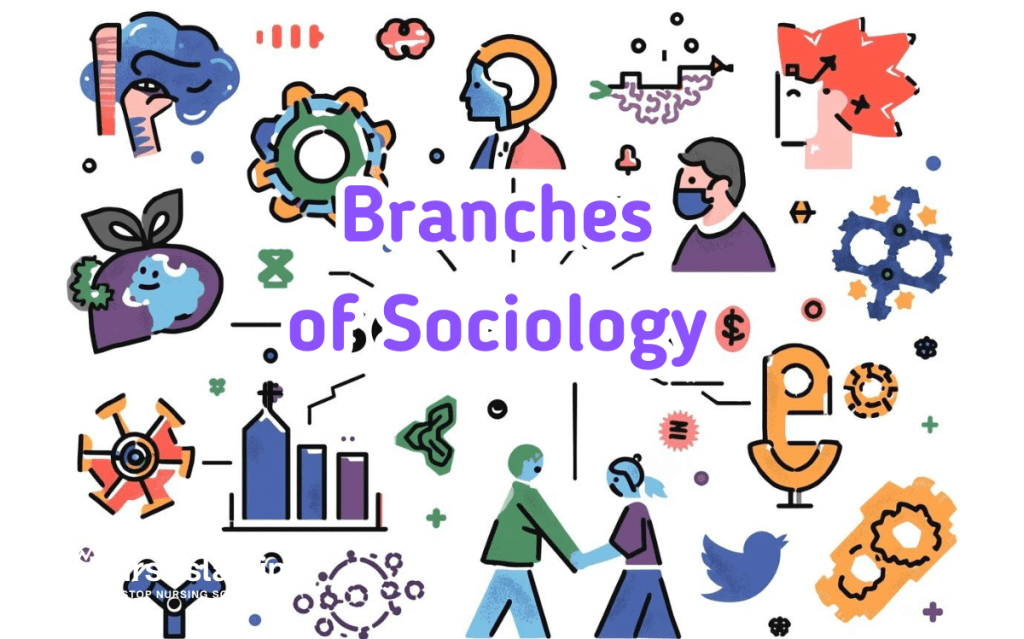
Sociology is divided into several major branches, each focusing on specific aspects of social life and employing distinct theoretical and methodological approaches. The main branches include:
1. Social Organisation
This branch studies the structure and functioning of social groups, communities, and institutions. It examines how individuals are organised into groups such as families, tribes, castes, classes, and organisations. Topics include social stratification, bureaucracy, and the dynamics of social networks. For example, the study of caste systems in India or class structures in Britain falls under this branch. Social organisation is crucial for understanding how societies maintain order and how inequalities are perpetuated or challenged.
2. Social Change
Social change explores the processes through which societies transform over time. This includes the study of technological advancements, revolutions, reforms, and cultural shifts. Sociologists analyse factors that drive social change such as economic development, political movements, and demographic transitions. For instance, the impact of globalisation on traditional cultures or the effects of digital technology on social interaction are examined within this branch. Understanding social change is vital for anticipating future trends and addressing emerging social issues.
3. Social Psychology
Social psychology bridges the gap between sociology and psychology by focusing on the influence of society on individual behaviour and vice versa. It investigates topics such as socialisation, attitude formation, group dynamics, conformity, and deviance. For example, studies on how peer pressure affects adolescent behaviour or how stereotypes shape perceptions are part of social psychology. This branch is essential for comprehending the interplay between personal identity and social context.
4. Applied Sociology
Applied sociology involves the practical application of sociological theories and methods to solve real-world problems. This branch addresses issues in areas such as health, education, industry, urban planning, and criminal justice. Sociologists may work with governments, NGOs, or corporations to design policies, evaluate programmes, or conduct social impact assessments. For example, analysing the effectiveness of a public health campaign or assessing the social impact of urban renewal projects exemplifies applied sociology.
5. Sociological Theory
Sociological theory develops and evaluates frameworks that explain social phenomena. This branch includes the study of classical theories (e.g., functionalism, conflict theory, symbolic interactionism) as well as contemporary perspectives (e.g., feminism, postmodernism). Theoretical work is foundational for guiding empirical research and interpreting social trends. For example, using conflict theory to analyse class struggles or symbolic interactionism to study identity formation highlights the role of sociological theory.
Specialised Subfields of Sociology
Beyond the major branches, sociology encompasses numerous specialised subfields that focus on particular domains of social life. Some of the most prominent subfields include:
1. Sociology of Education
This subfield examines the role of education in society, the functioning of educational institutions, and the relationship between education and social mobility. It addresses issues such as educational inequality, curriculum development, and the impact of schooling on values and norms. For example, research on the digital divide in Indian schools or the gender gap in STEM fields falls under the sociology of education.
2. Sociology of Religion
Sociology of religion studies the role of religion in shaping social behaviour, values, and institutions. It explores religious beliefs, rituals, organisations, and the relationship between religion and other social institutions. For instance, analyses of communal harmony, religious movements, or secularisation trends are central to this subfield.
3. Sociology of Family
This area focuses on the structure, dynamics, and functions of families across cultures and time periods. Topics include marriage patterns, kinship systems, family roles, and changes in family structure due to modernisation. Studies on the joint family system in India or single-parent households in Western societies are examples of research in this subfield.
4. Sociology of Gender
The sociology of gender investigates the social construction of gender roles, gender identity, and the impact of gender on opportunities and life outcomes. It addresses issues such as gender inequality, patriarchy, and feminist movements. For example, research on the glass ceiling in corporate India or gender-based violence in rural areas illustrates this subfield’s relevance.
5. Sociology of Health and Medicine
This subfield analyses the social determinants of health, the organisation of healthcare systems, and the interaction between patients and providers. It explores topics such as health disparities, medical ethics, and public health policies. For instance, sociological studies on access to healthcare in rural India or the social stigma associated with mental illness are significant contributions of this subfield.
6. Urban and Rural Sociology
Urban sociology studies life in cities, focusing on issues such as migration, urbanisation, housing, and social problems like crime and pollution. In contrast, rural sociology examines village life, agricultural systems, and rural development. For example, research on slum settlements in Mumbai or the impact of microfinance in rural Andhra Pradesh highlights the contributions of these subfields.
7. Criminology and Sociology of Law
Criminology studies crime, its causes, consequences, and prevention. The sociology of law examines the relationship between law, society, and social control. Topics include legal systems, justice, and the social construction of crime. For example, analyses of juvenile delinquency or the effectiveness of alternative dispute resolution mechanisms are pertinent here.
8. Industrial and Organisational Sociology
This subfield focuses on work, organisations, and industrial relations. It covers topics such as labour markets, workplace culture, and the impact of technology on employment. Studies on trade unions in India or the effects of automation on job opportunities exemplify this area.
9. Environmental Sociology
Environmental sociology explores the interactions between society and the environment. It examines how social practices contribute to environmental problems and how societies respond to ecological challenges. Research on climate change awareness, sustainable development, and environmental movements are key aspects of this subfield.
10. Political Sociology
Political sociology analyses the relationship between society and political systems. It investigates topics such as power, authority, governance, political participation, and social movements. For example, studies on election behaviour in India or the role of caste in politics fall within this domain.
Interdisciplinary Connections of Sociology
Sociology does not exist in isolation; it shares significant connections with other disciplines, enriching its perspectives and methodologies.
- Psychology: Both disciplines study human behaviour, but while psychology focuses on individual mental processes, sociology examines collective behaviour and social influences. Social psychology, as a bridge, investigates how group dynamics affect individual actions.
- Anthropology: Anthropology and sociology both study culture and society. However, anthropology often emphasises traditional societies and cultural practices, whereas sociology focuses more on contemporary social structures and institutions.
- Political Science: Political science analyses political systems, governance, and power, often overlapping with sociology in studying political institutions, social movements, and the role of citizens.
- Economics: Economics and sociology intersect in understanding economic behaviour, social class, poverty, and the impact of economic policies on society.
- History: Sociology draws on historical analysis to understand social change and the evolution of institutions, providing context for contemporary social phenomena.
Importance of Sociology: Understanding Society and Social Problems
The study of sociology is of immense significance for several reasons:
- Understanding Social Structure and Organisation: Sociology helps us comprehend how societies are organised, how social norms and values are established, and how roles and statuses are assigned. This understanding is vital for maintaining social order and addressing issues such as inequality and discrimination.
- Identifying and Addressing Social Problems: Sociology equips us to analyse social problems such as poverty, unemployment, crime, and communalism. By understanding the root causes, sociologists can contribute to developing effective interventions and policies.
- Promoting Social Change and Development: By studying the dynamics of social change, sociology informs strategies for social development and transformation. For example, sociological research can guide efforts to promote gender equality, improve education, or enhance public health.
- Fostering Social Cohesion and Integration: Sociology emphasises the importance of social integration, tolerance, and cooperation. It encourages respect for diversity and promotes peaceful coexistence in multicultural societies like India.
- Enhancing Critical Thinking and Analytical Skills: The discipline fosters critical thinking by encouraging individuals to question assumptions, analyse evidence, and understand multiple perspectives.
- Informing Policy and Decision Making: Sociological insights are invaluable for policymakers, administrators, and leaders in formulating policies that address societal needs and promote welfare.
Applications: Real-world Examples and Case Studies
Sociology’s practical applications are evident in numerous real-world contexts:
- Public Health: Sociologists in India have contributed to understanding and addressing issues such as child malnutrition, maternal health, and the spread of infectious diseases. For example, studies on the social determinants of health have informed government schemes like the Integrated Child Development Services (ICDS).
- Education: Research on educational inequality has led to policies promoting inclusive education and reservation systems to support disadvantaged groups.
- Urban Planning: Sociological studies of urbanisation and slum development have influenced the design of housing policies and urban renewal projects in cities like Mumbai and Delhi.
- Criminal Justice: Analyses of crime patterns and juvenile delinquency have informed reforms in the legal system and the development of rehabilitation programmes.
- Gender Equality: Sociological research has underpinned campaigns against gender-based violence, dowry, and discrimination, leading to progressive legislation and social awareness initiatives.
- Disaster Management: Understanding community dynamics and social resilience has improved disaster response strategies, as seen in the management of floods and cyclones in various Indian states.
Case Study: The Role of Sociology in Pandemic Response
During the COVID-19 pandemic, sociologists played a key role in analysing the social impact of lockdowns, misinformation, and public health campaigns. Their research helped authorities design effective communication strategies, address stigma, and ensure equitable access to healthcare and vaccines. The pandemic highlighted the need for sociological perspectives in managing large-scale crises and fostering community resilience.
Conclusion: The Future of Sociology and Its Continued Relevance
Sociology remains a dynamic and evolving discipline, continually adapting to the changing realities of society. As the world faces new challenges such as technological disruption, climate change, and rising inequalities, the importance of sociological insight has never been greater. By illuminating the complexities of social life, challenging assumptions, and informing policy, sociology empowers individuals and communities to create a more just and equitable world. For students, educators, and researchers, a robust understanding of the branches and significance of sociology is essential for both academic pursuit and practical engagement with society.
REFERENCES
- R Sreevani, Applied Sociology for Nurses, 2nd Edition, 2023, Jaypee Publishers, ISBN: 978-9356962866.
- I. Clement, Sociology for Nurses, 3rd Edition, 2023, Pearson Publishers, ISBN: 978-9357053273.
- Denny, Earle, Hewison, Sociology for Nurses, 3rd Edition, 2016, Wiley Publishers, ISBN: 978-1509505401.
- Hannah Cooke, Sociological Approaches to Health, Healthcare and Nursing, 1st Edition, September 9, 2024, ISBN: 978-0702083143.
- Jacob Anthikad, Sociology for Graduate Nurses, 2nd Edition, 2014, Jaypee Publishers, ISBN: 978-9351520085.
- Tubergen, Frank. March 2020. Introduction to Sociology. ISBN: 978-1351134958. https://www.researchgate.net/publication/339505825_Introduction_to_Sociology
Stories are the threads that bind us; through them, we understand each other, grow, and heal.
JOHN NOORD
Connect with “Nurses Lab Editorial Team”
I hope you found this information helpful. Do you have any questions or comments? Kindly write in comments section. Subscribe the Blog with your email so you can stay updated on upcoming events and the latest articles.


