


Last Updated on January 14, 2026 by Nurseslab.in Editorial Team
Explore the sociological concepts of accommodation and assimilation: accommodation enables diverse groups to coexist by adjusting without losing identity, while assimilation involves adopting dominant cultural traits. These processes are essential for understanding integration, identity formation, and multicultural dynamics in society.
Introduction
Nursing is not just a science of caring for the sick; it is also a profession deeply rooted in social understanding and human interaction. In today’s increasingly multicultural and diverse healthcare environments, nurses are expected to navigate a variety of social situations, interact with people from different backgrounds, and provide care that respects each patient’s unique social context. Sociology, the study of society, social relationships, and social institutions, offers essential insights for nurses to perform their roles effectively.
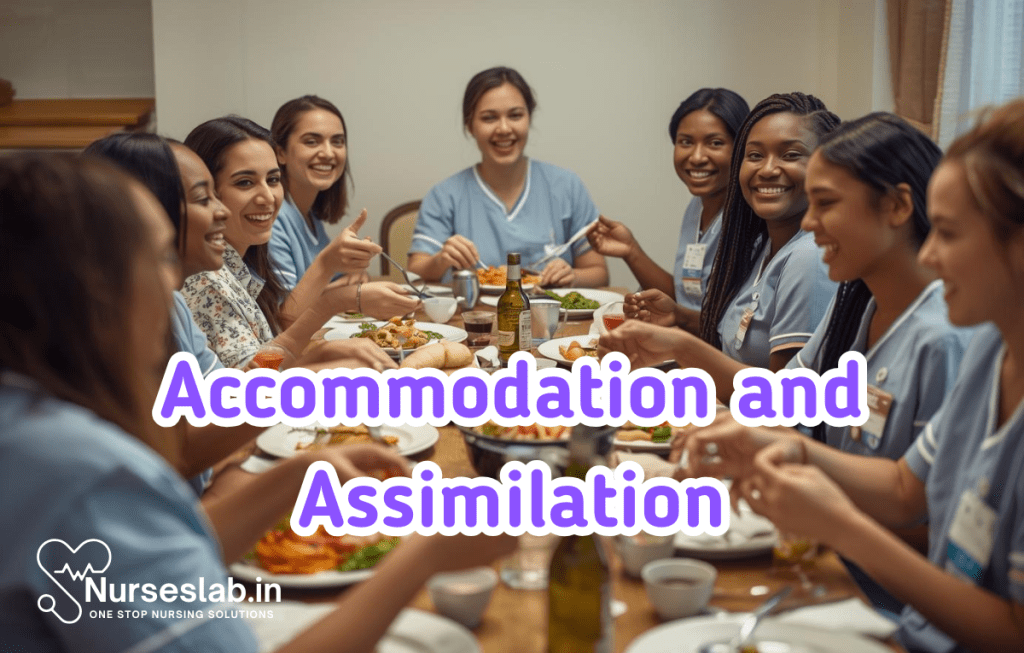
Among the key sociological concepts relevant to nursing are accommodation and assimilation. These processes describe how individuals and groups adjust, coexist, and integrate within society, especially when encountering diversity, conflict, or change. Understanding these concepts is crucial for nurses as they work in settings that demand collaboration, cultural sensitivity, and conflict resolution.
Understanding Accommodation
Definition of Accommodation
Accommodation in sociology refers to the process by which individuals or groups adjust their relationships and behaviours to reduce conflict and achieve peaceful coexistence. It involves making mutual adjustments, either consciously or unconsciously, to resolve differences without necessarily eliminating them. Accommodation is a dynamic and often ongoing process, especially in environments where people from diverse backgrounds interact.
Characteristics of Accommodation
- Adjustive Process: Accommodation is primarily about adjustment. It enables individuals or groups to modify their behaviour to interact harmoniously despite differences.
- Temporary or Permanent: The process can be short-term (e.g., finding a temporary solution to a conflict) or long-term (e.g., establishing ongoing protocols for interaction).
- Conscious or Unconscious: Sometimes, accommodation is a deliberate effort; at other times, it occurs naturally as people adapt to their environment.
- Does Not Remove Differences: Unlike assimilation, accommodation does not require the merging of identities or cultures, but rather, it allows coexistence despite differences.
- Facilitates Social Order: It is essential for maintaining peace and order in society, particularly in diverse settings such as hospitals and clinics.
Theoretical Background of Accommodation
The concept of accommodation has been explored by various sociologists. William G. Sumner and MacIver, for example, highlighted the importance of accommodation in maintaining social order and preventing conflicts from escalating. They described it as a fundamental social process that enables societies to function smoothly, especially in situations where differences are inevitable.
In the context of healthcare, accommodation is vital because nurses frequently interact with patients, families, and colleagues from diverse backgrounds, each bringing their own values, beliefs, and expectations. The ability to accommodate these differences is essential for effective communication, teamwork, and patient-centred care.
Forms of Accommodation
Accommodation can take various forms, depending on the nature of the differences and the context in which they occur. Understanding these forms helps nurses identify suitable approaches to managing conflicts and promoting cooperation.
1. Compromise
Compromise involves each party making concessions to reach a mutually acceptable solution. In a healthcare setting, compromise might occur when nurses from different cultural backgrounds agree on a shared approach to patient care, even if it means adjusting some of their personal preferences.
2. Tolerance
Tolerance is the willingness to allow others to hold opinions or beliefs different from one’s own, without necessarily agreeing with them. For nurses, practising tolerance can mean respecting patients’ cultural or religious practices, even if they differ from their own beliefs.
3. Arbitration
Arbitration is a formal process in which a neutral third party helps resolve a conflict. In hospitals, this might involve a senior nurse, manager, or ethics committee mediating disputes between staff members or between staff and patients.
4. Mediation
Mediation is similar to arbitration but often less formal. A mediator facilitates communication between parties to help them reach an agreement. For example, a nurse manager might mediate a disagreement between two nurses over shift assignments.
5. Subordination and Superordination
Subordination occurs when one party accepts a lower status in a relationship, while superordination refers to the dominance of another party. In nursing, this can be seen in hierarchical relationships, such as between doctors and nurses. While not ideal, recognising these dynamics helps nurses navigate workplace relationships more effectively.
6. Conversion
Conversion involves one party adopting the viewpoint or behaviour of another, often voluntarily. In healthcare, a nurse might adopt a new protocol after discussion with colleagues, even if it initially conflicted with their usual practice.
7. Coercion
Coercion is a less desirable form of accommodation, where one party is forced to accept the terms of another. This is generally discouraged in nursing but may occur in situations requiring strict adherence to safety protocols.
Examples of Accommodation in Healthcare
- A nurse adjusting their communication style to suit a patient who speaks a different language.
- Team members negotiating shift changes to accommodate personal commitments.
- Hospital staff respecting dietary restrictions of patients from various religious backgrounds.
Understanding Assimilation
Definition of Assimilation
Assimilation is the process by which individuals or groups with different backgrounds come to share a common culture, identity, or set of values. Unlike accommodation, which maintains differences, assimilation involves the gradual blending of differences, often resulting in a more homogeneous group or society.
Characteristics of Assimilation
- Integrative Process: Assimilation leads to the absorption of cultural traits, values, and behaviours, creating a sense of unity.
- Gradual and Continuous: It is typically a slow process, occurring over time as individuals interact and adapt.
- Bidirectional: Both the minority and majority groups may contribute to the new, shared culture.
- May Involve Loss of Distinct Identity: Over time, unique cultural or social characteristics may be lost or merged.
- Facilitates Social Integration: Assimilation is key to building cohesive teams and communities, especially in diverse settings.
Theoretical Background of Assimilation
Sociologists such as Robert Park and Ernest Burgess have studied assimilation in the context of immigrant populations and minority groups. They observed that assimilation is essential for social integration, reducing prejudice, and fostering a sense of belonging. In the healthcare sector, assimilation can help create unified teams that work effectively despite their diverse origins.
Forms of Assimilation
Assimilation manifests in several forms, each relevant to nursing and healthcare. Understanding these forms enables nurses to identify opportunities for integration and unity within their teams and with their patients.
1. Cultural Assimilation
Cultural assimilation involves adopting the cultural norms, values, and practices of another group. In hospitals, this might mean nurses from different backgrounds adopting a common set of professional values and behaviours to ensure consistent patient care.
2. Racial Assimilation
Racial assimilation refers to the blending of different racial groups into a single, unified group. This is especially important in multicultural societies like India, where healthcare teams often comprise individuals from various racial backgrounds.
3. Religious Assimilation
Religious assimilation occurs when individuals or groups adopt the religious beliefs or practices of another group. In healthcare, this can mean respecting and sometimes participating in patients’ religious practices to provide holistic care.
4. Linguistic Assimilation
Linguistic assimilation involves adopting the language of the dominant group. For instance, in Indian hospitals, staff may use English or Hindi as a common language, facilitating communication and reducing misunderstandings.
Examples of Assimilation in Healthcare
- Nurses from different states in India adopting a standard protocol and language for patient handovers.
- Staff members celebrating festivals from various cultures, fostering a sense of unity.
- International nurses adapting to the healthcare practices and norms of the host country.
Importance of Accommodation and Assimilation in Nursing
Understanding and applying the concepts of accommodation and assimilation are crucial for nurses for several reasons:
1. Impact on Patient Care
Patients come from diverse social, cultural, and religious backgrounds. Nurses who accommodate these differences and assimilate essential aspects into their care can build trust, improve communication, and provide more effective, patient-centred care. For example, accommodating dietary restrictions or religious practices can make patients feel respected and valued.
2. Teamwork and Collaboration
Nursing is inherently collaborative. Teams often comprise individuals from various backgrounds. Accommodation helps resolve conflicts and maintain harmony, while assimilation builds a shared sense of purpose and belonging. This is especially important in high-pressure environments such as intensive care units or emergency departments.
3. Multicultural Healthcare Settings
Healthcare settings are increasingly multicultural. Nurses must be adept at accommodating differences and fostering assimilation to ensure smooth functioning. This is particularly relevant in cities like Delhi, Mumbai, and Bangalore, where hospitals serve patients from across India and the world.
4. Professional Growth
Nurses who master these social processes are better equipped to handle complex situations, lead teams, and advance in their careers. They become role models for inclusive and compassionate care.
Practical Examples in Healthcare
Case Study 1: Accommodation in Action
A nurse in a Delhi hospital is assigned to care for a patient from a different state who speaks only Tamil. The nurse does not speak Tamil but makes an effort to communicate using basic words, gestures, and even a translation app. The nurse also ensures the patient’s dietary preferences, based on religious beliefs, are respected. This is a clear example of accommodation, where the nurse adjusts to the patient’s needs without expecting the patient to change.
Case Study 2: Assimilation in a Multicultural Team
A new hospital in Bangalore recruits nurses from various parts of India. Initially, there are misunderstandings due to language and cultural differences. Over time, the nurses adopt a common language (English) for communication, celebrate each other’s festivals, and develop shared protocols for patient care. This gradual blending of practices and values is an example of assimilation, resulting in a cohesive and effective team.
Case Study 3: Combination of Accommodation and Assimilation
In a Mumbai hospital, a team of nurses includes members from different religious backgrounds. During Ramadan, Muslim nurses are allowed flexible shifts to observe fasting. At the same time, all team members participate in Eid celebrations, adopting some festive practices. Here, both accommodation (flexible shifts) and assimilation (shared celebrations) contribute to a harmonious workplace.
Challenges in Achieving Accommodation and Assimilation
While accommodation and assimilation are essential, achieving them is not always easy. Nurses may encounter several challenges:
- Cultural Barriers: Deeply held beliefs and traditions can make it difficult for individuals to adapt or merge with others.
- Language Differences: Communication breakdowns can lead to misunderstandings and conflicts.
- Prejudice and Stereotyping: Preconceived notions about certain groups may hinder cooperation and integration.
- Resistance to Change: Some individuals may be reluctant to accommodate or assimilate, especially if they feel their identity is threatened.
- Institutional Constraints: Hospital policies may not always support flexibility or cultural sensitivity.
Strategies for Nurses
To overcome these challenges, nurses can adopt several effective strategies:
1. Develop Communication Skills
Clear and respectful communication is the foundation of both accommodation and assimilation. Nurses should strive to listen actively, express themselves clearly, and use language that is inclusive and non-judgemental. Learning basic phrases in patients’ languages or using translation services can help bridge communication gaps.
2. Cultivate Cultural Competence
Cultural competence is the ability to understand, respect, and work effectively with people from diverse backgrounds. Nurses should educate themselves about different cultures, religions, and traditions represented in their patient population and colleagues. Attending workshops, reading, and engaging in cultural exchange can enhance this competence.
3. Practise Conflict Resolution
Conflicts are inevitable in any workplace. Nurses should learn and apply conflict resolution techniques such as mediation, negotiation, and compromise. Seeking the help of neutral parties or mentors can also facilitate resolution.
4. Encourage Team Building
Regular team-building activities can help nurses get to know each other, build trust, and develop a shared identity. Celebrating cultural festivals, organising workshops, and holding regular meetings promote both accommodation and assimilation.
5. Advocate for Inclusive Policies
Nurses can advocate for hospital policies that support diversity, flexibility, and cultural sensitivity. This includes policies on language services, dietary options, flexible shifts, and anti-discrimination measures.
Conclusion
Accommodation and assimilation are fundamental social processes that enable individuals and groups to coexist, collaborate, and thrive in diverse environments. For nurses, understanding and applying these concepts is not just an academic exercise but a practical necessity. By accommodating differences and fostering assimilation, nurses can improve patient care, enhance teamwork, and create a more inclusive and harmonious healthcare environment.
As the Indian healthcare system continues to evolve and diversify, the ability to manage social differences and integrate effectively will remain a key skill for all healthcare professionals. Nursing students and practising nurses alike must commit to lifelong learning in sociology and cultural competence, ensuring that they are prepared to meet the challenges and opportunities of modern healthcare.
REFERENCES
- R Sreevani, Applied Sociology for Nurses, 2nd Edition, 2023, Jaypee Publishers, ISBN: 978-9356962866.
- I. Clement, Sociology for Nurses, 3rd Edition, 2023, Pearson Publishers, ISBN: 978-9357053273.
- Denny, Earle, Hewison, Sociology for Nurses, 3rd Edition, 2016, Wiley Publishers, ISBN: 978-1509505401.
- Hannah Cooke, Sociological Approaches to Health, Healthcare and Nursing, 1st Edition, September 9, 2024, ISBN: 978-0702083143.
- Jacob Anthikad, Sociology for Graduate Nurses, 2nd Edition, 2014, Jaypee Publishers, ISBN: 978-9351520085.
- Tubergen, Frank. March 2020. Introduction to Sociology. ISBN: 978-1351134958. https://www.researchgate.net/publication/339505825_Introduction_to_Sociology
Stories are the threads that bind us; through them, we understand each other, grow, and heal.
JOHN NOORD
Connect with “Nurses Lab Editorial Team”
I hope you found this information helpful. Do you have any questions or comments? Kindly write in comments section. Subscribe the Blog with your email so you can stay updated on upcoming events and the latest articles.


