


Last Updated on January 11, 2026 by Nurseslab.in Editorial Team
Viral hepatitis refers to liver infections caused by hepatitis viruses A, B, C, D, and E. These vary in transmission—fecal-oral, bloodborne, or perinatal—and can lead to acute or chronic disease. Vaccination, screening, and nursing care are vital for prevention and management.
Introduction
Viral hepatitis is a group of infectious diseases that afflict millions globally and represent a significant burden on healthcare systems. Characterised by inflammation of the liver due to viral infection, hepatitis can lead to acute or chronic disease, liver failure, cirrhosis, and hepatocellular carcinoma. Understanding viral hepatitis is vital for clinicians, public health officials, and medical students, given its varied presentations, transmission modes, and the evolving landscape of diagnosis and management.
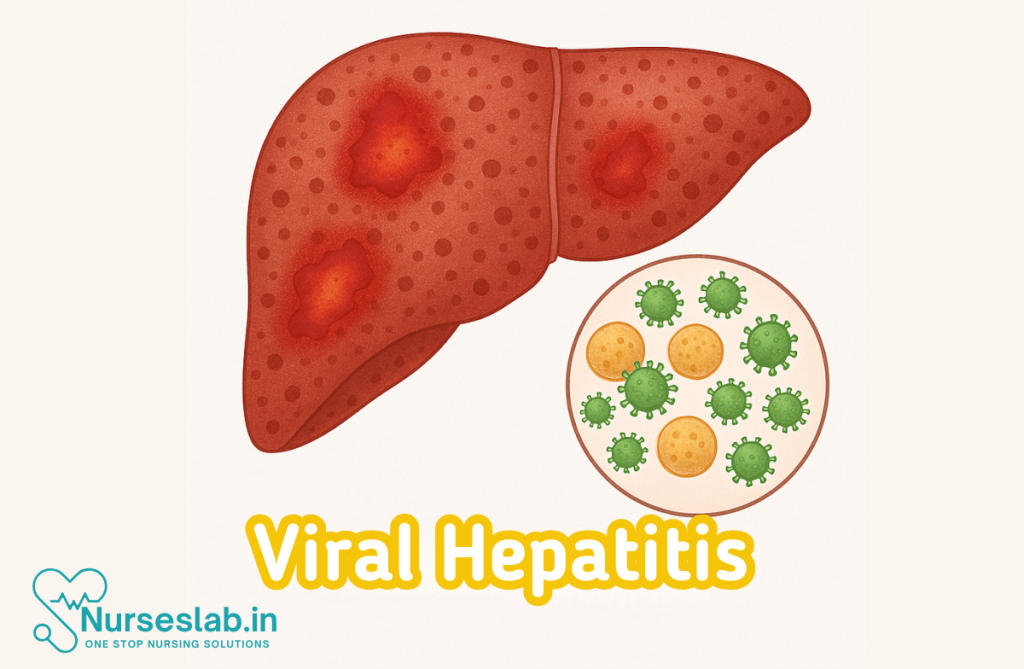
Classification of Hepatitis Viruses
The term “viral hepatitis” encompasses several distinct viruses, each with unique characteristics. The major types include hepatitis A (HAV), hepatitis B (HBV), hepatitis C (HCV), hepatitis D (HDV), and hepatitis E (HEV). Other rare or emerging hepatitis viruses (e.g., hepatitis G) have also been identified but are less clinically significant.
- Hepatitis A Virus (HAV): A non-enveloped RNA virus from the Picornaviridae family. It causes acute, self-limiting hepatitis and does not lead to chronic infection.
- Hepatitis B Virus (HBV): An enveloped DNA virus of the Hepadnaviridae family. HBV can cause both acute and chronic hepatitis, with potential progression to cirrhosis and hepatocellular carcinoma.
- Hepatitis C Virus (HCV): An enveloped RNA virus belonging to the Flaviviridae family. HCV is notorious for causing chronic infection, often asymptomatic, but can lead to severe liver disease.
- Hepatitis D Virus (HDV): A defective RNA virus requiring HBV for replication. HDV infection occurs only in the presence of HBV and can exacerbate disease severity.
- Hepatitis E Virus (HEV): A non-enveloped RNA virus from the Hepeviridae family. HEV typically causes acute hepatitis, but chronic infection is possible in immunocompromised individuals.
- Other Hepatitis Viruses: Hepatitis G and TT viruses have been described, but their clinical relevance is limited.
Epidemiology
Viral hepatitis remains a major global health challenge. According to the World Health Organization (WHO), viral hepatitis is responsible for over one million deaths annually, mainly due to complications such as cirrhosis and liver cancer. The epidemiology varies by type:
- HAV: Common in regions with poor sanitation. Outbreaks often occur in developing countries, but sporadic cases are reported worldwide.
- HBV: Approximately 296 million people live with chronic HBV infection globally. High prevalence is noted in sub-Saharan Africa, East Asia, and the Indian subcontinent.
- HCV: Estimated 58 million people have chronic HCV infection. The Middle East, Central Asia, and parts of Africa have higher rates.
- HDV: HDV affects an estimated 12–20 million people, mainly where HBV is endemic.
- HEV: HEV is prevalent in South and East Asia, with frequent outbreaks linked to contaminated water.
High-risk populations include healthcare workers, intravenous drug users, men who have sex with men, individuals receiving blood transfusions, and those in endemic regions. Pregnant women are particularly vulnerable to severe HEV infection.
Pathogenesis
The pathogenesis of viral hepatitis involves viral entry, replication within hepatocytes, and subsequent immune-mediated liver injury.
- HAV and HEV: Cause direct cytopathic damage to hepatocytes, leading to acute inflammation.
- HBV and HCV: Damage is primarily immune-mediated. The host’s immune response targets infected hepatocytes, causing chronic inflammation, fibrosis, and, eventually, cirrhosis or carcinoma.
- HDV: Exacerbates HBV-mediated injury through enhanced immune response and cytopathic effects.
The ability of these viruses to evade immune detection and persist within the liver determines the likelihood of chronicity and long-term complications.
Transmission Modes
Each hepatitis virus has distinct transmission routes, influencing epidemiology and prevention strategies.
| Virus | Transmission Route |
| HAV | Faeco-oral (contaminated food/water, close contact) |
| HBV | Parenteral (blood, body fluids), sexual, perinatal |
| HCV | Parenteral (blood transfusion, needle sharing), less commonly sexual, perinatal |
| HDV | Parenteral, sexual, perinatal (requires HBV co-infection) |
| HEV | Faeco-oral (contaminated water), zoonotic (animal reservoirs) |
Improved hygiene, safe injection practices, and blood screening have reduced transmission rates in many regions, but challenges persist in resource-limited settings.
Clinical Manifestations
The clinical spectrum of viral hepatitis ranges from asymptomatic infection to fulminant hepatic failure. Key features include:
Acute Infection
- Prodromal Phase: Malaise, anorexia, nausea, vomiting, fatigue, low-grade fever.
- Icteric Phase: Jaundice, dark urine, pale stools, pruritus, right upper quadrant pain.
- Recovery Phase: Symptoms resolve, but some may develop complications.
Chronic Infection
- Often asymptomatic for years.
- May progress to cirrhosis, portal hypertension, and hepatocellular carcinoma.
- Extrahepatic manifestations: glomerulonephritis, vasculitis, cryoglobulinaemia (especially with HCV).
Complications
- Fulminant Hepatic Failure: Rapid liver decompensation, encephalopathy, coagulopathy.
- Cirrhosis: Irreversible scarring, portal hypertension, variceal bleeding.
- Hepatocellular Carcinoma: Malignant transformation, poor prognosis.
Diagnosis
Accurate diagnosis of viral hepatitis is essential for effective management and prevention of complications. The diagnostic approach includes clinical assessment, laboratory investigations, and imaging.
Laboratory Tests
- Liver Function Tests (LFTs): Raised alanine transaminase (ALT), aspartate transaminase (AST), bilirubin, alkaline phosphatase.
- Serology: Detection of viral antigens and antibodies (e.g., HBsAg for HBV, anti-HCV for HCV).
- Molecular Testing: Polymerase chain reaction (PCR) for viral RNA/DNA quantification.
- Other Tests: Prothrombin time, albumin, complete blood count.
Imaging
- Ultrasound: Assessment of liver size, texture, and presence of masses.
- Elastography: Quantification of liver stiffness (fibrosis assessment).
- CT/MRI: Evaluation for complications such as cirrhosis or carcinoma.
Differential Diagnosis
- Other causes of hepatitis: alcoholic, autoimmune, drug-induced, metabolic.
- Extrahepatic causes of jaundice.
Treatment Options
Management of viral hepatitis depends on the type, severity, and chronicity of infection. The goals are to control viral replication, prevent progression, and manage complications.
Hepatitis A and E
- Supportive Care: Rest, hydration, nutritional support. Most cases are self-limiting.
- Hospitalisation: Required for severe cases or fulminant hepatitis.
Hepatitis B
- Acute HBV: Supportive care.
- Chronic HBV: Antiviral therapy with nucleos(t)ide analogues (e.g., tenofovir, entecavir) to suppress viral replication and prevent progression.
- Monitoring: Regular LFTs, viral load, and assessment for complications.
Hepatitis C
- Direct-Acting Antivirals (DAAs): Sofosbuvir, ledipasvir, daclatasvir, and others offer >95% cure rates for most genotypes.
- Monitoring: Viral load and response to therapy.
Hepatitis D
- Interferon alfa: Limited efficacy.
- HBV Suppression: Nucleos(t)ide analogues for HBV may indirectly help.
Severe and Complicated Cases
- Liver Transplantation: For fulminant hepatic failure or end-stage liver disease.
- Management of Complications: Treatment of ascites, encephalopathy, and variceal bleeding.
Prevention Strategies
Prevention of viral hepatitis is a cornerstone of public health. Strategies include vaccination, behavioural interventions, and improved healthcare infrastructure.
Vaccines
- HAV Vaccine: Inactivated vaccine; recommended for travellers, children, and high-risk adults.
- HBV Vaccine: Recombinant vaccine; part of childhood immunisation schedules and for high-risk groups.
- HEV Vaccine: Available in China; under evaluation elsewhere.
Public Health Measures
- Safe water supply and sanitation.
- Blood screening for transfusion safety.
- Safe injection and harm reduction for intravenous drug users.
- Sexual health education and condom promotion.
- Perinatal screening and prophylaxis for HBV.
Harm Reduction
- Needle exchange programmes.
- Treatment of substance use disorders.
- Education for healthcare workers regarding needlestick injuries.
Complications and Prognosis
Chronic viral hepatitis can result in severe complications that dictate long-term prognosis.
- Cirrhosis: Progressive fibrosis leads to liver failure, portal hypertension, and varices.
- Hepatocellular Carcinoma: Chronic HBV and HCV infections are the major risk factors for primary liver cancer.
- Extrahepatic Manifestations: Renal disease, vasculitis, metabolic disturbances.
- Mortality: High in those with advanced cirrhosis or carcinoma; early diagnosis and treatment improve outcomes.
Prognosis depends on the virus type, host factors (age, comorbidities, immune status), and access to medical care. With advances in antiviral therapy, the outlook for many patients has improved dramatically.
Recent Advances in Viral Hepatitis
The field of viral hepatitis has witnessed remarkable progress in recent years, particularly in therapeutics, diagnostics, and vaccine development.
Novel Antiviral Agents
- Direct-Acting Antivirals (DAAs) for HCV: Pan-genotypic DAAs have revolutionised treatment, offering high cure rates, shorter duration, and fewer side effects.
- New HBV Therapies: Research into finite-duration therapies, immune modulators, and entry inhibitors is ongoing.
- HDV Therapies: Myrcludex B (bulevirtide) has shown promise for HDV in clinical trials.
Improved Diagnostics
- Point-of-care molecular tests provide rapid, accurate diagnosis in remote settings.
- Non-invasive fibrosis assessment tools are replacing liver biopsy.
Vaccine Developments
- Universal HBV vaccination for newborns is expanding globally.
- HEV vaccine trials are ongoing outside China.
- Therapeutic vaccines for chronic HBV and HCV are under investigation.
Global Initiatives
- WHO’s goal to eliminate viral hepatitis as a public health threat by 2030 has spurred international collaboration, funding, and research.
- Innovative harm reduction programmes and public awareness campaigns are improving prevention.
Despite these advances, challenges remain in access to care, affordability of medications, vaccine coverage, and combating stigma.
Conclusion
Viral hepatitis is a complex, multifaceted global health issue that demands coordinated efforts in clinical care, public health, and research. Advances in diagnosis, treatment, and prevention have transformed the prognosis for many patients, yet significant challenges persist, particularly in resource-limited settings. Medical students and healthcare professionals must remain vigilant, informed, and proactive in addressing viral hepatitis through evidence-based practice, patient education, and advocacy. With continued innovation and commitment, the elimination of viral hepatitis as a public health threat is an achievable goal in the foreseeable future.
REFERENCES
- Apurba S Sastry, Essential Applied Microbiology for Nurses including Infection Control and Safety, First Edition 2022, Jaypee Publishers, ISBN: 978-9354659386
- Joanne Willey, Prescott’s Microbiology, 11th Edition, 2019, Innox Publishers, ASIN- B0FM8CVYL4.
- Anju Dhir, Textbook of Applied Microbiology including Infection Control and Safety, 2nd Edition, December 2022, CBS Publishers and Distributors, ISBN: 978-9390619450
- Gerard J. Tortora, Microbiology: An Introduction 13th Edition, 2019, Published by Pearson, ISBN: 978-0134688640
- Durrant RJ, Doig AK, Buxton RL, Fenn JP. Microbiology Education in Nursing Practice. J Microbiol Biol Educ. 2017 Sep 1;18(2):18.2.43. https://pmc.ncbi.nlm.nih.gov/articles/PMC5577971/
Stories are the threads that bind us; through them, we understand each other, grow, and heal.
JOHN NOORD
Connect with “Nurses Lab Editorial Team”
I hope you found this information helpful. Do you have any questions or comments? Kindly write in comments section. Subscribe the Blog with your email so you can stay updated on upcoming events and the latest articles.


