Last Updated on January 13, 2026 by Nurseslab.in Editorial Team
Explore Soft skills and hard skills: soft skills enhance emotional intelligence, collaboration, and leadership, while hard skills reflect technical proficiency and specialized training. Balancing both is key to professional growth, job readiness, and success in dynamic work environments.
Introduction
In today’s rapidly evolving professional landscape, the distinction between “soft skills” and “hard skills” has become increasingly important. Both sets of skills are essential for success in the workplace and beyond, yet they differ significantly in their nature, acquisition, and application.
Definitions of Soft Skills and Hard Skills
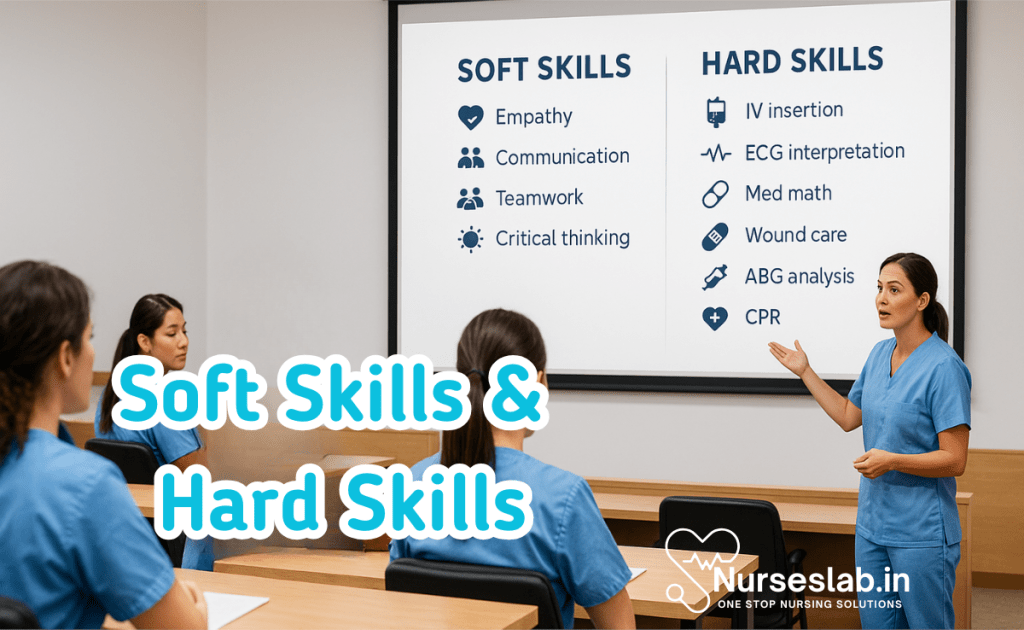
Soft skills refer to a set of personal attributes, social abilities, communication skills, and emotional intelligence that enable individuals to interact effectively and harmoniously with others. These skills are often intangible, challenging to quantify, and are developed over time through experience and self-awareness.
Hard skills, on the other hand, are specific, teachable abilities or knowledge sets acquired through formal education, training, or practice. These skills are measurable and often associated with a particular profession or technical field, such as programming, accounting, or medical procedures.
The importance of both soft and hard skills cannot be overstated in the modern workplace. While hard skills are often necessary to perform job-specific tasks, soft skills are crucial for effective collaboration, leadership, and adaptability in dynamic environments.
Concept of Soft Skills
Soft skills are the personal qualities and interpersonal abilities that enable individuals to work well with others, manage their own behaviour, and navigate complex social situations. Unlike hard skills, which relate to technical proficiency, soft skills revolve around how individuals interact, communicate, and build relationships.
The concept of soft skills has gained prominence due to the recognition that technical expertise alone is insufficient for long-term professional success. Employers increasingly seek candidates who can communicate effectively, work in teams, and adapt to change.
Differences Between Soft Skills and Hard Skills
- Nature: Soft skills are intangible and personality-driven, while hard skills are concrete and teachable.
- Measurement: Soft skills are difficult to quantify, while hard skills can be measured through tests or certifications.
- Acquisition: Soft skills are developed through life experiences, self-reflection, and practice, while hard skills are acquired via formal education or training.
- Application: Soft skills are universally applicable across various roles, while hard skills are often role-specific.
Components of Soft Skills
Soft skills encompass a wide range of abilities that contribute to personal and professional effectiveness. The following are key components:
- Communication Skills: The ability to convey information clearly, listen actively, and interpret non-verbal cues.
- Teamwork and Collaboration: Working effectively with others towards a common goal, respecting diverse perspectives, and sharing responsibilities.
- Problem-Solving: Analysing situations, identifying challenges, and developing practical solutions.
- Adaptability and Flexibility: Adjusting to new situations, embracing change, and remaining open-minded.
- Emotional Intelligence: Recognising, understanding, and managing one’s own emotions as well as empathising with others.
- Leadership: Inspiring and guiding others, making decisions, and taking responsibility.
- Conflict Resolution: Addressing disagreements constructively and finding mutually beneficial outcomes.
- Time Management: Prioritising tasks, managing deadlines, and using time efficiently.
- Critical Thinking: Evaluating information objectively and making reasoned judgments.
- Creativity: Generating innovative ideas and thinking outside the box.
- Interpersonal Skills: Building and maintaining positive relationships.
- Work Ethic: Demonstrating reliability, integrity, and dedication.
Applications of Soft Skills
Soft skills play a vital role in both the workplace and wider society. Their application enhances productivity, fosters positive relationships, and contributes to personal fulfilment and community well-being.
Soft Skills in the Workplace
In professional settings, soft skills are essential for:
- Effective Communication: Ensuring clear understanding among team members, clients, and stakeholders. For example, a project manager must communicate expectations and feedback to ensure project success.
- Teamwork: Collaborating to achieve shared objectives, such as healthcare teams working together to provide holistic care.
- Problem-Solving: Overcoming obstacles, such as resolving technical issues in IT or handling customer complaints in retail.
- Adaptability: Navigating organisational changes, such as adopting new technologies or responding to market shifts.
- Leadership: Guiding teams, making decisions, and motivating others, as seen in managerial roles across sectors.
- Conflict Resolution: Addressing disputes constructively to maintain a harmonious work environment.
- Emotional Intelligence: Understanding colleagues’ emotions, managing stress, and fostering a supportive atmosphere.
- Time Management: Meeting deadlines, balancing workloads, and increasing efficiency.
Benefits of Soft Skills in the Workplace
- Enhanced collaboration and teamwork
- Improved employee morale and job satisfaction
- Greater adaptability to change
- Increased productivity and efficiency
- Better customer and client relationships
- Reduced workplace conflicts
- Stronger leadership and decision-making
Challenges in Developing and Applying Soft Skills
- Subjectivity in assessment and feedback
- Cultural and language barriers
- Resistance to change or new approaches
- Limited opportunities for training and practice
Soft Skills in Society
Beyond the workplace, soft skills are equally important in society. They facilitate effective communication, foster community spirit, and enable individuals to build strong relationships. Examples include:
- Community Engagement: Volunteering, participating in local initiatives, and collaborating with others to address societal issues.
- Interpersonal Relationships: Building trust, resolving conflicts, and maintaining harmonious family and social connections.
- Leadership in Society: Leading community groups, organising events, and inspiring collective action.
- Adaptability in Social Change: Embracing diversity, coping with societal transformations, and promoting inclusivity.
- Problem-Solving in Daily Life: Making informed decisions, managing resources, and overcoming everyday challenges.
- Emotional Intelligence: Recognising and responding to the emotions and needs of others in various social contexts.
Role in Social Interactions and Community Building
Soft skills underpin successful social interactions and contribute to the development of cohesive, resilient communities. They enable individuals to participate actively in civic life, foster mutual respect, and promote understanding across different backgrounds and perspectives.
Hard Skills: Definition, Examples, and Comparison
Hard skills are specific abilities or knowledge required to perform particular tasks. They are usually acquired through formal education, training programmes, or hands-on experience. Hard skills are tangible and can be evaluated through examinations, certifications, or practical demonstrations.
Examples of hard skills include:
- Mathematical ability
- Computer programming
- Operating machinery
- Foreign language proficiency
- Accounting and financial analysis
- Medical procedures (e.g., administering injections, wound care)
- Legal research and documentation
- Laboratory techniques
While hard skills are essential for job performance, their effectiveness is often amplified when combined with strong soft skills. For instance, a nurse may excel in clinical procedures (hard skills) but must also demonstrate empathy and communication (soft skills) to provide holistic care.
Comparison of Soft Skills and Hard Skills
| Aspect | Soft Skills | Hard Skills |
| Definition | Personal attributes and interpersonal abilities | Technical abilities and job-specific knowledge |
| Acquisition | Life experience, practice, self-awareness | Formal education, training, certification |
| Measurement | Subjective, observation-based | Objective, test-based |
| Application | Universal, across roles and industries | Role-specific, technical tasks |
Soft Skills in Nursing: Importance, Examples, and Impact
Nursing is a profession that demands a unique blend of hard skills and soft skills. While clinical expertise is critical for delivering safe and effective patient care, soft skills are equally vital for building trust, ensuring patient comfort, and working within multidisciplinary teams.
Importance of Soft Skills in Nursing:
- Effective Communication: Nurses must communicate clearly with patients, families, and colleagues to ensure accurate information exchange and understanding.
- Empathy and Compassion: Understanding patients’ emotional and psychological needs is central to holistic care.
- Teamwork: Collaborating with doctors, therapists, and other healthcare professionals to deliver coordinated care.
- Adaptability: Responding to rapidly changing patient conditions and healthcare environments.
- Problem-Solving: Addressing clinical challenges, such as sudden changes in a patient’s health status.
- Emotional Intelligence: Managing stress, supporting patients and families, and maintaining professional composure.
- Leadership: Taking initiative, managing junior staff, and advocating for patients’ needs.
- Conflict Resolution: Handling disagreements among patients, families, or team members constructively.
- Cultural Competence: Providing care that respects diverse backgrounds and beliefs.
The integration of soft skills in nursing enhances patient outcomes, improves job satisfaction, and fosters positive work environments. Patients are more likely to trust and comply with nurses who demonstrate empathy and effective communication.
Table: Description and Application of Soft Skills and Hard Skills in Nursing
| Skill | Description | Application in Nursing |
| Communication | Exchanging information clearly and effectively | Explaining procedures to patients, updating families, reporting to doctors |
| Empathy | Understanding and sharing the feelings of others | Providing comfort to anxious patients, supporting grieving families |
| Teamwork | Collaborating with others to achieve common goals | Coordinating with healthcare teams for comprehensive care |
| Adaptability | Adjusting to new situations and changes | Responding to emergencies, adapting to new protocols |
| Problem-Solving | Identifying issues and finding solutions | Managing unexpected patient complications |
| Emotional Intelligence | Recognising and managing emotions | Dealing with stressful situations, supporting patients emotionally |
| Leadership | Guiding and inspiring others | Supervising junior staff, leading shifts |
| Conflict Resolution | Managing and resolving disputes | Handling disagreements among staff or with patients’ families |
| Cultural Competence | Understanding and respecting diversity | Providing care sensitive to patients’ cultural backgrounds |
| Clinical Skills (Hard) | Technical abilities such as administering medication, wound care | Performing injections, dressing wounds, operating medical equipment |
| Record Keeping (Hard) | Documenting patient information accurately | Maintaining medical records, updating charts |
| IV Therapy (Hard) | Administering intravenous treatments | Setting up IV lines, monitoring infusions |
| Basic Life Support (Hard) | Life-saving procedures | Performing CPR, using defibrillators |
Conclusion
Soft skills and hard skills are both indispensable for personal and professional development. While hard skills provide the technical foundation required for specific roles, soft skills enable individuals to navigate complex interpersonal dynamics, adapt to change, and lead effectively. In the context of nursing, the integration of both skill sets is critical for delivering high-quality, patient-centred care. As workplaces and societies continue to evolve, the future relevance of soft skills is only expected to grow, making their cultivation a priority for students, professionals, and organisations alike.
By understanding, developing, and applying both soft and hard skills, individuals can achieve greater success, satisfaction, and impact in their careers and communities.
REFERENCES
- R. Sreevani, Applied Psychology for Nurses, 5th Edition, 2024, Jaypee Publishers, ISBN: 978-9356966963.
- Xavier Belsiyal, Applied Psychology for Nurses, 1st Edition, July 15, 2023, Elsevier Publishers, ISBN: 978-8131266366
- Mary F Porter, Applied Psychology for Nurses, 27 October 2022, Legare Street Press, IBSN: 978-1015804302.
- Douglas A. Bernstein, Introduction to Clinical Psychology, 10th Edition, 31 October 2024, Cambridge University Press, ISBN: 978- 1009379298.
- Sailaxmi Gandhi, Basic and Applied Psychology for Nurses, First Edition, January 2023, Wolters Kluwer Publications, ISBN: 978-9395736534.
- Jacob Anthikad, Psychology for Graduate Nurses, 5th Edition, 30 January 2014, Jaypee Publishers, ISBN: 978-9351521549.
- Kumar, Rajesh. (2017). Basic Psychology for Nurses. https://www.researchgate.net/publication/337811601_Basic_Psychology_for_Nurses
Stories are the threads that bind us; through them, we understand each other, grow, and heal.
JOHN NOORD
Connect with “Nurses Lab Editorial Team”
I hope you found this information helpful. Do you have any questions or comments? Kindly write in comments section. Subscribe the Blog with your email so you can stay updated on upcoming events and the latest articles.