Last Updated on January 12, 2026 by Nurseslab.in Editorial Team
Discover the NANDA Nursing Diagnosis List 2026: a comprehensive classification of standardized nursing diagnoses used in care planning, documentation, and licensure exams. Covering domains like health promotion, nutrition, safety, and cognition, it guides nurses in identifying patient needs, planning interventions, and improving outcomes through evidence-based practice.
Nursing care today is grounded in evidence-based frameworks that empower nurses to deliver precise, patient-centred interventions. One of the most critical tools in this regard is the NANDA International (NANDA-I) Nursing Diagnosis list. The 2026 update brings fresh clarity and consistency to nursing diagnoses worldwide, ensuring practitioners remain at the forefront of patient assessment and care planning.
Connect with us By Joining with our Social Media Platforms..
Introduction
A nursing diagnosis forms the backbone of care planning, helping practitioners systematically identify patient needs, prioritise interventions, and foster optimal outcomes. The NANDA-I taxonomy, updated every three years, reflects advancements in knowledge, research, and clinical experience. The 2026 list features refinements and new diagnoses, underscoring the evolving nature of healthcare and the necessity for nurses to remain informed and adaptable.
This post aims to demystify the 2026 NANDA Nursing Diagnosis List. It presents all domains, classes, and diagnoses, offering clear, concise, and clinically relevant explanations to support daily practice, education, and ongoing professional development.
Overview of NANDA International
Brief History
Formed in 1982, NANDA International emerged from the need for a universal language in nursing practice. Initially known as the North American Nursing Diagnosis Association, NANDA-I has since become a global body, driving standardisation in nursing diagnoses, research, and education. Its taxonomy is now used in over 40 countries, supporting safe, evidence-based care across diverse settings.
Role in Nursing Practice
NANDA-I’s primary role is to provide a standardised classification system for nursing diagnoses. This system enhances interdisciplinary communication, guides care planning, and underpins nursing documentation. By fostering a shared vocabulary, NANDA-I strengthens the professional identity of nursing, supports research, and enables benchmarking of care outcomes worldwide.
Structure of NANDA Nursing Diagnoses
The NANDA-I taxonomy is organised into 13 domains, each representing a broad area of patient need. Within each domain, classes group related diagnoses, facilitating clarity and ease of use. Each diagnosis is defined by a label, definition, defining characteristics, and related/risk factors. This structure streamlines assessment, ensures comprehensive care, and promotes critical thinking.
| Domain | Focus Area | Classes (Subcategories) |
| Domain 1 | Health Promotion | Health Awareness, Health Management |
| Domain 2 | Nutrition | Ingestion, Digestion, Absorption, Hydration |
| Domain 3 | Elimination and Exchange | Urinary, gastrointestinal, Integumentary |
| Domain 4 | Activity/Rest | Sleep/Rest, Activity/Exercise, Energy Balance, Cardiovascular/Pulmonary Responses |
| Domain 5 | Perception/Cognition | Attention, Orientation, Sensation/Perception, Cognition, Communication |
| Domain 6 | Self-Perception | Self-Concept, Self-Esteem, Body Image |
| Domain 7 | Role Relationships | Caregiving Roles, Family Relationships, Social Relationships |
| Domain 8 | Sexuality | Sexual Identity, Sexual Function, Reproduction |
| Domain 9 | Coping/Stress Tolerance | Post-trauma Responses, Coping Responses, Neurobehavioural Stress Responses |
| Domain 10 | Life Principles | Values, Beliefs, Value/Belief Action Congruence |
| Domain 11 | Safety/Protection | Infection, Physical Injury, Violence, Environmental Hazards, Defensive Processes, Security |
| Domain 12 | Comfort | Physical Comfort, Environmental Comfort, Social Comfort |
| Domain 13 | Growth/Development | Growth, Development |
Domain 1: Health Promotion
Health promotion focuses on the patient’s motivation and desire to increase well-being and actualise human health potential. Diagnoses in this domain help nurses assess readiness for improved health, encourage preventive practices, and foster patient engagement.

Nursing Diagnosis:
Class 1. Health Awareness
- Decreased Diversional Activity engagement
- Risk for Decreased Diversional Activity engagement
- Excessive sedentary behaviours
- Risk for Excessive sedentary behaviours
- Imbalanced energy field
Class 2: Health Management
- Ineffective health self-Management
- Risk for Ineffective health self-Management
- Readiness for enhanced self-health Management
- Ineffective family health Management
- Risk for Ineffective family health Management
- Ineffective community health management
- Risk for ineffective community health management
- Risk for ineffective blood glucose pattern self-management.
- Ineffective dry eye self-management.
- Ineffective dry mouth self-management
- Risk for ineffective dry mouth self-management
- Ineffective fatigue self-management
- Ineffective lymphedema self-management
- Risk for ineffective lymphedema self-management.
- Ineffective nausea self-management
- Ineffective pain self-management
- Risk for ineffective overweight self-management
- Ineffective underweight self-management
- Risk for ineffective underweight self-management
- Ineffective health maintenance behaviours
- Risk for ineffective health maintenance behaviours
- Ineffective home maintenance behaviours
- Risk for ineffective home maintenance behaviours
- Readiness for enhanced home maintenance behaviours
- Readiness for enhanced exercise engagement
- Inadequate health literacy
- Risk for inadequate health literacy
- Readiness for enhanced health literacy
- Readiness for enhanced healthy aging
- Elder frailty syndrome
- Risk for elder frailty syndrome
Examples:
- Readiness for Enhanced Health Management: Patient demonstrates motivation and skills to manage health, but may benefit from additional support or education. Key for chronic disease management, lifestyle changes.
- Ineffective Health Management: Difficulty in integrating a treatment regimen for illness and its sequelae into daily living. May result from lack of knowledge, motivation, or resources.
- Ineffective Health Maintenance: Inability to identify, manage, and/or seek help to maintain health. Often linked with limited health literacy or social support.
- Ineffective Family Health Management: Family’s inability to integrate health-promoting behaviours into daily life for its members.
- Readiness for Enhanced Immunisation Status: Expressed desire to improve or maintain up-to-date immunisations.
- Readiness for Enhanced Health Literacy: Demonstrates motivation to improve understanding of health information and services.
Domain 2: Nutrition
Nutrition diagnoses focus on the processes of ingestion, digestion, absorption, and metabolism of nutrients. These diagnoses are essential for preventing malnutrition, dehydration, and related complications.

Nursing Diagnosis:
Class 1: Ingestion
- Inadequate nutritional intake
- Risk for inadequate nutritional intake
- Readiness for enhanced nutritional intake
- Inadequate protein energy nutritional intake
- Risk for inadequate protein energy nutritional intake
- Ineffective chest feeding
- Risk for ineffective chest feeding
- Disrupted exclusive chest feeding
- Risk for disrupted exclusive chest feeding
- Readiness for enhanced chest feeding
- Inadequate human milk production
- Risk for inadequate human milk production
- Ineffective infant feeding dynamics
- Ineffective child eating dynamics
- Ineffective adolescent eating dynamics
- Impaired swallowing
Class 2. Digestion
- This class does not currently contain any diagnoses
Class 3. Absorption
- This class does not currently contain any diagnoses
Class 4. Metabolism
- Neonatal hyperbilirubinemia
- Risk for neonatal hyperbilirubinemia
Class 5. Hydration
- Risk for impaired water-electrolyte balance
- Risk for impaired fluid volume balance
- Excessive fluid volume
- Risk for excessive fluid volume
- Inadequate fluid volume
- Risk for inadequate fluid volume
Examples:
- Ineffective Breastfeeding: Difficulty in baby or mother to achieve effective breastfeeding. May result from anatomical, physiological, or psychological factors.
- Effective Breastfeeding: Adequate baby-mother interaction resulting in proper nutrition.
- Readiness for Enhanced Breastfeeding: Mother expressing readiness to improve breastfeeding techniques.
- Imbalanced Nutrition: Less Than Body Requirements: Intake of nutrients insufficient to meet metabolic needs, leading to weight loss or growth failure.
- Imbalanced Nutrition: More Than Body Requirements: Intake of nutrients that exceeds metabolic needs, leading to weight gain or obesity.
- Risk for Imbalanced Nutrition: More Than Body Requirements: At risk of excessive nutrient intake and weight gain.
- Risk for Imbalanced Nutrition: Less Than Body Requirements: At risk of insufficient nutrient intake.
- Risk for Overweight: At risk for weight gain disproportionate to body frame.
- Overweight: Accumulation of excess body fat, but not to the degree of obesity.
- Obesity: Excessive accumulation of body fat adversely affecting health.
- Risk for Obesity: Presence of factors predisposing to obesity.
- Impaired Swallowing: Difficulty in swallowing, which can threaten nutrition and safety.
- Risk for Impaired Swallowing: At risk of developing swallowing difficulties.
- Impaired Infant Feeding Pattern: Disruption in the feeding pattern of an infant.
- Readiness for Enhanced Nutrition: Patient expresses willingness to improve nutritional status.
- Risk for Unstable Blood Glucose Level: Risk factors present for fluctuating blood glucose.
- Risk for Deficient Fluid Volume: At risk of dehydration due to inadequate intake or excessive loss.
- Risk for Excess Fluid Volume: At risk of fluid overload.
Domain 3: Elimination and Exchange
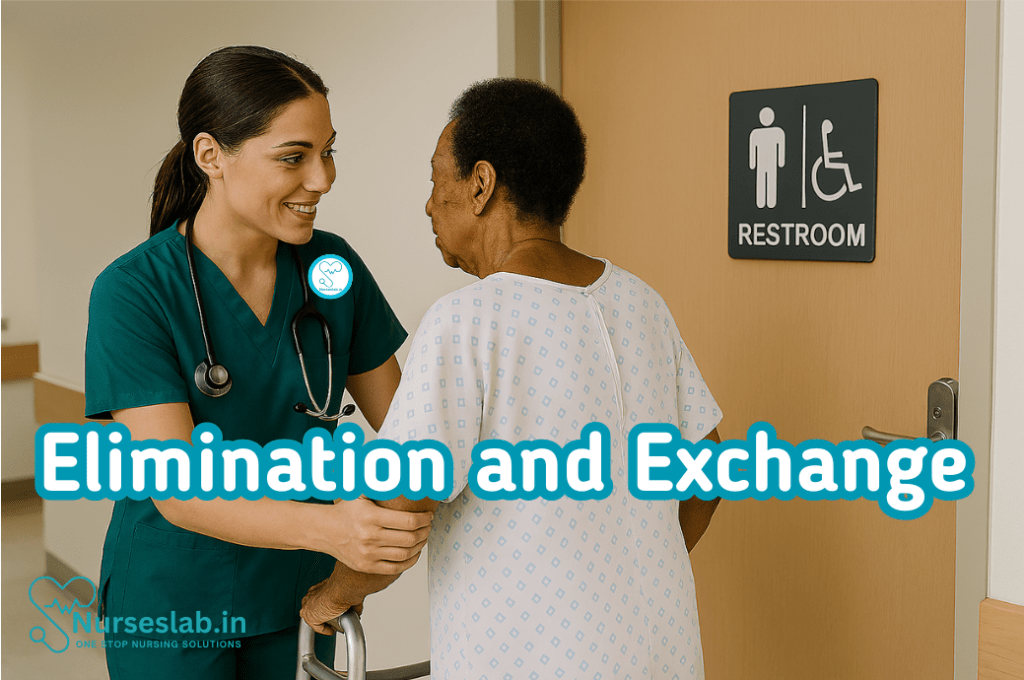
This domain addresses the processes of removal of body wastes and gas exchange. It includes urinary, gastrointestinal, and integumentary elimination.
Nursing Diagnosis:
Class 1. Urinary function
- Impaired urinary elimination
- Risk for urinary retention
- Disability-associated urinary incontinence
- Mixed urinary incontinence
- Stress urinary incontinence
- Urge urinary incontinence
- Risk for urge urinary incontinence
Class 2. Gastrointestinal function
- Impaired gastrointestinal motility
- Risk for impaired gastrointestinal motility
- Impaired intestinal elimination
- Risk for impaired intestinal elimination
- Chronic functional constipation
- Risk for chronic functional constipation
- Impaired fecal continence
- Risk for impaired fecal continence
Class 3. Integumentary function
This class does not currently contain any diagnoses
Examples:
- Impaired Urinary Elimination: Dysfunction in urine elimination patterns, such as incontinence, retention, or frequency.
- Functional Urinary Incontinence: Unable to reach the toilet due to physical, cognitive, or environmental barriers.
- Stress Urinary Incontinence: Involuntary urine loss with increased abdominal pressure (coughing, sneezing).
- Urge Urinary Incontinence: Sudden, intense urge to urinate leading to involuntary loss.
- Overflow Urinary Incontinence: Bladder overdistension leading to dribbling or continuous leakage.
- Reflex Urinary Incontinence: Involuntary loss of urine at predictable intervals.
- Risk for Urge Urinary Incontinence: At risk for developing urge incontinence.
- Risk for Urinary Tract Injury: At risk of trauma to urinary structures.
- Impaired Bowel Elimination: Dysfunction in bowel elimination, including constipation, diarrhoea, or incontinence.
- Constipation: Decreased frequency or difficulty in defecation.
- Perceived Constipation: Belief of being constipated, although not clinically confirmed.
- Chronic Functional Constipation: Persistent constipation of unknown origin.
- Risk for Constipation: At risk for developing constipation based on predisposing factors.
- Diarrhoea: Frequent, loose, or liquid stools.
- Bowel Incontinence: Involuntary passage of stool.
- Risk for Impaired Skin Integrity: At risk of skin breakdown due to incontinence.
- Ineffective Airway Clearance: Inability to clear secretions or obstructions from the respiratory tract.
- Ineffective Breathing Pattern: Inspiration and/or expiration that does not provide adequate ventilation.
- Impaired Gas Exchange: Excess or deficit in oxygenation and/or carbon dioxide elimination.
Domain 4: Activity/Rest
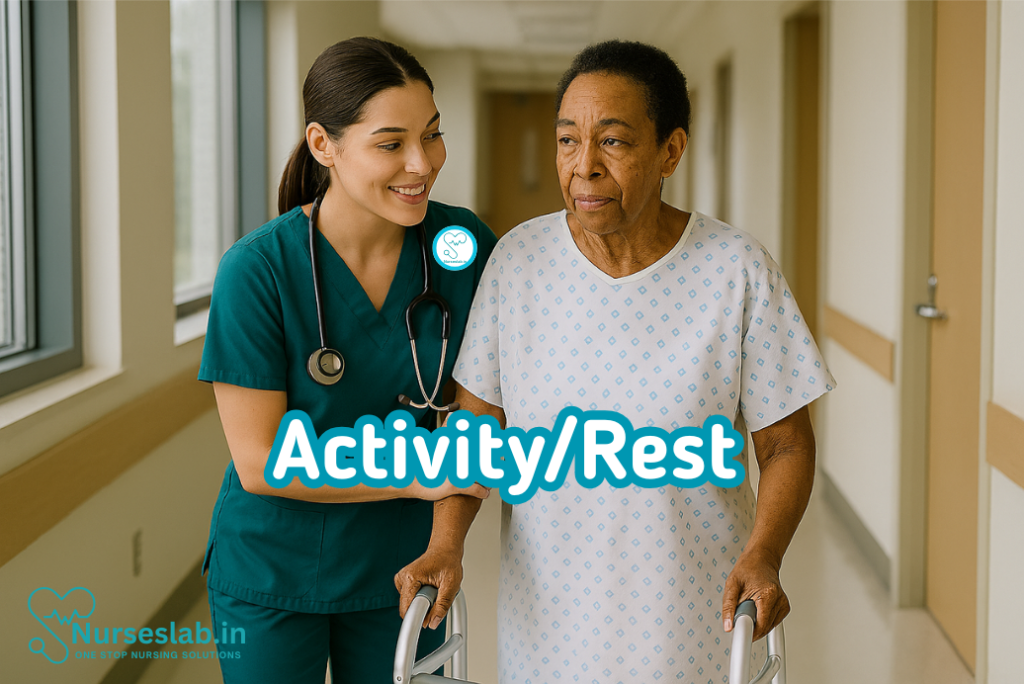
This domain focuses on the balance between physical activity and rest, including energy maintenance, sleep, and cardiovascular/respiratory fitness.
Nursing Diagnosis:
Class 1. Sleep / rest
- Ineffective sleep pattern
- Risk for ineffective sleep pattern
- Readiness for enhanced sleep pattern
- Ineffective sleep hygiene behaviours
- Risk for ineffective sleep hygiene behaviours
Class 2. Activity / exercise
- Impaired physical mobility
- Risk for impaired physical mobility
- Impaired bed mobility
- Impaired wheelchair mobility
- Impaired sitting ability
- Impaired standing ability
- Impaired transferring ability
- Impaired walking ability
Class 3. Energy balance
- Decreased activity tolerance
- Risk for decreased activity tolerance
- Excessive fatigue burden
- Impaired surgical recovery
- Risk for impaired surgical recovery
Class 4. Cardiovascular / pulmonary responses
- Risk for impaired cardiovascular function
- Risk for imbalanced blood pressure
- Risk for decreased cardiac output
- Risk for ineffective cerebral tissue perfusion
- Ineffective peripheral tissue perfusion
- Risk for ineffective peripheral tissue perfusion
- Ineffective breathing pattern
- Impaired spontaneous ventilation
- Impaired child ventilatory weaning response
- Impaired adult ventilatory weaning response
Class 5. Self-care
- Decreased self-care ability syndrome
- Risk for decreased self-care ability syndrome
- Readiness for enhanced self-care abilities
- Decreased bathing abilities
- Decreased dressing abilities
- Decreased feeding abilities
- Decreased grooming abilities
- Decreased toileting abilities
- Ineffective oral hygiene behaviours
- Risk for ineffective oral hygiene behaviours
Examples:
- Impaired Bed Mobility: Limitation in independent movement from one position to another in bed.
- Impaired Physical Mobility: Limitation in independent, purposeful physical movement of the body.
- Impaired Walking: Limitation in independent movement on foot.
- Impaired Wheelchair Mobility: Limitation in independent operation of a wheelchair.
- Risk for Disuse Syndrome: At risk of deterioration of body systems due to prescribed or unavoidable inactivity.
- Activity Intolerance: Insufficient physiological or psychological energy to endure or complete required or desired daily activities.
- Fatigue: An overwhelming, sustained sense of exhaustion and decreased capacity for physical and mental work.
- Impaired Home Maintenance: Inability to independently maintain a safe and growth-promoting environment.
- Risk for Falls: At increased risk for falling.
- Disturbed Sleep Pattern: Time-limited disruptions in sleep quantity, quality, or timing.
- Insomnia: Difficulty in initiating or maintaining sleep.
- Sleep Deprivation: Prolonged periods without adequate sleep.
- Readiness for Enhanced Sleep: Patient expresses desire to improve sleep.
- Ineffective Activity Planning: Difficulty in planning and managing activity and rest periods.
Domain 5: Perception/Cognition
Perception/cognition diagnoses address the ability to perceive, understand, and respond to information. These are central to patient safety, education, and autonomy.

Nursing Diagnosis:
Class 1. Attention
This class does not currently contain any diagnoses
Class 2. Orientation
This class does not currently contain any diagnoses
Class 3. Sensation / perception
This class does not currently contain any diagnoses
Class 4. Cognition
- Acute confusion
- Risk for acute confusion
- Chronic confusion
- Ineffective impulse control
- Disrupted thought processes
- Inadequate health knowledge
- Readiness for enhanced health knowledge
- Impaired memory
- Impaired decision-making
- Readiness for enhanced decision-making
- Impaired emancipated decision-making
- Risk for impaired emancipated decision-making
- Readiness for enhanced emancipated decision-making
Class 5. Communication
- Impaired verbal communication
- Risk for impaired verbal communication
- Readiness for enhanced verbal communication
Examples:
- Impaired Memory: Inability to remember or recall bits of information or skills.
- Impaired Thought Processes: Disruption in cognitive operations and activities.
- Impaired Communication: Decreased, delayed, or absent ability to receive, process, transmit, and use a system of symbols.
- Impaired Verbal Communication: Difficulty in using or understanding spoken language.
- Acute Confusion: Abrupt onset of reversible disturbances of consciousness, attention, cognition, and perception.
- Chronic Confusion: Irreversible, long-standing, and/or progressive deterioration of intellect and personality.
- Risk for Acute Confusion: At risk for developing acute confusion.
- Unilateral Neglect: Inattention to one side of the body/environment due to brain injury.
- Impaired Environmental Interpretation Syndrome: Inability to interpret environmental stimuli.
- Ineffective Impulse Control: Difficulty in controlling emotions or behaviours.
- Readiness for Enhanced Communication: Desire to improve communication skills.
Domain 6: Self-Perception
Self-perception diagnoses relate to the patient’s assessment of self, including self-esteem, body image, and personal identity. These diagnoses are crucial for mental health and social functioning.

Nursing Diagnosis:
Class 1. Self-concept
- Readiness for enhanced self-concept
- Disrupted personal identity
- Disrupted family identity syndrome
- Risk for disrupted family identity syndrome
- Risk for impaired human dignity
- Readiness for enhanced transgender social identity
Class 2. Self-esteem
- Chronic inadequate self-esteem
- Risk for chronic inadequate self-esteem
- Situational inadequate self-esteem
- Risk for situational inadequate self-esteem
- Inadequate health self-efficacy
Class 3. Body image
Disrupted body image
Examples:
- Disturbed Body Image: Confusion in mental picture of one’s physical self.
- Chronic Low Self-Esteem: Long-standing negative self-evaluation.
- Situational Low Self-Esteem: Temporary negative self-feelings in response to a specific situation.
- Risk for Situational Low Self-Esteem: At risk for developing negative self-feelings.
- Readiness for Enhanced Self-Concept: Shows desire to enhance self-understanding and acceptance.
- Readiness for Enhanced Self-Esteem: Expresses desire to improve self-worth.
- Ineffective Personal Identity: Inability to maintain clear boundaries of self.
- Readiness for Enhanced Body Image: Motivation to improve perception of body image.
Domain 7: Role Relationships
This domain addresses the patient’s roles and relationships within family, society, and other groups. Diagnoses here are critical for social well-being and continuity of care.

Nursing Diagnosis:
Class 1. Caregiving roles
- Impaired parenting behaviours
- Risk for impaired parenting behaviours
- Readiness for enhanced parenting behaviours
- Excessive parental role conflict
Class 2. Family relationships
- Disrupted family interaction patterns
- Risk for disrupted family interaction patterns
- Impaired family processes
- Readiness for enhanced family processes
- Risk for disrupted attachment behaviours
Class 3. Role performance
- Ineffective role performance
- Ineffective intimate partner relationship
- Risk for ineffective intimate partner relationship
- Readiness for enhanced intimate partner relationship
- Impaired social interaction
- Ineffective childbearing process
- Risk for ineffective childbearing process
- Readiness for enhanced childbearing process
Examples:
- Ineffective Role Performance: Difficulty in fulfilling role obligations.
- Ineffective Family Processes: Dysfunction in family relationships and activities.
- Interrupted Family Processes: Temporary disturbance in family functioning.
- Dysfunctional Family Processes: Alcoholism: Family dysfunction related to alcohol abuse.
- Ineffective Relationship: Strained or dysfunctional interpersonal relationships.
- Readiness for Enhanced Relationship: Patient demonstrates willingness to improve relationships.
- Impaired Parenting: Inability to provide nurturing care to children.
- Readiness for Enhanced Parenting: Desire to improve parenting skills.
- Risk for Impaired Parenting: Factors increasing risk of impaired parenting.
- Impaired Social Interaction: Difficulty in engaging in meaningful social exchanges.
- Social Isolation: Aloneness experienced by the individual and perceived as imposed by others and as a negative or threatening state.
- Parental Role Conflict: Discomfort in fulfilling parental roles.
Domain 8: Sexuality
Sexuality diagnoses focus on sexual identity, function, and reproduction. Nurses play a vital role in assessing and supporting patients’ sexual health.
Nursing Diagnosis:
Class 1. Sexual identity
This class does not currently contain any diagnoses
Class 2. Sexual function
Impaired sexual function
Class 3. Reproduction
Risk for impaired maternal-fetal dyad
Examples:
- Ineffective Sexuality Pattern: Expressions of concern about one’s own sexuality.
- Sexual Dysfunction: Change in sexual function perceived as unsatisfying or inadequate.
- Readiness for Enhanced Sexuality Pattern: Patient expresses willingness to improve sexual health or satisfaction.
- Risk for Ineffective Sexuality Pattern: At risk for concerns about sexual health or function.
Domain 9: Coping/Stress Tolerance
This domain involves the patient’s ability to manage stress and cope with changes or challenges. Diagnoses guide interventions to enhance resilience and mental health.

Nursing Diagnosis:
Class 1. Post-trauma responses
- Post-trauma syndrome
- Risk for post-trauma syndrome
- Risk for disrupted immigration transition
Class 2. Coping responses
- Maladaptive coping
- Readiness for enhanced coping
- Maladaptive family coping
- Readiness for enhanced family coping
- Maladaptive community coping
- Readiness for enhanced community coping
- Excessive caregiving burden
- Risk for excessive caregiving burden
- Maladaptive grieving
- Risk for maladaptive grieving
- Readiness for enhanced grieving
- Impaired resilience
- Risk for impaired resilience
- Readiness for enhanced resilience
- Readiness for enhanced hope
- Inadequate self-compassion
- Excessive anxiety
- Excessive death anxiety
- Excessive fear
Class 3. Neurobehavioral responses
- Risk for autonomic dysreflexia
- Ineffective emotion regulation
- Impaired mood regulation
- Acute substance withdrawal syndrome
- Risk for acute substance withdrawal syndrome
Examples:
- Ineffective Coping: Difficulty in managing stressors in a healthy way.
- Defensive Coping: Repeated projection of falsely positive self-evaluation based on a self-protective pattern.
- Compromised Family Coping: Family’s inability to support member’s adaptation to health challenges.
- Readiness for Enhanced Coping: Expressed desire to improve coping mechanisms.
- Post-Trauma Syndrome: Sustained maladaptive response to a traumatic event.
- Risk for Post-Trauma Syndrome: At risk for developing maladaptive responses to trauma.
- Relocation Stress Syndrome: Physiological and/or psychological disturbance in response to relocation.
- Risk for Relocation Stress Syndrome: At risk for disturbance due to relocation.
- Chronic Sorrow: Ongoing, pervasive sadness due to a significant loss.
- Ineffective Denial: Conscious or unconscious attempt to disavow knowledge or meaning of an event.
- Risk for Compromised Resilience: At risk for decreased ability to recover from adversity.
Domain 10: Life Principles
Diagnoses in this domain relate to values, beliefs, and life purpose, guiding holistic and spiritual care.

Nursing Diagnosis:
Class 1. Values
- This class does not currently contain any diagnoses
Class 2. Beliefs
- This class does not currently contain any diagnoses
Class 3. Value / belief / action congruence
- Moral distress
- Impaired spiritual well-being
- Risk for impaired spiritual well-being
- Readiness for enhanced spiritual well-being
- Impaired religiosity
- Risk for impaired religiosity
- Readiness for enhanced religiosity
Examples:
- Spiritual Distress: Impaired ability to experience and integrate meaning and purpose in life.
- Risk for Spiritual Distress: At risk for impaired ability to experience meaning in life.
- Readiness for Enhanced Spiritual Well-Being: Expressed desire to enhance personal spiritual health.
- Impaired Religiosity: Difficulty in adhering to religious beliefs or rituals.
- Risk for Impaired Religiosity: At risk of challenges to religious belief or practice.
- Readiness for Enhanced Religiosity: Expressed desire to improve religious well-being.
- Moral Distress: Psychological discomfort or anguish due to ethical dilemmas.
- Ineffective Value System: Difficulty in making decisions consistent with one’s values.
Domain 11: Safety/Protection
Safety/protection diagnoses focus on safeguarding the patient from injury, infection, or environmental hazards. This domain is fundamental for risk assessment and prevention.

Nursing Diagnosis:
Class 1. Infection
- Impaired immune response
- Risk for infection
- Risk for surgical wound infection
Class 2. Physical injury
- Risk for physical injury
- Risk for burn injury
- Risk for cold injury
- Risk for corneal injury
- Risk for dry eye
- Risk for perioperative positioning injury
- Neonatal pressure injury
- Risk for neonatal pressure injury
- Child pressure injury
- Risk for child pressure injury
- Adult pressure injury
- Risk for adult pressure injury
- Risk for urinary tract injury
- Impaired tissue integrity
- Risk for impaired tissue integrity
- Impaired skin integrity
- Risk for impaired skin integrity
- Impaired nipple-areolar complex integrity
- Risk for impaired nipple-areolar complex integrity
- Impaired oral mucous membrane integrity
- Risk for impaired oral mucous membrane integrity
- Risk for child falls
- Risk for adult falls
- Risk for aspiration
- Ineffective airway clearance
- Risk for accidental suffocation
- Risk for excessive bleeding
- Risk for shock
- Risk for thrombosis
- Risk for impaired peripheral neurovascular function
- Risk for sudden infant death
- Risk for elopement attempt
Class 3. Violence
- Risk for other-directed violence
- Risk for female genital mutilation
- Risk for suicidal self-injurious behavior
- Non-suicidal self-injurious behavior
- Risk for non-suicidal self-injurious behavior
Class 4. Environmental hazards
- Contamination
- Risk for contamination
- Risk for accidental poisoning
- Risk for occupational illness
- Risk for occupational physical injury
Class 5. Defensive processes
Risk for allergic reaction
Risk for latex allergy reaction
Class 6. Thermoregulation
- Ineffective thermoregulation
- Risk for ineffective thermoregulation
- Decreased neonatal body temperature
- Risk for decreased neonatal body temperature
- Decreased body temperature
- Risk for decreased body temperature
- Risk for decreased perioperative body temperature
- Hyperthermia
- Risk for hyperthermia
Examples:
- Risk for Infection: At increased risk for being invaded by pathogenic organisms.
- Risk for Injury: At risk for harm due to internal or external factors.
- Risk for Falls: At increased risk of accidental falls.
- Impaired Skin Integrity: Damage to mucous membrane, corneal, integumentary, or subcutaneous tissues.
- Impaired Tissue Integrity: Damage to tissues—skin, mucous membrane, cornea, or subcutaneous tissues.
- Risk for Impaired Skin Integrity: Risk factors present for skin breakdown.
- Delayed Surgical Recovery: Extended time to recover from surgical procedure.
- Risk for Bleeding: At risk of excessive blood loss.
- Risk for Suffocation: At risk for inadequate air supply.
- Risk for Thermal Injury: At risk for injury from heat or cold.
- Risk for Poisoning: At risk of exposure to toxic substances.
- Risk for Aspiration: At risk of inhaling gastric or oropharyngeal contents.
- Risk for Vascular Trauma: At risk for injury to blood vessels.
- Ineffective Protection: Decreased ability to guard self from internal or external threats.
- Risk for Ineffective Protection: At risk for compromised self-protection.
- Self-Neglect: Behavioural pattern of failing to meet basic needs.
- Risk for Self-Mutilation: At risk for intentional self-injury.
- Risk for Other-Directed Violence: At risk of harmful behaviour towards others.
- Risk for Latex Allergy Response: At risk of allergic reaction to latex.
- Contamination: Exposure to environmental or pathogenic agents.
- Risk for Contamination: At risk for exposure.
Domain 12: Comfort
Comfort diagnoses address the patient’s physical and psychological comfort, including pain management, environmental comfort, and social comfort.

Nursing Diagnosis:
Class 1. Physical comfort
- Impaired physical comfort
- Readiness for enhanced physical comfort
- Impaired end-of-life comfort syndrome
- Acute pain
- Chronic pain syndrome
- Chronic pain
- Labor pain
Class 2. Environmental comfort
- This class does not currently contain any diagnoses
Class 3. Social comfort
- Readiness for enhanced social comfort
- Inadequate social connectedness
- Inadequate social support network
- Excessive loneliness
- Risk for excessive loneliness
Class 4. Psychological comfort
- Impaired psychological comfort
- Readiness for enhanced psychological comfort
Examples:
- Acute Pain: Sudden onset pain, typically lasting less than six months.
- Chronic Pain: Persistent pain, lasting longer than six months.
- Nausea: Unpleasant sensation in the stomach, may precede vomiting.
- Impaired Comfort: Perceived lack of ease, relief, and transcendence in physical, psychospiritual, environmental, cultural, or social dimensions.
- Readiness for Enhanced Comfort: Patient expresses desire to improve comfort.
- Labour Pain: Pain associated with childbirth.
- Sleep Deprivation: Repeated interruptions of sleep.
Domain 13: Growth/Development
This domain covers diagnoses related to normal and delayed growth and development, crucial for paediatric, adolescent, and geriatric care.
Nursing Diagnosis:
Class 1. Growth
- Delayed child growth
- Risk for delayed child growth
Class 2. Development
- Delayed child development
- Risk for delayed child development
- Delayed infant motor development
- Risk for delayed infant motor development
- Impaired infant neurodevelopmental organization
- Risk for impaired infant neurodevelopmental organization
- Readiness for enhanced infant neurodevelopmental organization
- Ineffective infant suck-swallow response
Examples:
- Delayed Growth and Development: Failure to achieve expected developmental milestones.
- Risk for Delayed Development: At risk for not meeting developmental milestones.
- Readiness for Enhanced Growth: Demonstrates willingness to improve or maximise personal development.
How to Use the NANDA List in Clinical Practice
The NANDA Nursing Diagnosis List is a dynamic tool for assessment, planning, implementation, and evaluation of nursing care. Here is how you can integrate it into daily practice:
- Assessment: Collect comprehensive patient data—physical, psychological, social, and environmental.
- Diagnosis: Match patient findings with NANDA diagnoses, considering defining characteristics and related/risk factors.
- Planning: Set measurable outcomes and select interventions based on the identified diagnoses.
- Implementation: Carry out interventions, engaging the patient and family in care.
- Evaluation: Reassess patient status and adjust the care plan as needed.
Case Example 1: A diabetic patient with poor glycaemic control may be diagnosed with “Ineffective Health Management” and “Risk for Unstable Blood Glucose Level.” Interventions would target education, self-monitoring, and support.
Case Example 2: An elderly patient with frequent falls may be diagnosed with “Impaired Physical Mobility” and “Risk for Injury.” Planning would include mobility aids, environment modification, and exercise programmes.
Conclusion
The 2026 NANDA Nursing Diagnosis List offers a robust, evidence-based framework for holistic, patient-centred care. By organising diagnoses into structured domains, NANDA-I supports comprehensive assessment and clear communication, thereby improving patient outcomes and advancing nursing as a profession. Staying abreast of updates ensures nurses remain effective advocates for health, safety, and well-being.
Whether you are a nursing student, educator, or a practising nurse, integrating the updated NANDA list into clinical reasoning and documentation will strengthen your practice and uphold the highest standards of care in the years ahead. The future of nursing is collaborative, informed, and ever-evolving—let the 2026 NANDA-I taxonomy be your guide.
REFERENCES
- NANDA International Nursing Diagnoses 2025-2026 Update, 13th Edition, Thieme Medical Publishers, Inc.
- Ernstmeyer K, Christman E, editors. Nursing Fundamentals [Internet]. Eau Claire (WI): Chippewa Valley Technical College; 2021. Appendix A: Sample NANDA-I Diagnoses. Available from: https://www.ncbi.nlm.nih.gov/books/NBK591814/
- Herdman, T. H., & Kamitsuru, S. (Eds.). (2018). Nursing diagnoses: Definitions and classification, 2018-2020. Thieme Publishers New York
Stories are the threads that bind us; through them, we understand each other, grow, and heal.
JOHN NOORD
Connect with “Nurses Lab Editorial Team”
I hope you found this information helpful. Do you have any questions or comments? Kindly write in comments section. Subscribe the Blog with your email so you can stay updated on upcoming events and the latest articles.