


Last Updated on January 9, 2026 by Nurseslab.in Editorial Team
A G6PD test evaluates glucose-6-phosphate dehydrogenase enzyme levels in red blood cells. Deficiency can cause hemolytic anemia triggered by infections, certain foods, or medications. This test is vital for diagnosis, treatment planning, and patient safety.
Introduction
Glucose-6-phosphate dehydrogenase (G6PD) is a pivotal enzyme in the pentose phosphate pathway, crucial for maintaining cellular redox balance by generating nicotinamide adenine dinucleotide phosphate (NADPH). NADPH enables cells, particularly erythrocytes, to counteract oxidative stress by keeping glutathione in its reduced form. Deficiency of G6PD is one of the most prevalent enzyme deficiencies worldwide, with significant clinical implications. The G6PD test, therefore, is an essential diagnostic tool for identifying individuals at risk of haemolytic events and guiding safe clinical management, especially in populations exposed to oxidative triggers.
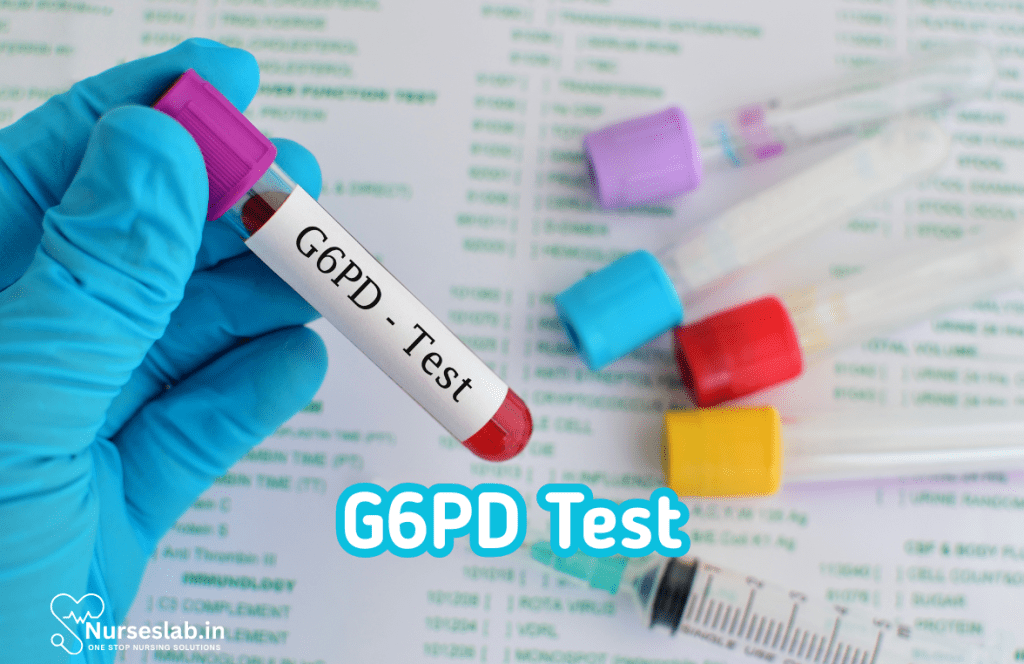
What Is G6PD Deficiency?:
G6PD deficiency is an X-linked hereditary disorder, resulting from mutations in the G6PD gene located on the X chromosome (Xq28). Males are more frequently affected due to hemizygosity, while females may present with variable phenotypes depending on the pattern of X-inactivation. Over 200 genetic variants of G6PD have been identified, each associated with varying levels of residual enzymatic activity.
Epidemiology of G6PD
Epidemiologically, G6PD deficiency affects approximately 400 million people globally. It is most prevalent in regions with historical or ongoing malaria transmission, including sub-Saharan Africa, the Mediterranean, the Middle East, South and Southeast Asia. The evolutionary advantage conferred by G6PD deficiency against Plasmodium falciparum malaria partially explains this distribution.
Pathophysiology of G6PD
Pathophysiologically, insufficient G6PD activity impairs NADPH generation, compromising the erythrocyte’s ability to detoxify reactive oxygen species. Exposure to oxidative stress—whether from infection, certain drugs, or foods—can precipitate acute haemolytic anaemia with symptoms ranging from mild fatigue to life-threatening anaemia, jaundice, and haemoglobinuria.
Purpose of the G6PD Test
The principal purpose of the G6PD test is to identify individuals with deficient enzyme activity who are at increased risk of haemolysis when exposed to specific triggers. This information is crucial for making informed decisions regarding the use of certain medications, such as antimalarials (primaquine), sulphonamides, nitrofurantoin, and dapsone, and for patient education concerning dietary and environmental exposures.
Populations at risk include neonates with unexplained jaundice, patients with suspected haemolytic anaemia, individuals from high-prevalence ethnic backgrounds, and those requiring medications known to provoke oxidative stress. Screening is also recommended prior to prescribing drugs with a known risk of haemolysis in G6PD-deficient individuals.
Types of G6PD Tests
G6PD testing methods fall into two broad categories: qualitative and quantitative assays.
Qualitative Assays
Qualitative assays, such as the fluorescent spot test, determine whether G6PD activity is sufficient to reduce NADP to NADPH, which fluoresces under ultraviolet light. These tests are rapid and suitable for screening but may lack sensitivity in detecting intermediate levels of deficiency and in heterozygous females.
Quantitative Assays
Quantitative spectrophotometric assays measure the rate of NADPH production, providing a precise value for G6PD activity, typically expressed in units per gram of haemoglobin (U/g Hb). These tests allow for classification of deficiency severity and are preferred for definitive diagnosis, especially in cases where accurate quantification is necessary.
Laboratory Methods
Laboratories may also employ molecular techniques to detect specific G6PD gene mutations, although these are generally reserved for research or population studies rather than routine clinical diagnostics.
Test Procedure
The standard G6PD test procedure begins with collection of a venous blood sample, typically in an ethylenediaminetetraacetic acid (EDTA) tube to prevent clotting. It is essential that samples are processed promptly, as delayed analysis or improper storage can lead to artifactual reduction in enzyme activity.
In the laboratory, haemolysate is prepared from the red blood cells, and the appropriate assay is conducted according to established protocols. Qualitative tests may be performed at the point of care, whereas quantitative assays require more complex instrumentation and trained personnel.
Careful attention to sample integrity, temperature control, and avoidance of haemolysis during collection are critical to ensure accurate results. Recent transfusion history must be considered, as donor erythrocytes may mask a deficiency in the recipient.
Clinical Indications
Clinical indications for G6PD testing include:
- Unexplained neonatal jaundice, particularly in populations with high prevalence of G6PD deficiency
- Acute haemolytic anaemia, especially following exposure to known triggers (e.g., certain drugs, fava beans, infections)
- Prior to initiation of medications with a risk of precipitating haemolysis in G6PD-deficient patients
- Screening in individuals from high-risk ethnic groups, especially males
- Family history of G6PD deficiency or related haemolytic events
Common triggers for haemolysis in G6PD-deficient individuals include:
- Infections (bacterial and viral)
- Drugs: antimalarials (primaquine), sulphonamides, dapsone, nitrofurantoin, aspirin (high doses)
- Foods: fava beans (favism)
- Environmental factors: naphthalene (mothballs)
Interpretation of Results
Interpretation of G6PD test results requires consideration of the reference ranges provided by the laboratory, which may vary depending on the assay and population studied. Generally, G6PD activity is categorised as:
- Normal: G6PD activity within the reference range; low risk of haemolysis
- Intermediate: Reduced activity, often seen in heterozygous females; potential risk depending on the degree of deficiency and exposure to triggers
- Deficient: Markedly reduced or absent G6PD activity; high risk of haemolytic episodes
A positive test (deficiency detected) necessitates clinical vigilance and management modification. In neonates, it may explain severe jaundice and guide phototherapy or exchange transfusion decisions. In adults, it informs safe prescribing and patient education.
False negatives may occur following recent blood transfusion, as donor red cells may have normal G6PD activity. Likewise, reticulocytosis following haemolysis can transiently elevate measured activity, obscuring the diagnosis. Repeat testing may be warranted in such scenarios.
Risks and Limitations
While G6PD testing is generally safe and reliable, several risks and limitations must be considered:
- Analytical errors: Sample mishandling, delayed processing, or improper storage may lead to inaccurate results
- Biological variability: Heterozygous females may exhibit intermediate or mosaic enzyme activity due to X-inactivation, complicating interpretation
- Recent transfusion: May mask true deficiency in recipients
- Reticulocytosis: Young erythrocytes have higher G6PD activity, potentially leading to false normal results after haemolytic episodes
- Assay limitations: Qualitative tests may not detect mild or intermediate deficiency; quantitative tests require specialised equipment and expertise
As with any diagnostic test, results must be interpreted in the clinical context, and repeat testing or alternative methods may be necessary in equivocal cases.
Implications for Patient Care
Identification of G6PD deficiency has significant implications for patient care, influencing management decisions, medication choices, and education strategies. Key aspects include:
- Medication avoidance: Patients with G6PD deficiency should avoid drugs known to precipitate haemolysis. Prescribers must consult updated lists of contraindicated medications.
- Dietary guidance: Avoidance of fava beans and other oxidative triggers is essential. Patient education should include recognition of foods and substances to avoid.
- Infection management: Prompt treatment of infections is necessary to minimise the risk of haemolytic crises.
- Neonatal care: Early recognition and management of jaundice can prevent kernicterus and other complications.
- Genetic counselling: Families affected by G6PD deficiency should receive information on inheritance patterns and implications for future offspring.
- Patient education: Clear communication regarding the nature of the deficiency, avoidance of triggers, and when to seek medical attention is vital to prevent adverse outcomes.
In acute haemolytic episodes, management includes withdrawal of the offending agent, supportive care, transfusion if necessary, and monitoring for complications. Long-term care focuses on prevention and education.
Nursing Care of a Patient Undergoing G6PD Test
The G6PD test is crucial for diagnosing patients susceptible to haemolytic anaemia, especially when exposed to specific drugs, foods, or infections. Nurses play a pivotal role in ensuring the safety, comfort, and well-being of patients undergoing this diagnostic procedure.
Pre-Test Nursing Care
Patient Assessment
Begin with a comprehensive assessment of the patient’s medical history, current symptoms, and risk factors. Note any previous episodes of jaundice, anaemia, or family history of G6PD deficiency. Assess for recent medication use, infections, or exposure to known triggers such as fava beans or certain chemicals.
- History Taking: Document any history of unexplained fatigue, pallor, dark urine, or jaundice.
- Drug History: Check for recent use of drugs that may precipitate haemolysis.
- Dietary History: Ask about consumption of foods like fava beans, which are known to trigger haemolysis in G6PD-deficient individuals.
Patient Preparation
Proper preparation helps reduce anxiety and ensures cooperation during blood sample collection.
- Explain the purpose and procedure of the G6PD test in simple terms, considering the patient’s educational and cultural background.
- Inform the patient that the test requires a blood sample and is generally safe, with minimal discomfort.
- Address any fears or misconceptions, particularly in children or anxious adults.
- Obtain informed consent, either written or verbal, as per institutional policy.
Special Considerations
In neonates or paediatric patients, extra care should be taken to ensure minimal distress. Use age-appropriate communication techniques and involve parents or guardians in the process.
During the Test: Nursing Responsibilities
Blood Sample Collection
The nurse’s role in sample collection is critical to ensure accuracy and prevent complications.
- Verify the patient’s identity using at least two identifiers (e.g., name and date of birth).
- Ensure the patient is comfortable and in a suitable position for venipuncture.
- Follow strict aseptic techniques to prevent infection.
- Choose an appropriate vein, preferably in the antecubital fossa for adults or heel prick for neonates.
- Collect the required volume of blood gently to avoid haemolysis of the sample.
- Label the sample accurately with patient details, date, and time of collection.
- Send the sample to the laboratory promptly to prevent degradation.
Monitoring and Support
Observe the patient for any signs of distress or adverse reactions during the procedure. Provide reassurance and support, especially for paediatric or anxious patients. In case of excessive bleeding or haematoma formation, apply pressure and seek medical advice if necessary.
Post-Test Nursing Care
Immediate Care
After blood collection, ensure the patient is comfortable and monitor the puncture site for bleeding or bruising.
- Apply a sterile dressing and advise the patient to keep the area clean and dry.
- Observe for any delayed reactions such as dizziness or fainting, especially in children or elderly patients.
Patient Education and Counselling
Education is a key component of nursing care for G6PD-deficient patients, especially after the test results are available.
- Result Interpretation: Explain the significance of the test results, whether normal or deficient. If the patient is found to be G6PD-deficient, provide detailed counselling about the condition.
- Prevention of Haemolysis: Instruct the patient to avoid known triggers such as certain drugs (e.g., primaquine, dapsone, sulphonamides), foods (especially fava beans), and exposure to naphthalene (found in mothballs).
- Recognition of Warning Signs: Teach the patient and family members to recognise symptoms of haemolytic anaemia, including sudden onset of pallor, jaundice, dark urine, fatigue, or shortness of breath.
- Emergency Action: Advise on immediate steps to take if symptoms occur, such as seeking medical attention and avoiding further exposure to triggers.
- Medication Alert: Encourage the patient to inform healthcare providers of their G6PD status before starting any new medication.
Documentation
Accurate documentation is essential for continuity of care.
- Record the procedure, patient’s response, and any adverse events in the medical record.
- Document patient education and counselling provided.
- Ensure test results are communicated to the treating physician and incorporated into the patient’s care plan.
Potential Complications and Nursing Interventions
While the G6PD test itself is low-risk, certain complications may arise in the context of the disorder.
- Haemolytic Crisis: If the patient presents with acute haemolysis, initiate supportive care as per protocol: maintain hydration, monitor vital signs, and prepare for possible blood transfusion.
- Infection Prevention: Maintain strict aseptic technique during blood collection to minimise the risk of infection.
- Psychological Support: Address anxiety and provide psychological support, especially for newly diagnosed patients and their families.
Role of the Nurse in Multidisciplinary Care
Nurses serve as a bridge between the patient, laboratory, and physician. Effective communication ensures timely diagnosis and management.
- Coordinate with laboratory personnel for accurate and timely processing of samples.
- Communicate test results promptly to the physician and assist in formulating the care plan.
- Participate in multidisciplinary meetings for complex cases requiring specialised input.
REFERENCES
- National Organization for Rare Disorders. Glucose-6-Phosphate Dehydrogenase Deficiency https://rarediseases.org/rare-diseases/glucose-6-phosphate-dehydrogenase-deficiency/
- TestID: G6PD: Glucose-6-phosphate dehydrogenase (G-6-PD), quantitative,erythrocytes: Clinical and interpretive. (n.d.).
https://www.mayomedicallaboratories.com/test-catalog/Clinical+and+Interpretive/8368 - KahnM, et al. (2017). Recombinant human G6PD for quality control and qualityassurance of novel point-of-care diagnostics for G6PD deficiency. DOI:
https://doi.org/10.1371/journal.pone.0177885 - U.S. National Institutes of Health, National Library of Medicine. G6PD Test. https://medlineplus.gov/lab-tests/g6pd-test/.
- Drlogy, G6PD Test To Check Blood Disorder and Anemia, https://www.drlogy.com/test/g6pd
Stories are the threads that bind us; through them, we understand each other, grow, and heal.
JOHN NOORD
Connect with “Nurses Lab Editorial Team”
I hope you found this information helpful. Do you have any questions or comments? Kindly write in comments section. Subscribe the Blog with your email so you can stay updated on upcoming events and the latest articles.


