


Last Updated on February 12, 2026 by Nurseslab.in Editorial Team
Pancreas tests measure digestive enzymes, hormones, and functional markers to assess pancreatic health. They help diagnose pancreatitis, pancreatic insufficiency, cystic fibrosis–related dysfunction, and other GI or endocrine disorders, supporting accurate clinical evaluation.
Introduction
The pancreas is a vital organ located in the abdomen, playing a central role in both the digestive and endocrine systems. It produces enzymes essential for digestion and hormones that regulate blood sugar. Disorders of the pancreas, such as pancreatitis, pancreatic cancer, and diabetes mellitus, can have serious health consequences. Accurate diagnosis and monitoring of pancreatic diseases rely on a variety of laboratory and imaging tests.
Anatomy and Function of the Pancreas
The pancreas is a glandular organ situated behind the stomach. It consists of two main components:
- Exocrine pancreas: Produces digestive enzymes (amylase, lipase, proteases) released into the small intestine via the pancreatic duct.
- Endocrine pancreas: Contains islets of Langerhans, which secrete hormones such as insulin, glucagon, and somatostatin into the bloodstream.
Disorders affecting either or both components can lead to a range of symptoms and complications, necessitating specific diagnostic tests.
Laboratory Tests for Pancreatic Function
1. Serum Amylase
Amylase is an enzyme produced by the pancreas and salivary glands, crucial for carbohydrate digestion. Elevated serum amylase levels are commonly associated with acute pancreatitis but can also rise due to other abdominal conditions such as perforated ulcers or intestinal obstruction.
- Procedure: Blood sample is collected and analyzed for amylase activity.
- Normal Range: Typically 30-110 U/L (may vary by laboratory).
- Interpretation: Levels more than three times the upper limit suggest acute pancreatitis, but mild elevations may not be specific.
- Limitations: Amylase levels return to normal within 2-3 days after an acute episode, and may not reflect chronic pancreatic disease.
2. Serum Lipase
Lipase is a pancreatic enzyme responsible for fat digestion. It is considered more specific for pancreatic disease than amylase.
- Procedure: Blood sample analyzed for lipase activity.
- Normal Range: 10-140 U/L (varies by laboratory).
- Interpretation: Elevated levels strongly indicate acute pancreatitis; lipase remains elevated longer than amylase.
- Advantages: Higher specificity for pancreatic disorders.
3. Blood Glucose
The endocrine function of the pancreas regulates blood glucose. Testing fasting and postprandial blood glucose helps assess pancreatic endocrine health.
- Procedure: Blood sample collected after fasting or following a glucose challenge.
- Interpretation: Elevated fasting glucose may indicate diabetes mellitus due to pancreatic dysfunction.
4. Fecal Elastase
Elastase is a pancreatic enzyme excreted in the stool. The fecal elastase test helps diagnose exocrine pancreatic insufficiency.
- Procedure: Stool sample is analyzed for elastase concentration.
- Normal Range: >200 mcg/g stool.
- Interpretation: Levels below 200 mcg/g suggest exocrine pancreatic insufficiency, often seen in chronic pancreatitis and cystic fibrosis.
5. Secretin Stimulation Test
Secretin is a hormone that stimulates the pancreas to release bicarbonate-rich fluid. This test assesses the pancreas’s exocrine response to secretin.
- Procedure: Secretin is administered intravenously, and duodenal fluid is collected via a tube for analysis of bicarbonate and enzyme content.
- Interpretation: Reduced bicarbonate output indicates exocrine pancreatic dysfunction.
- Limitations: Invasive and rarely used due to availability of non-invasive alternatives.
6. Glucose Tolerance Test (GTT)
The GTT evaluates the pancreas’s ability to regulate blood sugar through insulin secretion.
- Procedure: Patient consumes a glucose solution; blood samples are taken at intervals to measure glucose levels.
- Interpretation: Delayed glucose clearance may indicate diabetes due to pancreatic dysfunction.
7. Insulin and C-Peptide Levels
These tests help assess the pancreas’s ability to produce insulin.
- Procedure: Blood samples are analyzed for insulin and C-peptide concentrations.
- Interpretation: Abnormal levels can indicate insulinoma, type 1 or type 2 diabetes, or other endocrine disorders.
Imaging Tests for Pancreatic Evaluation
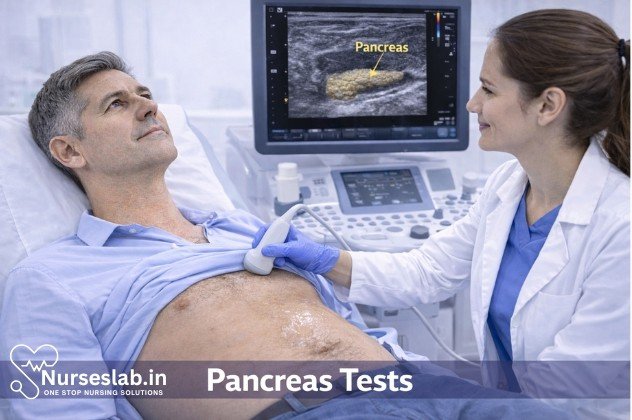
1. Abdominal Ultrasound
Ultrasound is a non-invasive imaging technique that uses sound waves to visualize the pancreas.
- Procedure: A transducer is placed on the abdomen to capture images.
- Uses: Useful for detecting pancreatic masses, cysts, ductal dilation, and changes suggestive of pancreatitis.
- Limitations: Pancreas may be obscured by bowel gas or obesity.
2. Computed Tomography (CT) Scan
CT scans provide detailed cross-sectional images of the abdomen and pancreas.
- Procedure: Patient lies in a CT scanner; contrast dye may be used to enhance images.
- Uses: Gold standard for diagnosing acute pancreatitis, detecting complications (necrosis, abscesses), and evaluating tumors.
3. Magnetic Resonance Imaging (MRI) and MRCP
MRI offers high-resolution images of soft tissues, while Magnetic Resonance Cholangiopancreatography (MRCP) visualizes pancreatic and biliary ducts.
- Procedure: Patient lies in an MRI scanner; MRCP uses specific sequences to highlight ducts.
- Uses: Helpful in diagnosing chronic pancreatitis, ductal obstructions, and cystic lesions.
4. Endoscopic Ultrasound (EUS)
EUS combines endoscopy and ultrasound to provide detailed images of the pancreas from within the digestive tract.
- Procedure: An endoscope with an ultrasound probe is inserted via the mouth into the stomach and duodenum.
- Uses: Highly sensitive for detecting small tumors, cysts, and evaluating chronic pancreatitis.
- Advantages: Enables fine-needle aspiration for biopsy.
5. Endoscopic Retrograde Cholangiopancreatography (ERCP)
ERCP is both a diagnostic and therapeutic procedure for pancreatic and biliary duct diseases.
- Procedure: Endoscope is advanced to the duodenum; contrast dye is injected into pancreatic and bile ducts, followed by X-rays.
- Uses: Detects ductal obstructions, stones, strictures, and allows interventions such as stent placement.
- Risks: May cause pancreatitis as a complication.
Specialized and Emerging Pancreatic Tests
1. Pancreatic Function Tests (Direct and Indirect)
Direct tests (such as secretin stimulation) measure the pancreas’s response to hormonal stimulation, while indirect tests (fecal fat quantification, serum markers) assess the effects of pancreatic insufficiency.
- Direct: Secretin, cholecystokinin stimulation tests.
- Indirect: Fecal fat analysis, breath tests for fat malabsorption.
2. Tumor Markers
Certain blood markers may suggest pancreatic cancer, though they are not definitive.
- CA 19-9: Elevated in many cases of pancreatic adenocarcinoma.
- Limitations: Not specific; may be elevated in other cancers or benign conditions.
3. Genetic and Molecular Tests
Genetic testing is increasingly used for hereditary pancreatitis, cystic fibrosis, and familial pancreatic cancer syndromes.
- Applications: Detect mutations in CFTR, PRSS1, SPINK1 genes.
- Uses: Guides diagnosis, prognosis, and management in selected patients.
Clinical Indications for Pancreas Testing
Pancreatic tests are ordered for a variety of clinical scenarios, including:
- Acute abdominal pain suggestive of pancreatitis
- Unexplained weight loss and malabsorption
- Jaundice and biliary obstruction
- Chronic diarrhea and steatorrhea
- Diabetes mellitus or hypoglycemia
- Suspected pancreatic neoplasms
- Family history of pancreatic disorders
Interpretation of Pancreatic Tests
Interpretation of pancreas tests must consider the clinical context, patient history, and other laboratory findings. For example:
- Elevated amylase and lipase with abdominal pain suggest acute pancreatitis.
- Low fecal elastase with steatorrhea indicates exocrine insufficiency.
- Imaging findings of masses or cysts may require biopsy for definitive diagnosis.
- Persistent hyperglycemia points towards endocrine dysfunction.
It is important to note that some tests lack specificity, and false positives and negatives can occur. Therefore, a combination of laboratory and imaging studies is often necessary for accurate diagnosis.
Limitations and Risks of Pancreatic Testing
While pancreatic tests are invaluable, they do have limitations:
- Laboratory tests: May be affected by renal function, medications, and other diseases.
- Imaging: May miss small lesions or be inconclusive due to technical factors.
- Procedures like ERCP: Carry risks including infection, bleeding, and pancreatitis.
- Tumor markers: Not sufficiently specific for cancer screening.
Nursing Care for Patients Undergoing Pancreas Testing Procedures
Pancreas testing procedures are varied and can include blood tests, imaging studies, and invasive interventions such as Endoscopic Retrograde Cholangiopancreatography (ERCP), Endoscopic Ultrasound (EUS), and pancreatic biopsy. The role of the nurse is pivotal throughout these procedures, ensuring patient safety, comfort, and optimal outcomes.
Pre-Procedure Nursing Care
Assessment and Preparation
Patient Assessment:
- Obtain a comprehensive medical history, including allergies (particularly to contrast media or sedatives), current medications, and previous reactions to anesthesia.
- Assess for bleeding disorders, renal insufficiency, and comorbidities that may influence the procedure.
- Evaluate baseline vital signs and document findings.
Patient Education:
- Explain the purpose, steps, and potential risks of the procedure in clear, simple language.
- Discuss fasting requirements, typically 6-8 hours prior to endoscopic or imaging procedures involving sedation or contrast.
- Review expected sensations (e.g., abdominal discomfort, bloating) and the need for cooperation during the procedure.
- Obtain informed consent, ensuring the patient (and family, where appropriate) understands the procedure and has had all questions answered.
Physical Preparation:
- Ensure the patient has fasted as prescribed.
- Insert an intravenous (IV) cannula for medication or contrast administration.
- Remove dentures, jewelry, and other personal items as necessary.
- Provide a hospital gown and assist with personal hygiene if needed.
Medication Management:
- Withhold or adjust medications as directed (e.g., anticoagulants may need to be paused).
- Administer premedications such as sedatives, antiemetics, or prophylactic antibiotics if prescribed.
Emotional Support:
- Address anxiety and fears by listening empathetically and providing reassurance.
- Encourage family involvement for support, if culturally appropriate.
Intra-Procedure Nursing Care
Role During the Procedure
- Monitoring and Safety:
- Monitor vital signs (heart rate, blood pressure, oxygen saturation, respirations) at regular intervals.
- Observe for signs of distress, allergic reactions, or complications such as hypotension or respiratory depression.
- Ensure emergency equipment (oxygen, suction, resuscitation cart) is immediately available.
Assistance to the Medical Team:
- Assist the physician during the procedure by preparing and handing instruments, managing specimens, and maintaining a sterile field.
- Help position the patient correctly (e.g., left lateral position for ERCP).
Patient Comfort:
- Provide reassurance throughout the procedure, updating the patient as appropriate.
- Administer sedation or analgesia as ordered, monitoring for efficacy and side effects.
Post-Procedure Nursing Care
Immediate Post-Procedure Management
Monitoring:
- Continue close monitoring of vital signs until the patient is stable and fully conscious (especially after sedation or anesthesia).
- Observe for early signs of complications, such as bleeding (hematemesis, melena), infection (fever, chills), pancreatitis (abdominal pain, vomiting), or allergic reactions.
- Assess the puncture site (if biopsy was performed) for bleeding or hematoma formation.
Pain Management:
- Evaluate pain using an appropriate scale and administer analgesics as prescribed.
- Provide non-pharmacological pain relief measures such as positioning and cold compresses if appropriate.
Hydration and Nutrition:
- Maintain NPO status until gag reflex returns and the patient is fully alert (commonly after endoscopy).
- Gradually reintroduce oral intake, starting with clear fluids, as tolerated and as per medical advice.
Patient Education and Discharge Planning:
- Instruct the patient on signs and symptoms of complications that require immediate medical attention (e.g., severe abdominal pain, persistent vomiting, fever, bleeding).
- Review medication instructions, dietary recommendations, and follow-up appointments.
- Provide written and verbal instructions to reinforce comprehension.
Documentation:
- Accurately document the procedure, medications administered, patient response, and any complications or interventions.
- Record teaching provided and the patient’s understanding.
Special Considerations in Pancreas Testing
Management of High-Risk Patients
- Patients with Diabetes:
- Monitor blood glucose closely, especially during periods of fasting.
- Adjust insulin or oral hypoglycemic agents as per protocol.
Patients with Renal Impairment:
- Assess renal function before administering contrast agents.
- Ensure adequate hydration to minimize nephrotoxicity risk.
Patients with Bleeding Disorders:
- Coordinate with the medical team regarding the management of anticoagulants and platelet function.
- Monitor for post-procedure bleeding more intensively.
Pediatric and Geriatric Considerations
- Pediatric Patients:
- Provide age-appropriate explanations and use comfort measures such as parental presence and distraction techniques.
- Monitor closely for dehydration and hypoglycemia.
Geriatric Patients:
- Assess for comorbidities and polypharmacy that may increase risk.
- Monitor for confusion or delirium post-sedation.
Potential Complications and Nursing Interventions
- Pancreatitis:
- Monitor for abdominal pain, nausea, vomiting, and elevated serum amylase/lipase.
- Report symptoms promptly and initiate supportive care as ordered (NPO, IV fluids, analgesia).
Bleeding:
- Assess for signs of gastrointestinal bleeding.
- Monitor hemoglobin/hematocrit and vital signs.
- Apply pressure to puncture sites and notify the physician of significant bleeding.
Infection:
- Monitor for fever, chills, and signs of local infection at puncture or IV sites.
- Follow aseptic technique rigorously during and after the procedure.
Allergic Reactions:
- Be prepared to manage anaphylaxis (airway management, epinephrine, fluids).
- Monitor for urticaria, bronchospasm, and hypotension.
Patient Advocacy and Ethical Considerations
Nurses serve as advocates for patient rights and dignity throughout pancreas testing procedures. This includes ensuring informed consent, respecting privacy and confidentiality, and supporting patient autonomy in decision-making. Cultural and linguistic needs should be addressed, providing interpreters or translated materials when necessary.
REFERENCES
- Crockett SD, Wani S, Gardner TB, Falck-Ytter Y, Barkun AN. American Gastroenterological Association Institute Guideline on Initial Management of Acute Pancreatitis. J Gastro. 2018:154(4):1096-1101. doi:10.1053/j.gastro.2018.01.032
- Feldman M, et al., eds. Sleisenger and Fordtran’s Gastrointestinal and Liver Disease: Pathophysiology, Diagnosis, Management. 11th ed. Elsevier; 2021. https://www.clinicalkey.com.
- Elsevier Point of Care. Clinical Overview: Acute pancreatitis. https://www.clinicalkey.com.
- National Institutes of Health. Blood tests for acute pancreatitis https://www.ncbi.nlm.nih.gov/pmc/articles/PMC4653980/.
- Boumitri C, Brown E, Kahaleh M. Necrotizing pancreatitis: current management and therapies. Clin Endosc. 2017 Jul;50(4):357-365. doi:10.5946/ce.2016.152
- The National Pancreas Foundation. Acute Pancreatitis Testing and Diagnosis https://pancreasfoundation.org/patient-information/acute-pancreatitis/acute-pancreatitis-testing-and-diagnosis/.
Stories are the threads that bind us; through them, we understand each other, grow, and heal.
JOHN NOORD
Connect with “Nurses Lab Editorial Team”
I hope you found this information helpful. Do you have any questions or comments? Kindly write in comments section. Subscribe the Blog with your email so you can stay updated on upcoming events and the latest articles.


