


Last Updated on February 13, 2026 by Nurseslab.in Editorial Team
A pathology report provides detailed laboratory analysis of tissue, cell, or fluid samples to diagnose diseases such as cancer, infections, and inflammatory conditions. It includes gross and microscopic findings, interpretations, and clinical correlations essential for treatment planning.
Introduction
This comprehensive pathology diagnostic test report has been prepared to provide a detailed evaluation of the submitted specimen from the patient, John Doe. The primary purpose of this diagnostic assessment is to identify potential pathological changes, inform clinical management, and guide further therapeutic decisions. The patient was referred for diagnostic evaluation following the presentation of unexplained clinical symptoms including persistent fatigue, mild fever, and weight loss. A thorough investigation was deemed necessary to rule out infectious, neoplastic, or autoimmune pathology.
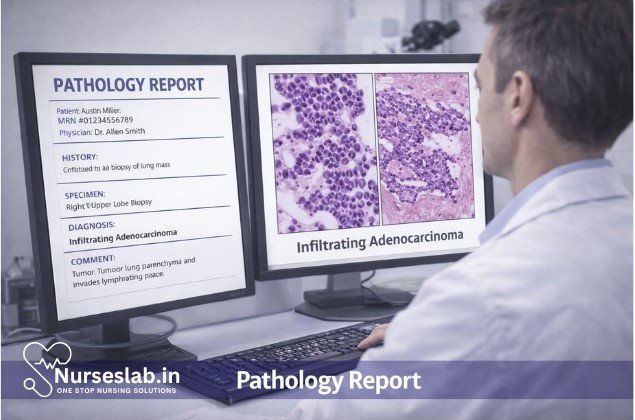
Pathology diagnostic testing is a cornerstone of modern medical practice, facilitating the accurate identification of disease processes through morphological, immunohistochemical, and molecular analyses.
Methodology
Specimen Collection
The specimen assessed in this report was obtained via ultrasound-guided core needle biopsy of the left axillary lymph node. The procedure was performed under sterile conditions, with the patient under local anaesthesia. A total of three core samples, each measuring approximately 1.5 cm in length, were collected and immediately placed in 10% neutral buffered formalin for fixation.
Test Procedures
Upon receipt in the pathology laboratory, specimens underwent standard processing, including dehydration, paraffin embedding, microtomy, and mounting on glass slides. The following diagnostic modalities were employed:
- Histopathological examination using haematoxylin and eosin (H&E) staining
- Immunohistochemical (IHC) analysis for markers including CD3, CD20, CD30, and Ki-67
- Molecular testing via polymerase chain reaction (PCR) for clonality assessment
- Special stains: Ziehl-Neelsen for acid-fast bacilli, PAS for fungal elements
Equipment Used
The diagnostic procedures utilised the following equipment:
- Leica RM2235 Microtome
- Olympus BX53 Light Microscope
- Ventana BenchMark ULTRA IHC Stainer
- ABI 7500 Real-Time PCR System
Results
Histopathological Findings
Microscopic examination of H&E-stained sections revealed effacement of normal lymph node architecture, replaced by sheets of atypical lymphoid cells. These cells exhibited enlarged nuclei, prominent nucleoli, and a moderate amount of pale cytoplasm. Occasional mitotic figures were present. No necrosis or granulomatous inflammation was identified.
Immunohistochemical Analysis
| Marker | Result | Interpretation |
| CD3 | Negative | T-cell lineage not supported |
| CD20 | Strongly Positive | B-cell lineage confirmed |
| CD30 | Negative | No evidence of Hodgkin lymphoma |
| Ki-67 | High (80%) | Elevated proliferative index |
Molecular Testing
PCR analysis demonstrated monoclonal immunoglobulin heavy chain gene rearrangement, supporting a clonal B-cell population. No evidence of Epstein-Barr virus DNA was detected.
Special Stain Results
- Ziehl-Neelsen: Negative for acid-fast bacilli
- PAS: Negative for fungal organisms
Summary of Findings
The cumulative findings reveal a lymph node infiltrated by a clonal population of atypical B-cells, with a high proliferative index and absence of infectious agents. The morphological and immunophenotypic profile is consistent with a diagnosis of diffuse large B-cell lymphoma (DLBCL).
Interpretation
The histopathological and immunohistochemical findings indicate a malignant lymphoproliferative disorder of B-cell origin. DLBCL is an aggressive non-Hodgkin lymphoma characterised by rapid growth and potential for systemic dissemination. The high Ki-67 index reflects robust cellular proliferation, correlating with the clinically observed rapid lymph node enlargement.
The absence of CD3 and CD30 expression excludes T-cell lymphoma and classic Hodgkin lymphoma, respectively. The lack of granulomatous inflammation, acid-fast bacilli, and fungal organisms rules out infectious etiologies such as tuberculosis and mycoses. Molecular confirmation of clonality further substantiates the diagnosis.
Discussion
Comparison with Literature
Diffuse large B-cell lymphoma accounts for approximately 30% of all non-Hodgkin lymphomas worldwide. It typically presents with rapidly enlarging lymphadenopathy and constitutional symptoms as seen in this patient. The diagnostic criteria outlined by the World Health Organization (WHO) are met in this case, including morphological features, immunophenotype (CD20+, high Ki-67), and molecular evidence of clonality.
Recent literature highlights the importance of early diagnosis and initiation of therapy, given the aggressive nature of DLBCL. Standard treatment protocols recommend combination immunochemotherapy, such as R-CHOP (rituximab, cyclophosphamide, doxorubicin, vincristine, prednisone), which has demonstrated significant survival benefit.
Limitations
It is important to acknowledge certain limitations inherent to the diagnostic process. Sampling error may occur if the biopsy does not capture representative tissue, though multiple cores were obtained in this case. Immunohistochemical interpretation can be affected by technical variability, and molecular results may be influenced by DNA quality. Additionally, the absence of cytogenetic analysis limits further subclassification of DLBCL subtypes (e.g., germinal centre vs. activated B-cell type).
Implications
The diagnosis of DLBCL has significant clinical implications, necessitating prompt and coordinated multidisciplinary management. The patient requires staging investigations, including PET-CT, to determine the extent of disease and guide therapeutic planning. Prognostic assessment using the International Prognostic Index (IPI) should also be undertaken.
Recommendations
- Refer the patient to haematology/oncology for initiation of R-CHOP chemotherapy regimen.
- Arrange for comprehensive staging with PET-CT and baseline laboratory investigations (CBC, LDH, renal and hepatic function).
- Assess for central nervous system involvement via lumbar puncture if clinically indicated.
- Monitor treatment response with interim and post-treatment imaging.
- Provide supportive care including infection prophylaxis and psychological support.
- Consider cytogenetic analysis for further prognostic stratification if resources permit.
Role of the Nurse in Handling Pathology Report Procedures
Nurses, as integral members of the multidisciplinary healthcare team, play a crucial role in managing pathology report procedures. Their responsibilities extend from ensuring timely communication to facilitating patient understanding and supporting clinical decision-making.
1.Receiving Pathology Reports
The initial step in the pathology report procedure involves the receipt and acknowledgment of the report. Nurses are often responsible for:
- Checking electronic health record (EHR) systems for incoming reports.
- Ensuring the correct patient identification to avoid mix-ups.
- Confirming that all relevant clinical information accompanies the report.
Timely receipt and verification are essential to prevent delays in patient care and to uphold safety standards.
2.Reviewing and Interpreting Pathology Reports
While nurses are not expected to make diagnoses based on pathology reports, they must be able to interpret key findings and understand the implications for patient care. This involves:
- Reading the report thoroughly to identify abnormal findings.
- Recognizing terminology and abbreviations commonly used in pathology.
- Clarifying unclear information with the pathologist or treating physician.
A nurse’s ability to interpret and contextualize pathology results ensures that the care team responds appropriately and promptly.
3.Communicating Results to the Care Team
Effective communication is a cornerstone of nursing practice. Nurses act as liaisons between pathologists, physicians, and other healthcare professionals. Their responsibilities include:
- Promptly notifying physicians of critical or abnormal results.
- Documenting communication actions in the patient’s records.
- Facilitating multidisciplinary meetings when complex pathology findings require collaborative decision-making.
By ensuring that pathology results are communicated efficiently, nurses help prevent delays in diagnosis and treatment.
4.Communicating Results to Patients and Families
Delivering pathology results to patients and their families is a sensitive task that requires compassion, clarity, and professionalism. Nurses may be responsible for:
- Explaining the significance of pathology findings in understandable language.
- Answering patient and family questions, or directing them to appropriate clinicians.
- Providing emotional support, especially when results indicate serious or life-changing diagnoses.
Nurses must balance honesty with empathy, recognizing the psychological impact of pathology results.
5.Facilitating Follow-Up Care
Pathology reports often lead to further investigations, treatment adjustments, or referrals. Nurses play a key role in:
- Coordinating appointments for additional tests or specialist consultations.
- Monitoring for side effects or complications related to new treatments.
- Educating patients about next steps, including preparation for procedures or lifestyle modifications.
By facilitating follow-up care, nurses help ensure continuity and comprehensiveness in patient management.
6.Ensuring Confidentiality and Ethical Practice
Adhering to ethical standards and maintaining patient confidentiality are paramount in handling pathology reports. Nurses must:
- Protect patient information by following hospital policies and legal requirements (e.g., HIPAA).
- Share pathology results only with authorized personnel.
- Obtain consent when discussing sensitive information with family members or caregivers.
Respect for patient privacy fosters trust and upholds professional integrity.
7.Documentation and Record Keeping
Accurate documentation is an essential aspect of nursing practice. When handling pathology reports, nurses should:
- Record the receipt and dissemination of pathology results in the patient chart.
- Note any communications with the patient, family, or other healthcare professionals.
- Track follow-up actions and outcomes related to the report findings.
Well-maintained records support legal compliance, quality assurance, and continuity of care.
8.Patient Advocacy and Support
Nurses serve as patient advocates, ensuring that individuals receive appropriate care based on pathology findings. This advocacy includes:
- Alerting the medical team if results appear to have been overlooked or misinterpreted.
- Facilitating second opinions or additional testing when warranted.
- Empowering patients to participate actively in their healthcare decisions.
Advocacy helps safeguard patient welfare and promotes patient-centered care.
9.Education and Continuous Professional Development
Continuous learning is vital for nurses to stay current with advancements in pathology and report management. Nurses should:
- Participate in ongoing training related to pathology procedures and terminology.
- Engage in interdisciplinary education to understand the perspectives of pathologists and physicians.
- Share knowledge with peers to improve collective competence in handling pathology reports.
A commitment to professional development enhances the quality and safety of patient care.
10.Managing Special Situations
Certain scenarios require additional nursing expertise when handling pathology reports. Examples include:
- Critical Results: Immediate action may be necessary for life-threatening findings, such as malignancies or severe infections.
- Pediatric Patients: Communicating with children and their families requires age-appropriate explanations and reassurance.
- End-of-Life Care: Pathology results may necessitate palliative interventions and sensitive discussions about prognosis.
Nurses must adapt their approach to meet the unique needs of each patient population.
11.Challenges and Solutions
Handling pathology report procedures is not without challenges. Common issues include:
- Delays in receiving reports due to laboratory backlogs.
- Complex or ambiguous findings that require further clarification.
- Emotional distress for patients and families upon receiving difficult news.
Nurses can address these challenges by:
- Establishing strong communication channels with laboratories and pathologists.
- Utilizing support resources such as counseling services and patient navigators.
- Advocating for system improvements to streamline report handling processes.
REFERENCES
- Kradin RL, Deshpande V, Iafrate AJ. General Principles in the Diagnosis of Infection. https://www.ncbi.nlm.nih.gov/pmc/articles/PMC7152079/ Diagnostic Pathology of Infectious Disease. 2018 Jul:3-15.
- Olthof PB, Metman MJH, de Krijger RR, Scheepers JJ, Roos D, Dekker JWT. Routine Pathology and Postoperative Follow-Up are Not Cost-Effective in Cholecystectomy for Benign Gallbladder Disease https://pubmed.ncbi.nlm.nih.gov/29696323/. World J Surg. 2018 Oct;42(10):3165-3170.
- College of American Pathologist, How to Read Your Pathology Report, https://www.yourpathologist.org/your-diagnosis/how-to-read-your-pathology-report/
- Altaleb, A. (2021). The Surgical Pathology Report Simplified. In: Altaleb, A. (eds) Surgical Pathology. Springer, Cham. https://doi.org/10.1007/978-3-030-53690-9_4
- National Cancer Institute (U.S.). Pathology Reports. https://www.cancer.gov/about-cancer/diagnosis-staging/diagnosis/pathology-reports-fact-sheet Reviewed 8/8/2022.
Stories are the threads that bind us; through them, we understand each other, grow, and heal.
JOHN NOORD
Connect with “Nurses Lab Editorial Team”
I hope you found this information helpful. Do you have any questions or comments? Kindly write in comments section. Subscribe the Blog with your email so you can stay updated on upcoming events and the latest articles.


