


Last Updated on February 13, 2026 by Nurseslab.in Editorial Team
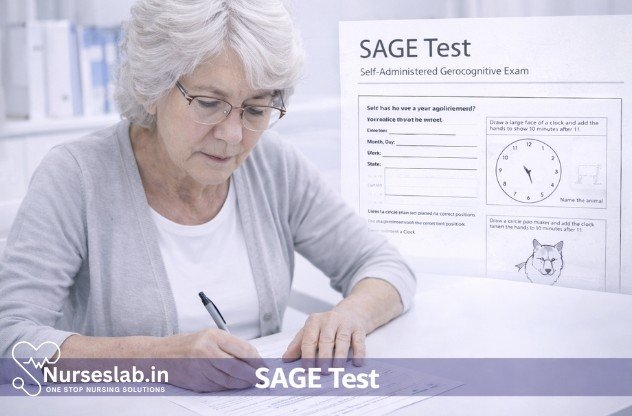
The SAGE test (Self‑Administered Gerocognitive Exam) is a brief cognitive screening tool that evaluates memory, problem‑solving, language, and thinking skills. It helps identify early cognitive impairment, dementia risk, and changes over time, supporting timely clinical evaluation.
Introduction
In the ever-evolving landscape of healthcare, early detection and assessment of cognitive impairment have become critical in improving patient outcomes, planning interventions, and supporting families. Among the various screening tools developed for this purpose, the Self-Administered Gerocognitive Examination (SAGE) test stands out for its accessibility, effectiveness, and innovative approach.
Background and Development
The SAGE test was developed at The Ohio State University Wexner Medical Center by Dr. Douglas Scharre and his research team. Its primary aim was to create an efficient, self-administered cognitive screening tool that could be used by individuals in the comfort of their own homes or in primary care settings. The need for such a tool arose from the increasing prevalence of dementia and other cognitive disorders, particularly as the global population ages.
Traditional cognitive assessments, such as the Mini-Mental State Examination (MMSE) or the Montreal Cognitive Assessment (MoCA), although effective, require administration by trained professionals and can be time-consuming. These limitations often result in delayed identification of cognitive impairment, as many individuals are hesitant to seek formal evaluation or may not have easy access to specialists. The SAGE test addresses these barriers by offering a simple, paper-based assessment that can be completed without medical supervision, thereby encouraging early detection and intervention.
Purpose and Objectives
The primary purpose of the SAGE test is to evaluate a person’s cognitive abilities and identify early signs of cognitive impairment, including mild cognitive impairment (MCI) and early dementia. Early identification is crucial, as it allows for timely medical evaluation, potential therapeutic interventions, planning for future care, and support for both patients and their families. Additionally, the SAGE test serves as a valuable tool for tracking cognitive changes over time, aiding in the monitoring of disease progression or response to treatments.
The objectives of the SAGE test can be summarized as follows:
- To provide a standardized, self-administered cognitive assessment tool.
- To facilitate early detection of cognitive impairment in community and primary care settings.
- To reduce barriers to cognitive screening, such as stigma, accessibility, and cost.
- To empower individuals to take proactive steps regarding their cognitive health.
- To assist healthcare providers in making informed decisions regarding further evaluation and management.
Structure and Content of the SAGE Test
The SAGE test is a brief, paper-and-pencil assessment that typically takes about 10 to 15 minutes to complete. It is designed for individuals aged 50 years and older, although it can be used in younger populations when cognitive concerns arise. The test is available in multiple forms to reduce the likelihood of practice effects if repeated over time.
The test comprises a variety of questions and tasks that assess multiple cognitive domains, including:
- Orientation: Questions related to date, month, year, and location.
- Language: Tasks involving naming objects, following written instructions, and verbal fluency.
- Memory: Recall of information, both immediate and delayed.
- Executive Function: Problem-solving, abstract thinking, and reasoning tasks.
- Visuospatial Skills: Tasks such as copying geometric figures or connecting dots in a sequence.
- Calculation: Simple arithmetic and number manipulation.
Each section is carefully designed to be culturally neutral and accessible to individuals with varying educational backgrounds. The SAGE test does not require computer use, making it suitable for older adults who may be less comfortable with technology.
Sample Questions and Tasks
To illustrate the diversity and scope of the SAGE test, here are examples of the types of questions and tasks included:
- Write today’s date and the name of the city you are in.
- Name the following objects shown in pictures.
- Draw a clock showing a specific time, such as 10 minutes past 11.
- Follow a three-step written instruction, such as “Fold this paper in half, put it on the floor, and pick it up.”
- Recall a list of words or a short story after a brief delay.
- Solve a simple math problem, such as subtracting serial sevens from 100.
These tasks provide a broad assessment of cognitive function, allowing for the detection of subtle changes that might indicate early impairment.
Administration and Scoring
One of the key features of the SAGE test is its self-administered nature. Individuals can download the test from the official Ohio State University website or receive it from their healthcare provider. The instructions are clear and straightforward, enabling most people to complete the test independently.
Upon completion, the test is reviewed and scored by a healthcare provider, typically a primary care physician, neurologist, or geriatric specialist. The scoring process is objective, with each correct response earning a point. The total score is then compared to established cutoffs that indicate normal cognition, mild cognitive impairment, or probable dementia.
Importantly, the SAGE test is not a diagnostic tool but rather a screening instrument. A low score suggests the need for further evaluation, which may include comprehensive neuropsychological testing, laboratory studies, and imaging.
Psychometric Properties and Validation
The SAGE test has undergone extensive validation in clinical studies. Research has demonstrated its reliability, validity, and sensitivity in detecting cognitive impairment. In one large study, the SAGE test correctly identified 79% of individuals with mild cognitive impairment and 95% of those with dementia, outperforming many traditional screening tools in community settings.
The test’s psychometric strengths include:
- High test-retest reliability, meaning that repeated administrations yield consistent results.
- Strong correlation with established cognitive assessments, such as the MMSE and MoCA.
- Minimal influence of age, education, or cultural background on test performance.
- Ease of use and accessibility, which increase the likelihood of widespread adoption.
Applications in Clinical Practice
The SAGE test has found widespread application in various clinical and community settings. Its ease of administration makes it ideal for use in primary care offices, senior centers, and even at home. Clinicians use the SAGE test to screen patients who present with memory complaints, confusion, or other cognitive concerns. It also serves as a valuable tool for monitoring cognitive changes over time, particularly in patients at risk for dementia or those with existing cognitive disorders.
Beyond the clinical setting, the SAGE test has been adopted by community organizations and advocacy groups to promote cognitive health awareness. Educational campaigns encourage individuals to take the test annually, similar to routine screenings for blood pressure or cholesterol. This proactive approach has the potential to shift the paradigm of dementia care from late-stage intervention to early detection and prevention.
Advantages of the SAGE Test
The popularity of the SAGE test can be attributed to several distinct advantages:
- Accessibility: The test is freely available online and can be completed at home, reducing barriers related to transportation, cost, and stigma.
- Self-Administration: Individuals can take the test without the need for a healthcare professional, empowering them to take charge of their cognitive health.
- Brevity: The test takes only 10 to 15 minutes, making it practical for use in busy clinical settings or as part of annual wellness visits.
- Comprehensive Coverage: By assessing multiple cognitive domains, the SAGE test provides a well-rounded picture of cognitive function.
- Minimally Affected by Education or Culture: The test’s design minimizes the impact of educational background or cultural differences, making it suitable for diverse populations.
Limitations and Considerations
Despite its many strengths, the SAGE test is not without limitations. It is important to recognize these in order to use the test effectively and interpret results appropriately.
- Screening Tool, Not a Diagnosis: The SAGE test is intended for screening purposes only. A low score should prompt further evaluation, not serve as a definitive diagnosis.
- Potential for Anxiety: Receiving a low score may cause anxiety or distress in individuals, underscoring the importance of follow-up support and counseling.
- Not Suitable for Severe Impairment: Individuals with significant visual, hearing, or motor impairments may be unable to complete the test accurately.
- Literacy Requirements: The test assumes a basic level of literacy in English, which may limit its use in certain populations.
- Potential for Practice Effects: Repeated administrations may result in improved scores due to familiarity, although the availability of multiple forms helps mitigate this issue.
Healthcare providers must interpret SAGE test results within the broader context of the individual’s medical history, current functioning, and other assessment data.
Comparisons with Other Cognitive Screening Tools
To fully appreciate the value of the SAGE test, it is helpful to compare it with other commonly used cognitive screening instruments.
- Mini-Mental State Examination (MMSE): The MMSE is widely used but has limitations related to educational bias and ceiling effects, making it less sensitive to early cognitive changes.
- Montreal Cognitive Assessment (MoCA): The MoCA is more sensitive to mild cognitive impairment but requires administration by a trained professional and is not self-administered.
- Saint Louis University Mental Status (SLUMS) Exam: Similar to the MoCA, the SLUMS exam is effective but requires professional administration.
- Clock Drawing Test: While useful, the clock drawing test focuses primarily on visuospatial and executive function and lacks the comprehensive assessment provided by the SAGE test.
The SAGE test occupies a unique niche as a comprehensive, self-administered tool, making it particularly valuable in community and primary care settings.
Ethical and Social Implications
The widespread availability of self-administered cognitive assessments like the SAGE test raises important ethical and social considerations. While early detection of cognitive impairment offers clear benefits, it also introduces challenges related to privacy, informed consent, and potential psychological impact.
Healthcare providers must ensure that individuals understand the purpose and limitations of the SAGE test. Support systems should be in place for those who receive concerning results, including access to counseling, further evaluation, and resources for care planning. Additionally, efforts should be made to protect the privacy and confidentiality of test results, particularly as more health data becomes digitized.
Nursing Care of Patients Undergoing SAGE Testing Procedure
SAGE is self-administered, nurses play a pivotal role in preparing the patient, facilitating the testing process, providing support, and ensuring accurate documentation and follow-up. The nurse’s involvement is essential in reducing patient anxiety, addressing barriers to testing, and ensuring the reliability of test results.
Pre-Procedure Nursing Care
Patient Assessment
Prior to SAGE testing, nurses should conduct a thorough assessment to determine the patient’s suitability for the procedure. Key elements of the assessment include:
- Medical History: Review for neurological, psychiatric, or sensory conditions that may affect test performance (e.g., stroke, vision or hearing impairments, depression).
- Medication Review: Identify medications that could influence cognitive function (e.g., sedatives, anticholinergics).
- Functional Status: Assess the patient’s ability to read, write, and use a pen or pencil, as SAGE is a written test.
- Language Proficiency: Ensure the test is administered in the patient’s preferred and proficient language.
Patient Education and Preparation
Education is vital to alleviate anxiety and ensure patient cooperation. Nurses should:
- Explain the purpose and importance of SAGE testing in simple, non-threatening terms.
- Clarify that the test is not an exam to “pass” or “fail” but a tool to help the healthcare team understand cognitive strengths and weaknesses.
- Describe the format, estimated time, and what to expect during the procedure.
- Address any questions or concerns the patient or family may have.
- Ensure the patient is comfortable, well-rested, and not hungry or in pain before the test.
Environmental Preparation
A quiet, well-lit, and private environment is essential for reliable SAGE testing. The nurse should:
- Minimize noise and distractions.
- Ensure the patient has the necessary visual or hearing aids.
- Provide a comfortable chair and work surface.
- Supply appropriate writing materials (sharp pencil, eraser, etc.).
Intra-Procedure Nursing Care
Facilitating the SAGE Test
Although SAGE is self-administered, the nurse’s presence is crucial for support and supervision. During the test, the nurse should:
- Hand the test to the patient and reiterate instructions clearly and calmly.
- Encourage the patient to take their time and answer all questions to the best of their ability.
- Refrain from coaching or providing answers, as this may invalidate the results.
- Monitor for signs of frustration, fatigue, or distress, and offer reassurance as needed.
- If the patient becomes overly anxious or upset, pause or reschedule the test as appropriate.
Special Considerations
- Patients with Disabilities: For patients with visual, hearing, or motor impairments, ensure appropriate accommodations, such as magnifying glasses, large-print tests, or adaptive writing tools.
- Language Barriers: Use translated versions of SAGE or involve an interpreter if necessary. Be attentive to cultural sensitivity in communication.
- Cognitive Fluctuations: If the patient has conditions like delirium or fluctuating cognition, consider rescheduling the test when they are at their baseline mental status.
Post-Procedure Nursing Care
Immediate Post-Test Care
After the test, nurses should:
- Thank the patient for their participation and effort.
- Assess the patient’s emotional response and provide support if they are anxious or upset about their performance.
- Document any difficulties, interruptions, or unusual behaviors observed during testing.
- Ensure that the completed test is properly labeled with the patient’s identifying information and delivered to the appropriate provider for scoring and interpretation.
Communication and Follow-Up
Clear communication with the patient and family after SAGE testing is essential. Nurses should:
- Inform the patient and family about when and how results will be discussed.
- Reinforce that SAGE is a screening tool and that further assessments may be needed.
- Provide educational materials on cognitive health and resources for support, if appropriate.
- Arrange follow-up appointments or referrals as directed by the healthcare provider.
Documentation and Legal Considerations
- Document the date and time of the SAGE test, patient’s baseline cognitive status, any pre-test education provided, and observations during the test.
- Note any deviations from standard procedures and reasons (e.g., accommodations for disabilities).
- Record the patient’s and family’s responses to the testing process.
- Ensure confidentiality of test results and comply with institutional policies regarding handling of sensitive information.
Patient and Family Support
Addressing Emotional Needs
Undergoing cognitive testing can be stressful for patients and their families. Nurses should be prepared to:
- Listen empathetically to concerns about memory loss and cognitive changes.
- Offer reassurance that cognitive changes can have many causes, some of which are reversible.
- Encourage open communication and involve family members in care planning when appropriate and with patient consent.
- Refer to counseling or mental health services if significant anxiety or depression is identified.
Education on Cognitive Health
- Provide information on lifestyle factors that support cognitive health, such as physical activity, social engagement, healthy diet, and mental stimulation.
- Discuss warning signs of cognitive decline and the importance of regular follow-up.
- Share community resources, support groups, and educational materials tailored to the patient’s needs and cultural background.
Interdisciplinary Collaboration
Optimal care for patients undergoing SAGE testing involves collaboration among nurses, physicians, psychologists, social workers, and other healthcare professionals. Nurses are key advocates for the patient, ensuring that test results are interpreted in context and that appropriate referrals and interventions follow.
Common Challenges and Solutions
Test Anxiety and Reluctance
Some patients may fear stigma or loss of independence if cognitive impairment is detected. Nurses can address these concerns by:
- Normalizing the testing process as a routine part of health care for older adults.
- Emphasizing the benefits of early detection and intervention.
- Building rapport and trust to reduce resistance.
Low Literacy or Language Barriers
Patients with limited literacy or proficiency in the test language may need additional support. Nurses should:
- Assess literacy levels before testing.
- Provide translated versions or use interpreters as needed.
- Advocate for alternative cognitive assessments when appropriate.
Physical or Sensory Impairments
When physical limitations are present, nurses can:
- Arrange for assistive devices and adaptive materials.
- Seek input from occupational therapy for patients with severe impairments.
- Document all accommodations made for accurate interpretation.
REFERENCES
- Kessels RPC, van Bergen FS, Harmsen IJ, et al. The Self-Administered Gerocognitive Examination (SAGE): Equivalence of Parallel Versions and Validity in Cognitively Unimpaired Controls and Patients With Mild Cognitive Impairment or Dementia in a Memory Clinic (https://pmc.ncbi.nlm.nih.gov/articles/PMC12101880/). Alzheimer Dis Assoc Disord. 2025 Apr-Jun 01;39(2):87-92.
- Scharre DW, Chang SI, Nagaraja HW, et al. Community cognitive screening using the Self-Administered Gerocognitive Examination (SAGE). J Neuropsychiatry Clin Neurosci. 2014;26(4):369-375. doi:10.1176/appi.neuropsych.13060145
- Scharre DW, Chang SI, Murden RA, et al. Self-administered gerocognitive examination (SAGE): a brief cognitive assessment Instrument for mild cognitive impairment (MCI) and early dementia. Alzheimer Dis Assoc Disord. 2010;24(1):64-71. doi:10.1097/WAD.0b013e3181b03277
- Scharre DW, Chang SI, Murden RA, et al. Self-administered Gerocognitive Examination (SAGE): a brief cognitive assessment Instrument for mild cognitive impairment (MCI) and early dementia (https://pubmed.ncbi.nlm.nih.gov/20220323/). Alzheimer Dis Assoc Disord. 2010 Jan-Mar;24(1):64-71.
- Sophie Bebeau, The SAGE Test: Detect Early Signs of Dementia with This Quick 15-minute Test on Tue Aug 05 2025. https://www.carewell.com/resources/blog/sage-test/
- Scharre DW, Chang SI, Nagaraja HN, et al. Digitally translated Self-Administered Gerocognitive Examination (eSAGE): relationship with its validated paper version, neuropsychological evaluations, and clinical assessments https://pmc.ncbi.nlm.nih.gov/articles/PMC5488440/. Alzheimers Res Ther. 2017 Jun 27;9(1):44.
Stories are the threads that bind us; through them, we understand each other, grow, and heal.
JOHN NOORD
Connect with “Nurses Lab Editorial Team”
I hope you found this information helpful. Do you have any questions or comments? Kindly write in comments section. Subscribe the Blog with your email so you can stay updated on upcoming events and the latest articles.


