


Last Updated on February 12, 2026 by Nurseslab.in Editorial Team
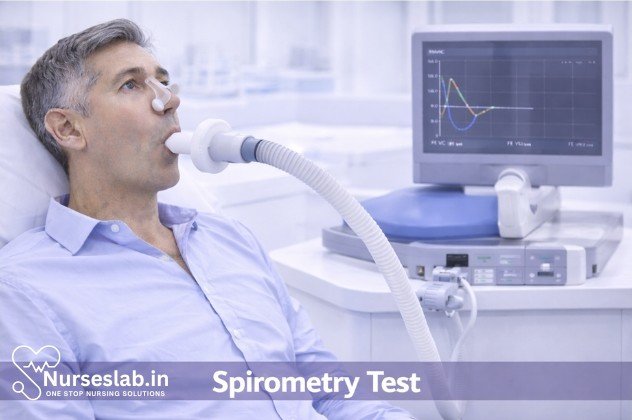
Spirometry is a key pulmonary function test that measures airflow, lung volumes, and breathing patterns. It helps diagnose and monitor asthma, COPD, restrictive lung disease, and other respiratory disorders, supporting accurate assessment and treatment planning.
Introduction
Spirometry is a cornerstone of pulmonary function testing, offering a non-invasive, objective, and quantitative assessment of lung function. Since its invention in the 19th century, spirometry has evolved considerably, becoming an indispensable tool in the diagnosis, evaluation, and management of respiratory diseases. Its widespread adoption is attributed to its simplicity, reproducibility, and diagnostic value.
Historical Context
The origins of spirometry can be traced back to John Hutchinson, who invented the spirometer in 1846. Hutchinson’s device enabled the measurement of vital capacity, sparking the systematic study of respiratory physiology. Over the decades, technological advancements have refined spirometry, expanding its clinical utility and improving accuracy. Today, spirometry is a standard diagnostic procedure in primary care and specialist respiratory clinics worldwide.
Importance in Clinical Practice
Spirometry provides essential information for the diagnosis and monitoring of respiratory diseases. It aids in distinguishing between obstructive and restrictive ventilatory defects, assessing disease severity, guiding treatment decisions, and evaluating response to therapy. Furthermore, spirometry is a key component in preoperative evaluation and occupational health assessments.
Purpose of Spirometry
Clinical Indications
Spirometry is indicated in a variety of clinical scenarios, including:
- Diagnosis of respiratory symptoms such as dyspnoea, chronic cough, or wheezing
- Screening for airflow obstruction in at-risk populations (e.g., smokers, occupational exposures)
- Monitoring disease progression in chronic respiratory conditions
- Assessing response to therapeutic interventions (e.g., bronchodilators, steroids)
- Preoperative risk assessment for pulmonary complications
- Evaluating fitness for work or exposure to respiratory hazards
Diseases Assessed by Spirometry
Spirometry is integral in the assessment of several respiratory conditions, including:
- Asthma
- Chronic Obstructive Pulmonary Disease (COPD)
- Restrictive lung diseases (e.g., interstitial lung disease, pulmonary fibrosis)
- Bronchiectasis
- Cystic fibrosis
- Neuromuscular disorders affecting respiratory muscles
Preparation for Spirometry
Patient Instructions
Proper patient preparation is crucial for obtaining reliable results. Patients should be provided with the following instructions:
- Avoid smoking for at least one hour before the test
- Refrain from consuming alcohol within four hours of the test
- Avoid vigorous exercise within 30 minutes prior to testing
- Wear loose, comfortable clothing that does not restrict chest movement
- Withhold short-acting bronchodilators for at least six hours and long-acting bronchodilators for 12–24 hours unless otherwise instructed by the clinician
- Inform the technician of any recent respiratory infections or acute illnesses
Contraindications
While spirometry is generally safe, certain conditions may preclude testing or necessitate caution:
- Recent myocardial infarction (within one month)
- Unstable angina
- Thoracic, abdominal, or eye surgery within the past six weeks
- Current pneumothorax
- Active hemoptysis of unknown origin
- Severe respiratory distress or inability to cooperate
Equipment and Methodology
Spirometer Types
Several types of spirometers are available, each with distinct mechanisms for measuring airflow and volume:
- Volume-displacement spirometers: Measure the volume of air displaced during breathing maneuvers (e.g., water-sealed, bellows, dry rolling seal spirometers).
- Flow-sensing spirometers: Assess airflow rates and calculate volume by integrating flow over time (e.g., pneumotachographs, turbine, ultrasonic spirometers).
- Digital spirometers: Incorporate electronic sensors and microprocessors for data acquisition, storage, and analysis.
Step-by-Step Spirometry Procedure
- Patient Identification and Consent: Confirm patient identity, explain the procedure, and obtain informed consent.
- Medical History Review: Screen for contraindications and ensure adherence to preparation guidelines.
- Positioning: Seat the patient upright with feet flat on the floor and back supported. Remove dentures if loose.
- Equipment Calibration: Ensure the spirometer is calibrated according to manufacturer specifications.
- Demonstration: The technician demonstrates the maneuver, emphasizing maximal effort and correct technique.
- Nose Clip Application: Apply a nose clip to prevent nasal air leak.
- Mouthpiece Placement: Instruct the patient to seal lips tightly around the mouthpiece.
- Forced Vital Capacity (FVC) Maneuver: The patient inhales maximally to total lung capacity, then exhales as forcefully and rapidly as possible to residual volume, followed by a maximal inspiration.
- Repetition: Perform at least three acceptable and reproducible maneuvers, allowing rest between attempts.
- Data Recording: Record and analyze the best results according to standard criteria.
- Post-Bronchodilator Testing (if indicated): Repeat spirometry 10–15 minutes after bronchodilator administration to assess reversibility.
Parameters Measured in Spirometry
Key spirometric parameters provide insight into various aspects of pulmonary function:
- Forced Vital Capacity (FVC): Total volume of air exhaled after a maximal inhalation.
- Forced Expiratory Volume in 1 Second (FEV1): Volume of air exhaled during the first second of the FVC maneuver.
- FEV1/FVC Ratio: Percentage of the FVC exhaled in the first second, crucial for distinguishing obstructive from restrictive patterns.
- Forced Expiratory Flow 25–75% (FEF25–75%): Average flow during the middle half of the FVC, reflecting small airway function.
- Peak Expiratory Flow (PEF): Maximum flow achieved during forced expiration.
- Other indices: FEV6, inspiratory capacity, and additional flow-volume loop parameters.
Interpretation of Results
Normal Values and Predicted Values
Interpretation relies on comparison with predicted normal values, which are derived from population studies and adjusted for age, sex, height, and ethnicity. The lower limit of normal (LLN), typically defined as the fifth percentile, helps distinguish abnormal from normal findings.
Patterns of Abnormality
- Obstructive Pattern: Characterised by a reduced FEV1/FVC ratio (< LLN), with or without a reduced FVC. Common in asthma, COPD, and bronchiectasis.
- Restrictive Pattern: Both FEV1 and FVC are reduced proportionally, so the FEV1/FVC ratio is normal or increased. Indicative of interstitial lung disease, chest wall disorders, or neuromuscular weakness.
- Mixed Pattern: Features of both obstruction and restriction, with reduced FEV1, FVC, and FEV1/FVC ratio.
Clinical Applications of Spirometry
Spirometry is invaluable in the diagnosis and management of numerous respiratory conditions:
- Asthma: Confirms reversible airflow obstruction, assesses severity, and monitors control.
- COPD: Essential for diagnosis, staging, and monitoring progression of disease.
- Other Respiratory Conditions: Identifies restrictive defects, monitors interstitial lung disease, and evaluates functional impact of neuromuscular disorders.
- Preoperative Assessment: Evaluates risk of postoperative pulmonary complications.
- Occupational Health: Screens for lung impairment in workers exposed to respiratory hazards.
Risks and Limitations of Spirometry
Potential Complications
Spirometry is generally safe, but minor complications may occur:
- Dizziness or light-headedness
- Coughing or bronchospasm
- Fatigue or chest discomfort
- Transient oxygen desaturation
- Rarely, syncope or cardiac arrhythmia in susceptible individuals
Test Limitations
Despite its utility, spirometry has inherent limitations:
- Requires patient cooperation and maximal effort, limiting use in young children, elderly, or cognitively impaired
- Cannot diagnose the underlying cause of an abnormal pattern without clinical correlation
- May underestimate or overestimate lung function if technique or calibration is suboptimal
- Not sensitive for early small airway disease or mild interstitial lung disease
- Contraindicated or unreliable in certain acute or unstable conditions
Quality Assurance in Spirometry
Calibration and Maintenance
Accurate spirometry requires regular calibration and maintenance of equipment. Calibration should be performed daily using a standardized syringe of known volume, and devices should be serviced according to manufacturer guidelines.
Reproducibility and Acceptability Criteria
Results are considered acceptable when three maneuvers meet the following criteria:
- Rapid start of exhalation with no hesitation or cough
- Exhalation duration of at least six seconds (or until plateau)
- Acceptable repeatability, with the two highest FVC and FEV1 values within 150 mL of each other
Technician Training
Technicians performing spirometry should receive formal training in test administration, patient coaching, troubleshooting, and infection control measures. Continuing education and periodic competency assessments are recommended to maintain high standards.
Nursing Care of Patients Undergoing Spirometry Diagnostic Procedure
Nurses play an essential role in ensuring the accuracy and safety of the spirometry procedure, as well as in providing holistic care to patients before, during, and after the test.
Nursing Responsibilities Before Spirometry
Patient Assessment
A thorough assessment is fundamental. Nurses should:
- Review the patient’s medical history, especially respiratory and cardiac conditions.
- Assess for contraindications and ensure the test is safe to perform.
- Obtain informed consent, explaining the purpose, procedure, risks, and benefits.
- Check for recent use of bronchodilators or other medications that may affect test results, and follow facility protocols regarding medication withholding.
- Evaluate for symptoms such as severe cough, chest pain, or hemoptysis.
Patient Preparation
- Instruct the patient to avoid heavy meals, smoking, vigorous exercise, and caffeine for a few hours before the test.
- Ensure the patient wears loose, comfortable clothing to facilitate deep breaths.
- Encourage the patient to empty their bladder before the procedure to reduce discomfort.
- Educate the patient about the test steps, emphasizing the importance of effort and cooperation for accurate results.
- Demonstrate the breathing technique, including full inhalation, tight mouth seal around the mouthpiece, and forceful exhalation.
Environment and Equipment Preparation
- Ensure the spirometer is calibrated and functioning correctly according to manufacturer and facility guidelines.
- Prepare disposable mouthpieces and nose clips to prevent air leakage and cross-contamination.
- Arrange for privacy and a quiet environment to reduce patient anxiety and distractions.
- Have tissues and a receptacle available for patient comfort and hygiene.
Nursing Care During Spirometry
Assisting with the Procedure
- Position the patient sitting upright, with feet flat on the floor and back straight, to optimize lung expansion.
- Apply a nose clip to prevent air escape through the nostrils.
- Instruct the patient to take a deep breath, seal their lips tightly around the mouthpiece, and exhale as forcefully and quickly as possible until no more air can be expelled.
- Monitor the patient for signs of distress, dizziness, or shortness of breath. Pause or stop the procedure if necessary.
- Encourage maximal effort and provide reassurance to alleviate anxiety.
- Repeat the test at least three times or until results are consistent, following standard protocols.
Infection Control
- Use disposable mouthpieces and nose clips whenever possible.
- Sanitize hands before and after the procedure.
- Clean and disinfect the spirometer and surrounding surfaces according to infection control policies.
- Dispose of single-use items properly.
Monitoring and Safety
- Continuously observe the patient for any adverse reactions, such as chest pain, severe coughing, or syncope.
- Be prepared to provide immediate assistance or call for medical help if complications arise.
- Document any incidents or deviations from protocol.
Nursing Care After Spirometry
Post-Procedure Monitoring
- Assess the patient for any delayed symptoms, such as lightheadedness, fatigue, or persistent cough.
- Allow the patient to rest if needed and provide reassurance.
- Offer water or tissues if the patient experiences throat dryness or coughing.
Patient Education and Follow-Up
- Discuss preliminary results if appropriate, but remind the patient that a physician will interpret the findings.
- Advise the patient on when to resume regular medications if any were withheld.
- Inform the patient of any further tests or appointments as directed by the healthcare provider.
- Provide education on maintaining lung health, such as smoking cessation, exercise, and adherence to prescribed therapies.
Documentation
- Record the date and time of the procedure, patient’s baseline and post-procedure vital signs, and any symptoms observed during or after the test.
- Document the patient’s cooperation, understanding, and any difficulties encountered.
- Include any instructions given to the patient and their response to the procedure.
Special Considerations in Nursing Care
Pediatric and Geriatric Patients
Children may require additional explanation, demonstrations, or the use of visual aids to ensure understanding. Patience and positive reinforcement are key. For elderly patients, consider comorbidities, cognitive status, and physical limitations. Adjust instructions and provide extra support as necessary.
Patients with Disabilities
Adapt the procedure for patients with hearing, speech, or mobility impairments. Use alternative communication methods, involve caregivers as appropriate, and ensure the environment is accessible.
Anxiety and Psychological Support
Many patients experience anxiety about diagnostic procedures. The nurse should adopt a calm, empathetic approach, provide clear explanations, and answer any questions to foster trust and compliance.
Potential Complications and Nursing Interventions
- Dizziness or Syncope: Stop the test, assist the patient to a safe position, and monitor vital signs.
- Bronchospasm: Recognize signs such as wheezing or increased respiratory effort, and notify the physician immediately.
- Fatigue or Hyperventilation: Allow the patient to rest between attempts, and provide reassurance.
- Chest Pain or Arrhythmia: Cease the test, monitor the patient, and seek urgent medical evaluation.
REFERENCES
- American Lung Association. What Is Spirometry and Why It is Done https://www.lung.org/lung-health-diseases/lung-procedures-and-tests/spirometry.
- Pulmonary function tests. National Heart, Lung, and Blood Institute. https://www.nhlbi.nih.gov/science/pulmonary-function-lab/tests.
- Fahy B, Sockrider M, Lareau S. Patient information series. Pulmonary function tests (https://pubmed.ncbi.nlm.nih.gov/24832755/). Am J Respir Crit Care Med. 2014;189:17-18.
- Broaddus VC, et al., eds. Pulmonary function testing: Interpretation and applications. In: Murray and Nadel’s Textbook of Respiratory Medicine. 7th ed. Elsevier; 2022. https://www.clinicalkey.com.
- Spirometry. American Academy of Allergy, Asthma & Immunology. https://www.aaaai.org/tools-for-the-public/conditions-library/asthma/spirometry.
- National Institutes of Health. What kind of lung function tests are there and what do they involve https://www.ncbi.nlm.nih.gov/books/NBK355303/)?
- Ranu H, Wilde M, Madden B. Pulmonary function tests https://www.ncbi.nlm.nih.gov/pmc/articles/PMC3229853/ . Ulster Med J. 2011;80(2):84-90.
Stories are the threads that bind us; through them, we understand each other, grow, and heal.
JOHN NOORD
Connect with “Nurses Lab Editorial Team”
I hope you found this information helpful. Do you have any questions or comments? Kindly write in comments section. Subscribe the Blog with your email so you can stay updated on upcoming events and the latest articles.


