


Last Updated on November 8, 2026 by Nurseslab.in Editorial Team
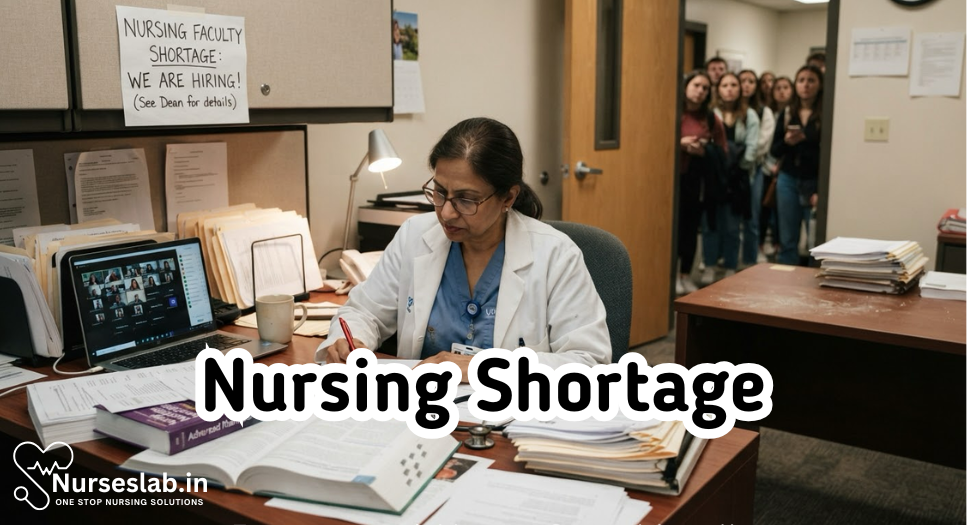
Explore the nursing faculty shortage, including its causes, impact on nursing education, student enrollment, workforce shortages, and potential solutions.
What It Means for Applicants
United States, 92,672 qualified applications to nursing programmes were turned away in a single year because there was nowhere to put the students.
In the United Kingdom, over roughly the same period, applications to study nursing fell by 35% in England and 34% across the UK, hitting a record low.
In India, policy analyses report that around 86% of faculty posts in nursing colleges stand vacant.
Three systems, three completely different symptoms — and underneath all of them, the same structural fact: the world does not have enough people to teach nursing. What differs is how that constraint surfaces, and therefore what an applicant should actually do about it.
The global baseline
WHO’s State of the World’s Nursing 2025 gives the authoritative picture, and the headline is genuinely mixed news.
| Measure | Figure |
|---|---|
| Global nursing workforce (2023) | 29.8 million, up from 27.9 million in 2018 |
| Global shortage (2023) | 5.8 million, down from 6.2 million in 2020 |
| Projected shortage by 2030 | 4.1 million |
| Distribution | 78% of the world’s nurses serve countries holding 49% of the global population |
| Foreign-born nurses | 1 in 7 worldwide |
| Nurses under 35 | 33% |
| Nurses expected to retire within 10 years | 19% |
So the workforce is growing and the shortage is shrinking. The problem is where the growth is happening.
The inequity is widening, not narrowing
- The African and Eastern Mediterranean regions are projected to carry nearly 70% of the global shortfall by 2030, up from 58% in 2020
- Africa’s nursing workforce is projected to grow only 7% between 2023 and 2030
- Nurse density: Africa has 14.1 nurses per 10,000 population; the European Region has 76.9 — more than five times as many
- Workforce size (2023): Western Pacific 8.5 million; Africa about 1.7 million; Eastern Mediterranean 1.3 million
- Entry-level wages are highest in Europe and the Eastern Mediterranean, lowest in Africa and South-East Asia
And a finding that goes directly to the education question: low-income countries are increasing nurse graduates faster than high-income countries — but population growth and limited job opportunities mean those extra graduates often do not improve nurse density at all.
Read that twice, because it overturns the intuitive model. In much of the world, the binding constraint is no longer only producing nurses. It is producing them well, employing them, and keeping them.
Why faculty is the choke point almost everywhere
Four drivers recur across systems, regardless of income level.
1. The pay differential between teaching and practising
This is the universal mechanism, and the US illustrates it most precisely because its data is the most complete:
| Role | Salary |
|---|---|
| Advanced practice registered nurse (median) | $134,920 |
| Master’s-prepared professor in a school of nursing | $82,762 |
A gap of roughly $52,000 — for a role requiring more education, often on a nine- or ten-month contract.
The same differential exists almost everywhere, and in lower-income countries it is frequently wider in relative terms, because the comparison is not teaching versus local practice. It is teaching versus practising abroad.
2. Migration drains the faculty tier specifically
This is the distinctly global driver, and it is routinely missed.
The nurses qualified to teach are precisely the nurses most able to emigrate. Faculty roles require postgraduate preparation, substantial clinical experience, and — in much of the world — strong English. That is an exact description of the most internationally marketable nurse in the world.
The migration figures show where they go. 1 in 7 nurses worldwide is foreign-born, but the distribution is stark:
| Country income group | Share of nurses who are foreign-born |
|---|---|
| High-income | 23% |
| Upper-middle-income | 8% |
| Low-income | 3% |
| Lower-middle-income | 1% |
Nearly a quarter of the nursing workforce in high-income countries was born elsewhere. Every one of those nurses was educated by a faculty member in their country of origin — and some of those faculty members left too.
So a country can expand its nursing schools and still lose ground, because the expansion competes for teachers against international salaries it cannot match. Building a nursing college does not create a nurse educator.
3. Ageing faculty, everywhere
Globally, 19% of nurses are expected to retire within ten years, and in 20 countries — mostly high-income — retirements are projected to outpace new entrants.
Faculty skew older than the clinical workforce by definition, because the role requires years of practice plus postgraduate study first. In the US, the proportion of nursing faculty aged 65 and over doubled from 16.9% in 2017 to 34.2% in 2024, with doctorally prepared professors averaging 60.2 years. Even assistant professors average nearly 49.
There is no large cohort of early-career faculty waiting behind them, in any system.
4. The postgraduate pipeline is narrow, and in places narrowing
Faculty roles require master’s or doctoral credentials. The pipeline producing them is constrained in different ways in different places:
- In the US, PhD enrolment has fallen for more than a decade — down 20.8% since 2013, from 5,145 to 4,077 students — even as BSN and master’s enrolment grew
- In India, postgraduate specialty courses reportedly struggle to attract students because employers do not recognise the qualification — a direct disincentive to acquiring the credential faculty posts require
- Across low-income countries, only 25% offer nursing leadership development programmes, against 66% globally and 78% in Europe
The common result: the credential required to teach is either unattractive, unrecognised, unaffordable, or unavailable.
Three patterns, three different applicant experiences
Here is the framework that makes the global picture usable. The same faculty shortage produces three distinct market conditions, and your strategy depends entirely on which one you are in.
Pattern 1 — Capacity-constrained
Where: United States, Canada, Australia, and many programmes across Western Europe
What it looks like: Strong applicant demand, insufficient seats. Qualified people are refused.
The US case: 92,672 qualified applications turned away in 2025; a 7.2% faculty vacancy rate; 1,588 unfilled full-time faculty posts across 863 schools, plus 150 more positions schools say they need. Meanwhile enrolment is rising — entry-level BSN up 4.9%, master’s up 4.8% — and the only level falling is the PhD that produces faculty.
Schools cite five limits: insufficient faculty, clinical placement sites, clinical preceptors, classroom space, and budget. For graduate programmes, the primary limits are faculty, preceptors, and clinical sites.
What it means for you: Admission is genuinely competitive. Being qualified is necessary and not sufficient. Rejection is frequently a statement about capacity rather than about you.
Pattern 2 — Demand-constrained
Where: United Kingdom, Ireland, parts of Scandinavia and Western Europe
What it looks like: Seats exist. Applicants are declining. The faculty shortage is masked because the student shortfall arrives first.
The UK case: applications to study nursing down 35% in England and 34% UK-wide between 2021 and the January 2025 UCAS deadline — a record low since UCAS began publishing in its current format. The Royal College of Nursing attributes this to a “broken model of education funding” leaving students in debt, compounded by low starting salaries, and calls for loan forgiveness for those committing to public service and uplifted maintenance grants.
What it means for you: Your admission odds are better than in Pattern 1 — but you must assess programme viability, not just entry requirements. Falling enrolment pressures university finances, which pressures course provision. Ask about the programme’s enrolment trend and institutional stability.
Pattern 3 — Infrastructure-constrained
Where: Much of Africa, South Asia, and parts of Southeast Asia and Latin America
What it looks like: Shortages of faculty, clinical sites, funding, and absorptive capacity simultaneously. Graduate numbers may be rising while nurse density does not.
The Indian case: roughly 86% of faculty posts vacant in nursing colleges and 80% in nursing schools; about 91% of institutions private and weakly regulated; around 62% concentrated in southern India; 1.7 nurses per 1,000 population, some 43% below the WHO norm, with roughly 2.4 million more nurses needed to meet it. The Indian Nursing Council Act of 1947 remains education-focused, offering little on scope of practice or standards of care.
The African picture: 14.1 nurses per 10,000 population; workforce projected to grow just 7% to 2030; the lowest entry wages alongside South-East Asia; leadership development available in only 43% of countries in the region.
What it means for you: The decisive question is not will I get a seat but is this institution actually capable of educating me. Verification work falls on the applicant.
What this means for applicants — by situation
If you are applying in a capacity-constrained system
1. Apply broadly, across selectivity tiers. Tens of thousands of qualified applications are declined annually. One application is not a strategy.
2. Use geography. In the US, faculty vacancy rates have been lowest in the Midwest and South, highest in the West and North Atlantic. Willingness to relocate materially improves your odds. The same logic applies within most countries: regional programmes with an established local health-system relationship face less placement competition than urban programmes competing with several schools for the same wards.
3. Optimise what capacity constraints make decisive. When a programme admits 60 of 400 qualified applicants, margins decide:
- Prerequisite science GPA — anatomy and physiology, microbiology, chemistry. Retaking a weak grade is often the highest-value single action
- Entrance exam scores (TEAS, HESI A2, or local equivalent) — learnable, heavily weighted, usually under-prepared for
- Direct patient-care experience — nursing assistant, patient care technician, EMT, phlebotomy
- A specific personal statement naming the experience, the population, and the intent
- Complete, early applications — many programmes use rolling or priority deadlines
4. Use the alternative entry routes deliberately. Diploma or associate-level entry followed by a degree top-up; accelerated programmes for existing graduates; direct-entry master’s for career changers; enrolled-nurse-to-registered-nurse bridges. These are frequently less constrained. Compare them on outcomes — accreditation, licensure pass rates, placement arrangements — not on speed of admission.
5. If waitlisted, use the year. Raise the science GPA, retake the entrance exam properly, get a patient-care role, widen your application list, and ask admissions directly what would strengthen your file. Most will tell you.
If you are applying in a demand-constrained system
1. Recognise your leverage — and still do the diligence. Easier admission does not mean better education.
2. Ask about programme and institutional stability. Falling applications strain university finances. Ask about enrolment trends, whether the programme has merged or restructured recently, and how secure its clinical contracts are.
3. Investigate the real cost. Where the RCN identifies student debt and low starting salaries as the cause of declining applications, those same factors will shape your own experience. Check bursaries, maintenance grants, and any service-commitment loan forgiveness available to you.
4. Check staffing honestly. A demand-constrained system still has a faculty shortage — it is simply hidden behind the enrolment shortfall. Ask the student-to-faculty ratio in clinical placements.
If you are applying in an infrastructure-constrained system
1. Verify regulatory recognition yourself. Confirm the institution’s current standing with the national regulator directly, not from the prospectus. Where the large majority of institutions are private and regulation is uneven, this is the single most important step you will take.
2. Ask who actually teaches, by name and qualification. In a system with very high faculty vacancy, posts may be filled nominally, or staff stretched across several roles and institutions. Ask how many full-time qualified faculty the programme has for your cohort size.
3. Interrogate clinical exposure specifically. Which hospitals, what patient volume, how many supervised hours, what supervision ratio. This is where under-resourced programmes cut first and most, and it is what determines whether you can actually practise at the end.
4. Check employer and licensing recognition before you enrol — particularly for postgraduate qualifications. If employers do not recognise a credential, it will not advance your career no matter what it cost you.
5. Visit, and talk to current students — not the ones the admissions office selects for you.
If you intend to train in one country and work in another
This applies to a very large share of the world’s nursing students, and it changes the calculus more than anything else in this post.
1. Work backwards from the destination regulator.
Before you enrol anywhere, identify the regulator in the country you intend to work in and read its requirements for internationally educated nurses. Your programme must satisfy that body, not just your national one. The relevant gatekeepers include the NCLEX for the United States and Canada, the NMC for the United Kingdom, AHPRA for Australia, and the respective health authority licensing examinations across the Gulf states. Requirements change — verify current ones directly with the regulator.
2. Check programme duration, content, and hours against destination standards.
Internationally educated nurses are commonly refused or delayed over insufficient clinical hours, missing content areas (frequently mental health or obstetric components), or programme length. A qualification perfectly valid at home can fail credential verification abroad. Confirm this before enrolment, not after graduation.
3. Confirm the institution will exist and respond in ten years.
Credential verification requires your school to supply transcripts, syllabi, and hour breakdowns on request, sometimes long after you graduate. Weakly regulated private institutions close. Ask how they handle verification requests.
4. Plan English language testing early.
IELTS or OET requirements are a frequent and entirely avoidable source of delay.
5. Understand the ethical recruitment landscape — because it may affect your route. WHO’s Health Workforce Support and Safeguards List identifies countries facing the most pressing workforce challenges, where active international recruitment is discouraged and investment should be prioritised. The provisional 2026 update lists 36 countries — those with a UHC service coverage index below 50 and fewer than 50 doctors, nurses and midwives per 10,000 population. Regional breakdown: 27 in the African Region, 5 Eastern Mediterranean, 2 Western Pacific, 1 Americas, 1 South-East Asia.
Critically, and this is widely misunderstood: the Code and the list do not restrict an individual health worker’s freedom to migrate where they are lawfully admitted. They constrain active recruitment campaigns by destination countries and employers, and steer them toward government-to-government agreements. If you are from a listed country, you retain your right to move. What may change is the recruitment pathway available to you — so apply through regulated, transparent channels and be sceptical of agencies charging large fees.
The other side: if you are thinking of teaching
Every figure in this post that reads as an obstacle for applicants reads as an opening for prospective faculty — and this is among the most under-discussed career opportunities in global nursing.
The demand is documented. In the US alone: 1,588 unfilled full-time faculty posts, plus 150 more schools say they need, with a third of current faculty at retirement age and a shrinking doctoral pipeline behind them. In India, with the large majority of faculty posts reportedly vacant, the scale is of a different order entirely.
The trade-off is the pay gap, and it should be weighed with the actual number in view: $82,762 against $134,920 in US advanced practice, and in many countries a far wider gap against practising abroad.
What partly offsets it:
- Loan forgiveness and nurse faculty loan programmes in several countries
- Employer tuition support for faculty pursuing doctorates
- Academic calendars and schedule autonomy
- Combining part-time teaching with clinical practice — increasingly common, and usually the best financial compromise
- Benefits, pension contributions, and tuition remission that salary comparisons omit
The lowest-risk entry point is adjunct or part-time clinical instruction while remaining in practice. It is how most faculty actually start, and it lets you test the work before committing to a doctorate.
There is also a strategic argument worth naming. In systems losing nurses to migration, a single faculty member who stays produces dozens of nurses who might otherwise never have been trained. That is not a sentimental point; it is the highest-leverage position in a constrained health system.
What is being done globally
WHO’s recommendations in State of the World’s Nursing 2025 are specific, and notably they do not stop at “train more nurses”:
- Strengthen domestic education systems and align qualifications with clearly defined roles
- Create jobs so graduates are actually hired and integrated — because graduate growth without employment does not improve nurse density
- Expand advanced practice nursing roles and develop regulation; these now exist in 62% of countries, up from 53% in 2020
- Expand leadership development, currently in 66% of countries but only 25% of low-income countries
- Address working conditions, pay equity, and mental health support — only 42% of responding countries have provisions for nurses’ mental health
Alongside these: ethical recruitment governance through the WHO Global Code and the Support and Safeguards List; academic–practice partnerships in which health systems fund faculty posts and guarantee placements; expanded regulatory acceptance of simulation to stretch limited clinical capacity; and centralised application systems to match applicants to unfilled seats in less-subscribed programmes.
None of these closes the teaching-versus-practising pay gap, which remains the structural core. Expect this constraint to persist across the next several application cycles, in every pattern.
WHO figures are from State of the World’s Nursing 2025, reporting 2023 data. AACN figures count applications rather than individual applicants and reflect surveyed schools at stated response rates. Indian faculty vacancy figures derive from policy analysis rather than a national census and should be read as indicative of scale. The 2026 Support and Safeguards List was provisional at the time of writing. Licensure and credential-verification requirements change frequently — always confirm current requirements directly with the relevant regulator.
REFERENCES
- State of the World’s Nursing 2025 — World Health Organization
- WHO report warns of worsening global nursing shortage; Africa and Eastern Mediterranean to bear 70% of shortfall — Down To Earth
- WHO Health Workforce Support and Safeguards List — 2026 provisional update
- Nursing Faculty Shortage Fact Sheet — American Association of Colleges of Nursing
- Schools of Nursing Enrollment Increases Across Most Program Levels — AACN
- UCAS figures a hammer blow as applications to study nursing hit new low — Royal College of Nursing
- A Sector That Needs to Be Nursed Back to Health: Nursing Education in India — Shankar IAS
Stories are the threads that bind us; through them, we understand each other, grow, and heal.
JOHN NOORD
Connect with “Nurses Lab Editorial Team”
I hope you found this information helpful. Do you have any questions or comments? Kindly write in comments section. Subscribe the Blog with your email so you can stay updated on upcoming events and the latest articles.


