


Last Updated on November 20, 2025 by Nurseslab.in Editorial Team
Hearing loss is a common medical condition affecting people of all ages with numerous causes.
There are three types of hearing loss:
- Sensorineural: This is the most common type of hearing loss and occurs when there is damage to the inner ear or the hearing nerve. Aging, injury, disease, medications, and loud noise exposure are potential causes. This type cannot be treated medically or surgically, but patients can benefit from using hearing aids.
- Conductive: This type of hearing loss occurs in the middle or outer ear, affecting how the sound waves are carried toward the inner ear. This may be caused by an obstruction in the ear canal, impacted middle ear, infection, bone abnormality, or injury to the eardrum and may be corrected medically or surgically.
- Mixed: Some patients with hearing loss may be affected by sensorineural and conductive hearing loss.
Clinical manifestations of hearing loss include the following:
- Difficulty understanding words
- Muffling of speech
- Trouble hearing consonants
- Frequently asking others to repeat themselves
- Needing to increase the television volume
- Withdrawal from conversations
- Social isolation
Hearing loss is diagnosed through a physical examination, general hearing screening test, tuning fork tests, and audiometer tests.
Nursing Process
Nursing care for patients with hearing loss focuses more on cerumen management to reduce hearing impairment and the use of hearing aids and patient education to help prevent complications, promote recovery, and enable effective communication.
Nursing Assessment
Effective nursing assessment and intervention are crucial in managing hearing loss to promote patient well-being and prevent further complications.
Initial Evaluation
The initial evaluation of a patient with suspected hearing loss involves a detailed medical history, physical examination, and diagnostic tests. Key aspects to assess include:
Medical History
Review the patient’s history for risk factors such as prolonged noise exposure, ototoxic medications, recurrent ear infections, and family history of hearing loss. Inquire about symptoms such as difficulty hearing conversations, tinnitus, vertigo, and ear pain.
Physical Examination
Perform a comprehensive physical examination focusing on the ears and related structures. Look for signs of ear canal obstruction, middle ear effusion, and abnormalities in the tympanic membrane. Assess the patient’s ability to hear different frequencies and volumes using a tuning fork or audiometer.
Diagnostic Tests
Obtain baseline audiometric tests, including pure-tone audiometry, speech audiometry, and tympanometry. These tests help determine the type and severity of hearing loss and guide further management.
Nursing Interventions
By identifying the underlying causes, implementing appropriate treatments, and providing comprehensive patient education, nurses can help patients maintain their hearing health and enhance their quality of life.

Medical Management
The management of hearing loss depends on the underlying cause and may include medical, surgical, and rehabilitative interventions. Key interventions include:
Medical Treatments
– Administer medications to treat underlying infections or inflammations contributing to hearing loss.
– Prescribe ototoxic medications with caution and monitor patients for signs of hearing impairment.
– Recommend hearing aids or other assistive listening devices to enhance communication abilities.
Surgical Interventions
– Refer patients with conductive hearing loss due to structural abnormalities or chronic infections to an otolaryngologist for evaluation and potential surgical intervention, such as tympanoplasty or cochlear implants.
Rehabilitation
– Encourage patients to attend auditory rehabilitation sessions to improve listening and communication skills.
– Provide resources and support for patients and their families to adapt to hearing loss, including education on lip-reading and sign language.
Patient Education
– Educate patients on the importance of protecting their hearing from further damage by avoiding loud noises and using ear protection.
– Inform patients about the potential benefits of hearing aids and other assistive devices and provide guidance on their proper use and maintenance.
Follow-up Care
– Schedule regular follow-up appointments to monitor the patient’s progress, adjust treatment plans, and address any emerging symptoms or complications.
– Encourage the patient to maintain a hearing health diary, recording any changes in hearing and the effectiveness of interventions, to facilitate ongoing evaluation and adjustment of treatments.
Nursing Care Plans
Once the nurse identifies nursing diagnoses for hearing loss, nursing care plans help prioritize assessments and interventions for both short and long-term goals of care. In the following section, you will find nursing care plan examples for hearing loss.
Chronic Low Self-Esteem
Patients with hearing loss may have significantly low self-esteem due to their impaired ability to communicate with others.
Related to:
- Disturbed body image
- Fear of rejection
- Vulnerability
- Inadequate sense of belonging
- Inadequate social support
- Ineffective communication skills
- Insufficient approval from others
As evidenced by:
- Depressive symptoms
- Excessive seeking of reassurance
- Expresses loneliness
- Hopelessness
- Reduced eye contact
- Self-negating verbalizations
- Shame
- Underestimates their ability to deal with the situation
- Isolates self
- Nonassertive/passive
Expected outcomes:
- Patient will show an improved ability to interact with other people.
- Patient will demonstrate self-acceptance and attempt to communicate with others.
Assessment:
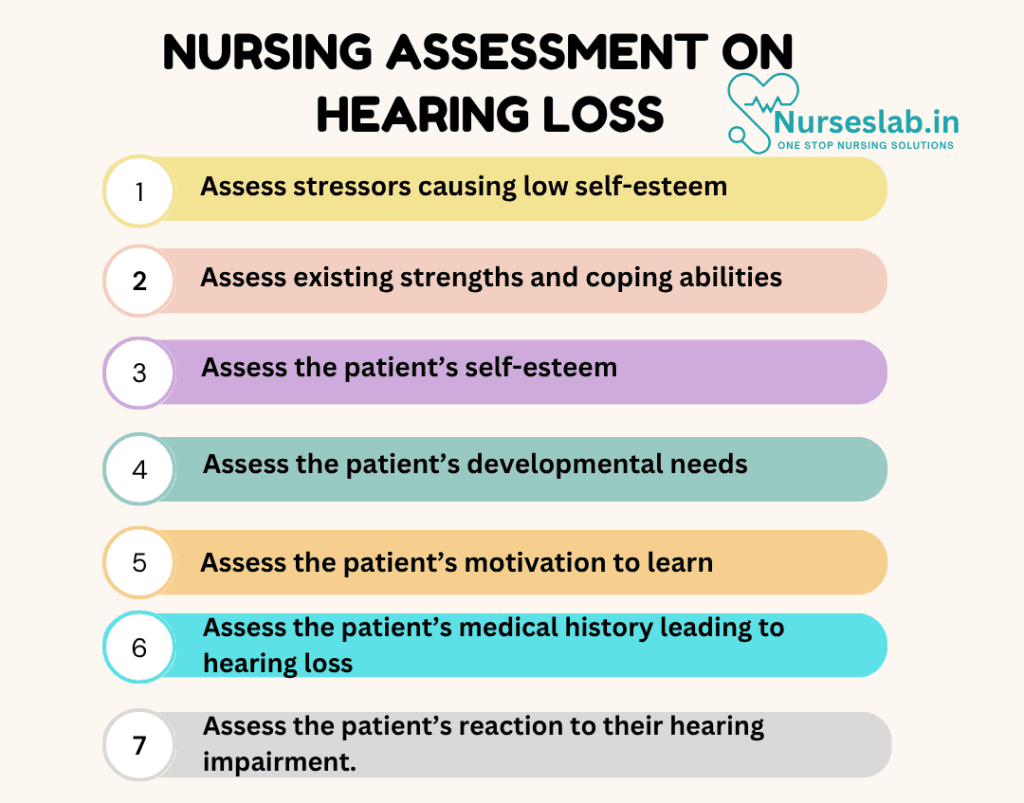
1. Assess stressors causing low self-esteem.
Psychological and physical stressors like hearing loss can cause the patient to feel insecure about themselves and communicating with others.
2. Assess existing strengths and coping abilities.
Hearing loss can significantly decrease the patient’s self-esteem causing anxiety and depression. Assess the patient’s coping abilities to their perceived limitation.
3. Assess the patient’s self-esteem.
Low self-esteem can manifest as insecurity, self-care deficits, inadequacy, nonadherence to the treatment regimen, isolation, and withdrawal from social relationships.
Interventions:
1. Use therapeutic communication.
Therapeutic communication techniques such as maintaining eye contact, listening, offering time, and validating the patient’s experiences promote trust and ongoing communication.
2. Help the patient recognize their strengths.
Acknowledging positive strengths and coping abilities to manage hearing loss can help boost the patient’s self-esteem.
3. Refer the patient to group therapies and support groups.
Support and community groups for hearing impairments provide the patient with emotional and social support enabling acceptance and promoting confidence.
4. Encourage socialization.
Once the patient becomes comfortable, encourage activities that promote ongoing socialization where talking isn’t the primary goal, such as quiet craft events or outdoor activities.
Deficient Knowledge
Lack of accurate information about hearing loss and its management can cause psychosocial and physiological complications.
Related to:
- Misinformation
- Inadequate commitment to learning
- Inadequate information about hearing loss
- Lack of available sources of information
- Inadequate knowledge of resources
- Inadequate participation in care planning
As evidenced by:
- Inaccurate follow-through of instructions
- Inaccurate statements about hearing loss
- Lack of motivation to change
- Development of poor social or language skills in children
- Nonadherence with hearing devices
Expected outcomes:
- Patient will actively participate in the care plan to manage hearing loss.
- Patient will utilize devices and tools to increase hearing ability.
Assessment:
1. Inquire about the patient’s attempts to correct their hearing loss.
It is helpful to assess what the patient has tried to correct their hearing loss, such as technological devices, surgery, or specialist care, so the nurse does not duplicate interventions.
2. Assess the patient’s developmental needs.
Hearing loss can affect people of all ages, and patient education must be developed according to the patient’s developmental needs. Children may require more intense support and resources.
3. Assess the patient’s motivation to learn.
Assess if the patient is interested in advanced technology or working with a specialist to improve their hearing.
Interventions:
1. Educate on tips to improve hearing abilities:
- Remove background noise
- Remind people not to yell but to speak clearly
- Be upfront about your hearing loss and explain how you hear best
- In a loud setting, such as a restaurant, ask to be seated in a quieter area
- Ask a friend to relay important information
- Focus on one person at a time instead of a group
- Turn on closed-captioning on the television
2. Refer the patient to a speech therapist or audiologist.
A speech therapist can help children develop their speech and language around hearing loss. An audiologist is integral in assessing hearing loss and recommending devices such as hearing aids or cochlear implants.
3. Teach the patient alternative communication techniques.
Children can be taught sign language at a young age. Amplifiers can increase sound volume while eliminating background noise. Text telephones can allow typing of messages instead of voice calls.
4. Recommend organizations and resources.
Schools for the deaf, the Hearing Loss Association of America, and community resources help adults and children learn about hearing loss and available technologies.
Impaired Verbal Communication
Hearing loss can affect a patient’s verbal communication as they have difficulty understanding spoken words, especially when there is background noise. Hearing loss affects mainly speech perception rather than speech production in adults. In children, it can affect the child’s speech development and language skills.
Related to:
- Hearing loss
- Inability to hear audibly
- Disease process
- Low self-esteem
- Impacted cerumen
- Inner ear abnormality
- Fluid in the ear
- Frequent ear infections
- Perceived vulnerability
- Psychological barriers
As evidenced by:
- Alternative communication
- Difficulty comprehending communication
- Difficulty establishing social interaction
- Difficulty maintaining communication
- Difficulty using facial expressions
- Inappropriate verbalization
- Withdrawal from conversations
- Absence of eye contact
- Difficulty expressing thoughts
- Frustration
Expected outcomes:
- Patient will demonstrate the use of effective communication techniques.
- Patient will communicate verbally and nonverbally congruently.
Assessment:
1. Assess the patient’s extent of hearing loss and ability to interpret spoken words.
Different conditions can cause hearing loss, including dysfunction in the central nervous system and damage to the inner ear and associated nerves. Central hearing loss causes difficulty perceiving speech and processing complex information.
2. Assess the patient’s medical history leading to hearing loss.
Early age hearing loss can affect the patient’s communication skills. Other factors may include long-term noise exposure, medications like chemotherapy, and illnesses such as meningitis.
3. Assess the patient’s reaction to their hearing impairment.
Patients respond differently to hearing loss, and evaluating the patient’s emotional and social status can help determine an appropriate plan of care to help promote coping and recovery.
Interventions:
1. Make sure you have the patient’s attention.
Before speaking or asking the patient questions, ensure you have their attention and make eye contact to prevent misunderstandings.
2. Place signage in the room.
It is reasonable to place a sign in the patient’s room to alert other healthcare providers to the patient’s hearing loss and how they best communicate.
3. Use simple and easy-to-understand instructions.
Simple and easy-to-understand instructions allow the patient time to process information correctly or follow instructions. Speak clearly, face the patient, and enunciate your words.
4. Encourage the use of alternative communication techniques.
Using gestures, writing, and sign language are effective strategies for communicating with patients with hearing loss.
5. Help utilize hearing aids.
Hearing aids are a common device used to overcome hearing loss. The nurse can assist the patient in charging, cleaning, and inserting hearing aids.
Nursing Diagnoses and Rationales for Hearing Loss
1. Impaired Communication
Rationale: Hearing loss can significantly impact a patient’s ability to communicate effectively, leading to misunderstandings, frustration, and social isolation. Assessing the degree of hearing loss, providing communication aids such as hearing aids or assistive listening devices, and educating the patient and their family on alternative communication strategies can enhance interaction and understanding. Ensuring a quiet environment, speaking clearly, and using visual cues can further facilitate effective communication.
2. Social Isolation
Rationale: Patients with hearing loss may withdraw from social interactions due to difficulty in hearing and understanding conversations, leading to feelings of loneliness and isolation. Encouraging participation in social activities, arranging support groups, and fostering a supportive environment can help mitigate these feelings. Providing information on community resources and assistive technologies can also promote social engagement and connectivity.
3. Risk for Injury
Rationale: Hearing loss can increase the risk of injury due to the inability to hear warning signals, alarms, or approaching hazards. Assessing the patient’s environment for safety risks, installing visual alert systems, and educating the patient on safety measures can reduce the risk of injury. Ensuring that the patient has access to emergency contacts and knows how to seek help if needed is crucial for their safety.
4. Anxiety
Rationale: Hearing loss can cause anxiety due to the fear of missing important information, the strain of trying to hear, or concerns about future hearing deterioration. Providing emotional support, counseling, and relaxation techniques can help alleviate anxiety. Educating the patient about their condition, treatment options, and coping strategies can empower them and reduce feelings of helplessness and worry.
5. Knowledge Deficit
Rationale: A lack of knowledge about hearing loss, its causes, and management can hinder a patient’s ability to cope effectively with the condition. Providing comprehensive education on the anatomy and physiology of hearing, potential causes of hearing loss, and available treatments and technologies can enhance the patient’s understanding and management of their condition. Offering resources for further learning and support can also be beneficial.
6. Ineffective Coping
Rationale: Patients with hearing loss may struggle to cope with the emotional and practical challenges it presents. Assessing the patient’s coping mechanisms and providing support through counseling, peer support groups, and stress management techniques can improve their ability to cope. Encouraging the involvement of family and friends in the coping process can also strengthen the patient’s support network and resilience.
7. Self-Care Deficit
Rationale: Severe hearing loss can hinder a patient’s ability to perform self-care activities, leading to a decline in personal hygiene and overall health. Evaluating the patient’s ability to carry out activities of daily living (ADLs), offering assistance as needed, and promoting the use of adaptive equipment can enhance their self-care capabilities. Educating the patient on techniques to manage hearing loss during self-care tasks and involving family members or caregivers in the care plan can further support the patient’s independence and well-being.
8. Risk for Depression
Rationale: Hearing loss can contribute to feelings of sadness, hopelessness, and depression due to the impact on communication, social interactions, and overall quality of life. Monitoring for signs of depression, providing emotional support, and referring to mental health professionals as needed can help address this risk. Encouraging participation in enjoyable activities and fostering a positive outlook are also important strategies.
9. Impaired Sensory Perception
Rationale: Hearing loss directly affects the patient’s ability to perceive auditory stimuli, which can impact their overall sensory experience. Assessing the degree of sensory impairment, providing appropriate auditory aids, and educating the patient on compensatory techniques can enhance sensory perception. Ensuring a stimulating environment with visual and tactile cues can also support the patient’s sensory experience.
10. Risk for Nutritional Deficit
Rationale: Hearing loss can indirectly impact nutritional intake if the patient withdraws from social meals or experiences anxiety related to dining in noisy environments. Assessing the patient’s nutritional status, offering meal planning assistance, and providing strategies to create a comfortable dining environment can help meet their nutritional needs. Collaboration with a dietitian to create a personalized nutrition plan and educating the patient on the importance of maintaining adequate nutrition can improve outcomes and support overall health.
REFERENCES
- ACCN Essentials of Critical Care Nursing. 3rd Edition. Suzanne M. Burns, MSN, RRT, ACNP, CCRN, FAAN, FCCM, FAANP. 2014. McGraw Hill Education.
- Deafness and hearing loss. World Health Organization. Reviewed: April 1, 2021. From: https://www.who.int/news-room/fact-sheets/detail/deafness-and-hearing-loss
- Hearing loss. Mayo Clinic. https://www.mayoclinic.org/diseases-conditions/hearing-loss/symptoms-causes/syc-20373072
- Medical-Surgical Nursing: Concepts for Interprofessional Collaborative Care. 9th Edition. Donna D. Ignatavicius, MS, RN, CNE, ANEF. 2018. Elsevier, Inc.
- Meyer C, Hickson L. Nursing Management of Hearing Impairment in Nursing Facility Residents. J Gerontol Nurs. 2020 Jul 1;46(7):15-25. DOI: 10.3928/00989134-20200605-04. PMID: 32597997.
- Types of Hearing Loss. Centers for Disease Control and Prevention. https://www.cdc.gov/ncbddd/hearingloss/types.html
- Types of Hearing Loss. Johns Hopkins Medicine. 2023. From: https://www.hopkinsmedicine.org/health/conditions-and-diseases/hearing-loss/types-of-hearing-loss
- Wyatt, C. (2012, September 25). Socializing with hearing loss, learn strategies to improve participation. SayWhatClub. https://www.saywhatclub.org/socializing-with-hearing-loss/
Stories are the threads that bind us; through them, we understand each other, grow, and heal.
JOHN NOORD
Connect with “Nurses Lab Editorial Team”
I hope you found this information helpful. Do you have any questions or comments? Kindly write in comments section. Subscribe the Blog with your email so you can stay updated on upcoming events and the latest articles.


