


Last Updated on January 11, 2026 by Nurseslab.in Editorial Team
Madeleine Leininger’s Theory of Culture Care Diversity and Universality is a foundational model in transcultural nursing, emphasizing the importance of culturally congruent care to improve health outcomes across diverse populations.
Life Story of Madeleine Leininger
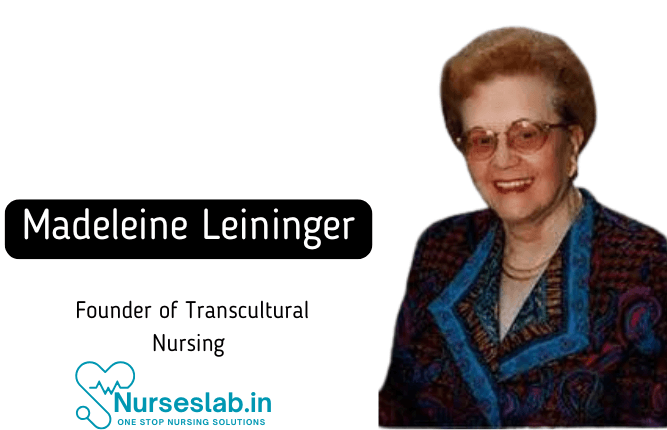
Madeleine M. Leininger (1925–2012) was a trailblazing nurse theorist and anthropologist who revolutionized nursing by introducing Transcultural Nursing a discipline that emphasizes culturally congruent care. Her Culture Care Theory remains one of the most influential frameworks in nursing today.
Early Life & Education
- Born July 13, 1925, in Sutton, Nebraska, on a family farm with four siblings.
- Inspired by her aunt’s illness to pursue nursing.
- Joined the U.S. Army Nurse Cadet Corps during WWII.
- Earned her nursing diploma from St. Anthony’s Hospital School of Nursing.
- Completed undergraduate studies at Mount St. Scholastica College and Creighton University.
- Received her MS in Psychiatric Nursing from Catholic University of America (1954).
- Became the first professional nurse to earn a PhD in Anthropology from the University of Washington (1966)2.
Career & Contributions
- Opened a psychiatric nursing program at Creighton University.
- Served as Dean of Nursing at the University of Washington and University of Utah.
- Held joint appointments in nursing and anthropology, a first in U.S. academia.
- Founded the Transcultural Nursing Society (1974) and the Journal of Transcultural Nursing (1989).
- Conducted fieldwork with the Gadsup people of Papua New Guinea, shaping her theory through ethnonursing research3.
Culture Care Theory
Introduced in the 1960s, her theory focuses on:
- Culturally congruent care: nursing that aligns with patients’ cultural values and beliefs.
- Emic and Etic knowledge:
- Emic: insider, folk knowledge.
- Etic: outsider, professional knowledge.
- Three modes of nursing care:
- Preservation/Maintenance
- Accommodation/Negotiation
- Repatterning/Restructuring
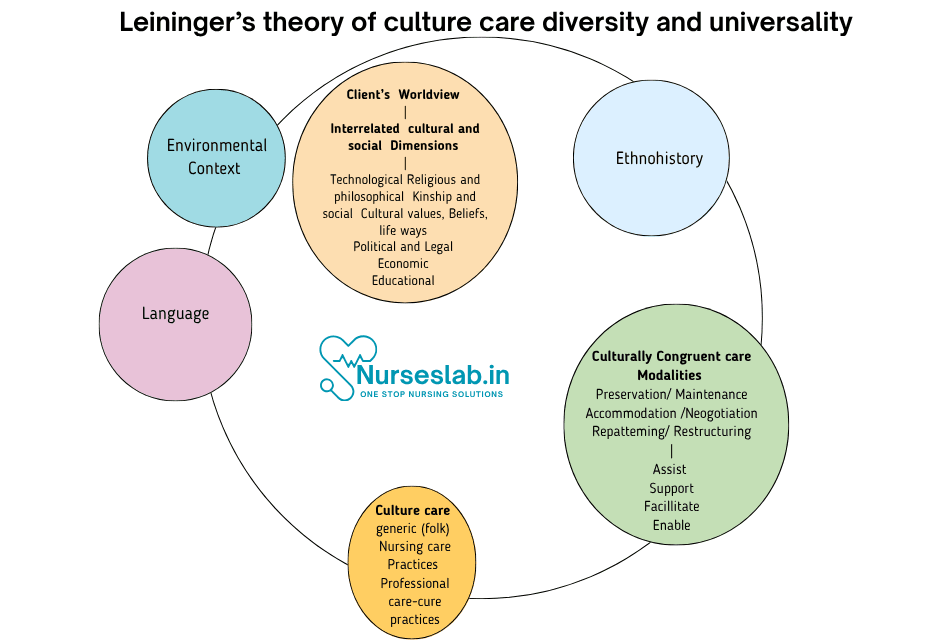
- Visualized through the Sunrise Model, which integrates cultural, social, and environmental factors2.
Legacy & Honors
- Named a Living Legend by the American Academy of Nursing (1998).
- Received numerous awards, including the President’s Award for Excellence in Teaching and the Gershenson Research Fellowship.
- Authored 27 books, over 200 articles, and gave 850+ lectures worldwide.
- Her work laid the foundation for culturally competent care in global nursing practice.
Final Years
- Served as Professor Emeritus at Wayne State University.
- Passed away on August 10, 2012, in Omaha, Nebraska, from lung failure at age 872.
- Buried in her hometown of Sutton, Nebraska.
Major Concepts
Core Philosophy
- Culture shapes every aspect of human life—including health, illness, and healing.
- Caring is the essence of nursing, and it must be tailored to the patient’s cultural values and beliefs.
- Nurses must understand both universal (shared) and diverse (unique) cultural care practices.
Core Concepts
| Concept | Description |
|---|---|
| Culture Care Diversity | Differences in values, beliefs, and practices among cultures |
| Culture Care Universality | Commonalities in care across cultures (e.g., nurturing, protection) |
| Culturally Congruent Care | Care that fits the patient’s cultural values and lifestyle |
| Ethnonursing | Research method developed by Leininger to study cultural care |
| Sunrise Model | Visual framework showing how cultural factors influence care decisions |
Sunrise Model Dimensions
The model includes factors such as:
- Technological influences
- Religious and philosophical beliefs
- Kinship and social systems
- Cultural values and lifeways
- Political, legal, and economic systems
- Educational background
These guide nurses in assessing and planning culturally appropriate care.
Application of Leininger’s Theory of Culture Care Diversity and Universality in Nursing Practice
Leininger’s theory guides nurses to provide culturally congruent care by recognizing cultural differences (diversity) and universal care practices (universality) that support health and well-being.
Steps of Application
- Cultural Assessment
- Assess the patient’s cultural beliefs, values, and health practices.
- Identify cultural factors that influence health behaviors and decision-making.
- Analysis of Cultural Data
- Determine which cultural practices are beneficial, neutral, or harmful to the patient’s health.
- Recognize both diversity and universality in care practices.
- Planning Culturally Congruent Care
- Develop a care plan that aligns with the patient’s culture while meeting clinical needs.
- Incorporate patient and family participation in decision-making.
- Implementation of Nursing Actions
- Apply three modes of nursing care actions:
- Cultural Care Preservation/Maintenance – Support positive practices.
- Cultural Care Accommodation/Negotiation – Adapt or adjust care to respect culture.
- Cultural Care Repatterning/Restructuring – Modify practices that are harmful to health.
- Apply three modes of nursing care actions:
- Evaluation
- Assess patient satisfaction with culturally congruent care.
- Determine whether health goals are achieved in a culturally sensitive manner.
Case Scenario 1: Muslim Patient in Postoperative Care
Scenario:
Mr. A, 45 years old, underwent abdominal surgery. He is a practicing Muslim who requests specific prayer times and halal meals during hospitalization.
Assessment
- Patient requests privacy for prayer five times a day.
- Prefers halal diet and avoidance of pork or gelatin-based medications.
- Appears calm when religious needs are met.
Nursing Diagnoses
- Readiness for enhanced spiritual well-being related to cultural and religious practices.
- Risk for imbalanced nutrition related to dietary restrictions in hospital meals.
Nursing Interventions (Leininger’s Approach)
- Cultural Care Preservation/Maintenance
- Support prayer schedules by providing a quiet, private environment.
- Ensure halal-compliant meals as per hospital dietary policy.
- Cultural Care Accommodation/Negotiation
- Coordinate medication schedules around prayer times if feasible.
- Discuss any hospital menu limitations and negotiate suitable alternatives.
- Cultural Care Repatterning/Restructuring(if required)
- Educate patient about safe postoperative positions during prayer to avoid complications.
Expected Outcome:
- Patient expresses satisfaction with spiritual and dietary needs being respected.
- Postoperative recovery is supported by culturally congruent care.
Case Scenario 2: Hispanic Mother with a Newborn in the NICU
Scenario:
Mrs. B, 30 years old, delivered a preterm baby admitted to the NICU. She practices traditional Hispanic postpartum rituals, including keeping the baby warm and avoiding cold exposure.
Assessment
- Expresses concern about the baby being in an incubator without extra blankets.
- Family requests involvement in infant care rituals.
- Shows emotional stress due to cultural mismatch with hospital practices.
Nursing Diagnoses
- Anxiety related to cultural conflict and NICU environment.
- Risk for impaired parent-infant bonding related to limited participation in care.
Nursing Interventions (Leininger’s Approach)
- Cultural Care Preservation/Maintenance
- Encourage family participation in safe traditional rituals like gentle touch or lullabies.
- Cultural Care Accommodation/Negotiation
- Explain the benefits of incubator temperature regulation and negotiate adding a small culturally acceptable blanket outside the incubator if safe.
- Involve parents in feeding, diapering, and kangaroo care.
- Cultural Care Repatterning/Restructuring(if required)
- Educate family on safe practices to avoid infection or thermal injury.
Expected Outcome:
- Family feels respected and involved in newborn care.
- Parent-infant bonding improves, and cultural needs are met without compromising safety.
REFERENCES
- Leininger, M.M. (1967). The culture concept and its relevance to nursing. Journal of Nursing Education, 6(2), 27-39. [Reprinted in Auld, M.E., & Birum, L.H. (Eds.) (1973). The challenge of nursing: A book of readings (pp. 39-46). St. Louis, MO: Mosby.]
- Leininger, M.M. (1978). Transcultural nursing: Concepts, theories, and practices. New York< NY: Wiley.
- McFarland MR, Wehbe-Alamah HB. Leininger’s Theory of Culture Care Diversity and Universality: An Overview With a Historical Retrospective and a View Toward the Future. J Transcult Nurs. 2019 Nov;30(6):540-557. https://pubmed.ncbi.nlm.nih.gov/31409201/
- Leininger, M. (1995). Transcultural nursing: Concepts, theories, research, and practices (2nd ed.). New York, NY: McGraw Hill.
- Leininger, M.M. (Ed.) (1991). Culture care diversity and universality: A theory of nursing. New York, NY: National League for Nursing.
- Leininger, M.M., & McFarland, M.R. (2006). Culture care diversity and universality: A worldwide nursing theory (2nd ed.). Boston MA: Jones and Bartlett.
- McFarland, M.R., & Wehbe-Alamah, H.B. (2015). Leininger’s culture care diversity and universality: A worldwide nursing theory (3rd ed.). Sudbury, MA: Jones and Bartlett Learning.
- Leininger, M.M. (1988). Leininger’s theory of nursing: Cultural care diversity and universality Nursing Science Quarterly, 1, 152-160.
- Leininger, M.M. (1988). Madeleine M. Leininger. In T.M. Schorr & A. Zimmerman, Making choices. Taking chances. Nurse leaders tell their stories (pp. 187-192). St. Louis: Mosby.
- Leininger, M.M. (1992). Reflections on Nightingale with a focus on human care theory and leadership. In F. Nightingale, Notes on nursing: What it is, and what it is not (Commemorative edition, pp. 28-38). Philadelphia, PA: J. B. Lippincott. (Original work published in 1859).
- Leininger, M.M. (1996). Culture care theory, research, and practice. Nursing Science Quarterly, 9, 71-78.
Stories are the threads that bind us; through them, we understand each other, grow, and heal.
JOHN NOORD
Connect with “Nurses Lab Editorial Team”
I hope you found this information helpful. Do you have any questions or comments? Kindly write in comments section. Subscribe the Blog with your email so you can stay updated on upcoming events and the latest articles.


