


Last Updated on August 11, 2025 by Nurseslab.in Editorial Team
Nola Pender’s Health Promotion Model (HPM) is a foundational framework in nursing that encourages individuals to take control of their health through positive behaviors, rather than simply avoiding illness. It’s widely used in clinical practice, education, and public health initiatives.
Life Story of Nola Pender
Nola Pender (born August 16, 1941, in Lansing, Michigan) is a renowned nurse theorist and educator best known for creating the Health Promotion Model (HPM)—a transformative framework that shifted nursing from illness treatment to preventive care and wellness.

Early Life & Education
- Inspired by nurses caring for her hospitalized aunt at age 7.
- Earned her Nursing diploma from West Suburban Hospital School of Nursing (1962).
- Completed her BS in Nursing (1964) and MS in Human Growth & Development (1965) at Michigan State University.
- Obtained dual PhDs in Psychology and Education from Northwestern University (1969).
Career & Contributions
- Began as a medical-surgical and pediatric nurse in Michigan.
- Taught at the University of North Dakota and Northern Illinois University, where she developed her theory.
- Served as Associate Dean for Research and Professor Emerita at the University of Michigan School of Nursing.
- Co-founded the Midwest Nursing Research Society and served as its president (1985–1987).
- Led the American Academy of Nursing as president (1991–1993).
Health Promotion Model (HPM)
Introduced in Health Promotion in Nursing Practice (1982), the model encourages nurses to:
- Focus on preventive care and positive motivation.
- Understand how individual experiences, personal factors, and environmental influences shape health behaviors.
- Promote self-care, physical activity, and healthy lifestyle choices.
Key concepts include:
- Individual characteristics and experiences
- Behavior-specific cognitions and affect
- Behavioral outcomes like commitment to action and competing demands
Her model has been revised in 1996 and 2002, and is widely used in nursing education and research.
Legacy & Honors
- Named a Living Legend by the American Academy of Nursing (2012).
- Received the Lifetime Achievement Award from the Midwest Nursing Research Society (2005).
- Authored eight textbooks and over 50 scholarly publications.
- Developed the Girls on the Move program to promote physical activity among adolescents.
- Continues to consult globally on health promotion and nursing education.
Major Concepts
Core Philosophy
- Health is a positive dynamic state, not just the absence of disease.
- Nurses play a key role in empowering patients to adopt healthy behaviors.
- The model emphasizes individual characteristics, behavior-specific cognitions, and behavioral outcomes.
Major Concepts of the Health Promotion Model
| Concept | Description |
|---|---|
| Individual Characteristics & Experiences | Includes prior behavior and personal factors (biological, psychological, sociocultural) |
| Behavior-Specific Cognitions & Affect | Includes perceived benefits/barriers, self-efficacy, activity-related affect, and interpersonal influences |
| Behavioral Outcome | Commitment to a plan of action and actual health-promoting behavior |
Key Influences on Behavior
- Perceived Benefits: Belief that the behavior will lead to positive outcomes
- Perceived Barriers: Belief that obstacles may prevent action
- Self-Efficacy: Confidence in one’s ability to perform the behavior
- Interpersonal Influences: Support from family, peers, and healthcare providers
- Situational Influences: Environmental factors that facilitate or hinder behavior
Key Components of the Model
- Individual Characteristics & Experiences
- Prior related behaviors (past experiences with health behaviors).
- Personal factors (biological, psychological, sociocultural).
- Behavior-Specific Cognitions & Affect
- Perceived benefits of action – What the patient believes they will gain.
- Perceived barriers to action – What prevents them from acting.
- Perceived self-efficacy – Confidence in performing the behavior.
- Activity-related affect – Positive/negative feelings associated with the activity.
- Interpersonal influences – Support from family, peers, healthcare providers.
- Situational influences – Environment, accessibility of resources.
- Behavioral Outcome
- Commitment to a plan of action.
- Immediate competing demands/preferences – Things that might distract or prevent the behavior.
- Health-promoting behavior – The desired outcome.
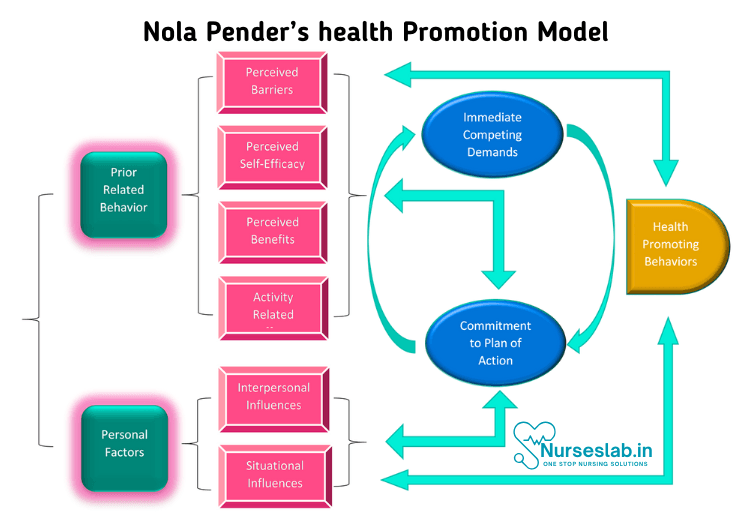
Assumptions
The HPM is based on the following assumptions, which reflect both nursing and behavioral science perspectives:
- Individuals seek to actively regulate their own behavior.
- Individuals in all their biopsychosocial complexity interact with the environment, progressively transforming the environment and being transformed over time.
- Health professionals constitute a part of the interpersonal environment, which exerts influence on persons throughout their life span.
- Self-initiated reconfiguration of person-environment interactive patterns is essential to behavior chang
Theoretical Statements
Theoretical statements derived from the model provide a basis for investigative work on health behaviors. The HPM is based on the following theoretical propositions:
- Prior behavior and inherited and acquired characteristics influence beliefs, affect, and enactment of health-promoting behavior.
- Persons commit to engaging in behaviors from which they anticipate deriving personally valued benefits.
- Perceived barriers can constrain commitment to action, a mediator of behavior as well as actual behavior.
- Perceived competence or self-efficacy to execute a given behavior increases the likelihood of commitment to action and actual performance of the behavior.
- Greater perceived self-efficacy results in fewer perceived barriers to a specific health behavior.
- Positive affect toward a behavior results in greater perceived self-efficacy, which can in turn, result in increased positive affect.
- When positive emotions or affect are associated with a behavior, the probability of commitment and action is increased.
- Persons are more likely to commit to and engage in health-promoting behaviors when significant others model the behavior, expect the behavior to occur, and provide assistance and support to enable the behavior.
- Families, peers, and health care providers are important sources of interpersonal influence that can increase or decrease commitment to and engagement in health-promoting behavior.
- Situational influences in the external environment can increase or decrease commitment to or participation in health-promoting behavior.
- The greater the commitments to a specific plan of action, the more likely health-promoting behaviors are to be maintained over time.
- Commitment to a plan of action is less likely to result in the desired behavior when competing demands over which persons have little control require immediate attention. 13. Commitment to a plan of action is less likely to result in the desired behavior when other actions are more attractive and thus preferred over the target behavior.
- Persons can modify cognitions, affect, and the interpersonal and physical environment to create incentives for health actions.
Application of Nola Pender’s Health Promotion Model in Nursing Practice
Focus:
- Encourages nurses to help individuals increase well-being and self-actualization by engaging in health-promoting behaviors.
- Emphasizes behavioral change influenced by personal, interpersonal, and situational factors.
Goal of the Model:
- Motivate patients to adopt healthy lifestyles by understanding what influences their behaviors and by removing barriers to change.
Assessment
- Identify past behaviors and personal factors that influence the patient’s health habits.
- Assess beliefs, motivations, and perceived barriers to healthy behavior.
Goal Setting
- Collaborate with the patient to set specific, realistic, and measurable health goals.
Planning
- Develop strategies to maximize perceived benefits and reduce perceived barriers.
- Enhance self-efficacy through skill-building and positive reinforcement.
Implementation
- Provide education, resources, and support to facilitate healthy behaviors.
- Use motivational interviewing to increase commitment to change.
Evaluation
- Monitor progress toward goals.
- Adjust the plan based on patient feedback and outcomes.
Nola Pender’s Health promotion Model is applied in nursing by assessing individual motivators and barriers, promoting self-efficacy, and facilitating patient-driven health behaviors to enhance overall well-being.
Case Scenario 1: Middle-Aged Woman with Sedentary Lifestyle
Scenario:
Mrs. A, 48 years old, works in an office and reports lack of physical activity, frequent fatigue, and mild weight gain. She expresses interest in exercising but says she’s “too busy” and “not motivated.”
Assessment (Health Promotion Model Focus)
- Past behavior: Minimal physical activity in recent years.
- Personal factors: Overweight (BMI 29), busy schedule, mild joint stiffness.
- Perceived benefits: Believes exercise will improve energy and weight control.
- Perceived barriers: Time constraints, joint discomfort.
- Self-efficacy: Low confidence in maintaining an exercise routine.
Nursing Diagnoses
- Sedentary lifestyle related to lack of motivation and time constraints.
- Readiness for enhanced health management related to expressed desire to increase activity.
Nursing Interventions
- Educate about short, achievable exercise options (e.g., 15-minute walks).
- Teach joint-friendly exercises to prevent discomfort.
- Help patient schedule activity breaks during work hours.
- Encourage tracking progress to boost motivation and self-efficacy.
- Arrange follow-up sessions for encouragement and progress evaluation.
Expected Outcome:
- Patient begins regular short exercise sessions and reports increased energy levels.
Case Scenario 2: College Student with Unhealthy Eating Habits
Scenario:
Mr. B, 21 years old, often skips breakfast, consumes fast food daily, and drinks sugar-sweetened beverages. He wants to “eat healthier” but says cooking is “too much effort.”
Assessment (Health promotion Model Focus)
- Past behavior: High intake of processed foods.
- Personal factors: Busy academic schedule, limited cooking skills.
- Perceived benefits: Acknowledges healthy eating will improve energy and concentration.
- Perceived barriers: Lack of time, convenience of fast food.
- Self-efficacy: Moderate—feels he can change if given simple strategies.
Nursing Diagnoses
- Imbalanced nutrition: more than body requirements related to frequent fast-food consumption.
- Readiness for enhanced nutrition related to motivation for dietary improvement.
Nursing Interventions
- Provide quick, healthy meal ideas requiring minimal preparation.
- Teach grocery shopping skills to choose healthy, affordable options.
- Encourage meal prepping for busy academic days.
- Set incremental dietary goals, such as replacing sugary drinks with water.
- Suggest using nutrition tracking apps to monitor progress.
Expected Outcome:
- Patient consistently incorporates healthier meals and reduces fast food intake.
REFERENCES
- Pender, N. J. (1982). Health promotion in nursing practice. New York: Appleton-Century-Crofts.
- Pender, N. J. (1987). Health promotion in nursing practice (2nd ed.). Norwalk, CT: Appleton- Lange.
- Marriner TA, Raile AM. Nursing theorists and their work. 5th ed. Sakraida T.Nola J. Pender. The Health Promotion Model. St Louis: Mosby; 2005
- Polit DF, Beck CT. Nursing research:Principles and methods. 7th ed. Philadelphia: Lippincott Williams & Wilkins; 2007
- Black JM, Hawks JH, Keene AM. Medical surgical nursing. 6th ed. Philadelphia: Elsevier Mosby; 2006.
Potter PA, Perry AG. Fundamentals of nursing. 6th ed. St.Louis: Elsevier Mosby; 2006. - Santos MGD, Pleutim NI, Queiroz-Cardoso AI, Ramalho LDS, Souza VS, Teston EF. Use of the Health Promotion Model by Nursing in Primary Care: an integrative review. Rev Bras Enferm. 2025 Mar 14;78(2):e20240096. doi: 10.1590/0034-7167-2024-0096. https://pmc.ncbi.nlm.nih.gov/articles/PMC11913135/
- Michael, A. HEALTH PROMOTION MODEL BY NOLA PENDER Theoretical Propositions of the HPM. https://www.academia.edu/75391816/HEALTH_PROMOTION_MODEL_BY_NOLA_PENDER_Theoretical_Propositions_of_the_HPM
Stories are the threads that bind us; through them, we understand each other, grow, and heal.
JOHN NOORD
Connect with “Nurses Lab Editorial Team”
I hope you found this information helpful. Do you have any questions or comments? Kindly write in comments section. Subscribe the Blog with your email so you can stay updated on upcoming events and the latest articles.


