


Last Updated on January 14, 2026 by Nurseslab.in Editorial Team
Barbara Dossey’s Theory of Integral Nursing is a transformative framework that blends science, art, and spirituality to promote healing and wholeness in nursing practice. It’s a grand theory that expands holistic nursing by integrating multiple dimensions of human experience physical, emotional, mental, spiritual, cultural, and environmental.
Life Story of Barbara Dossey
Dr. Barbara Montgomery Dossey (born April 3, 1945) is an internationally acclaimed nurse theorist, educator, author, and Florence Nightingale scholar. Her life’s work has elevated holistic nursing, nurse coaching, and global health consciousness, making her one of the most influential voices in integrative healthcare.
Early Life & Education
- Born in Texas, USA, with early interests in healing and spirituality.
- Earned her BSN (1965) from Baylor University, MS (1975) from Texas Woman’s University, and PhD (2002) from Union Institute & University.
- Her personal health challenges, including a recurrent viral eye infection, inspired her journey into holistic self-care and integrative therapies.
Career & Contributions
- Began in critical care and cardiovascular nursing, later shifting to holistic nursing in the 1970s.
- Co-founded the International Nurse Coach Association (INCA) and the Integrative Nurse Coach Academy.
- Served as International Co-Director of the Nightingale Initiative for Global Health (NIGH), promoting the UN’s Sustainable Development Goals (SDGs) through nursing advocacy.
- Developed the Theory of Integral Nursing and co-authored the Theory of Integrative Nurse Coaching.
Publications & Thought Leadership
- Authored or co-authored 31 books, including:
- Holistic Nursing: A Handbook for Practice (8th ed., 2022)
- The Art and Science of Nurse Coaching (2nd ed., 2021)
- Florence Nightingale: Mystic, Visionary, Healer (2010)
- Her writings blend science, spirituality, and global consciousness, inspiring nurses to embrace healing as a lifelong journey into wholeness.
Awards & Recognition
| Award | Organization | Year |
|---|---|---|
| Lifetime Achievement Award | American Holistic Nurses Association | 2014 |
| Holistic Nurse of the Year | AHNA | 1985 |
| Healer of the Year | Nurse Healers Professional Associates | 1998 |
| Book of the Year (multiple) | American Journal of Nursing | 1984–2015 |
| Visionary Award | Academy of Integrative Health and Medicine | 2016 |
Global Impact
- Led the 2010 International Year of the Nurse campaign.
- Advocated for 2010–2020 as the International Decade for a Healthy World.
- Works to empower nurses as agents of change, emphasizing collaboration, cultural diversity, and planetary healing.
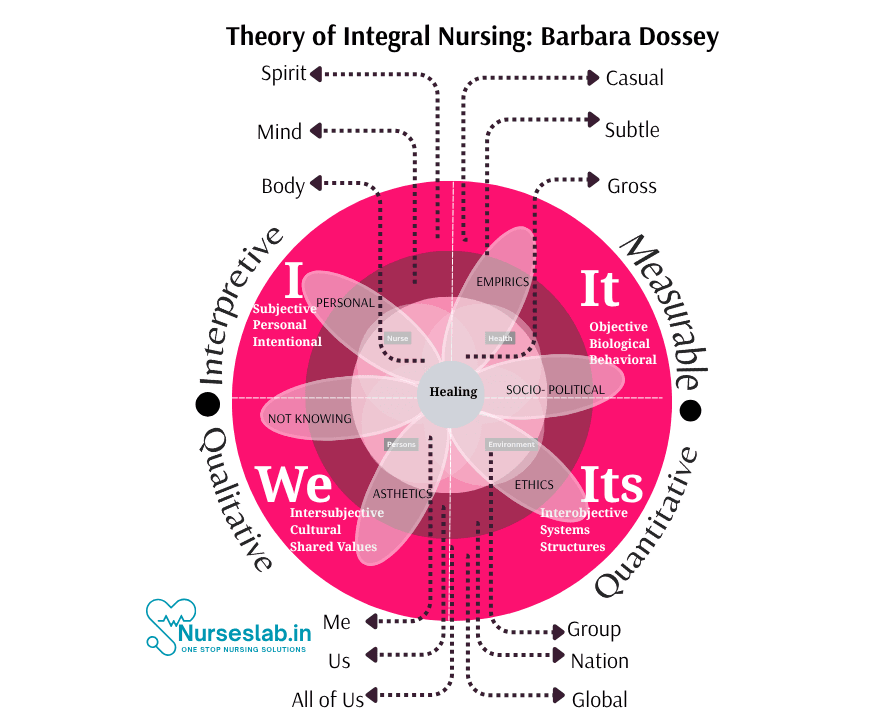
Core Components of the Theory
- Integral Process: A dynamic, reflective approach that connects personal awareness with professional practice.
- Integral Worldview: Encourages nurses to see health and healing through multiple lenses individual, collective, internal, and external.
- Integral Dialogues: Deep conversations that foster understanding across disciplines and cultures this is praxis, or theory in action.
Key Concepts
| Concept | Description |
|---|---|
| Healing | A lifelong journey into wholeness—not just curing symptoms but achieving balance. |
| Metaparadigm of Nursing | Includes nurse, person, health, and environment—all interconnected. |
| Patterns of Knowing | Six ways nurses understand the world: personal, empirical, aesthetic, ethical, sociopolitical, and “not knowing.” |
| Four Quadrants Model | Based on Ken Wilber’s AQAL model: I (personal), We (shared), It (behavioral), Its (systems). |
| AQAL Framework | “All Quadrants, All Levels”—a comprehensive map of human experience and consciousness. |
Download PDF “NIGH’s INTEGRAL MODELS”
Application of Barbara Dossey’s Theory of Integral Nursing
Barbara Dossey’s Theory of Integral Nursing is a holistic nursing framework that integrates body, mind, spirit, and environment to promote healing, health, and well-being. It is based on the Integral Model by Ken Wilber, focusing on healing the patient, self, and environment.
Key Principles of Application
- Holistic and Patient-Centered Care
- Focuses on healing the whole person physical, emotional, mental, social, and spiritual aspects.
- Involves individualized care plans considering the patient’s unique experiences and beliefs.
- Self-Care and Nurse’s Healing Presence
- Emphasizes self-reflection, mindfulness, and self-care for the nurse to enhance therapeutic presence.
- A nurse’s inner balance improves their ability to support patient healing.
- Healing Relationships
- Encourages authentic, compassionate, and therapeutic relationships with patients and families.
- Promotes effective communication and trust-building as part of integral healing.
- Interdisciplinary Collaboration
- Integrates multiple healthcare disciplines to address all dimensions of patient care.
- Focuses on teamwork and shared decision-making for holistic outcomes.
- Evidence-Based and Integral Practice
- Combines conventional medical care with complementary and alternative therapies (e.g., meditation, relaxation techniques, therapeutic touch).
- Encourages evidence-based interventions to achieve optimal patient well-being.
- Creating a Healing Environment
- Designs physical and emotional environments that promote comfort, safety, and recovery.
- Considers noise, light, air quality, and emotional support in care settings.
- Global and Community Health Awareness
- Expands nursing care to cultural, social, and environmental health dimensions.
- Supports community wellness and ecological awareness as part of holistic healing.
Case Scenario 1: Patient with Advanced Cancer in Palliative Care
Scenario:
Mr. A, 68 years old, is in the palliative stage of lung cancer. He experiences severe pain, anxiety, and spiritual distress about the end of life. He is withdrawn and reports difficulty sleeping.
Nursing Diagnosis:
- Chronic pain related to disease progression.
- Anxiety related to fear of death and uncertainty about the future.
- Spiritual distress related to life-limiting illness.
Nursing Interventions (Integral Approach):
- Provide pain management using pharmacologic and non-pharmacologic interventions (guided imagery, relaxation).
- Facilitate therapeutic communication to address emotional and spiritual concerns.
- Collaborate with a chaplain or spiritual counselor for spiritual support.
- Modify environment for comfort: soft lighting, calm music, and family presence.
- Evaluate improvement in comfort, emotional state, and spiritual well-being.
Case Scenario 2: Postoperative Patient Experiencing Anxiety and Sleep Disturbance
Scenario:
Mrs. B, 45 years old, underwent hysterectomy 2 days ago. She complains of pain, cannot sleep well, and expresses fear about her recovery and returning to work.
Nursing Diagnosis:
- Acute pain related to surgical incision.
- Sleep pattern disturbance related to anxiety and hospitalization.
- Anxiety related to unfamiliar hospital environment and postoperative recovery.
Nursing Interventions (Integral Approach):
- Provide effective pain management and teach deep-breathing relaxation exercises.
- Create a healing environment: dim lights, reduce noise, and ensure a comfortable bed.
- Offer emotional support and encourage verbalization of fears.
- Integrate holistic methods such as aromatherapy or soft background music for relaxation.
- Assess pain relief, sleep quality, and anxiety reduction.
REFERENCES
- Dossey, B. M. (2020). Theory of integral nursing. In M. Smith (Ed.), Nursing Theories and Nursing Practice (5th ed.) (pp. 211-234). Philadelphia: F. A. Davis.
- Rosa, W. E., Dossey, B. M., Koithan, M., Kreitzer, M. J., Manjrekar, P., Meleis, A. I., Mukamana, D., Ray, M. A., & Watson, J. (2020). Nursing theory in the quest for the sustainable development goals. Nursing Science Quarterly, 33(2) 178–182.
- Dossey, B. M., Beck, D.M, Oerther, S. & Manjrekar, P. (2017). Florence Nightingale’s legacy: The rationale for an integral worldview in achieving the sustainable development goals. In W. Rosa (Ed.), A New Era in Global Health: Nursing and the United Nations 2030 Agenda for Sustainable Development (pp. 149-178). New York, NY: Springer Publishing Company.
- Dossey BM. Theory of integral nursing. ANS Adv Nurs Sci. 2008 Jan-Mar;31(1):E52-73. doi: 10.1097/01.ANS.0000311536.11683.0a. https://pubmed.ncbi.nlm.nih.gov/20531261/
- Dossey, B. M. Theory of integral nursing. (2016). In Dossey, B.M. & Keegan, L. (Eds.) Holistic Nursing: A Handbook for Practice (7th ed). Note. Published in (5th ed., 2009, 6th ed., 2013; 8th ed 2020).
- Shea, L. & Frisch, N. C. (2016).Wilber’s integral theory and Dossey’s theory of integral nursing: An examination of two integral approaches in nursing scholarship. Journal of Holistic Nursing, 34(3): 244-52.
- Hess, D. R. (2016). Curriculum for an RN-to-BSN program using the theory of integral nursing. In B. M. Dossey & L. Keegan (Eds). Holistic nursing: A Handbook for Practice (7th ed.) (pp.40-46). Burlington, MA: Jones and Bartlett Learning.
- Dossey, B. M. (2008). Theory of integral nursing. Advances in Nursing Science, 31(1): E52–73.
Stories are the threads that bind us; through them, we understand each other, grow, and heal.
JOHN NOORD
Connect with “Nurses Lab Editorial Team”
I hope you found this information helpful. Do you have any questions or comments? Kindly write in comments section. Subscribe the Blog with your email so you can stay updated on upcoming events and the latest articles.


