


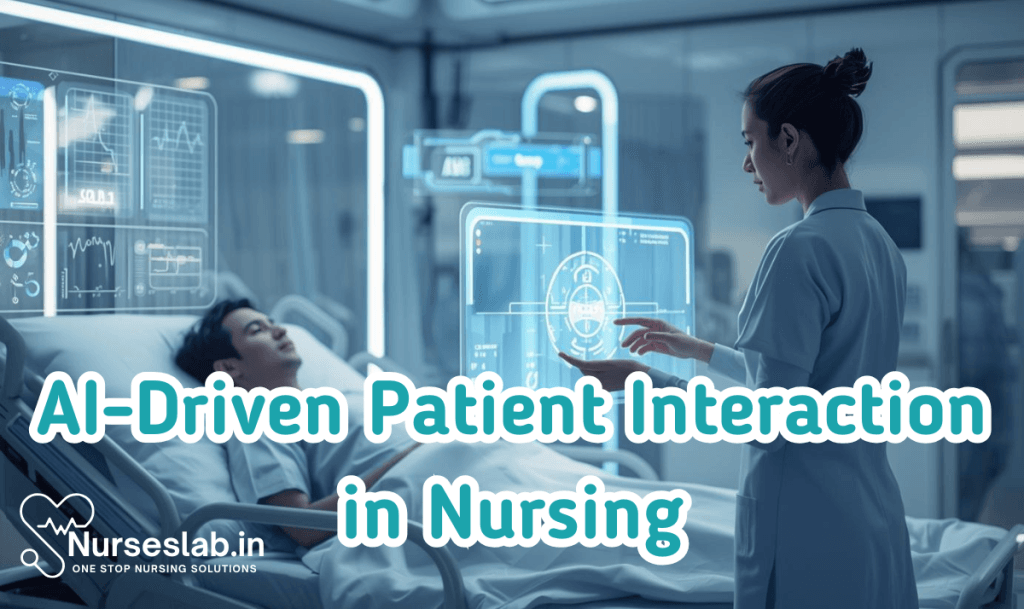
Explore AI-driven patient interaction in nursing: intelligent systems enable personalized communication, real-time monitoring, and predictive support. Nurses use AI to enhance patient engagement, streamline care delivery, and improve outcomes through responsive, data-informed interactions.
Introduction
Artificial Intelligence (AI) has rapidly emerged as a transformative force across the healthcare sector, fundamentally altering how care is delivered, managed, and experienced. In nursing, Artificial Intelligence (AI)-driven technologies—particularly chatbots and robots—are revolutionising patient interaction, enabling nurses to provide more personalised, efficient, and accessible care than ever before. As healthcare systems worldwide grapple with increasing patient loads, staff shortages, and the demand for higher quality outcomes, Artificial Intelligence (AI) offers innovative solutions that are reshaping both the practical and relational aspects of nursing care.
The Evolution of AI Chatbots in Patient Interaction
History and Development of Chatbots in Healthcare
The concept of chatbots dates back to early computer science experiments, but their application in healthcare, particularly nursing, has accelerated in recent years due to advancements in natural language processing (NLP) and machine learning. Early healthcare chatbots were limited to rule-based systems capable of answering simple queries. However, today’s Artificial Intelligence (AI)-powered chatbots leverage sophisticated algorithms and vast medical databases, allowing them to understand complex patient inquiries, provide timely information, and even triage symptoms.
Current Capabilities of AI Chatbots
Modern chatbots in nursing are designed to support a variety of patient interactions, such as appointment scheduling, medication reminders, symptom checking, and post-discharge follow-ups. These systems can engage patients in conversational dialogue, interpret their needs, and escalate issues to human clinicians when necessary. By integrating with electronic health records (EHRs), chatbots can offer tailored advice and interventions based on individual patient histories, enhancing the quality and relevance of care.
Examples of Chatbot Use in Nursing Practice
Several real-world implementations highlight the impact of chatbots in nursing. For instance, Florence is a widely used Artificial Intelligence (AI) nurse chatbot that reminds patients to take medications, educates them about side effects, and provides lifestyle advice. Similarly, Babylon Health’s chatbot assists with triaging patient symptoms and routing them to appropriate care providers. These examples demonstrate how chatbots are becoming indispensable tools for enhancing patient engagement and supporting nursing workflows.
Robots in Nursing
Types of Robots in Nursing
Robots in nursing can be broadly categorised into three types: assistive robots, social robots, and telepresence robots.
- Assistive Robots: These robots perform physical tasks such as lifting and transferring patients, delivering supplies, and monitoring vital signs. They help reduce the physical strain on nurses and improve patient safety.
- Social Robots: Designed to provide companionship and emotional support, social robots interact with patients, particularly the elderly and those with cognitive impairments, helping to reduce feelings of loneliness and anxiety.
- Telepresence Robots: These robots enable remote consultations and monitoring, allowing nurses and doctors to interact with patients across distances, particularly in rural or underserved areas.
Real-World Applications and Case Studies
In Japan, the use of Paro, a therapeutic robot modelled after a baby seal, has shown significant benefits in dementia care, providing comfort and stimulating social interaction among patients. In Indian hospitals, assistive robots such as the Robocare series are deployed to transport medications and assist with routine tasks, freeing up nurses for more critical patient care responsibilities. Telepresence robots like VGo are increasingly used in remote monitoring, enabling nurses to check on patients, answer queries, and provide guidance without being physically present.
Benefits of AI-Driven Patient Interaction in Nursing
Improved Efficiency and Workflow Optimisation
AI technologies streamline routine tasks, allowing nurses to focus on complex clinical decision-making and direct patient care. Chatbots handle administrative duties, respond to frequently asked questions, and automate documentation, significantly reducing workload and minimising errors. Robots assist with physical tasks, ensuring safe patient handling and timely delivery of supplies, which improves overall operational efficiency.
Enhanced Patient Satisfaction and Engagement
AI-driven tools foster continuous patient engagement by providing instant responses and personalised support. Patients can receive timely reminders, educational materials, and real-time updates about their treatment plans. Social robots, in particular, enhance patient well-being by offering companionship and stimulating cognitive activity, contributing to higher satisfaction rates and improved mental health outcomes.
Increased Accessibility and Inclusivity
By leveraging AI, nursing care extends beyond hospital walls, reaching patients in remote, rural, or underserved communities. Telepresence robots and chatbots bridge geographical gaps, enable remote monitoring, and facilitate virtual consultations, ensuring equitable access to quality care irrespective of location.
Data-Driven and Personalised Care
AI systems analyse vast amounts of patient data to identify patterns, predict risks, and recommend personalised interventions. Chatbots and robots integrated with EHRs provide tailored advice based on individual patient profiles, supporting nurses in delivering evidence-based and patient-centric care. This data-driven approach also enables proactive management of chronic conditions, early detection of complications, and continuous improvement of care protocols.
Challenges and Limitations of AI in Nursing
Technical and Operational Barriers
Despite significant advancements, several technical challenges hinder the widespread adoption of Artificial Intelligence (AI) in nursing. System integration with existing healthcare infrastructure can be complex and costly. Issues such as interoperability, reliability, and real-time data processing remain persistent. Additionally, AI tools require robust internet connectivity and digital literacy, which may be lacking in certain healthcare settings.
Human Factors and Resistance to Change
Nurses and other healthcare professionals may exhibit resistance to adopting AI technologies due to concerns about job displacement, loss of autonomy, and the potential erosion of the human touch in care. Training and upskilling are essential to ensure that nurses can effectively use AI tools and adapt to evolving workflows.
Limitations in Scope and Decision-Making
AI-driven systems are primarily designed to assist with routine tasks and decision support. They may not fully capture the nuances of complex clinical scenarios or emotional contexts, necessitating human oversight and intervention. Over-reliance on Artificial Intelligence (AI) could potentially lead to missed cues or inappropriate responses in sensitive situations.
Ethical and Privacy Considerations
Data Security and Patient Consent
The integration of AI into nursing raises critical ethical concerns regarding data privacy and security. AI systems rely on extensive patient data, necessitating stringent safeguards to protect sensitive information from breaches or unauthorised access. Transparent data use policies and informed patient consent are paramount to maintaining trust and compliance with regulatory standards such as the Personal Data Protection Bill in India and GDPR in Europe.
Preserving the Human Element in Care
While AI enhances efficiency and accessibility, it cannot replace the empathy, compassion, and intuition that define nursing care. Ethical practice demands a balanced approach, where Artificial Intelligence (AI) augments rather than supplants human interaction. Nurses must ensure that technology serves as a tool to enhance—not diminish—the quality of patient relationships.
Bias, Fairness, and Accountability
AI algorithms are susceptible to bias if trained on unrepresentative data, potentially leading to disparities in care delivery. Regular audits, transparent development processes, and inclusive data sets are essential to mitigate bias and ensure fairness. Clear accountability frameworks must be established to address errors or adverse outcomes arising from AI-driven decisions.
Implementation Strategies
Best Practices for Adoption
Successful implementation of Artificial Intelligence (AI) in nursing requires a strategic, multidisciplinary approach. Key best practices include:
- Stakeholder Engagement: Involving nurses, administrators, IT professionals, and patients in the selection and deployment of AI tools ensures alignment with clinical needs and operational realities.
- Comprehensive Training: Providing ongoing education and support enables nurses to develop digital competencies, fostering confidence and proficiency in using AI technologies.
- Pilot Programmes: Launching pilot initiatives allows healthcare organisations to evaluate AI tools, gather feedback, and refine implementation strategies before scaling up.
- Continuous Evaluation: Regular monitoring and assessment of Artificial Intelligence (AI) systems help identify areas for improvement, address technical issues, and ensure sustained impact.
- Ethical Governance: Establishing ethical guidelines and oversight committees ensures responsible use of Artificial Intelligence (AI), safeguarding patient rights and promoting transparency.
Integration with Existing Systems
AI tools must be interoperable with current healthcare information systems, facilitating seamless data exchange and workflow integration. Collaborative partnerships with technology vendors and adherence to industry standards are crucial for successful integration.
Future Trends
Advancements in AI Algorithms and Robotics
Future developments in Artificial Intelligence (AI) are set to further enhance nursing practice. Advances in deep learning, reinforcement learning, and natural language understanding will enable chatbots to engage in more nuanced, empathetic conversations and provide sophisticated clinical guidance. Next-generation robots will feature improved mobility, dexterity, and social intelligence, expanding their roles from assistive functions to complex clinical interventions.
Integration of Wearables and Remote Monitoring
AI-powered wearables and remote monitoring devices are transforming chronic disease management and preventive care. These technologies continuously collect patient data, enabling proactive interventions and real-time support from nursing teams. Integration with Artificial Intelligence (AI) chatbots and robots will facilitate holistic care, bridging gaps between home and hospital settings.
Personalisation and Predictive Analytics
The future of Artificial Intelligence (AI) in nursing lies in highly personalised, predictive care. Advanced analytics will enable nurses to anticipate patient needs, detect early warning signs, and customise interventions based on individual risk profiles. This shift towards proactive, precision nursing promises improved outcomes and enhanced patient experiences.
The Changing Role of Nurses
As AI technologies become more prevalent, the role of nurses will evolve from task-oriented functions to higher-order clinical, analytical, and relational responsibilities. Nurses will increasingly act as coordinators, educators, and advocates, leveraging Artificial Intelligence (AI) tools to deliver comprehensive, patient-centred care.
Conclusion
AI-driven patient interaction is fundamentally transforming nursing, offering unprecedented opportunities to enhance efficiency, accessibility, and quality of care. Chatbots and robots are reshaping how nurses engage with patients, streamline workflows, and deliver personalised support. However, successful integration requires careful consideration of technical, operational, ethical, and human factors. By embracing best practices and ongoing innovation, nurses and healthcare organisations can harness the full potential of Artificial Intelligence (AI) to create a more responsive, equitable, and compassionate healthcare system.
Looking ahead, the synergy between nurses and Artificial Intelligence (AI) technologies will continue to evolve, enabling a future where intelligent systems empower nurses to focus on what matters most—delivering exceptional, empathetic care to every patient.
REFERENCES
- TERN, The Rise of AI Chatbots: How Nurses Are Using AI for Real-Time Clinical Decisions in 2025, June 28, 2025, https://en.tern-group.com/blog/the-rise-of-ai-chatbots-how-nurses-are-using-ai-for-real-time-clinical-decisions-in-2025
- Wei Q, Pan S, Liu X, Hong M, Nong C, Zhang W. The integration of AI in nursing: addressing current applications, challenges, and future directions. Front Med (Lausanne). 2025 Feb 11;12:1545420. https://pmc.ncbi.nlm.nih.gov/articles/PMC11850350/
- Upturate, From Chatbots to Robots: AI Innovations Changing Patient Interactions, August 21, 2025, https://upturate.com/from-chatbots-to-robots-ai-innovations-changing-patient-interactions/
- Dailah HG, Koriri M, Sabei A, Kriry T, Zakri M. Artificial Intelligence in Nursing: Technological Benefits to Nurse’s Mental Health and Patient Care Quality. Healthcare (Basel). 2024 Dec 18;12(24):2555. doi: 10.3390/healthcare12242555. PMID: 39765983; PMCID: PMC11675209.
Stories are the threads that bind us; through them, we understand each other, grow, and heal.
JOHN NOORD
Connect with “Nurses Lab Editorial Team”
I hope you found this information helpful. Do you have any questions or comments? Kindly write in comments section. Subscribe the Blog with your email so you can stay updated on upcoming events and the latest articles.


