


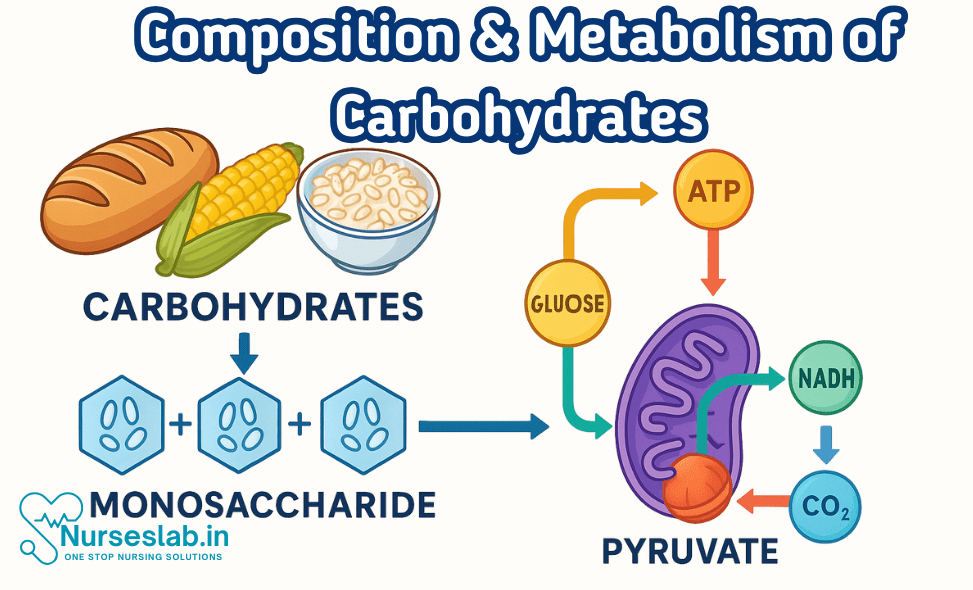
The composition of carbohydrates includes monosaccharides, disaccharides, and polysaccharides. Their metabolism involves digestion into glucose, glycolysis, glycogenesis, and oxidative phosphorylation—providing ATP, regulating blood sugar, and supporting cellular energy needs.
Introduction
Among the biomolecules crucial for life, carbohydrates occupy a central role. For nurses, a solid grasp of carbohydrate biochemistry is fundamental—not only for understanding metabolism and energy production but also for recognising, monitoring, and managing common clinical conditions such as diabetes mellitus and hypoglycaemia.
Chemical Composition of Carbohydrates
Elements and General Formula
Carbohydrates are organic compounds composed of carbon (C), hydrogen (H), and oxygen (O) atoms. They typically follow the general formula Cn(H2O)n, which reflects their name “hydrates of carbon.” For example, glucose (C6H12O6) fits this formula. However, some carbohydrates may deviate slightly from this ratio due to modifications such as deoxygenation or addition of other groups.
Types of Bonds
The basic structural unit of carbohydrates is the monosaccharide, which may link together via glycosidic bonds to form more complex carbohydrates. Glycosidic bonds are covalent linkages formed between the anomeric carbon of one sugar and a hydroxyl group of another. The nature (alpha or beta) and position (e.g., 1→4, 1→6) of these bonds significantly influence the properties and digestibility of the resulting carbohydrate.
Classification of Carbohydrates
Carbohydrates can be classified based on their complexity and the number of sugar units they contain. The main categories include monosaccharides, disaccharides, oligosaccharides, and polysaccharides.
Monosaccharides
Monosaccharides are the simplest carbohydrates, consisting of a single sugar unit. They are classified further by the number of carbon atoms:
- Trioses (3 carbons): e.g., glyceraldehyde
- Tetroses (4 carbons): e.g., erythrose
- Pentoses (5 carbons): e.g., ribose, deoxyribose
- Hexoses (6 carbons): e.g., glucose, fructose, galactose
Monosaccharides are crucial for energy production and serve as building blocks for larger carbohydrates.
Disaccharides
Disaccharides consist of two monosaccharide units linked by glycosidic bonds. Common examples include:
- Sucrose: glucose + fructose (table sugar)
- Lactose: glucose + galactose (milk sugar)
- Maltose: glucose + glucose (product of starch digestion)
Disaccharides must be broken down into monosaccharides before absorption.
Oligosaccharides
Oligosaccharides contain 3 to 10 monosaccharide units. They are found in foods like legumes and are partially digested in the human gut. Examples include raffinose and stachyose.
Polysaccharides
Polysaccharides are complex carbohydrates consisting of long chains of monosaccharide units. They may be linear or branched and serve various structural and storage functions.
- Starch: The primary storage carbohydrate in plants, composed of amylose (linear) and amylopectin (branched).
- Glycogen: The major storage form in animals, highly branched for rapid mobilisation.
- Cellulose: A structural polysaccharide in plants; indigestible by humans but contributes to dietary fibre.
Physiological Roles of Carbohydrates
Energy Source
Carbohydrates are the body’s principal source of energy. Glucose, in particular, is vital for brain function, red blood cells, and muscle activity. Each gram of carbohydrate provides approximately 4 kilocalories of energy.
Structural Roles
Certain carbohydrates, like ribose and deoxyribose, form the backbone of nucleic acids (RNA and DNA). Polysaccharides such as cellulose provide structural integrity to plant cell walls, while glycoproteins and glycolipids contribute to cell membrane structure in humans.
Cell Signalling and Recognition
Carbohydrates attached to proteins and lipids on cell surfaces (glycoproteins and glycolipids) are involved in cell recognition, immune responses, and signalling pathways—key processes in health and disease.
Digestion and Absorption of Carbohydrates
Overview of Digestion
Carbohydrate digestion involves enzymatic breakdown of complex carbohydrates into absorbable monosaccharides. This process unfolds in several stages:
Digestion in the Mouth
Salivary amylase (ptyalin) initiates the hydrolysis of starch into maltose and dextrins. The action is brief, as food quickly passes through the mouth.
Digestion in the Stomach
The acidic environment of the stomach inactivates salivary amylase. No significant carbohydrate digestion takes place here.
Digestion in the Small Intestine
Pancreatic amylase resumes the breakdown of starches into maltose, maltotriose, and dextrins. Brush border enzymes (maltase, lactase, sucrase, isomaltase) at the intestinal lining further hydrolyse disaccharides and oligosaccharides into monosaccharides (glucose, galactose, and fructose).
Absorption Mechanisms
Monosaccharides are absorbed primarily in the jejunum. Glucose and galactose are taken up via sodium-dependent active transport (SGLT1 transporter), while fructose is absorbed by facilitated diffusion (GLUT5 transporter). All three are then transported into the bloodstream by GLUT2 at the basolateral membrane.
Metabolism of Carbohydrates
Overview
Carbohydrate metabolism encompasses a series of interconnected biochemical pathways that ensure energy homeostasis and supply of metabolic intermediates. The major pathways include glycolysis, gluconeogenesis, glycogenesis, glycogenolysis, and the pentose phosphate pathway.
Glycolysis
Glycolysis is the central pathway of glucose catabolism, occurring in the cytoplasm of all cells. It converts one molecule of glucose into two molecules of pyruvate, yielding a net gain of 2 ATP and 2 NADH per glucose molecule. Glycolysis consists of two phases:
- Preparatory phase: Glucose is phosphorylated and split into two three-carbon molecules (glyceraldehyde-3-phosphate).
- Payoff phase: These molecules are further processed to generate ATP and NADH.
Key regulatory enzymes include hexokinase/glucokinase, phosphofructokinase-1 (PFK-1), and pyruvate kinase. Under anaerobic conditions, pyruvate is converted to lactate (lactic acid fermentation), especially in muscles during intense exercise.
Gluconeogenesis
Gluconeogenesis is the synthesis of glucose from non-carbohydrate precursors such as lactate, amino acids, and glycerol. It primarily occurs in the liver (and to a lesser extent in the kidneys) during fasting, starvation, or intense exercise. This pathway ensures a continuous supply of glucose, especially for the brain and red blood cells.
- Key enzymes: Pyruvate carboxylase, phosphoenolpyruvate carboxykinase (PEPCK), fructose-1,6-bisphosphatase, and glucose-6-phosphatase.
Glycogenesis
Glycogenesis is the process of synthesising glycogen from glucose. It occurs mainly in the liver and skeletal muscles when there is excess glucose. The process involves the conversion of glucose-6-phosphate to glucose-1-phosphate, which is then added to a growing glycogen chain by glycogen synthase.
- Key enzyme: Glycogen synthase.
Glycogenolysis
Glycogenolysis is the breakdown of glycogen to release glucose-1-phosphate, which can be converted to glucose-6-phosphate and then to free glucose (in the liver) or utilised in glycolysis (in muscle). This process is vital during fasting or increased energy demand.
- Key enzyme: Glycogen phosphorylase.
Pentose Phosphate Pathway (PPP)
The pentose phosphate pathway is an alternative route for glucose metabolism. It generates NADPH (for biosynthetic reactions and antioxidant defence) and ribose-5-phosphate (for nucleotide synthesis). The PPP operates mainly in the liver, adipose tissue, and red blood cells.
- Key enzyme: Glucose-6-phosphate dehydrogenase (G6PD).
Regulation of Carbohydrate Metabolism
The regulation of carbohydrate metabolism is complex and tightly controlled to maintain blood glucose levels within a narrow range. Hormones play a central role in this regulation.
Hormonal Control
- Insulin: Secreted by pancreatic beta cells in response to elevated blood glucose, insulin stimulates glucose uptake by cells, promotes glycogenesis, inhibits gluconeogenesis and glycogenolysis, and enhances glycolysis.
- Glucagon: Produced by pancreatic alpha cells, glucagon acts during fasting or low blood glucose to stimulate glycogenolysis and gluconeogenesis, while inhibiting glycogenesis.
- Adrenaline (epinephrine): Released during stress or exercise, adrenaline promotes glycogenolysis in muscle and liver, providing rapid energy supply.
- Cortisol and growth hormone: These hormones also modulate carbohydrate metabolism during prolonged stress or fasting.
Feedback Mechanisms
Allosteric regulation of key enzymes (e.g., PFK-1 in glycolysis, fructose-1,6-bisphosphatase in gluconeogenesis) and covalent modification (phosphorylation/dephosphorylation) ensure rapid metabolic adaptation. Blood glucose levels are maintained via negative feedback mechanisms involving insulin and glucagon.
Clinical Relevance
A thorough understanding of carbohydrate metabolism is essential for recognising and managing various metabolic disorders.
Diabetes Mellitus
Diabetes mellitus is characterised by chronic hyperglycaemia resulting from defects in insulin secretion, action, or both. Type 1 diabetes involves autoimmune destruction of beta cells, while Type 2 diabetes is associated with insulin resistance. Poorly controlled diabetes can lead to acute complications (e.g., diabetic ketoacidosis, hyperosmolar coma) and long-term sequelae (e.g., nephropathy, neuropathy, retinopathy).
Hypoglycaemia
Hypoglycaemia refers to abnormally low blood glucose levels, which may be life-threatening if not promptly recognised and managed. It may result from excessive insulin administration, inadequate food intake, or strenuous exercise. Symptoms include sweating, confusion, tremors, and, if severe, loss of consciousness.
Glycogen Storage Diseases
These are inherited disorders caused by defects in enzymes involved in glycogen metabolism. Examples include Von Gierke’s disease (glucose-6-phosphatase deficiency) and McArdle’s disease (muscle phosphorylase deficiency). Clinical features range from hypoglycaemia and hepatomegaly to muscle cramps and exercise intolerance.
Diagnostic Tests
- Blood glucose estimation: Fasting and postprandial blood glucose, random blood sugar tests.
- Glycated haemoglobin (HbA1c): Reflects average blood glucose over 2-3 months.
- Oral glucose tolerance test (OGTT): Assesses the body’s ability to handle a glucose load.
- Urine glucose and ketone testing: Useful in acute settings.
Implications for Nursing Practice
Nurses play a pivotal role in monitoring and managing patients with carbohydrate metabolism disorders. Key responsibilities include:
- Monitoring: Regular assessment of blood glucose, recognition of hypo- or hyperglycaemia, and timely intervention.
- Patient Education: Teaching patients about the importance of diet, medication adherence, and self-monitoring of blood glucose. Educating about recognition and management of hypoglycaemia or hyperglycaemia symptoms is vital.
- Dietary Considerations: Advising on balanced carbohydrate intake, understanding glycaemic index, and timing of meals to maintain stable blood glucose levels.
- Collaboration: Working with dietitians, physicians, and other healthcare professionals to develop comprehensive care plans.
- Documentation: Accurate recording of blood glucose readings, dietary intake, and patient responses to interventions.
A nurse’s understanding of carbohydrate biochemistry enables effective patient care, early detection of complications, and improved health outcomes, especially in patients with diabetes and other metabolic disorders.
REFERENCES
- Harbans Lal, Textbook of Applied Biochemistry and Nutrition& Dietetics 2nd Edition ,November 2024, CBS Publishers and Distributors, ISBN: 978-9394525757
- Suresh K Sharma, Textbook of Biochemistry and Biophysics for Nurses, 2nd Edition, September 2022, Jaypee Publishers, ISBN: 978-9354655760
- Peter J Kennelly, Harpers Illustrated Biochemistry Standard Edition, September 2022, McGraw Hill Lange Publishers, ISBN: 978-1264795673
- Denise R Ferrier, Ritu Singh, Lippincott Illustrated Reviews Biochemistry, Second Edition, June 2024, ISBN- 978-8197055973
- Yadav, Tapeshwar & Bhadeshwar, Sushma. (2022). Essential Textbook of Biochemistry for Nursing.
- Applied Sciences, Importance of Biochemistry for Nursing Practice, November 2, 2023, https://bns.institute/applied-sciences/importance-biochemistry-nursing-practice/
Stories are the threads that bind us; through them, we understand each other, grow, and heal.
JOHN NOORD
Connect with “Nurses Lab Editorial Team”
I hope you found this information helpful. Do you have any questions or comments? Kindly write in comments section. Subscribe the Blog with your email so you can stay updated on upcoming events and the latest articles.


