


Imogene King’s Conceptual System is a grand nursing theory that provides a comprehensive framework for understanding human interactions and guiding nursing practice. It’s the foundation for her Theory of Goal Attainment, which emphasizes collaborative relationships between nurses and patients to achieve health-related goals.
Life Story of Imogene King
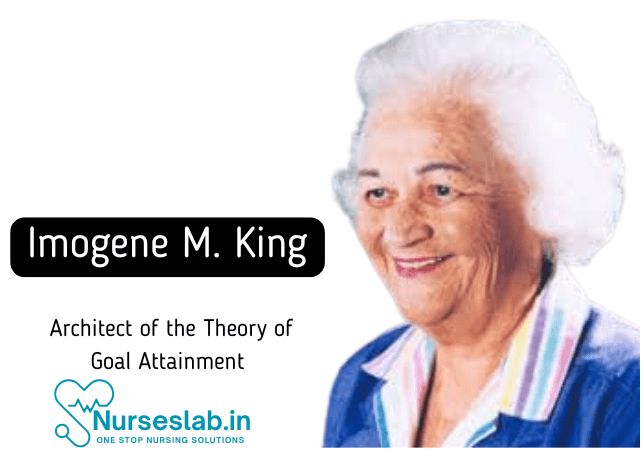
Imogene Martina King (1923–2007) was a visionary nurse theorist whose work transformed nursing into a dynamic, patient-centered discipline. Her Theory of Goal Attainment emphasized collaboration between nurse and patient to achieve health goals—an idea that continues to shape nursing education and practice worldwide.
Early Life & Education
- Born January 30, 1923, in West Point, Iowa, the youngest of three children.
- Initially aspired to be a teacher, but her uncle—a physician—encouraged her to pursue nursing.
- Earned a nursing diploma from St. John’s Hospital School of Nursing in 1945.
- Completed her BSN (1948) and MSN (1957) at St. Louis University.
- Received her Doctorate in Education (EdD) from Teachers College, Columbia University in 1961.
Career & Contributions
- Held academic roles at Loyola University, Ohio State University, and University of South Florida, where she retired as Professor Emeritus.
- Served as Assistant Chief of Research Grants at the U.S. Department of Health, Education, and Welfare.
- Developed a master’s program in nursing based on her conceptual framework at Loyola.
- Published her first theoretical article in 1964 and her landmark book Toward a Theory for Nursing in 1971.
Theory of Goal Attainment
King’s Conceptual System theory centers on nurse-patient interaction as a process of:
- Perception → Communication → Transaction → Goal Setting → Action → Evaluation
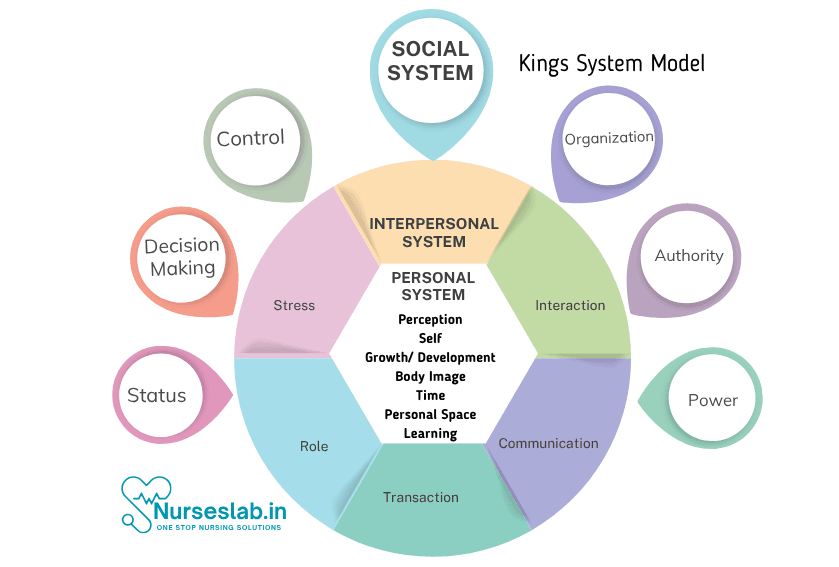
She identified three interacting systems:
| System | Key Concepts |
|---|---|
| Personal | Perception, self, growth, body image, time, space |
| Interpersonal | Interaction, communication, role, stress |
| Social | Organization, authority, power, decision-making |
Her theory asserts that mutual goal setting leads to better health outcomes and patient satisfaction.
Legacy & Honors
- Named a Living Legend by the American Academy of Nursing (2005).
- Inducted into the ANA Hall of Fame (2004).
- Received the Jessie M. Scott Award and multiple honors for her contributions to nursing education.
- Her work has been translated into multiple languages and applied globally in clinical, academic, and research settings.
- Passed away on December 24, 2007, in St. Petersburg, Florida.
Major Concepts
Three Interacting Systems in King’s Conceptual Framework
| System Type | Description |
|---|---|
| Personal System | Focuses on the individual’s perception, self, growth and development, body image, space, and time. Each person is seen as a unique, open system in constant interaction with their environment. |
| Interpersonal System | Involves interactions between two or more individuals. Key concepts include communication, interaction, transaction, role, and stress. This system is central to nurse-patient relationships. |
| Social System | Encompasses larger groups and organizations such as families, communities, and healthcare institutions. Concepts include organization, authority, power, status, and decision-making. |
These systems are interconnected, and changes in one can influence the others. King believed that understanding these systems helps nurses assess, plan, and evaluate care more effectively.
Key Concepts Supporting King’s Conceptual System Theory
- Perception: How individuals interpret their environment and experiences.
- Communication & Interaction: Essential for establishing trust and understanding.
- Transaction: A purposeful interaction leading to goal attainment.
- Role & Stress: Influence behavior and adaptation within systems.
Application of Imogene King’s Conceptual System in Nursing Practice
Imogene King’s Conceptual System focuses on goal attainment through nurse–patient interactions, guided by the personal, interpersonal, and social systems. Its application in nursing involves the following:
1. Assessment
- Evaluate the patient’s personal system (perception, growth, development, body image, learning, time, and space).
- Identify interpersonal factors influencing nurse–patient communication and interactions.
- Consider social system elements such as family, culture, healthcare team, and community support.
2. Goal Setting (Transaction Process)
- Engage in mutual decision-making between nurse and patient.
- Establish realistic and measurable health goals collaboratively.
3. Planning
- Develop a nursing care plan based on agreed-upon goals.
- Incorporate interventions that address personal, interpersonal, and social system needs.
4. Implementation
- Perform nursing interventions to help the patient achieve the established goals.
- Maintain effective communication and continuous interaction to facilitate progress.
5. Evaluation
- Determine goal attainment and the effectiveness of nursing actions.
- Modify the care plan if goals are unmet or require adjustment.
Case Scenario 1: Post-Myocardial Infarction (MI) Patient
Scenario:
Mr. A, 58 years old, was admitted to the cardiac unit after a mild myocardial infarction. He expresses fear of another heart attack and is uncertain about lifestyle changes.
Assessment (Based on King’s Systems)
- Personal system: Fear, limited knowledge about disease and diet changes.
- Interpersonal system: Communicates well but needs reassurance and guidance.
- Social system: Supportive spouse willing to assist with care.
Nursing Diagnoses
- Anxiety related to recent cardiac event as evidenced by verbal expressions of fear.
- Knowledge deficit related to secondary prevention and lifestyle modification.
Nursing Interventions
- Personal System:
- Assess the patient’s perception of illness and readiness to learn.
- Provide stress-reduction techniques (breathing exercises, relaxation).
- Interpersonal System:
- Initiate goal-setting conversation about cardiac rehab participation and diet changes.
- Offer emotional support and establish trust through active listening.
- Social System:
- Involve spouse in education sessions about cardiac diet and home care.
- Collaborate with a cardiac rehabilitation team for long-term follow-up.
Expected Outcome:
- Patient demonstrates reduced anxiety.
- Verbalizes understanding of lifestyle changes and participates in goal-directed cardiac rehab.
Case Scenario 2: Postpartum Mother Experiencing Breastfeeding Difficulties
Scenario:
Mrs. B, 28 years old, delivered a healthy baby 2 days ago. She reports breastfeeding pain, difficulty with latching, and fear she cannot feed her baby properly.
Assessment (Based on King’s Systems)
- Personal system: Physical discomfort, low self-confidence.
- Interpersonal system: Willing to learn but needs emotional reassurance.
- Social system: Mother-in-law and husband present and supportive.
Nursing Diagnoses
- Ineffective breastfeeding related to knowledge deficit and pain.
- Situational low self-esteem related to perceived inability to care for infant.
Nursing Interventions
- Personal System:
- Assess the mother’s perception of pain and breastfeeding challenges.
- Provide comfort measures (warm compresses, proper positioning).
- Interpersonal System:
- Teach and demonstrate proper latching techniques.
- Offer positive reinforcement to enhance confidence.
- Social System:
- Educate family to offer support and encouragement during breastfeeding.
- Refer to a lactation consultant if additional help is needed.
Expected Outcome:
- Mother demonstrates effective breastfeeding technique.
- Expresses increased confidence and reduced anxiety about infant care.
REFERENCES
- King, I.M. (1964). Nursing theory—Problems and prospect. Nursing Science, 2, 394–403.
- King, I.M. (1968). A conceptual frame of reference for nursing. Nursing Research, 17, 27–31.
- Frey, Maureen & Sieloff, Christina & Norris, Diane. (2002). King’s Conceptual System and Theory of Goal Attainment: Past, Present, and Future. Nursing science quarterly. 15. 107-12. https://www.researchgate.net/publication/11418329_King’s_Conceptual_System_and_Theory_of_Goal_Attainment_Past_Present_and_Future/citation/download
- King, I.M. (1971). Toward a theory for nursing: General concepts of human behavior. New York, NY: Wiley.
- Hagerty, T. A., Samuels, W., Norcini-Pala, A., & Gigliotti, E. (2017). Peplau’s Theory of Interpersonal Relations: An Alternate Factor Structure for Patient Experience Data? Nursing science quarterly, 30(2), 160-167.
- Scobbie, L., Dixon, D., & Wyke, S. (2011). Goal setting and action planning in the rehabilitation setting: development of a theoretically informed practice framework. Clinical Rehabilitation, 25(5), 468-482.
- Duwe, G. (2017). The use and impact of correctional programming for inmates on pre-and post-release outcomes. US Department of Justice, Office of Justice Programs, National Institute of Justice.
- King, I.M. (1981). A theory for nursing: Systems, concepts, process. New York: Wiley. [Reissued 1990. Albany, NY: Delmar.]
- Afza.Malik Imogene King’s Conceptual System and Theory of Goal Attainment, February 26, 2023, https://nurseseducator.com/imogene-kings-conceptual-system-and-theory-of-goal-attainment/
- King, I.M. (1983). King’s theory of nursing. In I.W. Clements & F.B. Roberts (Eds.), Family health: A theoretical approach to nursing care (pp. 177– 188). New York, NY: Wiley.
- King, I.M. (1986). King’s theory of goal attainment. In P. Winstead Fry (Ed.), Case studies in nursing theory (pp. 197–213). New York: National League for Nursing.
- King, I.M. (1987). King’s theory of goal attainment. In R.R. Parse (Ed.), Nursing science. Major paradigms, theories, and critiques (pp. 107–113). Philadelphia, PA: Saunders.
- King, I.M. (1988). Imogene M. King. In T.M. Schorr & A. Zimmerman (Eds.), Making choices. Taking chances. Nurse leaders tell their stories (pp. 146–153). St. Louis, MO: Mosby.
- King, I.M. (1989). King’s general systems framework and theory. In J.P. Riehl-Sisca (Ed.), Conceptual models for nursing practice (3rd ed., pp. 149–158). Norwalk, CT: Appleton & Lange.
- King, I.M. (1990a). Health as the goal for nursing. Nursing Science Quarterly, 3, 123–128.
- King, I.M. (1990b). King’s conceptual framework and theory of goal attainment. In M.E. Parker (Ed.), Nursing theories in practice (pp. 73–84). New York, NY: National League for Nursing.
- King, I.M. (1992). King’s theory of goal attainment. Nursing Science Quarterly, 5, 19–26.
- King, I.M. (1995a). A systems framework for nursing. In M.A. Frey & C.L. Sieloff (Eds.), Advancing King’s systems framework and theory of nursing (pp. 14–22). Thousand Oaks, CA: Sage.
- King, I.M. (1995b). The theory of goal attainment. In M.A. Frey & C.L. Sieloff (Eds.), Advancing King’s systems framework and theory of nursing (pp. 23–32). Thousand Oaks, CA: Sage.
- King, I.M. (1996). The theory of goal attainment in research and practice. Nursing Science Quarterly, 9, 61–66.
- King, I.M. (1997a). Reflections on the past and a vision for the future. Nursing Science Quarterly, 10, 15–17.
- King, I.M. (1997b). King’s theory of goal attainment in practice. Nursing Science Quarterly, 10, 180–185.
- King, I.M. (1999). A theory of goal attainment: Philosophical and ethical implications. Nursing Science Quarterly, 12, 292-296.
- King, I.M. (2001). Imogene M. King: Theory of goal attainment. In M.E. Parker (Ed.), Nursing theories and nursing practice (pp. 275-286). Philadelphia, PA: F.A. Davis.
Stories are the threads that bind us; through them, we understand each other, grow, and heal.
JOHN NOORD
Connect with “Nurses Lab Editorial Team”
I hope you found this information helpful. Do you have any questions or comments? Kindly write in comments section. Subscribe the Blog with your email so you can stay updated on upcoming events and the latest articles.


