


Explore the pathology of hemodynamic disorders: fluid imbalance, endothelial injury, and circulatory failure lead to edema, hemorrhage, thrombosis, embolism, infarction, and shock. Understanding these mechanisms is essential for diagnosing vascular pathology and preventing organ damage in clinical practice.
Understanding hemodynamic disorders is crucial for nurses, as these conditions are central to many acute and chronic illnesses encountered in clinical practice. By integrating knowledge of pathology and genetics, nurses can enhance patient outcomes through improved assessment, intervention, and education.
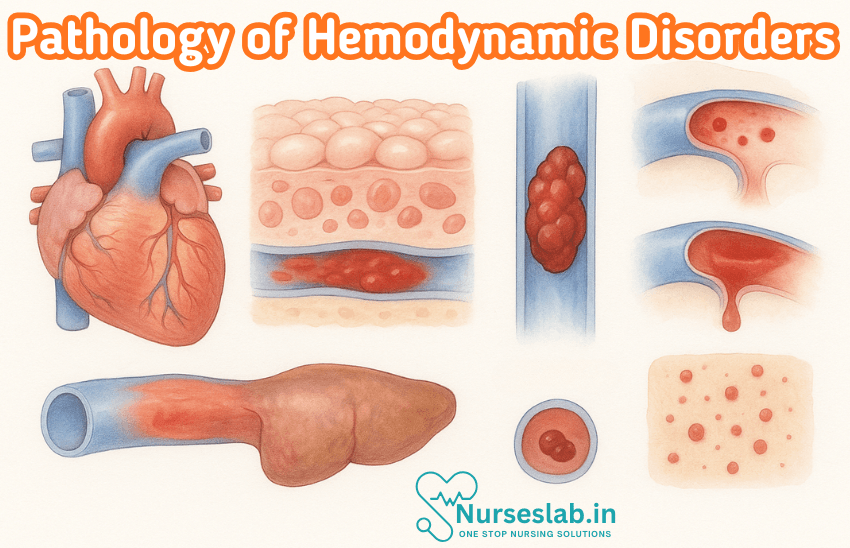
Introduction
Hemodynamic disorders—conditions affecting blood flow and the forces within the circulatory system—are pivotal in the development and progression of numerous diseases. Nurses are often the first to recognise early signs of hemodynamic compromise and play a vital role in monitoring, intervention, and patient education. A strong grasp of the underlying pathology and genetic factors enables nurses to deliver holistic, evidence-based care, anticipate complications, and contribute to multidisciplinary management strategies.
Pathology and Genetics: Relevance for Nurses
Pathology provides the foundation for understanding disease mechanisms, while genetics offers insight into individual susceptibility and inheritance patterns. Together, these disciplines help nurses interpret clinical findings, support patients with inherited conditions, and promote personalised care. In an era of precision medicine, integrating genetic knowledge into nursing practice is increasingly essential to manage hemodynamic disorders.
Hemodynamic Disorders – Definition and Classification
Normal Hemodynamics: An Overview
Normal hemodynamics refers to the physiological processes that maintain stable blood flow and pressure throughout the body’s tissues and organs. Key elements include:
- Cardiac output: The amount of blood pumped by the heart per minute.
- Vascular resistance: The resistance blood encounters as it flows through vessels.
- Blood volume: The total amount of circulating blood.
- Capillary permeability: The ability of substances to move across capillary walls.
Disruption in any of these components can result in hemodynamic disorders, leading to tissue hypoperfusion, oedema, or organ dysfunction.
Classification of Hemodynamic Disorders
Hemodynamic disorders can be broadly classified into:
- Disorders of fluid balance: e.g., oedema, dehydration.
- Disorders of blood flow: e.g., thrombosis, embolism.
- Disorders of blood pressure and perfusion: e.g., shock, hypertension.
Pathophysiology of Hemodynamic Disorders
Mechanisms Affecting Hemodynamic Stability
Hemodynamic stability is governed by a delicate balance between hydrostatic pressure, oncotic pressure, and the integrity of the vascular system. Key mechanisms include:
- Fluid Balance: The movement of water between blood vessels and tissues is controlled by hydrostatic (pushing) and oncotic (pulling) pressures. Imbalances can lead to fluid accumulation (oedema) or depletion.
- Vascular Integrity: Damage to blood vessels from inflammation, trauma, or infection can increase permeability, allowing proteins and cells to leak into tissues.
- Blood Flow: Normal flow is laminar and uninterrupted. Disruptions, such as turbulence from vessel narrowing or stasis from immobility, can predispose to clot formation.
Key Pathological Processes
- Oedema: Excess fluid in interstitial spaces due to increased hydrostatic pressure, reduced oncotic pressure, or increased capillary permeability.
- Thrombosis: Formation of a blood clot within a vessel, often due to endothelial injury, abnormal flow, or hypercoagulability.
- Embolism: Obstruction of a vessel by material (e.g., thrombus, fat, air) travelling through the bloodstream.
- Shock: Critical reduction in tissue perfusion, resulting in cellular injury and organ dysfunction.
Genetic Factors in Hemodynamic Disorders
Genetic Predispositions
Genetics plays a significant role in predisposing individuals to certain hemodynamic disorders. Inherited mutations or polymorphisms can affect coagulation pathways, vascular structure, or cardiac function, increasing susceptibility to conditions such as thrombosis, embolic events, or shock.
Examples of Inherited Conditions Affecting Hemodynamics
- Hereditary Thrombophilia: Conditions like Factor V Leiden mutation and prothrombin gene mutation increase the risk of abnormal clot formation.
- Familial Hypercholesterolaemia: Genetic disorders affecting lipid metabolism can promote atherosclerosis and vascular occlusion.
- Hereditary Haemorrhagic Telangiectasia: A genetic disorder leading to vascular malformations and bleeding tendencies.
- Marfan Syndrome: A connective tissue disorder causing vascular fragility and risk of aortic dissection.
Genetic testing and family history are valuable tools in identifying at-risk individuals and guiding preventive strategies.
Common Hemodynamic Disorders
1. Oedema
Causes
- Increased hydrostatic pressure (e.g., heart failure, venous obstruction).
- Reduced plasma oncotic pressure (e.g., nephrotic syndrome, liver disease).
- Increased capillary permeability (e.g., inflammation, allergic reactions).
- Lymphatic obstruction (e.g., malignancy, infection).
Types
- Localised oedema: Confined to a specific area, often due to localised injury or inflammation.
- Generalised oedema (anasarca): Widespread, often due to systemic illness such as heart or renal failure.
Clinical Features
- Swelling of affected tissues
- Pitting on pressure (in some cases)
- Discomfort, restricted movement
- Potential complications: skin breakdown, infection
2. Thrombosis
Pathogenesis
Thrombosis results from Virchow’s triad—endothelial injury, abnormal blood flow, and hypercoagulability. Each factor contributes to the formation of an intravascular blood clot.
Risk Factors
- Inherited thrombophilia (e.g., Factor V Leiden)
- Prolonged immobility
- Major surgery or trauma
- Malignancy
- Pregnancy, oral contraceptive use
- Obesity, smoking
Complications
- Venous thromboembolism (VTE): deep vein thrombosis (DVT) and pulmonary embolism (PE)
- Arterial thrombosis: myocardial infarction, stroke
- Post-thrombotic syndrome: chronic pain and swelling
3. Embolism
Types
- Thromboembolism: Most common type, where a fragment of a thrombus travels to a distant site.
- Fat embolism: Often following long bone fractures.
- Air embolism: Entry of air into the circulation, e.g., during surgery or trauma.
- Amniotic fluid embolism: Rare, but catastrophic complication during childbirth.
Clinical Significance
Emboli can obstruct blood flow to vital organs, causing infarction (tissue death), stroke, or sudden death, depending on size and location.
4. Shock
Types
- Hypovolaemic shock: Due to loss of blood or plasma volume (e.g., haemorrhage, burns).
- Cardiogenic shock: Due to pump failure (e.g., myocardial infarction, arrhythmias).
- Distributive shock: Due to abnormal distribution of blood flow (e.g., septic shock, anaphylaxis).
- Obstructive shock: Due to physical obstruction of blood flow (e.g., pulmonary embolism, cardiac tamponade).
Stages of Shock
- Initial (compensated): The body activates compensatory mechanisms (e.g., increased heart rate, vasoconstriction) to maintain perfusion.
- Progressive (decompensated): Compensatory mechanisms fail, leading to worsening tissue hypoxia and cellular dysfunction.
- Irreversible: Profound organ damage and failure; recovery is unlikely even with intervention.
Pathophysiology
Shock leads to inadequate oxygen delivery, cellular energy failure, accumulation of metabolic waste, and multi-organ dysfunction. Early recognition and intervention are critical.
Clinical Implications and Diagnosis
Signs and Symptoms
Clinical presentation varies with the type and severity of the disorder:
- Oedema: Swelling, weight gain, decreased mobility, skin changes.
- Thrombosis: Limb pain/swelling (DVT), chest pain/dyspnoea (PE), neurological deficits (stroke).
- Embolism: Sudden-onset symptoms—chest pain, breathlessness, neurological impairment.
- Shock: Hypotension, tachycardia, cold clammy skin, confusion, oliguria.
Diagnostic Approaches
Diagnosis involves a combination of clinical assessment, laboratory tests, and imaging studies:
- History and physical examination: Identifying risk factors and clinical signs.
- Laboratory investigations: Full blood count, coagulation profile, D-dimer, cardiac enzymes, arterial blood gases.
- Imaging studies: Ultrasound (for DVT), CT/MRI (for embolism, stroke), echocardiography (for cardiac function), X-ray (for fluid overload).
- Genetic testing: In selected cases, to identify inherited risk factors for thrombosis or vascular disorders.
Management and Nursing Considerations
Medical Management
- Oedema: Treat underlying cause, diuretics, fluid restriction, limb elevation, compression stockings.
- Thrombosis: Anticoagulation (heparin, warfarin, DOACs), thrombolysis, surgical intervention.
- Embolism: Supportive care, anticoagulation, surgical or catheter-based removal of embolus.
- Shock: Airway and breathing support, intravenous fluids, vasopressors/inotropes, address underlying cause (e.g., antibiotics for sepsis, blood transfusion for haemorrhage).
Nursing Interventions
- Monitor vital signs, fluid balance, and neurological status.
- Early recognition of deterioration and prompt escalation of care.
- Administer prescribed medications and monitor for adverse effects.
- Implement preventive strategies: pressure injury prevention, deep vein thrombosis prophylaxis, infection control.
- Provide emotional support and education to patients and families regarding disease process, prognosis, and self-care.
Patient Education
- Importance of medication adherence and follow-up appointments.
- Recognition of warning signs (e.g., sudden swelling, chest pain, breathlessness).
- Lifestyle modifications: smoking cessation, regular exercise, healthy diet, weight management.
- Genetic counselling for families with inherited conditions.
Monitoring and Prevention Strategies
- Routine risk assessment for venous thromboembolism in hospitalised patients.
- Prophylactic anticoagulation and mechanical measures in high-risk individuals.
- Early mobilisation post-surgery or during hospitalisation.
- Regular monitoring of laboratory parameters and therapeutic drug levels.
Case Studies and Practical Scenarios
Case Study 1: Deep Vein Thrombosis in a Postoperative Patient
A 55-year-old woman, post-abdominal surgery, develops swelling and pain in her left calf. Physical examination reveals tenderness and increased warmth. Ultrasound confirms Deep Vein Thrombosis. She is started on low-molecular-weight heparin. Nursing care includes close monitoring for bleeding, education on anticoagulation, and use of compression stockings. Preventive measures for other patients include early mobilisation and risk assessment.
Case Study 2: Acute Pulmonary Embolism in a Young Adult with Factor V Leiden
A 28-year-old man presents with sudden shortness of breath and chest pain. He has a family history of thrombosis. CT pulmonary angiography confirms a pulmonary embolism. Laboratory testing reveals he is heterozygous for Factor V Leiden mutation. Management involves anticoagulation, genetic counselling, and education regarding risk factors for future events.
Case Study 3: Anasarca in Chronic Kidney Disease
A 65-year-old man with long-standing diabetes and hypertension is admitted with generalised swelling. Examination and investigations reveal anasarca secondary to nephrotic syndrome. Nursing interventions include fluid balance monitoring, skin care, dietary advice, and psychosocial support.
Case Study 4: Septic Shock in an Elderly Patient
An 80-year-old woman with pneumonia develops hypotension, tachycardia, and confusion. She is diagnosed with septic shock. Management includes intravenous antibiotics, fluid resuscitation, vasopressors, and supportive care. The nurse monitors for signs of organ dysfunction, maintains strict infection control, and provides communication support for the family.
REFERENCES
- Ramadas Nayak, Textbook of Pathology and Genetics for Nurses, 2nd Edition,2024, Jaypee Publishers, ISBN: 978-93-5270-031-8.
- Suresh Sharma, Textbook of Pharmacology, Pathology & Genetics for Nurses II, 2nd Edition, 31 August 2022, Jaypee Publishers, ISBN: 978-9354655692.
- Kumar, V., Abbas, A.K., & Aster, J.C. (2020). Robbins and Cotran Pathologic Basis of Disease. 10th Edition. Elsevier.
- McCance, K.L., & Huether, S.E. (2018). Pathophysiology: The Biologic Basis for Disease in Adults and Children. 8th Edition. Elsevier.
- Prabhu, S.R. (2023). Hemodynamic Disorders. In: Textbook of General Pathology for Dental Students. Springer, Cham. https://doi.org/10.1007/978-3-031-31244-1_13
- Elzagheid, Adam. (2020). Hemodynamic in General Pathology. 10.13140/RG.2.2.30432.02561.
Stories are the threads that bind us; through them, we understand each other, grow, and heal.
JOHN NOORD
Connect with “Nurses Lab Editorial Team”
I hope you found this information helpful. Do you have any questions or comments? Kindly write in comments section. Subscribe the Blog with your email so you can stay updated on upcoming events and the latest articles.


