


Adeline Falk-Rafael’s Critical Caring Theory is a mid-range nursing theory that blends Jean Watson’s caring science with critical feminist perspectives, aiming to re-center social justice within public health nursing practice.
Life Story of Adeline Falk- Rafael
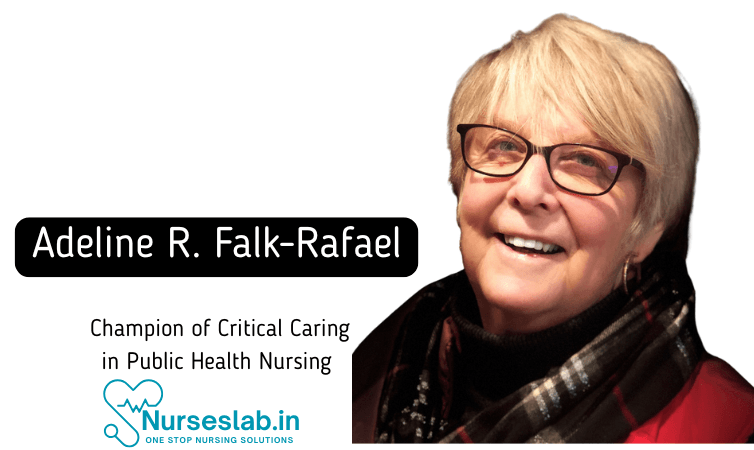
Dr. Adeline Falk-Rafael is a distinguished Canadian nursing theorist, educator, and researcher whose work has profoundly shaped public health nursing through her development of the Critical Caring Theory. Her career reflects a deep commitment to social justice, empowerment, and holistic care.
Early Life & Education
- Began her nursing journey in the 1960s.
- Earned her BScN (1989) from University of Western Ontario, MSN (1993) from D’Youville College, and PhD (1997) from University of Colorado.
- Her academic path was rooted in both clinical practice and a passion for community health.
Career & Contributions
- Served as Dean of Nursing at the University of Saskatchewan.
- Held faculty positions at York University in Ontario, Canada.
- Focused on public health nursing, nursing education, and health equity.
- Developed the Critical Caring Theory, a mid-range theory integrating:
- Jean Watson’s Theory of Human Caring
- Critical Social Theory
- Advocated for nurses as agents of social change, emphasizing political action to address health disparities.
Critical Caring Theory: Core Processes
| Process | Description |
|---|---|
| Trusting Relationship | Building authentic, caring connections |
| Health Promotion | Supporting positive health behaviors |
| Basic Needs Care | Attending to physical well-being |
| Inner Self Care | Nurturing emotional and spiritual health |
| Social Action | Engaging in advocacy and policy change |
| Facilitating Learning | Empowering through education |
| Healing Environment | Creating spaces that foster recovery |
This model encourages nurses to witness injustice downstream and advocate upstream for systemic change—a metaphor she calls the “Trombone Slide” of nursing.
Selected Publications
- Advancing Nursing Theory Through Theory-Guided Practice (2005)
- Speaking Truth to Power: Nursing’s Legacy and Moral Imperative (2005)
- Empowerment as a Process of Evolving Consciousness (2001)
- Globalization and Global Health: Toward Nursing Praxis in the Global Community (2006)
Her work appears in journals like Advances in Nursing Science and Journal of Nursing Education.
Recognition & Affiliations
- Fellow, American Academy of Nursing
- Honorary Life Member, Registered Nurses Association of Ontario (2011)
- Member of:
- Canadian Nurses Association
- Community Health Nurses of Canada
- College of Nurses of Ontario
Major Concepts of Critical caring Theory
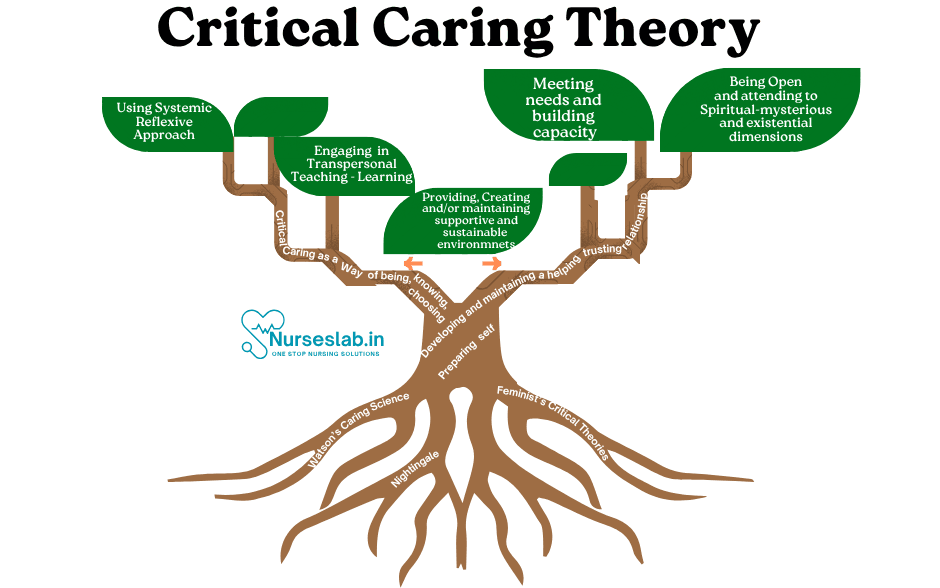
Caring, Critical Caring Health Promoting Processes, political activism, social justice, public health nursing practice
- Hybrid Foundation: Merges Watson’s carative factors with feminist critiques of power and inequity.
- Seven Carative Health-Promoting Processes: These form the “core” of public health nursing practice:
- Building trusting relationships
- Advocating for social justice
- Promoting health equity
- Empowering individuals and communities
- Creating supportive environments
- Engaging in reflective practice
- Collaborating across disciplines
Application of Adeline Falk-Rafael’s Critical Caring Theory
- Patient and Community Assessment
- Identify individual and community health needs, focusing on social determinants of health such as housing, education, income, and access to care.
- Assess vulnerable populations for inequities that impact well-being.
- Planning and Advocacy
- Develop patient-centered and community-centered plans that address both clinical and social needs.
- Advocate for resources, policies, and services that promote health equity.
- Intervention
- Deliver holistic nursing care addressing physical, psychological, social, and environmental factors.
- Empower patients and communities through education, health promotion, and self-care strategies.
- Engage in policy discussions or community programs to reduce health disparities.
- Evaluation
- Assess patient health outcomes along with community impact.
- Evaluate reductions in disparities and improvements in access and quality of care.
Case Scenario 1: Homeless Patient with Uncontrolled Diabetes
Scenario:
Mr. J, 55 years old, is homeless and presents to the clinic with poorly controlled Type 2 Diabetes. He reports inconsistent meals, difficulty storing insulin, and fear of losing his shelter spot if he seeks care. He shows foot wounds and high blood sugar levels.
Possible Nursing Diagnoses:
- Ineffective health management related to lack of resources and unstable housing.
- Risk for infection related to open foot wounds.
- Powerlessness related to socioeconomic and environmental barriers.
Nursing Interventions (Critical Caring Approach):
- Assess social determinants of health: Identify housing instability, food insecurity, and lack of access to care.
- Provide wound care and diabetic teaching adapted to his living conditions.
- Collaborate with social workers to arrange temporary housing or shelters with medical access.
- Advocate for community resources (free clinics, mobile health units, food programs).
- Empower the patient by setting realistic self-care goals within his circumstances.
Case Scenario 2: Immigrant Mother with Limited Access to Prenatal Care
Scenario:
Mrs. L, 28 years old, recently immigrated and speaks limited English. She is pregnant with her second child, has no insurance, and reports fear of discrimination at the hospital. She shows signs of anemia and anxiety about giving birth.
Possible Nursing Diagnoses:
- Risk for impaired fetal growth related to inadequate prenatal care.
- Anxiety related to cultural and language barriers.
- Ineffective health-seeking behavior related to lack of knowledge of available resources.
Nursing Interventions (Critical Caring Approach):
- Provide culturally sensitive communication using interpreter services.
- Educate about prenatal care, nutrition, and warning signs in a language she understands.
- Connect with community programs for free prenatal care and nutritional support (e.g., WIC).
- Advocate for access to healthcare services regardless of immigration status.
- Empower the patient to attend regular prenatal visits and engage in safe self-care practices.
REFERENCES
- Falk-Rafael, Adeline. (2005). Speaking truth to power: nursing’s legacy and moral imperative. ANS. Advances in Nursing Science, 28(3), 212–223. https://doi.org/10.1097/00012272-200507000-00004
- Falk-Rafael, Adeline R. (2005). Advancing nursing theory through theory-guided practice: the emergence of a critical caring perspective. ANS. Advances in Nursing Science, 28(1), 38–49. http://www.ncbi.nlm.nih.gov/pubmed/15718937
- Falk-Rafael, Adeline R., & Betker, Claire. (2012). The primacy of relationships: a study of public health nursing practice from a critical caring perspective. ANS. Advances in Nursing Science, 35(4), 315–332. https://doi.org/10.1097/ANS.0b013e318271d127 https://pubmed.ncbi.nlm.nih.gov/30230200/
- Chinn PL, Falk-Rafael A. Embracing the Focus of the Discipline of Nursing: Critical Caring Pedagogy. J Nurs Scholarsh. 2018 Nov;50(6):687-694. doi: 10.1111/jnu.12426. Epub 2018 Sep 19. PMID: 30230200.
- Falk-Rafael, Adeline R., & Betker, Claire. (2012). Witnessing Social Injustice Downstream and Advocating for Health Equity Upstream: “The Trombone Slide” of Nursing. ANS. Advances in Nursing Science, 35(2), 98–112. https://doi.org/10.1097/ANS.0b013e31824fe70f
- Falk-Rafael, A.R. (In press). Critical Caring. In Smith, M. (Ed). Nursing Theory and Nursing Practice (6th ed.) F.A. Davis: Philadelphia
Stories are the threads that bind us; through them, we understand each other, grow, and heal.
JOHN NOORD
Connect with “Nurses Lab Editorial Team”
I hope you found this information helpful. Do you have any questions or comments? Kindly write in comments section. Subscribe the Blog with your email so you can stay updated on upcoming events and the latest articles.


