


Last Updated on January 16, 2026 by Nurseslab.in Editorial Team
A one-to-one interview is a qualitative research method where a researcher conducts a face-to-face or virtual conversation with a single participant to collect detailed information about their thoughts, experiences, and perspectives. This method is widely used in fields like sociology, psychology, market research, and education to explore topics in depth.
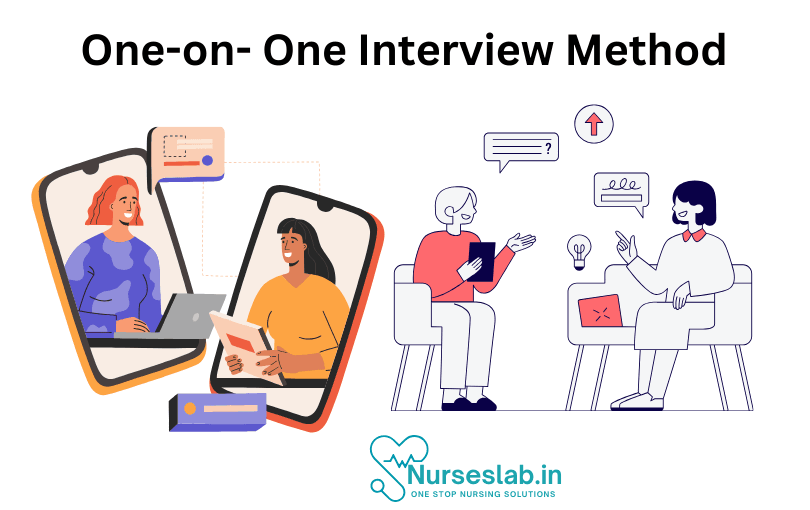
This article provides an overview of the methods for conducting one-to-one interviews and a practical guide to executing them effectively.
One-to-One Interview
A one-to-one interview involves direct communication between a researcher and a participant, focusing on gathering rich, detailed data through open-ended questions. Unlike surveys or group discussions, it allows for personalized interaction and deeper exploration of individual experiences and opinions.
Example:
- A researcher interviewing a teacher to understand the challenges of integrating technology in classrooms.
Importance of One-to-One Interviews
- In-Depth Understanding: Provides detailed insights into participants’ thoughts and experiences.
- Personalized Approach: Adapts questions and follow-ups to the individual’s responses.
- Flexibility: Allows for clarification and exploration of unexpected themes.
- Rich Data: Captures emotions, motivations, and nuanced perspectives.
- Confidentiality: Ensures participants can share sensitive or personal information in a private setting.
Techniques for One-On-One Interviews
One-on-one interviews are a common and valuable method for assessing candidates during hiring. Employers use various techniques to make these interviews effective in evaluating a candidate’s skills, qualifications, and cultural fit. Here are some strategies for conducting successful one-on-one interviews:
1. Structured Interviews
In a structured interview, the interviewer follows a predetermined set of questions for all candidates. This consistency allows for a fair and objective evaluation of each candidate based on the same criteria.
The questions are carefully crafted to assess specific competencies, skills, and experiences relevant to the job.
2. Behavioral Interviews
This technique probes a candidate’s past behavior to predict future performance. Interviewers ask questions that require candidates to share specific examples of how they have handled situations in the past.
The STAR method (Situation, Task, Action, Result) is often used to structure responses and better understand a candidate’s abilities.
3. Situational Interviews
Situational interviews present hypothetical scenarios related to the job, and candidates are asked how they would approach or solve these situations.
This technique assesses a candidate’s problem-solving skills, decision-making process, and ability to apply knowledge to real-world situations.
4. Case Interviews
Common in industries such as consulting and finance, case interviews present candidates with real or hypothetical business problems. Candidates are expected to analyze the situation and provide solutions.
This technique evaluates analytical thinking, strategic planning, and the ability to apply knowledge to practical challenges.
5. Competency-Based Interviews
Competency-based interviews focus on specific competencies required for the job. Interviewers assess how well candidates align with these key competencies through targeted questions.
This technique helps evaluate a candidate’s suitability for the role based on the identified core competencies.
6. Role-Playing Exercises
In certain situations, role-playing exercises can be employed to simulate on-the-job scenarios. This allows the interviewer to observe how candidates handle specific tasks or interpersonal interactions.
Role-playing provides insights into a candidate’s practical skills, adaptability, and ability to perform under pressure.
7. Panel Interviews
While not strictly one-on-one, panel interviews involve multiple interviewers questioning a candidate simultaneously. Each panel member may represent different aspects of the job or the organization.
This technique provides diverse perspectives and allows for a more comprehensive evaluation.
8. Informational Interviews
Informational interviews focus on gathering more information about the candidate’s background, experiences, and aspirations. It creates a more conversational setting to understand the candidate’s motivations and career goals.
Methods of Conducting One-to-One Interviews
1. Structured Interviews
- Description: The researcher uses a predefined set of questions with little deviation.
- Advantages:
- Ensures consistency across interviews.
- Facilitates comparison between participants.
- Example: Asking all employees the same questions about job satisfaction in a workplace study.
2. Semi-Structured Interviews
- Description: Combines predefined questions with the flexibility to explore new topics based on participant responses.
- Advantages:
- Balances consistency with adaptability.
- Encourages deeper exploration of themes.
- Example: A researcher interviewing patients about their healthcare experiences and probing further based on their answers.
3. Unstructured Interviews
- Description: A conversational approach with minimal predefined questions, focusing on broad themes.
- Advantages:
- Encourages participants to speak freely.
- Uncovers unexpected insights.
- Example: Exploring a historian’s perspective on a significant historical event with an open-ended conversation.
4. In-Depth Interviews
- Description: A detailed exploration of a participant’s experiences, often lasting over an hour.
- Advantages:
- Provides comprehensive insights into complex topics.
- Ideal for sensitive or niche topics.
- Example: Understanding the coping strategies of cancer survivors through detailed interviews.
Guide to Conducting One-to-One Interviews
1. Preparation
- Define Objectives: Clarify the purpose of the interview and the information you aim to gather.
- Develop an Interview Guide: Create a list of questions or themes to address during the conversation.
- Choose the Right Setting: Ensure the interview location is quiet, comfortable, and free from distractions.
- Test Equipment: For recorded interviews, check devices like recorders or video conferencing tools in advance.
- Obtain Consent: Inform participants about the purpose of the interview and how their data will be used.
2. Conducting the Interview
- Build Rapport: Start with small talk or simple questions to make the participant comfortable.
- Ask Open-Ended Questions: Use questions that encourage detailed responses.
- Example: “Can you describe your experience with remote work during the pandemic?”
- Listen Actively: Pay close attention to the participant’s responses and use verbal and non-verbal cues to show engagement.
- Probe for Details: Use follow-up questions to clarify or expand on responses.
- Example: “You mentioned challenges with collaboration. Can you elaborate on what made it difficult?”
- Maintain Neutrality: Avoid leading questions or expressing personal opinions to ensure unbiased responses.
3. Closing the Interview
- Summarize Key Points: Recap the main topics discussed to confirm understanding.
- Invite Final Thoughts: Ask if the participant has anything additional to share.
- Example: “Is there anything else you’d like to add about your experience?”
- Express Gratitude: Thank the participant for their time and insights.
4. Post-Interview Tasks
- Transcription: Convert audio or video recordings into text for analysis.
- Review Notes: Highlight key themes, patterns, or notable quotes.
- Data Analysis: Organize responses using coding or thematic analysis to draw conclusions.
Tips for Effective One-to-One Interviews
- Be Respectful of Time: Stick to the agreed duration and respect the participant’s schedule.
- Create a Comfortable Environment: Ensure the participant feels safe and valued.
- Use Non-Verbal Cues: Nod, maintain eye contact, and use facial expressions to encourage openness.
- Adapt to the Participant: Adjust your approach based on the participant’s comfort level and communication style.
- Stay Neutral: Avoid judgmental reactions to maintain the participant’s trust.
Advantages of One-to-One Interviews
- Customizable: Tailored to individual participants for detailed insights.
- Confidential: Provides a safe space for participants to share sensitive information.
- Exploratory: Allows for in-depth exploration of complex or sensitive topics.
- Flexible: Adapts to emerging themes during the conversation.
Limitations of One-to-One Interviews
- Time-Consuming: Requires significant time for conducting, transcribing, and analyzing interviews.
- Potential for Bias: Researcher bias may influence questioning or interpretation.
- Limited Generalizability: Small sample sizes may not represent broader populations.
- Dependence on Participant Honesty: Responses rely on the participant’s willingness and ability to share truthful information.
Examples of One-to-One Interview Applications
1. Education
- Objective: Understand the challenges faced by teachers during remote learning.
- Method: Conduct semi-structured interviews with 20 teachers across different schools.
2. Healthcare
- Objective: Explore patient experiences with telemedicine services.
- Method: Use in-depth interviews to gather insights from patients with chronic conditions.
3. Business
- Objective: Assess employee satisfaction with a new workplace policy.
- Method: Conduct structured interviews with a random sample of employees.
4. Social Science
- Objective: Investigate how individuals from different backgrounds perceive climate change.
- Method: Use unstructured interviews to capture diverse perspectives.
REFERENCES
- Creswell, J. W. (2018). Research Design: Qualitative, Quantitative, and Mixed Methods Approaches. Sage Publications.
- Patton, M. Q. (2015). Qualitative Research and Evaluation Methods. Sage Publications.
- Seidman, I. (2019). Interviewing as Qualitative Research: A Guide for Researchers in Education and the Social Sciences. Teachers College Press.
- Stofer, Kathryn. (2019). Preparing for One-on-One Qualitative Interviews: Designing and Conducting the Interview. EDIS. 2019. 4. 10.32473/edis-wc338-2019.
- Christine Rhodes, Yasuhiro Kotera & HongIan Lim. (2023) Identifying strengths in response to social isolation during the COVID-19 pandemic among pre-university students in Singapore: a thematic enquiry. British Journal of Guidance & Counselling 51:6, pages 899-910.
- QuestionPro, One-On-One Interviews: Techniques, Questions, Pros & Cons, https://www.questionpro.com/blog/one-on-one-interviews/
Stories are the threads that bind us; through them, we understand each other, grow, and heal.
JOHN NOORD
Connect with “Nurses Lab Editorial Team”
I hope you found this information helpful. Do you have any questions or comments? Kindly write in comments section. Subscribe the Blog with your email so you can stay updated on upcoming events and the latest articles.


