


Last Updated on January 21, 2026 by Nurseslab.in Editorial Team
Introduction
Knee gel injections, often referred to as viscosupplementation, have emerged as a widely used treatment for individuals suffering from knee osteoarthritis and chronic joint pain. Characterized by pain, stiffness, and loss of mobility, knee osteoarthritis can significantly impact the quality of life. While oral medications, physical therapy, and even surgery are common options, knee gel injections offer a minimally invasive alternative aimed at improving joint function and reducing discomfort.
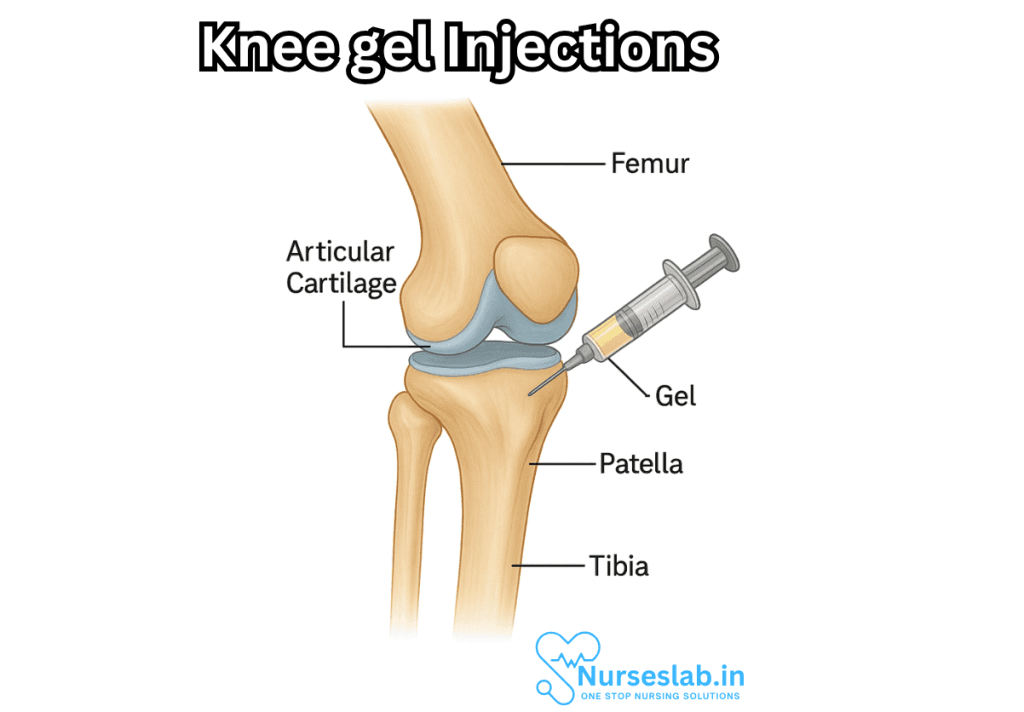
What Are Knee Gel Injections?
Knee gel injections involve the administration of a gel-like substance, typically hyaluronic acid, directly into the knee joint. Hyaluronic acid is a naturally occurring molecule in the synovial fluid—the lubricating substance found within healthy joints. Its primary function is to cushion and lubricate the joint, enabling smooth movement and absorbing shock.
As osteoarthritis progresses, the concentration and quality of hyaluronic acid in the knee joint diminish, resulting in increased friction between the bones, pain, and inflammation. By injecting a synthetic or animal-derived version of hyaluronic acid back into the joint, viscosupplementation aims to restore lubrication, reduce pain, and improve mobility.
Types of Knee Gel Injections
There are several formulations of hyaluronic acid injections available, each varying in molecular weight, source, and dosing schedule. The most common types include:
- Low-molecular-weight hyaluronic acid: Derived mostly from rooster combs (avian source), generally administered as a series of injections over several weeks.
- High-molecular-weight hyaluronic acid: Often synthetic or bacterial fermentation-based, sometimes given as a single injection.
- Cross-linked hyaluronic acid: Modified to last longer in the joint, requiring fewer injections for sustained results.
Some brand names you may encounter include Synvisc, Euflexxa, Orthovisc, Supartz, and Monovisc.
Who Can Benefit from Knee Gel Injections?
Viscosupplementation is typically recommended for individuals with mild to moderate osteoarthritis who have not experienced sufficient relief from other treatments such as oral pain medications, corticosteroid injections, or physical therapy. It is less effective for those with severe bone-on-bone changes or advanced arthritis.
Ideal candidates often include:
- Adults with persistent knee pain due to osteoarthritis
- Patients seeking to delay or avoid knee replacement surgery
- Individuals unable to tolerate nonsteroidal anti-inflammatory drugs (NSAIDs)
- Those looking for non-surgical pain management options
However, knee gel injections may not be suitable for everyone. People with allergies to avian products, infections in the knee, or bleeding disorders should consult their physician before considering this therapy.
The Procedure: What to Expect
The process of receiving knee gel injections is relatively straightforward and can be performed in a clinical setting:
- The patient is seated or lying down with the knee exposed.
- The skin over the joint is cleaned, and a local anesthetic may be applied.
- Using image guidance (often ultrasound), the physician inserts a needle into the knee joint space.
- The hyaluronic acid gel is injected directly into the joint.
- In some cases, excess joint fluid may be removed prior to the injection (joint aspiration).
Depending on the product, the procedure may involve a single injection or a series of injections spaced out over several weeks.
Benefits of Knee Gel Injections
The potential advantages of knee gel injections include:
- Pain relief: Many patients report significant reduction in knee pain, especially during activities such as walking, climbing stairs, or exercising.
- Improved mobility: Enhanced joint lubrication can lead to greater flexibility and range of motion.
- Delay of surgery: For some, viscosupplementation helps postpone the need for knee replacement or other invasive procedures.
- Low risk profile: Compared to surgery, knee gel injections are minimally invasive and associated with fewer complications.
It is important to note that not every patient will experience the same level of benefit, and improvements may take several weeks to manifest.
Side Effects and Risks
Knee gel injections are generally considered safe, but, as with any medical procedure, there are associated risks. Common side effects include:
- Mild pain, swelling, or stiffness in the injected knee
- Redness or warmth at the injection site
- Rarely, infection or allergic reaction
- Joint effusion (accumulation of fluid)
Most side effects are minor and resolve within a few days. Patients should contact their healthcare provider if they experience severe pain, fever, or symptoms suggestive of infection.
Effectiveness: What Does the Research Say?
Medical studies have demonstrated mixed results regarding the effectiveness of knee gel injections. Some patients experience marked relief lasting several months, while others report minimal improvement. Factors that can influence outcomes include the severity of arthritis, activity level, overall health, and the specific formulation used.
A meta-analysis of clinical trials suggests that viscosupplementation may offer modest pain relief for certain individuals, particularly those in early stages of osteoarthritis. However, leading organizations such as the American Academy of Orthopaedic Surgeons (AAOS) and the Osteoarthritis Research Society International (OARSI) have highlighted the need for more robust evidence to establish definitive guidelines.
Alternatives to Knee Gel Injections
For those seeking other strategies to address knee pain, the following options may be considered:
- Physical therapy: Targeted strengthening and stretching exercises
- Oral medications: NSAIDs, acetaminophen, or supplements
- Corticosteroid injections: Potent anti-inflammatory agents
- Platelet-rich plasma (PRP) injections: Uses the patient’s own blood components to promote healing
- Weight management: Reducing body weight can decrease joint stress
- Surgical interventions: Procedures such as arthroscopy or knee replacement for advanced disease
Living with Osteoarthritis: Tips for Managing Knee Pain
Beyond medical treatments, lifestyle modifications play a crucial role in managing knee osteoarthritis:
Consider assistive devices like knee braces or canessually work faster and more consistently than gel shots to relieve knee pain. Gel shots don’t work for everyone, and when they do, they can take a few weeks to kick in. Cortisone shots kick in more immediately, but they only last a few months. Gel injections last an average of six months.
- Engage in low-impact activities such as swimming, cycling, or walking
- Maintain a healthy weight to reduce joint strain
- Use supportive footwear and orthotics
- Practice gentle stretching to preserve flexibility
Nursing Care of Patient with Knee Gel Injections
Gel injections for the knee, often used to manage osteoarthritis, require attentive nursing care to ensure patient safety, comfort, and optimal therapeutic outcomes.
Pre-Procedure Preparation
- Patient Education: Explain the purpose of knee gel injections, the expected benefits, and any potential side effects. Clarify the procedure steps and answer any questions to alleviate apprehension.
- Allergy Assessment: Assess for allergies to medications, including hyaluronic acid products, or any components of the injectable gel.
- Site Assessment: Examine the injection site for signs of infection, swelling, or skin compromise. Notify the healthcare provider of any abnormalities.
- Consent: Ensure informed consent is obtained and documented prior to the procedure.
Post-Procedure Nursing Care
- Monitoring: Observe for immediate adverse reactions, such as local swelling, redness, or discomfort at the injection site. Monitor for systemic reactions, though rare.
- Pain Management: Advise on application of ice packs to reduce swelling or pain as needed. Assess pain level and offer prescribed analgesics if necessary.
- Mobility and Activity: Instruct the patient to avoid strenuous activities or prolonged standing on the day of the injection. Encourage gradual return to normal activity based on the healthcare provider’s recommendations.
- Infection Prevention: Educate on signs of infection (increased redness, warmth, purulent discharge, fever) and instruct to report these signs promptly.
- Documentation: Record the procedure details, patient’s tolerance, and any post-injection observations in the medical record.
Patient Education and Support
- Expected Effects: Explain that pain relief may not be immediate and may occur gradually over several weeks.
- Follow-Up: Reinforce the importance of attending follow-up appointments for assessment of therapeutic response and repeat injections, if scheduled.
- Holistic Support: Address any concerns or misconceptions about the treatment and provide resources about osteoarthritis management and community support as needed.
By providing comprehensive nursing care before, during, and after knee gel injections, nurses play a pivotal role in enhancing patient comfort, safety, and overall treatment success.
REFERENCES
- Altman R, Hackel J, Niazi F, Shaw P, Nicholls M. Efficacy and safety of repeated courses of hyaluronic acid injections for knee osteoarthritis: A systematic review. https://pubmed.ncbi.nlm.nih.gov/29496227/). Semin Arthritis Rheum. 2018 Oct;48(2):168-175.
- Testa G, Giardina SMC, Culmone A, et al. Intra-articular injections in knee osteoarthritis: a review of literature. J Funct Morphol Kinesiol. 2021;6(1):15. doi:10.3390/jfmk6010015
- American Academy of Orthopaedic Surgeons. Visco supplementation Treatment for Knee Arthritis. https://orthoinfo.aaos.org/en/treatment/viscosupplementation-treatment-for-knee-arthritis/). Last reviewed 2/2021.
- De Lucia O, Murgo A, Pregnolato F, et al. Hyaluronic acid injections in the treatment of osteoarthritis secondary to primary inflammatory rheumatic diseases: a systematic review and qualitative synthesis. Adv Ther. 2020;37(4):1347-1359. doi:10.1007/s12325-020-01256-7
- Global Healthy Living Foundation. Intra-articular Hyaluronate (Hyaluronic Acid Injections. https://creakyjoints.org/education/treatments/intra-articular-hyaluronate/.
- Saltychev M, Mattie R, McCormick Z, Laimi K. The magnitude and duration of the effect of intra-articular corticosteroid injections on pain severity in knee osteoarthritis: a systematic review and meta-analysis. Am J Phys Med Rehabil. 2020;99(7):617-625. doi:10.1097/PHM.0000000000001384
- Peck J, Slovek A, Miro P, Vij N, et al. A Comprehensive Review of Viscosupplementation in Osteoarthritis of the Knee. https://www.ncbi.nlm.nih.gov/pmc/articles/PMC8567800/). Orthop Rev (Pavia). 2021 Jul 10;13(2):25549.
- Bae G, Kim S, Lee S, Lee WY, Lim Y. Prolotherapy for the patients with chronic musculoskeletal pain: systematic review and meta-analysis. Anesth Pain Med (Seoul). 2021;16(1):81-95. doi:10.17085/apm.20078
- Ong KL, Runa M, Xiao Z, et al. Severe acute localized reactions following intra-articular hyaluronic acid injections in knee osteoarthritis. Cartilage. 2021;13(1_suppl):1474S-1486S. doi:10.1177/1947603520905113
Stories are the threads that bind us; through them, we understand each other, grow, and heal.
JOHN NOORD
Connect with “Nurses Lab Editorial Team”
I hope you found this information helpful. Do you have any questions or comments? Kindly write in comments section. Subscribe the Blog with your email so you can stay updated on upcoming events and the latest articles.


