


Last Updated on January 21, 2026 by Nurseslab.in Editorial Team
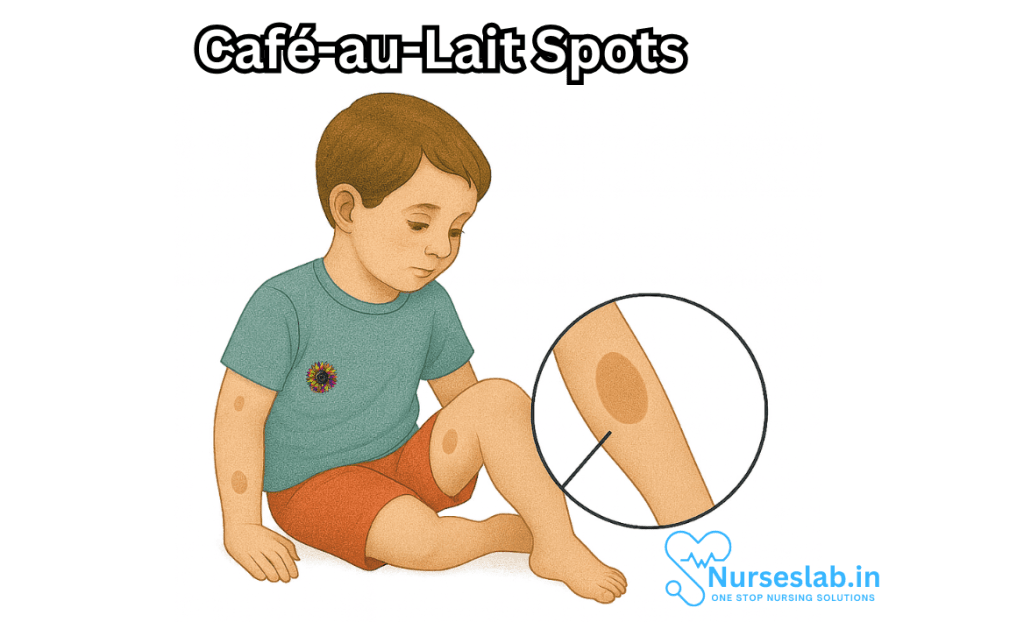
Café-au-lait spots are light brown skin patches, named after the French term for “coffee with milk” due to their characteristic color. Though often harmless and common in the general population, these spots can occasionally serve as indicators of underlying medical conditions, particularly certain genetic disorders. Understanding the nature, origin, and clinical significance of café-au-lait spots is essential for both clinicians and the general public.
What Are Café-au-Lait Spots?
Café-au-lait spots are flat, pigmented birthmarks that vary in size from a few millimeters to several centimeters. Their color typically ranges from light tan to a more uniform brown, with well-defined edges. They are caused by an increased amount of melanin (the pigment that gives skin its color) in the affected skin cells.
Appearance and Characteristics
- Color: Uniform, light brown (like coffee with milk)
- Shape: Usually oval or irregular, but with smooth borders
- Texture: Flat, not raised or bumpy
- Size: Can range from tiny spots to large patches
- Location: Can appear anywhere on the body, including the trunk, extremities, and face
Frequency in the Population
Café-au-lait spots are commonly found in children and adults of all backgrounds. It is estimated that up to 10-20% of healthy individuals may have one or two café-au-lait spots, and having a single spot is usually considered benign.
Why Do Café-au-Lait Spots Form?
The formation of café-au-lait spots is typically due to a localized increase in melanin production. Melanin is produced by melanocytes, specialized cells in the skin, and a concentration of melanocytes or increased melanin in certain areas results in these pigmented patches.
Genetic and Non-Genetic Causes
- Non-Genetic: Sometimes café-au-lait spots appear as isolated findings, without associated diseases or genetic predispositions.
- Genetic: In other cases, multiple café-au-lait spots may be a sign of an underlying genetic syndrome, such as neurofibromatosis type 1 (NF1) or other less common disorders.
Clinical Significance of Café-au-Lait Spots
While a single café-au-lait spot is usually harmless and of no clinical concern, the presence of several spots, especially of a certain size and distribution, can be a valuable clue for diagnosing specific diseases.
Neurofibromatosis Type 1 (NF1)
Neurofibromatosis type 1 (NF1) is perhaps the best-known condition associated with café-au-lait spots. NF1 is a genetic disorder caused by mutations in the NF1 gene and is inherited in an autosomal dominant manner.
- Diagnostic Criteria: The presence of six or more café-au-lait spots larger than 5 mm in diameter (prepubertal children) or larger than 15 mm (postpubertal individuals) is one of the diagnostic criteria for NF1.
- Other Features: NF1 is also characterized by skinfold freckling, Lisch nodules (iris hamartomas), neurofibromas (benign nerve sheath tumors), and various other neurological and orthopedic manifestations.
- Incidence: NF1 occurs in approximately 1 in 3,000 births worldwide.
Other Conditions Associated with Café-au-Lait Spots
Although NF1 is the most common disorder associated with café-au-lait spots, there are several other conditions where they may be present:
- Neurofibromatosis Type 2 (NF2): Less frequently associated but may present with similar pigmentary changes.
- McCune-Albright Syndrome: Characterized by large, irregular café-au-lait spots, usually with jagged borders (“Coast of Maine” appearance), as well as endocrine abnormalities and fibrous dysplasia of bone.
- Legius Syndrome: Caused by mutations in the SPRED1 gene, it can mimic NF1 in its early presentation, including café-au-lait spots and freckling, but lacks neurofibromas and other NF1 features.
- Other Rare Syndromes: Disorders such as Noonan syndrome, tuberous sclerosis, and constitutional mismatch repair deficiency may also present with café-au-lait spots or other pigmentary changes.
Diagnosis and Evaluation
The evaluation of café-au-lait spots hinges on their number, size, and accompanying clinical features.
When Are Café-au-Lait Spots a Cause for Concern?
- If a child presents with six or more café-au-lait spots, especially if they are larger than 5 mm before puberty or 15 mm after, further genetic evaluation is recommended.
- Associated findings such as freckling in the armpits or groin, neurofibromas, or family history of genetic syndromes warrant referral to a specialist.
- Large, irregularly bordered café-au-lait spots may prompt evaluation for McCune-Albright syndrome if accompanied by other signs.
Diagnostic Workup
- Physical examination of the skin and other systems
- Family history assessment
- Genetic testing for suspected syndromes (NF1, SPRED1, etc.)
- Imaging studies (if neurological or orthopedic involvement suspected)
- Ophthalmological evaluation (for Lisch nodules in NF1)
Treatment and Management
Café-au-lait spots themselves are harmless and do not require treatment. However, if they are a sign of an underlying condition, management focuses on that disease rather than the skin spots.
For Isolated Café-au-Lait Spots
No treatment is necessary. Cosmetic removal is generally not recommended, although options such as laser therapy exist for those who wish to reduce their appearance.
For Associated Syndromes
- Neurofibromatosis Type 1: Requires multidisciplinary management, including regular follow-up for neurological, orthopedic, and ophthalmological complications.
- McCune-Albright Syndrome: Management of endocrine problems and bone abnormalities as needed.
- Other Genetic Syndromes: Tailored treatment plans according to the specific manifestations.
Prognosis
The prognosis for individuals with isolated café-au-lait spots is excellent, as the spots do not affect general health nor do they turn malignant. The prognosis for conditions such as NF1 or McCune-Albright syndrome depends on the severity and organs involved, and ongoing monitoring is crucial.
Social and Psychological Impact
While café-au-lait spots are generally not medically dangerous, they can sometimes cause cosmetic concerns or social anxiety, particularly if they are large or numerous. Support groups and counseling may be helpful for individuals or families affected by associated syndromes.
Nursing Care of Patients with Café-au-Lait Spots
Nurses play a crucial role in the identification, assessment, patient education, and psychosocial support for individuals presenting with these skin findings.
Assessment and Identification
- Physical Examination: Nurses should conduct thorough skin assessments during routine or targeted evaluations. Document the number, size, shape, and location of café-au-lait spots. More than six spots greater than 0.5 cm in diameter in children or 1.5 cm in adults may warrant further investigation.
- Medical History: Gather information about family history of genetic disorders, associated symptoms (such as neurological issues, bone pain, or endocrine abnormalities), and any changes in the appearance of skin lesions.
- Referral and Collaboration: If multiple café-au-lait spots or associated features are identified, nurses should communicate findings to the healthcare team for further diagnostic workup and multidisciplinary involvement.
Monitoring and Ongoing Care
- Regular Follow-Up: For patients with isolated spots, routine monitoring is sufficient. No medical treatment is required unless cosmetic concerns arise. For patients with associated syndromes, regular assessments for complications are necessary, including neurological, orthopedic, endocrine, and ophthalmological evaluations.
- Documentation: Consistent and accurate documentation of lesion changes, associated symptoms, and psychosocial impacts is essential for continuity of care.
Patient and Family Education
- Understanding the Condition: Educate patients and families about the benign nature of isolated café-au-lait spots, emphasizing that these marks do not affect general health nor become malignant.
- Associated Syndromes: Provide information about possible underlying genetic conditions if multiple spots or related symptoms are present. Explain the need for further investigation and the importance of ongoing monitoring.
- Cosmetic Options: Discuss cosmetic concerns sensitively. Inform patients about available options such as laser therapy, but emphasize that removal is generally not recommended unless desired for personal reasons.
Psychosocial Support
- Addressing Social Concerns: Recognize that visible marks can cause distress or social anxiety, particularly in children or adolescents. Provide reassurance and promote positive self-image.
- Counseling Services: Refer patients and families to support groups or counseling services as needed, especially for individuals affected by genetic syndromes or experiencing psychological distress.
- Peer Support: Encourage participation in peer support networks, which can be valuable for coping and sharing experiences.
Care for Patients with Associated Syndromes
- Neurofibromatosis Type 1 (NF1): Collaborate with a multidisciplinary team for specialized management. Monitor for complications such as learning disabilities, skeletal abnormalities, and visual impairment. Nurses should advocate for regular screening protocols and coordinate care with neurologists, orthopedists, and ophthalmologists.
- McCune-Albright Syndrome: Support management of endocrine problems, including monitoring for signs of precocious puberty or thyroid abnormalities. Help coordinate care with endocrinologists and other specialists.
- Other Genetic Syndromes: Assist with individualized care plans tailored to the specific manifestations identified. Ensure families are provided with resources and support for navigating complex healthcare needs.
Promoting Holistic Well-being
- Empowerment: Encourage patients and families to participate actively in their care and decision-making processes. Provide comprehensive information about all aspects of café-au-lait spots and associated conditions.
- Advocacy: Advocate for patients within healthcare systems and educational settings, addressing any potential discrimination or misunderstanding related to visible skin differences.
- Coordination of Care: Facilitate communication among healthcare providers, ensuring seamless transitions and sharing of critical information.
Special Considerations for Pediatric Patients
- Developmental Support: Monitor for developmental milestones and learning difficulties in children with NF1 or other syndromes. Work closely with families, educators, and therapists to support optimal development.
- Family-Centered Care: Recognize the emotional impact of diagnosis on parents and siblings. Provide education, emotional support, and practical resources.
Cultural Sensitivity
- Respect for Diversity: Café-au-lait spots occur in all ethnic groups and may have different cultural meanings. Approach conversations about skin differences with sensitivity and respect for personal and cultural perspectives.
REFERENCES
- Genetic and Rare Diseases Information Center. Multiple Café-Au-Lait Spots. https://rarediseases.info.nih.gov/diseases/3967/multiple-cafe-au-lait-spots.
- StatPearls. Cafe Au Lait Macules. https://www.statpearls.com/ArticleLibrary/viewarticle/18754.
- Jha SK, Mendez MD. Cafe Au Lait Macules. [Updated 2023 Jul 31]. In: StatPearls [Internet]. Treasure Island (FL): StatPearls Publishing; 2025 Jan-. Available from: https://www.ncbi.nlm.nih.gov/books/NBK557492/
- U.S. National Library of Medicine. Neurofibromatosis Type 1 (https://medlineplus.gov/genetics/condition/neurofibromatosis-type-1/#inheritance).
- Albaghdadi M, Thibodeau ML, Lara-Corrales I. Updated Approach to Patients with Multiple Café au Lait Macules. Dermatol Clin. 2022 Jan. 40 (1):9-23.
- Almuqbil M, Alshaikh FY, Altwaijri W, Baarmah D, Hommady RH, Alshaikh MY, et al. Epidemiology and Outcomes of Neurofibromatosis Type 1 (NF-1): Multicenter Tertiary Experience. J Multidiscip Healthc. 2024. 17:1303-1314.
- U.S. National Library of Medicine. Birthmarks – Pigmented (https://medlineplus.gov/ency/article/000828.htm).
Stories are the threads that bind us; through them, we understand each other, grow, and heal.
JOHN NOORD
Connect with “Nurses Lab Editorial Team”
I hope you found this information helpful. Do you have any questions or comments? Kindly write in comments section. Subscribe the Blog with your email so you can stay updated on upcoming events and the latest articles.


