


Last Updated on January 13, 2026 by Nurseslab.in Editorial Team
Explore parasitology: a branch of microbiology focused on parasites, their life cycles, host interactions, and disease-causing mechanisms. Parasitology supports infection control, diagnostics, and treatment strategies—critical for healthcare, tropical medicine, and global health initiatives.
Introduction
Parasitic diseases remain a significant health concern globally, especially in tropical and subtropical regions. For nurses, understanding parasitology is vital as parasitic infections frequently present in clinical practice. Knowledge of the life cycles of parasites, diagnostic approaches, and treatment options equips nurses to play a critical role in patient care, infection control, and health education.
Scope and Relevance
The study of parasites—organisms that live on or within another organism (the host) and derive nutrients at the host’s expense—has direct implications for nursing. Nurses are often the first point of contact for patients with parasitic diseases and are responsible for sample collection, patient education, and assisting in treatment protocols. Understanding parasitology enhances the nurse’s ability to recognise symptoms, facilitate timely diagnosis, and support management and prevention strategies in the healthcare setting.
Basics of Parasitology
Definition of Parasitology
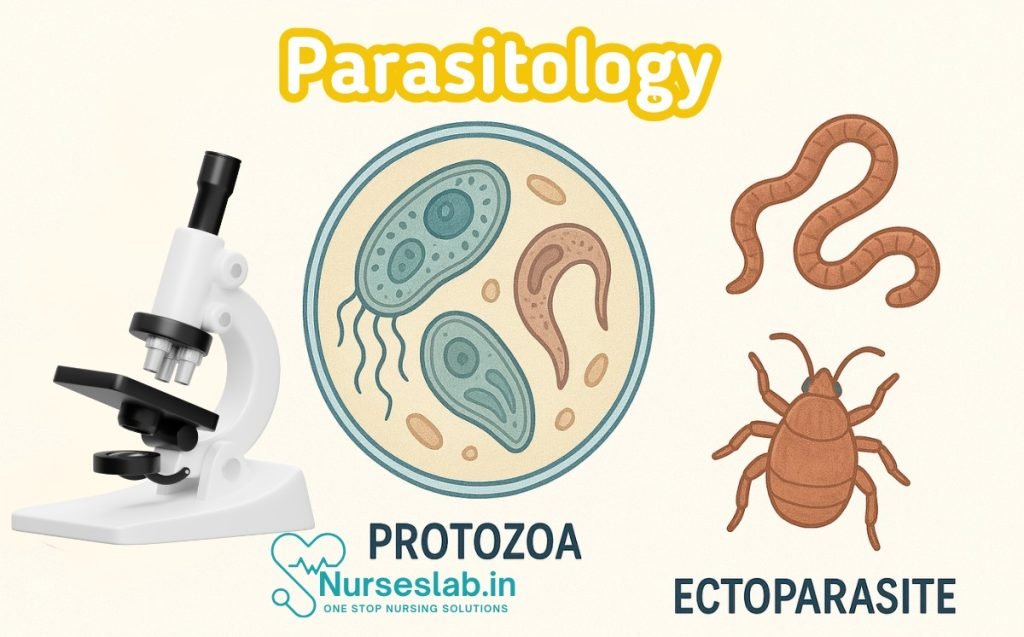
Parasitology is the branch of microbiology that deals with the study of parasites, their biology, life cycles, interactions with hosts, and the diseases they cause. It encompasses protozoa, helminths, and ectoparasites, each with unique characteristics and clinical significance.
Classification of Parasites
- Protozoa: Single-celled eukaryotic organisms, including Plasmodium (malaria), Entamoeba histolytica (amoebiasis).
- Helminths: Multicellular worms, subdivided into:
- Nematodes (roundworms) – e.g., Ascaris lumbricoides
- Cestodes (tapeworms) – e.g., Taenia solium
- Trematodes (flukes) – e.g., Schistosoma species
Ectoparasites: Parasites living on the surface of the host, such as lice, fleas, ticks, and mites.
Host-Parasite Interactions
The relationship between host and parasite is complex and dynamic. The host provides nutrients and shelter, while the parasite may cause harm by damaging tissues, triggering immune responses, or depriving the host of essential nutrients. The outcome may range from asymptomatic carriage to severe, life-threatening disease. Nurses should be aware of the factors influencing host susceptibility, such as age, immune status, nutrition, and environmental exposures.
Life Cycle of Parasites
Understanding the life cycle of a parasite is crucial for effective disease control and management. Typically, a parasitic life cycle involves several stages, often requiring more than one host:
- Definitive host: Where the parasite reaches sexual maturity.
- Intermediate host: Harbours the larval or asexual stage.
- Vector: An organism (often an insect) that transmits the parasite but may not itself be affected.
Parasites may have direct (single host) or indirect (multiple hosts) life cycles, and understanding these pathways helps guide prevention and treatment strategies.
Examples of Parasite Life Cycles
Plasmodium Species (Malaria)
- Human Host: After a bite from an infected female Anopheles mosquito, sporozoites enter the bloodstream and migrate to the liver. They mature into schizonts and release merozoites, which infect red blood cells. This erythrocytic cycle is responsible for the clinical manifestations of malaria.
- Mosquito Host: When the mosquito feeds on an infected person, it ingests gametocytes. These develop into sporozoites within the mosquito’s gut, completing the cycle.
- Transmission: Primarily via mosquito bites; rarely through blood transfusion or congenital routes.
Ascaris lumbricoides (Roundworm)
- Human Host: Ingestion of embryonated eggs from contaminated food or water. Larvae hatch in the intestine, migrate via the bloodstream to the lungs, ascend the trachea, and are swallowed back into the intestines, where they mature into adults and lay eggs.
- Transmission: Faecal-oral route; poor sanitation is a major risk factor.
Taenia solium (Pork Tapeworm)
- Human Host (Definitive): Ingestion of undercooked pork containing cysticerci. The larvae develop into adult tapeworms in the intestine. Eggs passed in faeces may infect pigs (intermediate hosts).
- Human Host (Accidental Intermediate): Ingestion of eggs can lead to cysticercosis, where larvae invade tissues such as the brain, eyes, and muscles.
- Transmission: Consumption of undercooked pork and poor hygiene.
Entamoeba histolytica (Amoeba)
- Human Host: Ingestion of mature cysts from contaminated water or food. Excystation occurs in the small intestine, releasing trophozoites that colonise the colon and may invade tissues, causing amoebic dysentery or abscesses.
- Transmission: Faecal-oral route; associated with inadequate sanitation.
Modes of Transmission
- Vector-borne (e.g., malaria, leishmaniasis)
- Faecal-oral (e.g., amoebiasis, ascariasis)
- Skin penetration (e.g., schistosomiasis, hookworm)
- Direct contact (e.g., scabies, lice)
- Consumption of contaminated food or water (e.g., taeniasis)
Laboratory Diagnosis of Parasitic Diseases
Sample Collection
Accurate diagnosis begins with proper sample collection. Nurses play a vital role in obtaining and handling specimens such as blood, stool, urine, sputum, or tissue samples, following standard precautions to prevent contamination and transmission.
Microscopy
- Direct microscopy: Wet mounts or stained smears (e.g., Giemsa stain for malaria, iodine stain for stool ova and cysts).
- Thick and thin blood films: Essential for malaria diagnosis, allowing identification of Plasmodium species and estimation of parasitaemia.
- Concentration techniques: Increase the likelihood of detecting parasites in low-intensity infections (e.g., formalin-ether concentration for stool).
Serological Tests
- Enzyme-linked immunosorbent assay (ELISA): Detects parasite antigens or host antibodies.
- Indirect haemagglutination, immunofluorescence, rapid diagnostic tests (RDTs): Used for diseases like malaria, leishmaniasis, and toxoplasmosis.
Serology is particularly useful when parasites are difficult to detect microscopically, such as in tissue-invasive infections.
Molecular Methods
- Polymerase chain reaction (PCR): Highly sensitive and specific; detects parasite DNA or RNA in clinical samples.
- Real-time PCR: Provides quantitative results and can differentiate between species.
Molecular diagnostics are rapidly becoming standard for many parasitic diseases, especially in reference laboratories.
Interpretation of Results
Nurses should understand the limitations and implications of diagnostic tests. False negatives may occur due to low parasite load or improper sample collection. False positives can result from cross-reactivity or contamination. Correlation with clinical findings and epidemiological context is essential for accurate diagnosis.
Treatment of Parasitic Diseases
Principles of Antiparasitic Therapy
- Specificity: Selection of drugs based on the identified parasite and disease stage.
- Combination therapy: Use of multiple drugs to increase efficacy and prevent resistance (e.g., artemisinin-based combination therapy for malaria).
- Supportive care: Management of symptoms such as dehydration, anaemia, or seizures.
- Monitoring: Assessing response to therapy and managing side effects.
Common Antiparasitic Drugs and Mechanisms
| Drug | Class | Indications | Mechanism |
| Chloroquine, Artemisinin | Antimalarial | Malaria | Disrupts parasite metabolism within red blood cells |
| Metronidazole | Amoebicide | Amoebiasis, Giardia, Trichomoniasis | DNA damage in anaerobic organisms |
| Mebendazole, Albendazole | Antihelminthic | Ascariasis, Hookworm, Taeniasis | Inhibits microtubule synthesis in worms |
| Praziquantel | Antischistosomal | Schistosomiasis, Tapeworms | Increases membrane permeability to calcium ions |
| Ivermectin | Antiparasitic | Onchocerciasis, Strongyloidiasis, Scabies | Binds to glutamate-gated chloride channels |
Drug Resistance
Emergence of drug resistance among parasites, especially Plasmodium and helminths, is a growing challenge. Nurses should promote adherence to prescribed regimens, educate patients about the dangers of incomplete treatment, and report suspected resistance to public health authorities.
Supportive Care
- Fluid and electrolyte management (especially in diarrhoeal diseases)
- Blood transfusion for severe anaemia (e.g., severe malaria)
- Management of complications such as seizures, organ failure, or secondary infections
Prevention and Control
Hygiene and Sanitation
- Handwashing with soap and clean water
- Safe disposal of human waste
- Proper food handling and cooking (especially meat and fish)
- Provision of safe drinking water
Vector Control
- Use of insecticide-treated bed nets (ITNs)
- Indoor residual spraying
- Environmental management (removing stagnant water)
- Personal protective measures (repellents, protective clothing)
Patient Education
- Explaining modes of transmission and preventive measures
- Encouraging completion of treatment regimens
- Educating about the importance of seeking early medical care
Public Health Measures
- Mass drug administration in endemic areas
- Surveillance and reporting of cases
- Community health campaigns
- Vaccination where available (e.g., malaria vaccines in pilot programmes)
Case Studies and Practical Applications
Common Scenarios in Nursing Practice
- Malaria: A 30-year-old male presents with fever and chills. The nurse collects a blood sample for thick and thin smears, educates the patient about mosquito control, and monitors for complications.
- Amoebiasis: A child with diarrhoea is admitted. The nurse collects a stool sample, ensures rehydration, and assists in administration of metronidazole.
- Ascariasis: In a rural health camp, nurses educate families about hand hygiene and distribute deworming tablets to children.
- Scabies: In a hostel, multiple students present with itching and rashes. The nurse identifies possible scabies infestation, initiates appropriate topical treatment, and instructs on washing clothes and bedding.
Role of Nurses in Diagnosis and Management
- Early recognition of parasitic diseases based on clinical presentation and epidemiology
- Accurate collection and transport of specimens to the laboratory
- Administration of prescribed antiparasitic medications and supportive treatments
- Patient and community education for prevention and adherence
- Participation in public health initiatives and reporting of notifiable diseases
Conclusion
Parasitic diseases pose ongoing challenges in clinical and community settings. Nurses are at the forefront of diagnosis, treatment, prevention, and education. Mastery of the basics of parasitology—including the life cycles of common parasites, laboratory diagnostic techniques, and treatment options—empowers nurses to deliver high-quality care and contribute to public health efforts. Continued professional development and awareness of emerging trends, such as drug resistance and new diagnostic tools, are essential for effective nursing practice in the fight against parasitic diseases.
Future Directions in Parasitology for Nurses
- Integration of molecular diagnostics and point-of-care tests in routine practice
- Participation in research and surveillance of emerging parasitic diseases
- Collaboration with interdisciplinary teams for comprehensive patient care
- Advocacy for improved sanitation, vector control, and health education at the community level
REFERENCES
- Apurba S Sastry, Essential Applied Microbiology for Nurses including Infection Control and Safety, First Edition 2022, Jaypee Publishers, ISBN: 978-9354659386
- Joanne Willey, Prescott’s Microbiology, 11th Edition, 2019, Innox Publishers, ASIN- B0FM8CVYL4.
- Anju Dhir, Textbook of Applied Microbiology including Infection Control and Safety, 2nd Edition, December 2022, CBS Publishers and Distributors, ISBN: 978-9390619450
- Gerard J. Tortora, Microbiology: An Introduction 13th Edition, 2019, Published by Pearson, ISBN: 978-0134688640
- Durrant RJ, Doig AK, Buxton RL, Fenn JP. Microbiology Education in Nursing Practice. J Microbiol Biol Educ. 2017 Sep 1;18(2):18.2.43. https://pmc.ncbi.nlm.nih.gov/articles/PMC5577971/
Stories are the threads that bind us; through them, we understand each other, grow, and heal.
JOHN NOORD
Connect with “Nurses Lab Editorial Team”
I hope you found this information helpful. Do you have any questions or comments? Kindly write in comments section. Subscribe the Blog with your email so you can stay updated on upcoming events and the latest articles.


