


Last Updated on January 12, 2026 by Nurseslab.in Editorial Team
Explore bacteriology: a branch of microbiology that examines bacterial structure, growth, genetics, and interactions with hosts. Essential for understanding infectious diseases, antibiotic resistance, and clinical diagnostics, bacteriology supports advancements in healthcare, biotechnology, and public health.
Introduction
Bacteriology, a cornerstone of microbiology, is the scientific discipline dedicated to the study of bacteria: their structure, function, classification, and role in health and disease. As one of the most ancient and diverse domains of life, bacteria profoundly influence human life, medicine, agriculture, and industry. Understanding general bacteriology is crucial for medical professionals, microbiologists, and educators, as it underpins the principles of infection, disease prevention, and therapeutic intervention.
Bacterial Morphology
Shapes and Arrangements
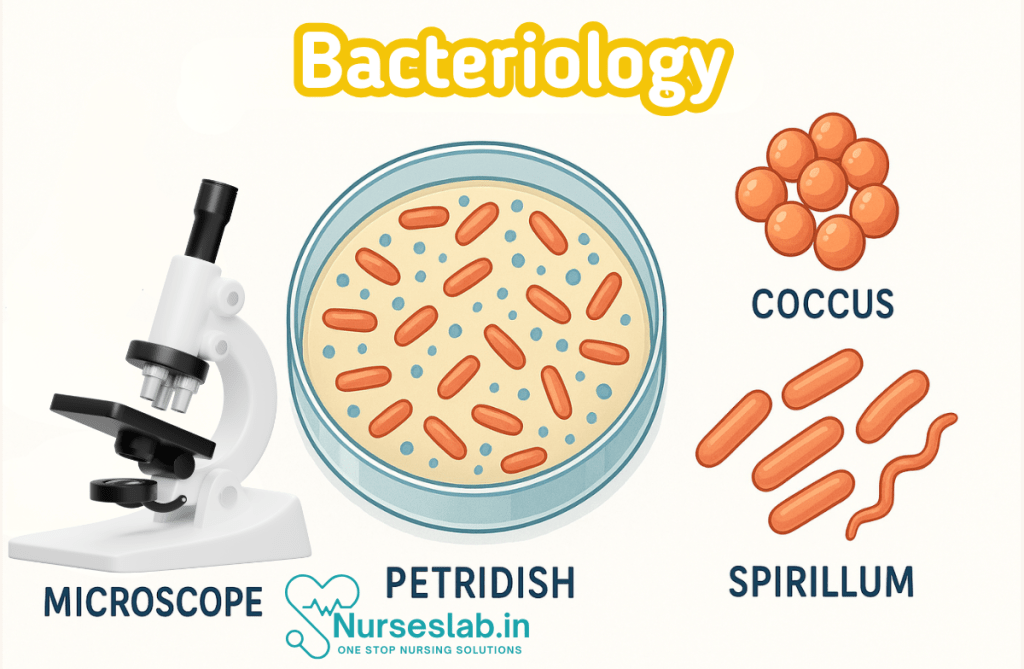
Bacterial morphology refers to the size, shape, and arrangement of bacterial cells, which are key criteria for their identification and classification. Bacteria exhibit a remarkable variety of shapes, each adapted to their ecological niche and mode of life. The primary bacterial shapes include:
- Cocci: Spherical bacteria. They may exist singly or in characteristic arrangements such as:
- Diplococci: Pairs (e.g., Neisseria species)
- Streptococci: Chains (e.g., Streptococcus pyogenes)
- Staphylococci: Clusters resembling grapes (e.g., Staphylococcus aureus)
- Tetrads: Groups of four
- Sarcinae: Cubical packets of eight or more
- Bacilli: Rod-shaped bacteria. Arrangements include:
- Single bacilli (e.g., Escherichia coli)
- Diplobacilli: Pairs
- Streptobacilli: Chains
- Coccobacilli: Short, oval rods resembling cocci
- Spirilla: Rigid, spiral-shaped bacteria (e.g., Spirillum minus).
- Spirochetes: Flexible, helical bacteria (e.g., Treponema pallidum).
- Vibrios: Comma-shaped, curved rods (e.g., Vibrio cholerae).
- Pleomorphic bacteria: Exhibit variable shapes (e.g., Mycoplasma species).
Basis of Classification
Bacterial classification is not solely based on morphology but also incorporates staining characteristics, metabolic properties, genetic analysis, and ecological traits. Nevertheless, morphology serves as an essential preliminary tool in laboratory identification and clinical diagnosis.
Medically Important Bacteria
Overview
Medically important bacteria are those that play a direct or indirect role in human health and disease. They may be pathogens, commensals, or beneficial symbionts. The study of such bacteria is central to clinical microbiology, infectious disease management, and epidemiology.
Examples of Medically Important Bacteria
| Bacterial Genus/Species | Gram Reaction | Associated Diseases |
| Staphylococcus aureus | Gram-positive cocci | Skin infections, pneumonia, endocarditis, toxic shock syndrome |
| Streptococcus pyogenes | Gram-positive cocci | Pharyngitis, scarlet fever, rheumatic fever, cellulitis |
| Escherichia coli | Gram-negative bacilli | Urinary tract infections, gastroenteritis, neonatal meningitis |
| Mycobacterium tuberculosis | Acid-fast bacilli | Tuberculosis |
| Neisseria gonorrhoeae | Gram-negative diplococci | Gonorrhoea, pelvic inflammatory disease |
| Vibrio cholerae | Gram-negative comma-shaped | Cholera |
| Clostridium tetani | Gram-positive bacilli (spore-forming) | Tetanus |
| Salmonella typhi | Gram-negative bacilli | Typhoid fever |
| Helicobacter pylori | Gram-negative spiral | Peptic ulcers, gastritis |
These examples illustrate the diversity of medically significant bacteria, their varied morphologies, and the spectrum of diseases they cause.
Bacterial Cell Anatomy
External Structures
Bacterial cells, though simpler than eukaryotic cells, possess specialised structures that contribute to their survival, pathogenicity, and adaptation. The primary external components include:
- Capsule (Glycocalyx): A viscous, gelatinous outer covering, composed mainly of polysaccharides or polypeptides. It protects bacteria from phagocytosis, aids in adherence to surfaces, and contributes to virulence (e.g., Streptococcus pneumoniae).
- Flagella: Long, whip-like appendages responsible for motility. Their arrangement (monotrichous, lophotrichous, amphitrichous, peritrichous) is species-specific and aids in identification.
- Pili (Fimbriae): Short, hair-like projections involved in attachment to host cells and surfaces. Some pili (sex pili) facilitate conjugation—the transfer of genetic material between bacteria.
- Cell Wall: A rigid structure providing shape, protection, and osmotic stability. Its composition varies between Gram-positive and Gram-negative bacteria (discussed in detail below).
- Cell Membrane (Plasma Membrane): A semi-permeable barrier controlling the movement of substances into and out of the cell.
Internal Structures
- Cytoplasm: A gel-like matrix containing water, enzymes, nutrients, wastes, and cell structures. It is the site of metabolic activity.
- Nucleoid: The region containing the bacterial chromosome (a single, circular, double-stranded DNA molecule). Unlike eukaryotes, bacteria lack a nuclear membrane.
- Plasmids: Small, circular, extrachromosomal DNA molecules carrying genes for antibiotic resistance, toxin production, and other traits.
- Ribosomes: 70S ribosomes (smaller than eukaryotic 80S ribosomes) responsible for protein synthesis.
- Inclusion Bodies: Reserve deposits of nutrients (e.g., glycogen, polyphosphate granules, sulphur granules).
- Endospores: Highly resistant, dormant structures produced by certain genera (e.g., Bacillus, Clostridium) under adverse conditions. They can survive extreme heat, desiccation, and chemicals.
Bacterial Cell Wall
Composition and Types
The bacterial cell wall is a defining feature, essential for maintaining shape, integrity, and protection against osmotic lysis. Its composition forms the basis of the Gram stain, a fundamental laboratory technique distinguishing two major groups: Gram-positive and Gram-negative bacteria.
Gram-Positive Cell Wall
- Thick Peptidoglycan Layer: Composed of repeating units of N-acetylglucosamine (NAG) and N-acetylmuramic acid (NAM) cross-linked by peptide chains.
- Teichoic Acids: Polymers of glycerol or ribitol phosphate, embedded within the peptidoglycan, contributing to cell wall rigidity and antigenicity.
- Lipoteichoic Acids: Anchored in the plasma membrane, extending through the peptidoglycan, involved in adherence and immune response modulation.
- Absence of Outer Membrane: Gram-positive bacteria lack an outer lipid membrane.
Gram-Negative Cell Wall
- Thin Peptidoglycan Layer: Located within the periplasmic space between the inner (plasma) and outer membranes.
- Outer Membrane: Composed of phospholipids, lipoproteins, and lipopolysaccharide (LPS). The LPS contains:
- Lipid A: Endotoxin responsible for many of the toxic effects in Gram-negative infections.
- Core Polysaccharide and O Antigen: Variable, immunogenic components.
- Porins: Protein channels in the outer membrane allowing passage of small molecules.
Other Variations
- Acid-Fast Bacteria: (e.g., Mycobacterium species) possess a high concentration of mycolic acids in their cell wall, conferring resistance to desiccation and certain antibiotics; detected by the Ziehl-Neelsen stain.
- Cell Wall-Less Bacteria: (e.g., Mycoplasma species) lack a cell wall and are bounded only by a cell membrane, rendering them resistant to beta-lactam antibiotics.
Functions of the Cell Wall
- Maintains cell shape and prevents osmotic lysis
- Provides a point of attachment for flagella
- Acts as a barrier to toxic substances
- Contributes to pathogenicity and immune evasion
- Serves as a target for several antibiotics (e.g., penicillins, cephalosporins)
Cell Membrane Structure and Role in Physiology
The bacterial cell membrane (plasma membrane) is a dynamic, selectively permeable barrier composed primarily of phospholipids and proteins. Unlike eukaryotic cells, bacterial membranes do not contain sterols (except in Mycoplasma species).
Structural Features
- Phospholipid Bilayer: Amphipathic molecules arranged with hydrophilic heads facing outward and hydrophobic tails inward.
- Integral and Peripheral Proteins: Responsible for transport, enzymatic activity, signal transduction, and structural support.
- Mesosomes: Infoldings of the membrane, once thought to play a role in DNA replication and cell division, now considered artefacts of preparation.
Functions
- Regulates the movement of nutrients, waste, and ions
- Site of energy generation (electron transport chain and ATP synthesis)
- Facilitates secretion of enzymes and toxins
- Participates in cell wall synthesis
- Acts as an anchor for cytoskeletal elements
Physiology of Bacteria
Metabolism
Bacterial metabolism encompasses all biochemical reactions occurring within the cell, enabling growth, reproduction, and adaptation. Key metabolic characteristics include:
- Catabolism: Breakdown of organic substrates (carbohydrates, lipids, proteins) to generate energy (ATP).
- Anabolism: Synthesis of cellular components from simpler molecules.
- Energy Generation: Bacteria may be:
- Obligate aerobes: Require oxygen for respiration (e.g., Pseudomonas aeruginosa).
- Obligate anaerobes: Cannot tolerate oxygen (e.g., Clostridium species).
- Facultative anaerobes: Grow with or without oxygen (e.g., Escherichia coli).
- Microaerophiles: Require low levels of oxygen (e.g., Campylobacter jejuni).
- Aerotolerant anaerobes: Indifferent to oxygen presence (e.g., Lactobacillus species).
- Fermentation: Anaerobic process generating energy by substrate-level phosphorylation; important in bacteria such as Lactobacillus, Streptococcus.
- Photosynthesis: Some bacteria (e.g., cyanobacteria) can perform oxygenic or anoxygenic photosynthesis.
Reproduction
Unlike eukaryotes, bacteria reproduce asexually, primarily through binary fission—a process in which a single cell divides into two genetically identical daughter cells. Under optimal conditions, some bacteria can double in number every 20 minutes. Other mechanisms contributing to genetic diversity include:
- Conjugation: Transfer of genetic material via sex pili.
- Transformation: Uptake of free DNA from the environment.
- Transduction: Transfer of DNA mediated by bacteriophages (viruses that infect bacteria).
Adaptation and Survival Mechanisms
- Endospore Formation: Enables survival under harsh conditions.
- Biofilm Formation: Bacteria adhere to surfaces and produce extracellular polymeric substances, forming communities resistant to antibiotics and immune responses (e.g., dental plaque by Streptococcus mutans).
- Antibiotic Resistance: Acquisition of resistance genes via mutation or horizontal gene transfer.
- Quorum Sensing: Cell-to-cell communication regulating gene expression in response to population density.
Factors Affecting Bacterial Growth
Environmental Factors
- Temperature: Bacteria are classified based on their optimal growth temperature.
- Psychrophiles: Grow best at 0–20°C (e.g., Pseudomonas fluorescens).
- Mesophiles: Optimal at 20–45°C; most human pathogens fall into this group (e.g., Escherichia coli).
- Thermophiles: Thrive at 45–80°C (e.g., Bacillus stearothermophilus).
- Hyperthermophiles: Prefer temperatures above 80°C.
- pH: Most bacteria grow best at near-neutral pH (6.5–7.5). Acidophiles and alkaliphiles are adapted to acidic or alkaline environments, respectively.
- Oxygen Availability: As previously discussed, bacteria exhibit varied oxygen requirements.
- Osmotic Pressure: High salt or sugar concentrations can inhibit growth (halophiles are adapted to high salt).
- Moisture: Water is essential for metabolic processes; desiccation can limit bacterial survival.
Nutritional Factors
- Carbon Source: Required for cellular structure and energy (e.g., glucose, lactose).
- Nitrogen Source: For synthesis of proteins and nucleic acids (e.g., ammonia, nitrate, amino acids).
- Minerals: Elements such as phosphorus, sulphur, potassium, magnesium, calcium, and iron are vital cofactors and structural components.
- Growth Factors: Organic compounds like vitamins, amino acids, purines, and pyrimidines that some bacteria cannot synthesise and must obtain from the environment.
Other Influences
- Antibiotics and Chemical Agents: Can inhibit or kill bacteria, affecting population dynamics.
- Host Defences: Immune system components may restrict bacterial growth in vivo.
- Competition: Interactions with other microorganisms can influence bacterial community structure and survival.
Conclusion
General bacteriology provides foundational knowledge essential for understanding the vast diversity, structure, physiology, and clinical significance of bacteria. By mastering bacterial morphology, recognising the features of medically important bacteria, and appreciating the intricate anatomy and physiology of these organisms, medical students, microbiologists, and educators are better equipped to diagnose, treat, and prevent bacterial diseases.
The study of factors affecting bacterial growth further informs strategies for infection control, antimicrobial therapy, and public health interventions. As the field of bacteriology continues to evolve, ongoing research will deepen our understanding of bacteria and their critical roles in health, disease, and the environment.
REFERENCES
- Apurba S Sastry, Essential Applied Microbiology for Nurses including Infection Control and Safety, First Edition 2022, Jaypee Publishers, ISBN: 978-9354659386
- Joanne Willey, Prescott’s Microbiology, 11th Edition, 2019, Innox Publishers, ASIN- B0FM8CVYL4.
- Anju Dhir, Textbook of Applied Microbiology including Infection Control and Safety, 2nd Edition, December 2022, CBS Publishers and Distributors, ISBN: 978-9390619450
- Gerard J. Tortora, Microbiology: An Introduction 13th Edition, 2019, Published by Pearson, ISBN: 978-0134688640
- Durrant RJ, Doig AK, Buxton RL, Fenn JP. Microbiology Education in Nursing Practice. J Microbiol Biol Educ. 2017 Sep 1;18(2):18.2.43. https://pmc.ncbi.nlm.nih.gov/articles/PMC5577971/
Stories are the threads that bind us; through them, we understand each other, grow, and heal.
JOHN NOORD
Connect with “Nurses Lab Editorial Team”
I hope you found this information helpful. Do you have any questions or comments? Kindly write in comments section. Subscribe the Blog with your email so you can stay updated on upcoming events and the latest articles.


