Last Updated on January 9, 2026 by Nurseslab.in Editorial Team
Nursing care plans in 2026 combine evidence‑based practice, digital documentation, AI‑supported assessment, and patient‑centered interventions. Modern care planning enhances accuracy, continuity of care, and clinical decision‑making across diverse healthcare settings.
If you’re a nursing student, recent graduate, or a new nurse stepping into clinical practice, learning how to create a thorough and effective nursing care plan is essential. With evolving standards and digital documentation, staying updated with the nursing care plan format 2026 is crucial for safe, patient-centred care.
What is a Nursing Care Plan?
A nursing care plan is a structured document that guides nurses in delivering individualised patient care. It connects every phase of the nursing process—assessment, diagnosis, planning, intervention, and evaluation—into a logical, actionable sequence. The purpose of a care plan is to ensure systematic, evidence-based care that enhances patient outcomes, facilitates communication among healthcare team members, and documents the rationale for clinical decisions.
Care plans are more than paperwork; they are living documents that evolve as the patient’s condition changes. They help nurses prioritise care, set measurable goals, and track patient progress. Whether you’re working in a hospital, clinic, or community setting, the ability to write and implement effective care plans is a foundational nursing skill.
The Nursing Process and Care Plans
- Assessment: Collecting comprehensive patient data (history, observations, vital signs, lab results).
- Diagnosis: Identifying actual or potential health problems using standardised language (e.g., NANDA nursing diagnosis).
- Planning: Setting SMART goals in nursing—specific, measurable, achievable, relevant, and time-bound objectives.
- Implementation: Carrying out nursing interventions to address the patient’s needs.
- Evaluation: Reviewing patient responses and updating the care plan as needed.
Step-by-Step: How to Write a Nursing Care Plan (2026 Format)
Here is a detailed, step-by-step guide to writing a care plan in line with nursing care plan format 2026:
- Assessment
- Gather comprehensive patient information: history, physical examination, lab results, and vital signs.
- Identify abnormal findings and potential risks.
- Nursing Diagnosis
- Use standardised NANDA nursing diagnosis statements (e.g., “Acute Pain related to surgical incision as evidenced by patient rating pain 8/10”).
- Setting SMART Goals
- Goals should be Specific, Measurable, Achievable, Relevant, and Time-bound—for example, “Patient will report pain less than 4/10 within 24 hours.”
- Goals provide direction and criteria for success.
- Planning Interventions
- Choose evidence-based nursing actions to address the diagnosis and achieve the goal.
- Include both independent and collaborative interventions.
- Rationales
- For each intervention, briefly explain why it’s appropriate, using research or guidelines.
- Evaluation
- Determine if the patient has met the goal. Update the care plan if goals are unmet or patient needs change.
Common Errors to Avoid
- Using vague or non-specific language (e.g., “Patient will feel better” vs. “Patient will report pain less than 4/10”).
- Listing interventions without rationales.
- Failing to individualise care plans—copy-paste approaches don’t work for unique patients.
- Not updating the plan after patient reassessment.
Why Use Standardised Formats?
Using standardised nursing care plan formats 2026 improves communication, supports evidence-based practice, and ensures documentation is clear and audit-ready. It also helps new nurses transition smoothly from academic templates to real-world clinical records.
Student vs Clinical Nursing Care Plans: What’s Different?
Nursing students often write care plans that are more detailed than those used in everyday clinical practice. Here’s how they differ:
| Aspect | Student Care Plan | Clinical Care Plan |
| Level of Detail | In-depth, includes rationales, references, full documentation of assessment data | Streamlined, focused on practical interventions and outcomes |
| Purpose | Demonstrate knowledge, critical thinking, and application of theory | Guide daily patient care, facilitate communication |
| Format | Often 4-column or 5-column, with rationales and references | Usually 3-column or 4-column, concise and targeted |
| Language | Formal, academic, with references to guidelines and research | Professional, clear, but less academic |
As you transition from student to nurse, you’ll move from highly detailed, educational care plans to practical, efficient documentation. However, the principles remain the same: prioritise patient needs, use standardised language, and focus on outcomes.
Latest Nursing Care Plan Formats for 2026
A nursing care plan is a structured approach that guides nurses in delivering patient-centred care. It ensures systematic assessment, diagnosis, planning, intervention, and evaluation, thereby enhancing patient outcomes. Nursing care plans can be documented in various formats, each with its unique structure and focus. The most common are the 3-column, 4-column, 5-column, and 6-column formats. Below, you’ll find detailed notes on each format, including their components, purposes, and practical application.
1. Three-Column Nursing Care Plan Format
The three-column format is one of the simplest and most widely used structures in clinical practice and nursing education. It helps in clarifying the relationship between the nursing diagnosis, the goals of care, and the interventions required.
- Nursing Diagnosis: This column identifies the patient’s actual or potential health problems based on assessment data. The nursing diagnosis is a clinical judgement about the patient’s response to actual or potential health conditions or needs. It forms the basis for the selection of nursing interventions.
- Goals: This column outlines the desired outcomes that are expected as a result of nursing interventions. Goals should be specific, measurable, achievable, relevant, and time-bound (SMART). They provide direction for planning and evaluating care.
- Nursing Interventions: This column specifies the actions the nurse will take to achieve the stated goals. Interventions may include observations, treatments, teaching, and support, and can be independent, dependent, or collaborative.
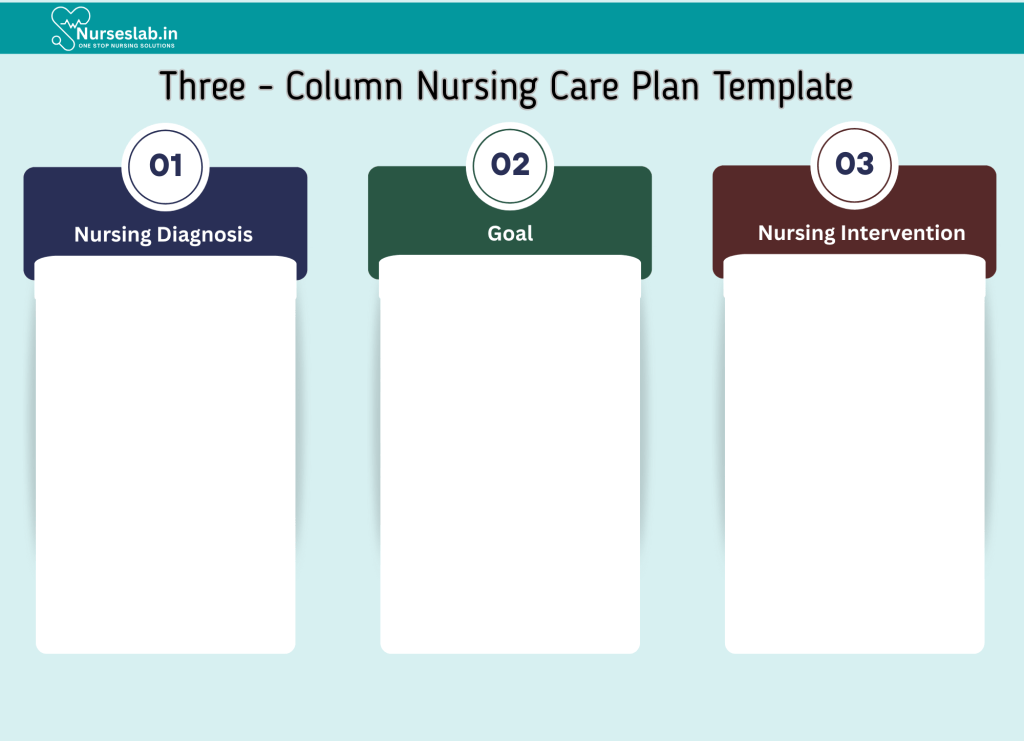
The three-column format is beneficial for its straightforwardness and clarity. It enables quick identification of problems, objectives, and actions, facilitating efficient care delivery and documentation.
2. Four-Column Nursing Care Plan Format
The four-column format expands on the three-column layout by adding an evaluation component. This additional column allows nurses to assess the effectiveness of the interventions and the achievement of goals.
- Nursing Diagnosis: As above, this is the identified health problem or need.
- Goal: The expected outcome or desired change in patient status.
- Nursing Intervention: The specific nursing actions undertaken to address the diagnosis and achieve the goal.
- Evaluation: This column records the patient’s response to the nursing interventions. It provides a means to determine if goals were met, partially met, or unmet, and to decide whether to continue, modify, or terminate the care plan.
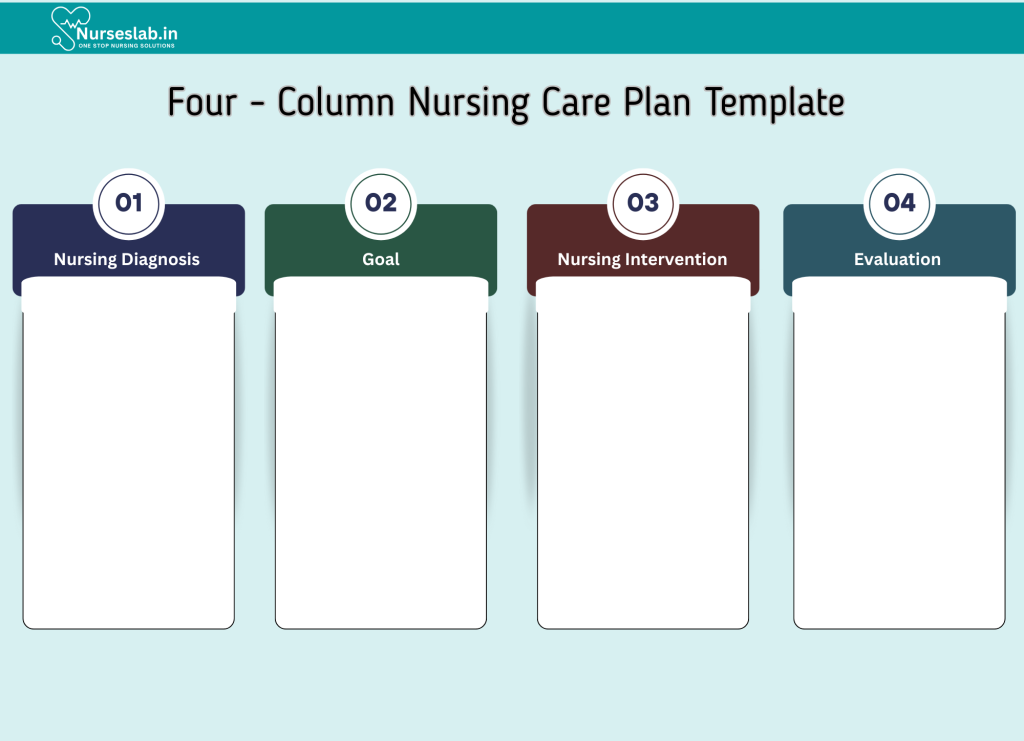
This format fosters a continuous cycle of care. By explicitly including evaluation, it ensures that care is dynamic and responsive to the patient’s changing needs, and that the effectiveness of nursing actions is consistently monitored.
3. Five-Column Nursing Care Plan Format
The five-column format offers a more detailed approach by introducing a distinct ‘Assessment’ and ‘Planning’ phase, in addition to the diagnosis, interventions, and evaluation.
- Assessment: This column documents the collection of objective and subjective data about the patient. It includes observations, patient statements, physical examination findings, and diagnostic results. Assessment is the foundation for all subsequent steps in the care plan.
- Nursing Diagnosis: Formulated based on assessment data, this identifies the patient’s problems that nurses can address.
- Planning: This column outlines the specific, measurable goals or expected outcomes for the patient. It details what the nurse hopes to achieve within a given timeframe.
- Nursing Intervention: Describes the actions the nurse will implement to achieve the planned outcomes. These should be evidence-based and tailored to the individual patient.
- Evaluation: Records the patient’s progress towards the outcomes and the effectiveness of the interventions. It informs future care decisions, such as continuing, modifying, or discontinuing interventions.
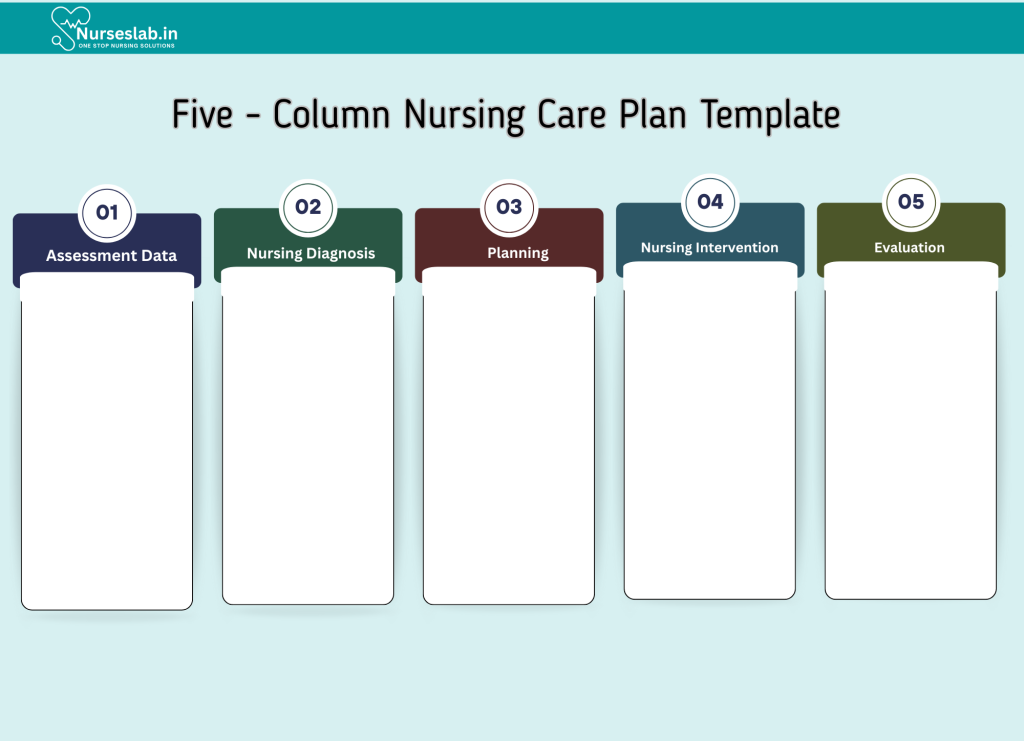
The five-column format provides a comprehensive framework that emphasises thorough data collection and deliberate planning. It is particularly useful in complex cases where detailed documentation is essential.
4. Six-Column Nursing Care Plan Format
The six-column format is the most detailed, incorporating all the previous elements and adding a ‘Rationale’ column. This format is often used in academic settings to encourage critical thinking and ensure that each intervention is justified by scientific evidence or clinical guidelines.
- Assessment: A systematic collection of relevant patient data, including history, physical exam findings, laboratory results, and subjective information.
- Nursing Diagnosis: The nurse’s clinical judgement about the patient’s response to health conditions and life processes, formulated from assessment findings.
- Goals: Clearly defined, patient-centred, measurable outcomes that guide nursing care.
- Nursing Intervention: Evidence-based nursing actions designed to achieve the goals.
- Rationale: This column provides the scientific or logical reasoning behind each intervention. Rationales explain why a particular action is chosen and how it will help achieve the desired outcome, often referencing research, best practice guidelines, or clinical experience.
- Evaluation: Documents the patient’s response to interventions, indicating whether goals were met, partially met, or unmet, and guiding further revisions to the care plan.
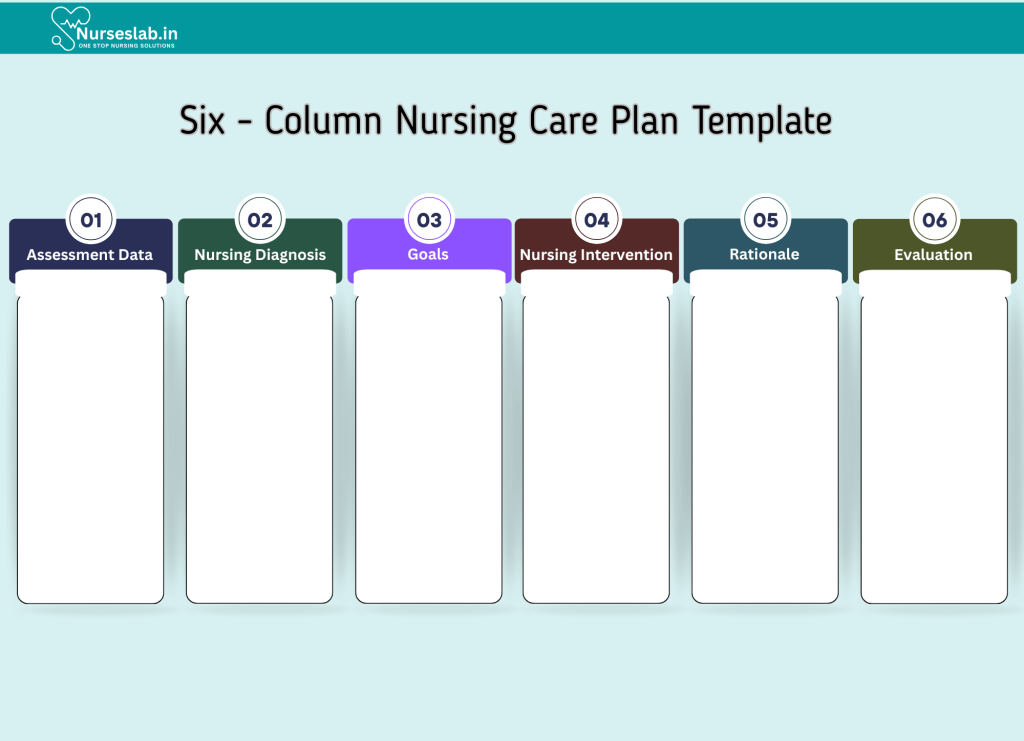
The six-column format fosters a deeper understanding of the nursing process. By requiring rationales, it ensures interventions are not only appropriate but also grounded in evidence, promoting accountability and professional development.
This nursing care plan example shows how to apply nursing care plan format 2026 with clear diagnosis, SMART goals, evidence-based interventions, and objective evaluation.
Comparative Overview and Practical Application
Each care plan format serves a unique purpose and is suited to different clinical environments and educational needs:
- Three-column plans are ideal for rapid documentation and straightforward cases, emphasising the direct link between diagnosis, goals, and interventions.
- Four-column plans introduce evaluation, supporting continuous quality improvement and patient-centred care.
- Five-column plans are comprehensive, suitable for complex clinical cases where detailed assessment and planning are required.
- Six-column plans are educational tools that reinforce evidence-based practice and critical thinking by including rationales for each intervention.
In practice, nurses may adapt these formats based on institutional policies, the complexity of patient needs, and personal preferences. Electronic health records often integrate elements from these formats for efficient and standardised documentation.
Key Points for Effective Nursing Care Plans
- All formats are guided by the nursing process: assessment, diagnosis, planning, implementation (intervention), and evaluation.
- Care plans should be patient-centred, goal-oriented, and evidence-based.
- Documentation must be clear, concise, and updated regularly to reflect changes in the patient’s condition or response to care.
- Evaluation is crucial in all formats, ensuring that care is effective and adjusted as needed.
- Rationales in the six-column format enhance understanding and support clinical decision-making.
Tips to Write Care Plans Faster and Better
- Use Templates: Save time with digital or printed templates based on the 3-column or 4-column care plan.
- Individualise Each Plan: Even with templates, tailor interventions and goals to each patient’s unique situation.
- Be Concise and Clear: Avoid unnecessary jargon—focus on essential information that guides care.
- Apply Professional Language: Use standardised terminology such as NANDA nursing diagnosis and SMART goals in nursing.
- Update Regularly: Care plans should evolve with the patient’s condition—make updates after every reassessment or major change.
- Collaborate: Discuss care plans with the healthcare team to ensure consistency and comprehensive care.
- Practice: The more care plans you write, the faster and more accurate you’ll become—consider writing practice plans for case studies.
REFERENCES
- Nexus Nursing, Nursing Care Plan Template: A Step-by-Step Guide, January 13, 2025, https://nexusnursinginstitute.com/nursing-care-plan-template/
- Australian Commission on Safety and Quality in Health Care. (2021). Components of a comprehensive care plan: Information for clinicians. https://www.safetyandquality.gov.au/publications-and-resources/resource-library/components-comprehensive-care-plan-information-clinicians
- NANDA International Nursing Diagnoses 2025-2026 Update, 13th Edition, Thieme Medical Publishers, Inc.
- Ernstmeyer K, Christman E, editors. Nursing Fundamentals [Internet]. Eau Claire (WI): Chippewa Valley Technical College; 2021. Appendix A: Sample NANDA-I Diagnoses. Available from: https://www.ncbi.nlm.nih.gov/books/NBK591814/
- Ernstmeyer K, Christman E, editors. Nursing Fundamentals [Internet]. Eau Claire (WI): Chippewa Valley Technical College; 2021. Appendix B: Template for Creating a Nursing Care Plan. Available from: https://www.ncbi.nlm.nih.gov/books/NBK591825/
Stories are the threads that bind us; through them, we understand each other, grow, and heal.
JOHN NOORD
Connect with “Nurses Lab Editorial Team”
I hope you found this information helpful. Do you have any questions or comments? Kindly write in comments section. Subscribe the Blog with your email so you can stay updated on upcoming events and the latest articles.