


Last Updated on August 28, 2026 by Nurseslab.in Editorial Team
Overview
Menarche marks the first visible menstrual bleeding caused by cyclic activity of the reproductive hormone system and shedding of the uterine lining. It usually occurs during adolescence after other pubertal changes have begun. In well-nourished populations, the median age is commonly around 12 to 13 years, but healthy timing varies among individuals and populations. Genetics, nutrition, body composition, general health, physical activity, psychosocial stress, socioeconomic conditions, and environmental influences can all affect timing.
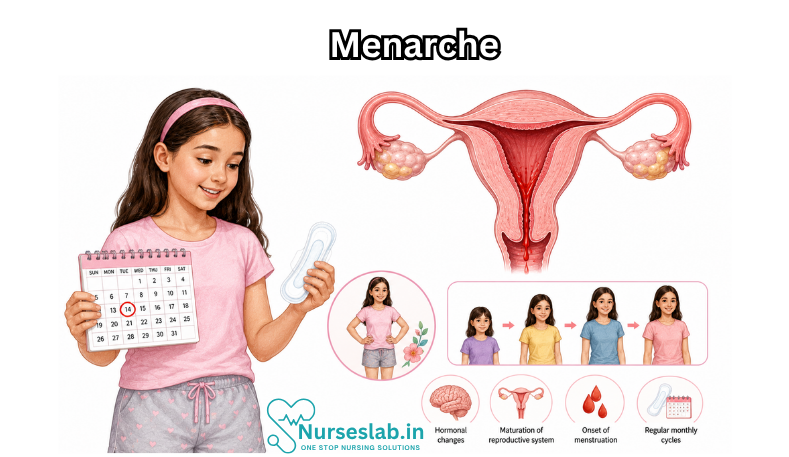
Menarche indicates that the hypothalamic–pituitary–ovarian axis has matured enough to produce menstrual bleeding. It does not prove that every cycle is ovulatory, predict adult fertility, or mean that pubertal development is complete. During the first years after menarche, cycles are often irregular because coordinated ovulation and progesterone production are still maturing. The menstrual pattern is nevertheless an important health indicator: unexpected timing, prolonged gaps, very heavy bleeding, or major disruption of daily life can reveal endocrine, nutritional, anatomical, haematological, or chronic medical problems.
How Puberty Leads to Menarche
Puberty begins when the hypothalamus increases pulsatile release of gonadotropin-releasing hormone. This stimulates the pituitary gland to release luteinising hormone and follicle-stimulating hormone. These gonadotropins act on the ovaries, which produce oestrogen and later progesterone. Oestrogen supports breast development, growth of reproductive organs, accumulation of bone mineral, and thickening of the endometrium. When hormone support falls, the endometrium sheds and bleeding occurs.
The first outward sign is usually breast budding, called thelarche. Pubic and underarm hair reflect adrenal androgen activity and do not by themselves prove ovarian maturation. Growth accelerates, body shape changes, vaginal discharge may appear, and menarche commonly follows about two to three years after breast development begins. The sequence matters clinically. An adolescent with no breast development needs a different evaluation from one with mature breast development, monthly pelvic pain, and no visible bleeding.
What to Expect Before and During the First Period
- Breast development, a growth spurt, pubic or underarm hair, acne, body odour, and clear or whitish vaginal discharge may precede menarche.
- The first bleeding may be light spotting, brown discharge, or a more recognisable red flow.
- Bleeding may last only a few days or up to about a week; early periods can differ from month to month.
- Mild lower abdominal cramping, backache, tiredness, breast tenderness, headache, bloating, or temporary mood change may occur.
- Early cycles may be anovulatory and irregular. Their unpredictability usually improves as hormonal coordination matures.
- A first period can occur unexpectedly, so carrying a pad and spare underwear can reduce anxiety.
Normal Menstrual Patterns After Menarche
A cycle is counted from the first day of one period to the first day of the next. During the early post-menarcheal years, most cycles fall within a broad range, and longer or shorter intervals are more common than in adults. Bleeding usually lasts no more than seven days. It is difficult to estimate blood volume directly, so clinicians ask about product use, flooding, leakage, clots, overnight changes, and interference with school or activity.
Irregularity can be developmental, but it should not be dismissed automatically. A gap of more than 90 days is unusual even early after menarche and deserves assessment. Cycles that remain markedly irregular two years after menarche, occur very frequently, or are consistently prolonged may indicate another condition. A menstrual diary records dates, duration, flow, pain, medications, and missed activities; it is usually more useful than memory alone.
Factors That Influence Timing
- Genetics: Family patterns strongly influence the age and tempo of puberty.
- Nutrition and energy availability: Undernutrition, restrictive eating, or energy expenditure that exceeds intake can delay reproductive maturation.
- Body composition: Higher body mass is associated at population level with earlier puberty, but body size alone does not determine timing.
- Intensive physical training: High training load combined with inadequate energy intake can delay menarche and affect bone health.
- Chronic disease: Coeliac disease, inflammatory bowel disease, cystic fibrosis, kidney disease, diabetes, and other illnesses may delay development when poorly controlled.
- Endocrine conditions: Thyroid, pituitary, adrenal, ovarian, or hypothalamic disorders can alter timing.
- Previous treatment: Chemotherapy, radiotherapy, or surgery involving the brain or ovaries can affect puberty.
- Stress and social conditions: Psychosocial adversity may influence timing, but an individual pattern should not be attributed to stress without appropriate assessment.
Delayed Menarche and Primary Amenorrhoea
Primary amenorrhoea means that menarche has not occurred by the expected age or developmental stage. Evaluation is generally indicated when there has been no menstrual period by age 15 despite otherwise normal development, no breast development by age 13, or no menarche within about three years after breast development begins. Earlier assessment is appropriate when growth is abnormal, puberty stops progressing, cyclic pelvic pain occurs without bleeding, virilisation develops, or systemic illness is suspected.
Causes of Delayed Menarche
- Constitutional delay: Puberty and growth mature later but otherwise follow a normal sequence, often with a family history of late development.
- Functional hypothalamic suppression: Low energy availability, weight loss, eating disorders, excessive exercise, stress, or chronic illness reduce gonadotropin signalling.
- Pituitary or hypothalamic disease: Tumours, congenital gonadotropin deficiency, high prolactin, injury, infection, or previous cranial radiation can interfere with hormone release.
- Ovarian insufficiency or gonadal dysgenesis: Ovaries may not respond normally because of chromosomal conditions, autoimmune disease, genetic causes, surgery, chemotherapy, or radiation.
- Thyroid or other endocrine disease: Both underactive and overactive thyroid states can disrupt puberty and menstruation.
- Anatomical differences: An imperforate hymen, transverse vaginal septum, absent uterus, cervical obstruction, or other reproductive-tract difference may prevent visible bleeding.
- Differences of reproductive development: Variations in chromosomes, gonadal development, hormone synthesis, or hormone response may present with absent menarche.
- Pregnancy: Pregnancy must be considered whenever biologically possible, regardless of reported history, using confidential and respectful care.
Early Menarche and Precocious Puberty
Menstrual bleeding at an unusually young age may be part of true early puberty, exposure to hormones, an ovarian or adrenal disorder, severe hypothyroidism, or bleeding that is not menstrual. Pubertal signs beginning before age eight generally warrant medical review. The younger the child and the faster the progression, the more important timely assessment becomes. Clinicians distinguish centrally activated puberty from peripheral hormone production because causes and treatments differ.
Abnormal Bleeding After Menarche
Anovulation is common early after menarche and can produce irregular or heavy bleeding. However, the first menstrual periods may also reveal a bleeding disorder. Heavy menstrual bleeding deserves assessment when it causes anaemia, flooding, repeated leakage, frequent product changes, large clots, prolonged bleeding, or disruption of normal activities.
- Bleeding lasting longer than seven days.
- Soaking a pad or tampon every one to two hours for several consecutive hours.
- Needing simultaneous products, frequent overnight changes, or regular changes at school.
- Flooding through clothes or bedding.
- Dizziness, faintness, breathlessness, palpitations, marked fatigue, pallor, or headaches suggesting anaemia.
- Frequent nosebleeds, easy bruising, prolonged bleeding after dental work, or a family history of a bleeding disorder.
- Bleeding associated with pregnancy, infection, medication, endocrine disease, or a structural condition.
Diagnostic Evaluation
Evaluation is tailored to the concern: delayed menarche, early puberty, irregular cycles, heavy bleeding, severe pain, or another symptom. Privacy, dignity, assent, and age-appropriate explanation are essential.
- Menstrual and pubertal history: Age at breast development, pubic-hair development, growth spurt, first bleeding, cycle dates, duration, flow, pain, and progression of puberty.
- Growth and nutrition: Height and weight trends, recent weight change, food intake, body-image concerns, vomiting, restrictive eating, and training load.
- General medical history: Chronic illness, headaches, visual symptoms, altered smell, excessive thirst, fatigue, bowel symptoms, hot flushes, and prior surgery, chemotherapy, or radiation.
- Medication and exposure review: Hormones, antipsychotics, anti-seizure medicines, glucocorticoids, supplements, and possible contact with topical oestrogen or testosterone.
- Family history: Timing of puberty, thyroid disease, infertility, early menopause, genetic conditions, and bleeding disorders.
- Confidential psychosocial history: Stress, mood, safety, school participation, substance use, eating behaviour, gender-related concerns, and pregnancy possibility are discussed sensitively.
- Physical examination: Height, weight, growth pattern, blood pressure, pubertal stage, thyroid, skin, acne, excessive hair growth, signs of chronic disease, and relevant neurological or abdominal findings.
- Pregnancy testing: Included whenever pregnancy is biologically possible; consent, confidentiality, and safeguarding procedures follow local law and policy.
- Initial blood tests: Common tests include full blood count, ferritin, thyroid-stimulating hormone, prolactin, luteinising hormone, follicle-stimulating hormone, and oestradiol.
- Targeted hormone tests: Testosterone, sex hormone-binding globulin, DHEAS, 17-hydroxyprogesterone, cortisol-related testing, or other studies are chosen according to acne, hirsutism, virilisation, or suspected adrenal disease.
- Bleeding evaluation: Coagulation studies and specialist testing for von Willebrand disease or platelet disorders may be appropriate with heavy bleeding.
- Pelvic ultrasound: Assesses the uterus, ovaries, and possible outflow obstruction. It is not required for every adolescent with irregular early cycles.
- Bone-age radiograph: May support evaluation of early or delayed puberty by comparing skeletal maturation with chronological age.
- MRI: Brain or pituitary imaging is reserved for findings such as neurological symptoms, marked prolactin elevation, or specific hormone patterns. Pelvic MRI may clarify complex anatomy.
- Genetic testing: Karyotype or targeted genetic analysis may be recommended when ovarian insufficiency, gonadal dysgenesis, absent reproductive structures, or a difference of reproductive development is suspected.
How Results Are Interpreted
- Low gonadotropins with low oestrogen: Suggest reduced hypothalamic or pituitary stimulation, as may occur with low energy availability, chronic illness, constitutional delay, or central disease.
- High follicle-stimulating hormone with low oestrogen: Suggests impaired ovarian function and prompts evaluation for genetic, autoimmune, or treatment-related causes.
- Normal breast development with an absent uterus: Requires specialist assessment for reproductive-tract development or androgen-response differences.
- Normal puberty with monthly pain but no bleeding: Raises concern for an outflow obstruction.
- Raised prolactin: Can reflect medication, hypothyroidism, physiological factors, or pituitary disease and should be confirmed and interpreted carefully.
- Iron deficiency: May occur even before severe anaemia and requires treatment plus control of ongoing blood loss.
Management and Treatment
Normal menarche does not require medical treatment. Management is needed only for symptoms, abnormal timing, excessive bleeding, an identified underlying condition, or significant distress. Goals include normal pubertal progression, protection of bone and general health, comfortable menstrual participation, correction of anaemia, and prevention of complications.
Education and Routine Support
- Explain menstruation before the first period using clear, non-stigmatising language.
- Discuss pads, period underwear, tampons, or menstrual cups according to comfort, access, ability, and product instructions.
- Encourage changing products regularly, washing hands, and avoiding scented internal products or douching.
- Create a school plan with spare products, underwear, a small disposal bag, and access to a trusted adult or nurse.
- Track cycle dates, flow, pain, and missed activities.
- Address period poverty by connecting families with school, community, or public services where available.
- Provide inclusive education to all young people so menstruation is treated as a normal health topic rather than a source of shame.
Management of Delayed Menarche
- Constitutional delay: Reassurance and monitoring may be sufficient when growth and development are otherwise healthy.
- Low energy availability: Restore adequate nutrition and reduce excessive exertion through coordinated medical, nutrition, and mental-health care.
- Chronic disease: Optimise management of the underlying condition.
- Hypothyroidism or hyperprolactinaemia: Treat the endocrine cause.
- Ovarian insufficiency or gonadal dysgenesis: Specialist-directed oestrogen replacement is introduced gradually to support pubertal development and bone health, with later addition of progestogen when a uterus is present.
- Anatomical obstruction: Surgical correction may be required by an experienced paediatric or adolescent gynaecology team.
- Fertility and psychosocial support: Offer developmentally appropriate counselling about diagnosis, future reproductive options, privacy, and identity without making assumptions.
Managing of Early Puberty
- Treat any underlying central, ovarian, adrenal, thyroid, or exposure-related cause.
- For progressive central precocious puberty, a paediatric endocrinologist may use a gonadotropin-releasing hormone analogue to pause further pubertal progression.
- Monitor growth velocity, bone age, pubertal stage, and emotional wellbeing.
- Provide age-appropriate preparation for bleeding and school support while protecting privacy.
Management of Heavy Menstrual Bleeding
- Stabilisation: Assess circulation, symptoms, haemoglobin, and the need for urgent hospital care when bleeding is severe.
- Iron replacement: Oral or intravenous iron is chosen according to severity, tolerance, and response.
- Non-hormonal therapy: Tranexamic acid may reduce bleeding; suitability depends on individual clotting risk and medical advice.
- Hormonal therapy: Combined hormonal treatment or progestogen can control acute bleeding and regulate subsequent cycles when appropriate.
- Bleeding disorder care: Coordinate with haematology when von Willebrand disease, platelet dysfunction, or another disorder is suspected.
- Underlying cause: Treat thyroid disease, infection, pregnancy-related conditions, or other identified contributors.
- Follow-up: Recheck symptoms, blood count, ferritin, adherence, and quality of life.
Managing of Period Pain
- Heat, sleep, hydration, gentle movement, and planned rest may provide relief.
- Non-steroidal anti-inflammatory medicines can be effective when medically suitable and used according to professional or label guidance.
- Hormonal treatment may be considered when pain is recurrent or disabling.
- Pain starting from the first periods, worsening over time, causing vomiting or fainting, or persisting despite treatment should prompt evaluation for another cause.
Potential Clinical Conditions Identified Through Menstrual Patterns
- Polycystic ovary syndrome: Persistent menstrual irregularity plus clinical or biochemical androgen excess may suggest PCOS, but normal pubertal changes can mimic it and diagnosis should be cautious.
- Functional hypothalamic amenorrhoea: Menstrual suppression associated with low energy availability, stress, chronic illness, or excessive exercise can compromise bone health.
- Thyroid disease: May cause early, delayed, irregular, heavy, or absent periods.
- Bleeding disorders: Heavy bleeding from menarche can be an early sign of von Willebrand disease or platelet dysfunction.
- Endometriosis: Severe or progressive menstrual pain, especially when unresponsive to routine treatment, may warrant specialist assessment.
- Reproductive-tract obstruction: Cyclic pain without visible bleeding requires prompt evaluation.
- Primary ovarian insufficiency: Delayed puberty or loss of established cycles with high gonadotropins needs specialist care.
Psychological, Social, and Cultural Considerations
Menarche can be welcomed, feared, ignored, celebrated, or stigmatised depending on personal experience and culture. Accurate preparation reduces surprise and shame. Education should avoid presenting menstruation as dirty, dangerous, or proof of emotional maturity. It should also avoid assuming that every adolescent has the same feelings about bodily changes. Confidential, respectful communication is especially important for young people with disabilities, sensory needs, limited access to private toilets, or distress related to menstruation.
School attendance and participation are useful measures of menstrual health. An adolescent should not routinely miss education, sport, sleep, or social activities because of bleeding or pain. Practical accommodations may include ready access to toilets, products, drinking water, pain relief under school policy, and permission to change clothing. Persistent disruption is a clinical concern rather than something that must simply be endured.
Hygiene and Product Safety
- Choose products based on comfort, flow, access, activity, and the ability to change or clean them safely.
- Follow manufacturer instructions for absorbency, duration of use, insertion, removal, washing, and storage.
- Wash hands before and after changing products.
- Change saturated products promptly and never leave an internal product in beyond the recommended time.
- Seek urgent care for sudden fever, rash, vomiting, dizziness, confusion, or severe illness during use of an internal product.
- Use plain water externally as needed; the vagina cleans itself, and douching is unnecessary.
- Persistent itch, pain, odour, unusual discharge, sores, or irritation should be assessed rather than treated repeatedly with unverified remedies.
Nursing Care of a Patient at Menarche
Nursing care focuses on age-appropriate education, reassurance, menstrual hygiene, pain management, privacy, emotional support, recognition of abnormal bleeding, and encouraging healthy communication with caregivers and healthcare providers.
Assessment
- Assess age at menarche, date of first bleeding, amount of bleeding, colour, duration, clots, pad use, and associated symptoms such as cramps, headache, nausea, fatigue, mood changes, or dizziness.
- Assess pubertal development history, including breast development, growth spurt, acne, body hair, and whether menarche timing appears early, typical, or delayed.
- Ask sensitively about menstrual hygiene knowledge, access to pads or other menstrual products, privacy at home and school, sanitation facilities, and cultural beliefs or concerns.
- Assess pain severity, effect on school or activities, coping methods, medication use, and contraindications to common pain medicines.
- Screen for abnormal patterns such as very heavy bleeding, bleeding longer than seven days, severe pain, fainting, symptoms of anaemia, bleeding between periods after cycles begin, or possible pregnancy when relevant.
- Assess emotional response, anxiety, embarrassment, body image, family support, peer support, health literacy, and need for confidential adolescent counselling.
- Review medical history, bleeding disorders, endocrine disorders, eating pattern, weight changes, excessive exercise, chronic illness, medication use, and family history of early or delayed puberty or heavy menstrual bleeding.
Priority Nursing Diagnoses
- Deficient knowledge related to first menstruation, menstrual hygiene, normal cycle variation, and when to seek care.
- Anxiety related to unfamiliar body changes, bleeding, pain, privacy concerns, or cultural stigma.
- Acute pain related to uterine cramping during early menstrual cycles.
- Risk for impaired skin integrity related to prolonged moisture exposure, improper product use, or limited access to hygiene supplies.
- Risk for deficient fluid volume or anaemia related to unusually heavy or prolonged bleeding.
- Readiness for enhanced health management related to puberty education, cycle tracking, hygiene practices, and healthy self-care habits.
Nursing Interventions
- Provide calm reassurance that menarche is a normal part of puberty and that early cycles are often irregular while the body’s hormonal system matures.
- Teach normal menstrual expectations, including that cycles may vary during the first few years, flow usually lasts several days, and mild cramps or mood changes can occur.
- Teach menstrual hygiene, including choosing appropriate products, changing pads or other products regularly, washing hands before and after changes, cleaning the genital area gently, and disposing of products safely.
- Encourage menstrual tracking using a calendar, notebook, or app to record start date, duration, flow, pain, symptoms, and school or activity impact.
- Support pain relief with warm compresses, rest, hydration, gentle activity, relaxation breathing, and prescribed or approved over-the-counter pain medicine when appropriate.
- Promote nutrition and well-being through regular meals, iron-rich foods, hydration, sleep, physical activity, and support for body image and emotional changes.
- Ensure privacy, dignity, and culturally sensitive communication; include caregivers when appropriate while respecting the adolescent’s need for confidential questions.
- Refer for medical evaluation if bleeding is very heavy, prolonged, associated with fainting or severe dizziness, severe pain, signs of anaemia, early puberty concerns, delayed menarche, or possible pregnancy.
Patient and Family Education
- Explain that menarche means the first period and is part of normal puberty.
- Teach that the first periods may be irregular, light or moderate, and may not come every month at first.
- Review how to use and change menstrual products, how often to change them, and how to carry spare supplies at school or outside the home.
- Encourage the adolescent to ask trusted adults or healthcare providers questions about periods, pain, hygiene, mood changes, and body changes without shame.
- Teach warning signs that need medical care: soaking through a pad or tampon every one to two hours, bleeding longer than seven days, large clots, severe pain, fainting, severe dizziness, shortness of breath, fever, foul-smelling discharge, or no first period by the age recommended by the healthcare provider.
- Discuss respectful puberty education, privacy, emotional support, and school planning so the adolescent has access to supplies and safe facilities.
- Explain that pregnancy can become possible after menarche if ovulation occurs, so age-appropriate reproductive health education should be provided according to family, clinical, and legal guidance.
Expected Outcomes
- The adolescent verbalizes that menarche is a normal part of puberty and describes expected early cycle variation.
- The adolescent demonstrates correct menstrual hygiene practices and knows how to access menstrual products.
- The adolescent tracks periods and identifies symptoms or bleeding patterns that should be reported.
- Menstrual discomfort is managed with safe non-pharmacological and approved medication strategies.
- The adolescent reports reduced anxiety, improved confidence, and ability to participate in school and daily activities.
- The adolescent and family explain warning signs, follow-up needs, and supportive communication strategies.
Evaluation
Evaluate nursing care by reviewing the adolescent’s understanding of menarche, ability to use menstrual products safely, period-tracking habits, pain control, emotional adjustment, school participation, access to supplies, caregiver support, and recognition of warning signs.
REFERENCES
- Dr. Jennifer Davis, Menstruation, Menarche, and Menopause Explained, August 1, 2026, https://mlrb.net/define-menstruation-menarche-and-menopause/
- Karapanou O, Papadimitriou A. Determinants of menarche. (https://pubmed.ncbi.nlm.nih.gov/20920296/) Reprod Biol Endocrinol. 2010 Sep 30;8:115.
- Lacroix AE, Gondal H, Langaker MD. Physiology, menarche. (https://pubmed.ncbi.nlm.nih.gov/29261991/)In: StatPearls. Treasure Island, FL: StatPearls Publishing; March 27, 2021.
- Martinez GM.Trends and patterns in menarche in the United States: 1995 through 2013–2017 (https://www.cdc.gov/nchs/data/nhsr/nhsr146-508.pdf). (https://www.cdc.gov/nchs/data/nhsr/nhsr146-508.pdf)Natl Health Stat Report. 2020 Sep;(146):1-12.
Stories are the threads that bind us; through them, we understand each other, grow, and heal.
JOHN NOORD
Connect with “Nurses Lab Editorial Team”
I hope you found this information helpful. Do you have any questions or comments? Kindly write in comments section. Subscribe the Blog with your email so you can stay updated on upcoming events and the latest articles.


