


Last Updated on January 13, 2026 by Nurseslab.in Editorial Team
Martha E. Rogers’ Science of Unitary Human Beings (SUHB) is a visionary nursing theory that redefines how we understand health, healing, and the human experience. It views people not as separate from their environment, but as energy fields in constant interaction with the universe.
Life Story of Martha Rogers
Martha Elizabeth Rogers (1914–1994) was a pioneering nurse theorist whose Science of Unitary Human Beings revolutionized nursing by introducing a cosmic, energy-based view of human health. Her work emphasized the interconnectedness of people and their environments, challenging traditional biomedical models and inspiring generations of nurses to think holistically.

Early Life & Education
- Born May 12, 1914, in Dallas, Texas—the same birthday as Florence Nightingale.
- Eldest of four children in a family that deeply valued education.
- By age 10, she had mastered the Greek alphabet and devoured encyclopedias.
- Initially studied pre-med at the University of Tennessee but switched to nursing due to gender biases in medicine.
- Earned her nursing diploma from Knoxville General Hospital (1936).
- Completed a BSN in Public Health Nursing from George Peabody College (1937).
- Obtained her MA in Public Health Nursing Supervision from Teachers College, Columbia University (1945).
- Later earned an MPH (1952) and ScD (1954) from Johns Hopkins University.
Career Highlights
- Worked as a public health nurse in Michigan, Connecticut, and Arizona.
- Founded the Visiting Nurse Service of Phoenix, building it from the ground up.
- Became Professor and Head of the Division of Nursing at New York University (1954–1975).
- Continued teaching and presenting globally even after retirement, becoming Professor Emerita in 1979.
- Inducted posthumously into the American Nurses Association Hall of Fame (1996)2.
Theory of Unitary Human Beings
Published in her landmark book An Introduction to the Theoretical Basis of Nursing (1970), Rogers’ theory proposed:
- Humans and environments are energy fields in constant interaction.
- Health is not merely the absence of disease but a reflection of pattern and harmony within these fields.
- Introduced principles of homeodynamics:
- Resonancy: continuous change from lower to higher frequency.
- Helicy: unpredictable but non-random change.
- Integrality: mutual, simultaneous interaction between human and environmental fields.
- Her theory was considered radical—some called it “space-age nursing”—but it laid the groundwork for energy-based and holistic care models.
Legacy & Influence
- Authored influential works like:
- Educational Revolution in Nursing (1961)
- Reveille in Nursing (1964)
- An Introduction to the Theoretical Basis of Nursing (1970)
- Inspired nursing scholars such as Sr. Callista Roy and Margaret Newman.
- Her ideas continue to shape nursing curricula and inspire innovative care models worldwide.
Core Concepts of SUHB
Rogers proposed that humans are:
- Unitary beings: Indivisible and irreducible, not simply a sum of parts.
- Pan-dimensional energy fields: Existing beyond time and space, constantly evolving.
- Integral with the environment: Human and environmental fields are in continuous mutual interaction.
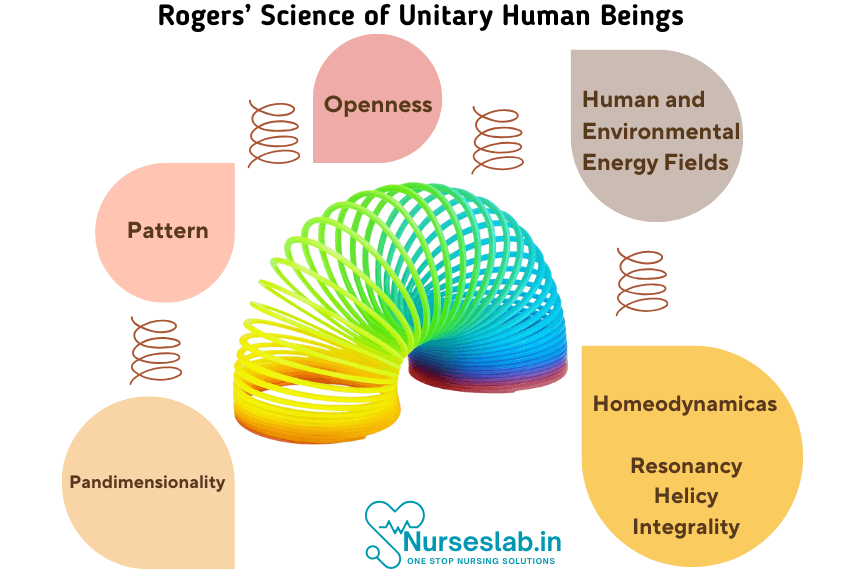
Key Elements of the Theory
| Concept | Description |
|---|---|
| Energy Field | Fundamental unit of living and non-living; defines both person and environment |
| Openness | No boundaries between human and environmental fields—energy flows freely |
| Pattern | Unique identifying characteristic of each energy field |
| Pan-dimensionality | A domain without spatial or temporal limits |
| Homeodynamic Principles | Describe the dynamic nature of energy field interactions |
Three Homeodynamic Principles
These principles explain how change occurs in human-environment interactions:
- Resonancy: Continuous change in rhythm and frequency of energy fields
- Helicy: Unpredictable, non-linear evolution of energy patterns
- Integrality: Mutual, simultaneous interaction between human and environmental fields
Implications for Nursing Practice
- Encourages holistic care that honors the unity of body, mind, and spirit.
- Supports non-invasive interventions like therapeutic touch, guided imagery, and energy-based healing.
- Shifts focus from disease treatment to pattern recognition and enhancement of well-being.
Application of Rogers’ Science of Unitary Human Beings
- Holistic and Energy-Based Care
- Focus on the patient as a whole, not just the disease.
- Recognize energy flow and environmental interactions in promoting healing.
- Promotion of Harmony
- Modify the environment to enhance comfort, safety, and positive energy.
- Example interventions: Soothing lighting, music therapy, and therapeutic touch.
- Patterning of Human and Environmental Fields
- Support patients in achieving balance through mind-body-spirit practices.
- May involve guided imagery, meditation, or energy therapies.
- Non-Invasive and Complementary Interventions
- Encourage non-pharmacological therapies that align human and environmental energy fields:
- Music therapy
- Aroma therapy
- Therapeutic presence and touch
- Relaxation and breathing exercises
- Encourage non-pharmacological therapies that align human and environmental energy fields:
- Nurse-Patient Interaction as Energy Exchange
- Therapeutic presence and empathy contribute to a healing environment.
- The nurse becomes part of the patient’s energy field, supporting harmony and adaptation.
Case Scenario 1: Oncology Patient Experiencing Anxiety and Insomnia
Scenario:
Mr. A, 55 years old, is admitted to the oncology ward for chemotherapy. He reports difficulty sleeping, high anxiety, and fear of disease progression.
Assessment
- Reports insomnia and frequent awakenings
- Appears anxious and restless
- Expresses fear and emotional distress
Nursing Diagnoses
- Anxiety related to cancer diagnosis and hospitalization.
- Sleep pattern disturbance related to stress and environmental factors.
Nursing Interventions Based on Rogers’ Theory
Focus: Patterning the human-environment energy field to promote harmony
- Provide therapeutic presence and active listening to reduce anxiety.
- Modify the environment with soft lighting, calming music, and aromatherapy to promote relaxation.
- Encourage guided imagery and deep breathing exercises before bedtime.
- Collaborate with the healthcare team for non-pharmacologic sleep promotion strategies.
Expected Outcome:
- Patient verbalizes reduced anxiety.
- Reports improved sleep and relaxation.
Case Scenario 2: Post-Operative Patient with Pain and Emotional Distress
Scenario:
Mrs. B, 40 years old, underwent a hysterectomy 2 days ago. She experiences moderate incisional pain, feels emotionally low, and refuses to ambulate due to fear of pain.
Assessment
- Incisional pain rated 6/10
- Verbalizes fear of movement
- Appears withdrawn and tearful
Nursing Diagnoses
- Acute pain related to surgical incision as evidenced by verbal report.
- Disturbed energy field related to post-operative stress and emotional distress.
Nursing Interventions Based on Rogers’ Theory
Focus: Promoting harmony and energy balance
- Administer analgesics as prescribed to reduce pain.
- Use therapeutic touch and relaxation techniques to promote comfort.
- Modify the environment with calm lighting, minimal noise, and comfortable positioning.
- Encourage gentle ambulation with support while reinforcing positive outcomes.
- Engage the patient in meditation or breathing exercises to enhance emotional stability.
Expected Outcome:
- Pain decreases to ≤3/10 after interventions.
- Patient participates in gradual mobility and reports emotional relief.
REFERENCES
- Barrett, E. A. M., & Malinski, V. M. (Eds.). (1994). Martha E. Rogers: Eighty years of excellence. New York, NY: Society of Rogerian Scholars.
- Barrett, E. A. M., & Malinski, V. M. (Eds.). (1994). Martha E. Rogers: Her life and her work. Philadelphia, PA: F.A. Davis.
- Huch, M. H. (1991). Perspectives on health. Nursing Science Quarterly, 4, 33–40.
- Huch, M. H. (1995). Nursing and the next millennium. Nursing Science Quarterly, 8, 38–44.
- Malinski, V. M. (1986). Further ideas from Martha Rogers. In V. M. Malinski (Ed.), Explorations on Martha Rogers’ science of unitary human beings (pp. 9– 14). Norwalk, CT: Appleton Century Crofts.
- Randell, B. P. (1992). Nursing theory: The 21st century. Nursing Science Quarterly, 5, 176–184.
- Rogers, M. E. (1961). Educational revolution in nursing. New York< NY: Macmillan.
- Hedlund Å. Martha Rogers’ science of unitary human beings in relation to workers health and well-being: A scoping review. Work. 2023;76(3):953-968. https://pmc.ncbi.nlm.nih.gov/articles/PMC10657656/
- Rogers, M. E. (1963). Some comments on the theoretical basis of nursing practice. Nursing Science, 1(1), 11–13, 60–61.
- Rogers, M. E. (1964). Reveille in nursing. Philadelphia, NY: F.A. Davis.
- Rogers, M. . (1970). An introduction to the theoretical basis of nursing. Philadelphia, P: F.A. Davis.
- Rogers, M. E. (1980a). Nursing: A science of unitary man. In J. P. Riehl & C. Roy (Eds.), Conceptual models for nursing practice (2nd ed., pp. 329–337). New York, NY: Appleton Century Crofts.
- Rogers, M. E. (1981). Science of unitary man. A paradigm for nursing. In G. E. Lasker (Ed.), Applied systems and cybernetics. Vol. 4. Systems research in health care, biocybernetics and ecology (pp. 1719–1722). New York, NY: Pergamon Press.
- Rogers, M. E. (1983). Science of unitary human beings: A paradigm for nursing. In I. W. Clements and F. B. Roberts (Ed.), Family health: A theoretical approach to nursing care (pp. 219–227). New York, NY: Wiley.
- Rogers, M. E. (1985). A paradigm for nursing. In R. Wood & J. Kekahbah (Eds.), Examining the cultural implications of Martha E. Rogers’ Science of Unitary Human Beings (pp. 13–23). Lecompton, KS: Wood Kekahbah Associates.
- Rogers, M.E. (1986). Science of unitary human beings. In V. M. Malinski (Ed.), Explorations on Martha Rogers’ science of unitary human beings (pp. 3–8). Norwalk, CT: Appleton Century Crofts.
- Rogers, M.E. (1987a). Nursing research in the future. In J. Roode (Ed.), Changing patterns in nursing education (pp. 121–123). New York, NY: National League for Nursing.
- Rogers, M.E. (1987b). Rogers’ Science of Unitary Human Beings. In R. R. Parse (Ed.), Nursing science. Major paradigms, theories, and critiques (pp. 139– 146). Philadelphia, PA: Saunders.
- Rogers, M.E. (1988). Nursing science and art: A prospective. Nursing Science Quarterly, 1, 99–102.
- Rogers, M.E. (1989). Nursing: A science of unitary human beings. In J. P. Riehl-Sisca (Ed.), Conceptual models for nursing practice (3rd ed., pp. 181–188). Norwalk, CT: Appleton & Lange.
- Rogers, M. E. (1990). Nursing: Science of unitary, irreducible, human beings: Update 1990. In E.A.M. Barrett (Ed.), Visions of Rogers’ science based nursing (pp. 5–11). New York, NY: National League for Nursing.
- Rogers, M. E. (1990). Space age paradigm for new frontiers in nursing. In M.E. Parker (Ed.), Nursing theories in practice (pp. 105–113). New York, NY: National League for Nursing.
- Rogers, M. E. (1992). Nightingale’s notes on nursing: Prelude to the 21st century. In F.N. Nightingale, Notes on nursing: What it is, and what it is not (Commemorative edition, pp. 58–62). Philadelphia, PA: Lippincott.
- Rogers, M. E. (1992). Nursing science and the space age. Nursing Science Quarterly, 5, 27–34.
- Rogers, M. E. (1992). Window on science of unitary human beings. In M. O’Toole (Ed.), Miller Keane encyclopedia and dictionary of medicine, nursing, and allied health (p. 1339). Philadelphia, PA: Saunders.
- Rogers, M. E. (1994). Nursing science evolves. In M. Madrid & E. A. M. Barrett (Eds.),
- Rogers’ scientific art of nursing practice (pp. 3–9). New York, NY: National League for Nursing Press.
- Rogers, M. E. (1994). The science of unitary human beings: Current perspectives. Nursing Science Quarterly, 7, 33–35.
- Rogers, M. E. (2005). Rogerian science review: Glossary. Visions: The Journal of Rogerian Nursing Science, 13, 70-71. [Reprinted from Rogerian Nursing Science News, Fall 1991.]
- Rogers, M. E., Doyle, M. B., Racolin, A., & Walsh, P. C. (1990). A conversation with Martha Rogers on nursing in space. In E. A. M. Barrett (Ed.), Visions of Rogers’ science based nursing (pp. 375–386). New York, NY: National League for Nursing.
- Rogers, M .E., & Malinski, V. (2005). Questions for Dr. Martha Rogers. Visions: The Journal of Rogerian Nursing Science, 13, 65-67. [Reprinted from Rogerian Nursing Science News, 1(3), 6, 1989.]
- Safier, G. (1977). Contemporary American leaders: An oral history. New York, NY: McGraw Hill.
- Smith, M.J. (1988). Perspectives on nursing science. Nursing Science Quarterly, 1, 80–85.
- Society of Rogerian Scholars. (2023). Evolving Rogerian Nursing Science: John R. Phillips’ Unique Contributions. Society of Rogerian Scholars.
- Takahashi, T. (1992). Perspectives on nursing knowledge. Nursing Science Quarterly, 5, 86–91.
Stories are the threads that bind us; through them, we understand each other, grow, and heal.
JOHN NOORD
Connect with “Nurses Lab Editorial Team”
I hope you found this information helpful. Do you have any questions or comments? Kindly write in comments section. Subscribe the Blog with your email so you can stay updated on upcoming events and the latest articles.


