Nursing Interventions – Implementing Your Patient Care Plans
To provide quality patient care over a period of time, nurses need a roadmap that guides their actions and quantifies desired outcomes. As a registered nurse, you will be responsible for creating a plan of care based on each patient’s needs and health goals. A nursing care plan is a formal process that includes six components: assessment, diagnosis, expected outcomes, interventions, rationale, and evaluation. Documenting these steps ensures effective communication between doctors, nurses, and other healthcare professionals over multiple shifts.
Interventions are a key element of the nursing care plan. This guide explores nursing interventions and their role in patient care.
What Are Nursing Interventions?
Nursing interventions are actions a nurse takes to implement their patient care plan, including any treatments, procedures, or teaching moments intended to improve the patient’s comfort and health.
These actions can be as simple as adjusting the patient’s bed and resting position—or as involved as psychotherapy and crisis counseling. While some nursing interventions are doctors’ orders, nurse practitioners can also develop orders using principles of evidence-based practice. Common nursing interventions include:
- Bedside care and assistance
- Administration of medication
- Postpartum support
- Feeding assistance
- Monitoring of vitals and recovery progress
Nursing Intervention Categories
Nursing interventions are grouped into three categories according to the role of the healthcare professional involved in the patient’s care:
- Independent: A nurse can perform independent interventions on their own without assistance from other medical personnel; e.g., routine nursing tasks such as checking vital signs.
- Dependent: Some actions require instructions or input from a doctor, such as prescribing new medication. A nurse cannot initiate dependent interventions alone.
- Interdependent: Collaborative, or interdependent, interventions involve team members across disciplines. In certain cases, such as post-surgery, the patient’s recovery plan may require a prescription medication from a doctor, feeding assistance from a nurse, and treatment by a physical therapist or occupational therapist.
The Role of Assessments
The nursing assessment is the first step in the nursing care plan. During the assessment process, both physicians and nurses might ask questions and perform tests to gain information about a patient’s health and state of being. Professionals gather information from the patient’s:
- Vital signs
- Physical complaints or concerns
- External body conditions
- Medical history
- Current neurological functioning
After gathering all essential information during the assessment process, the nurse can use clinical judgment to formulate a nursing diagnosis list. Based on the assessment and diagnosis, the nurse can develop a care plan that outlines which interventions to include. For example, the nursing diagnosis list may conclude the patient has a lack of appetite due to post-surgery pain. From this medical diagnosis, the nurse can set goals to resolve the patient’s pain through actions such as administering pain-relief medication and assessing the patient’s pain levels every few hours.
Nursing Interventions Classification System

1. Family Nursing Interventions
Family nursing interventions are those that address not only the patient, but other family members as well. They could entail education of family members about caring for the patient; or, in the case of new mothers, interventions could consist of instruction and assistance with breastfeeding and other forms of infant care.
2. Behavioral Nursing Interventions
This category includes actions a nurse takes to help their patient change an unhealthful behavior or habit; for example, suggesting physical and emotional coping methods for a patient who wants to quit smoking.
3. Physiological Nursing Interventions
Basic interventions concerning the patient’s physical health include hands-on procedures ranging from feeding to hygiene assistance.
Some physiological nursing interventions are more complex, such as the insertion of an IV line to administer fluids to a dehydrated patient.
4. Community Nursing Interventions
Some hospitals and clinics focus on public health initiatives to educate patients, their families, and local communities. These community nursing interventions are organized efforts that encourage general health and wellness.
5. Safety Nursing Interventions
After undergoing surgery, patients need education on safety procedures and protocols to prevent injury. These safety interventions may include instructions for using a walker or a cane or how to take a shower safely.
6. Health System Interventions
During their shift, nurses take the initiative to ensure that the patient’s environment is safe and comfortable, such as repositioning them to avoid pressure ulcers in bed. These routine procedures classify as health system interventions.
While a nurse may not use every type of intervention every day, each is an essential form of care needed to maintain the patient’s physical, emotional, and mental well-being and reach the desired outcome.
Nursing Interventions to Performed by a Nurse in each Shift
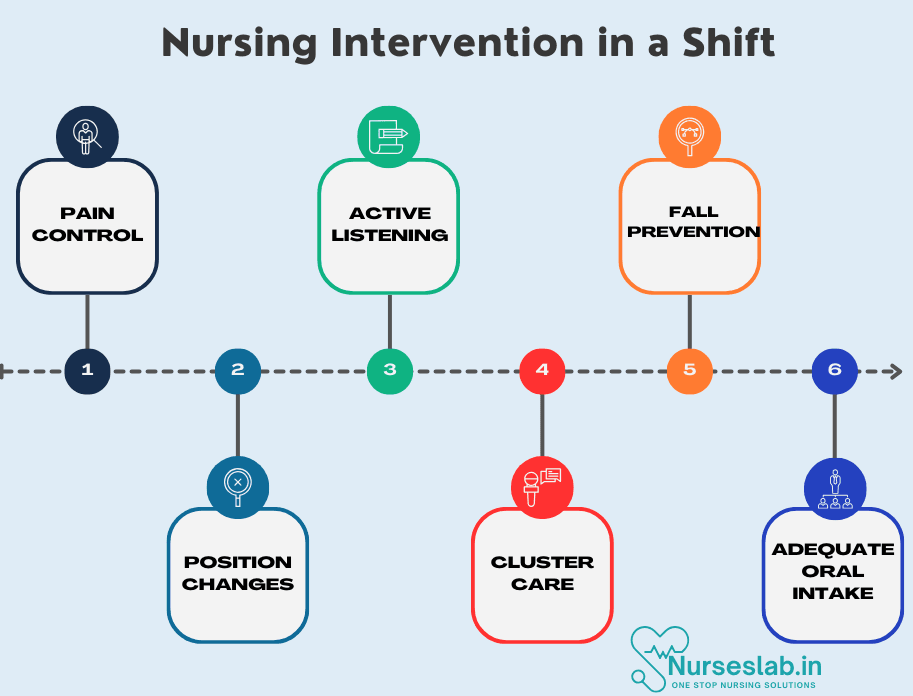
On-duty nurses routinely perform certain nursing interventions as part of their daily tasks. In addition to educating the patient on their care and recovery progression, nurses will typically perform the following each shift:
- Pain control: Ensuring that the patient is comfortable and monitoring their intake of pain medication, if applicable
- Position changes: Promoting a change of the patient’s resting position to prevent bedsores
- Active listening: Listening to the patient and repeating back information so they feel heard
- Cluster care: Informing other nurses and care team members of the patient’s needs each shift to help consolidate trips and avoid frequent traffic in the patient’s room
- Fall prevention: Educating the patient, generally someone who is elderly or recovering post-surgery, of instructions to avoid the risk of fall and injury
- Adequate oral intake: Promoting fluid consumption by mouth for patients currently receiving fluid through IVs as a means to decrease and discontinue IV use
REFERENCES
- Nursing Interventions for Home Care,” Dec. 26, 2019: https://www.inhomecare.com/what-is-nursing-intervention-guide-to-nurse-interventions/
- Eustace, R. W., Gray, B., & Curry, D. M. (2015). The meaning of family nursing intervention: what do acute care nurses think?. Research and theory for nursing practice, 29(2), 125–142.
- National Library of Medicine, “NIC (Nursing Interventions Classification) – Synopsis,” 2007, https://www.nlm.nih.gov/research/umls/sourcereleasedocs/current/NIC/index.html
- National Library of Medicine, “Nursing Admission Assessment and Examination,” Sept. 2, 2020, https://www.ncbi.nlm.nih.gov/books/NBK493211/
- RN Speaks, “Nursing Interventions – The Core of Nursing Process,” Sept. 3, 2020, https://rnspeak.com/nursing-interventions/
- nursing intervention. (n.d.) Medical Dictionary. (2009). Retrieved April 22 2021, https://medical dictionary.thefreedictionary.com/nursing+intervention
- Helen Ballantyne, “Developing nursing care plans,” Nursing Standard, Feb. 24, 2016: https://pubmed.ncbi.nlm.nih.gov/26907149/
Stories are the threads that bind us; through them, we understand each other, grow, and heal.
JOHN NOORD
Connect with “Nurses Lab Editorial Team”
I hope you found this information helpful. Do you have any questions or comments? Kindly write in comments section. Subscribe the Blog with your email so you can stay updated on upcoming events and the latest articles.