Last Updated on January 21, 2026 by Nurseslab.in Editorial Team
The nursing process becomes a road map for the actions and interventions that nurses implement to optimize their patients’ well-being and health. This chapter will explain how to use the nursing process as standards of professional nursing practice to provide safe, patient-centered care.
Before learning how to use the nursing process, it is important to understand some basic concepts related to critical thinking and nursing practice.
Critical Thinking and Clinical Reasoning
“Critical thinkers” possess certain attitudes that foster rational thinking. These attitudes are as follows:
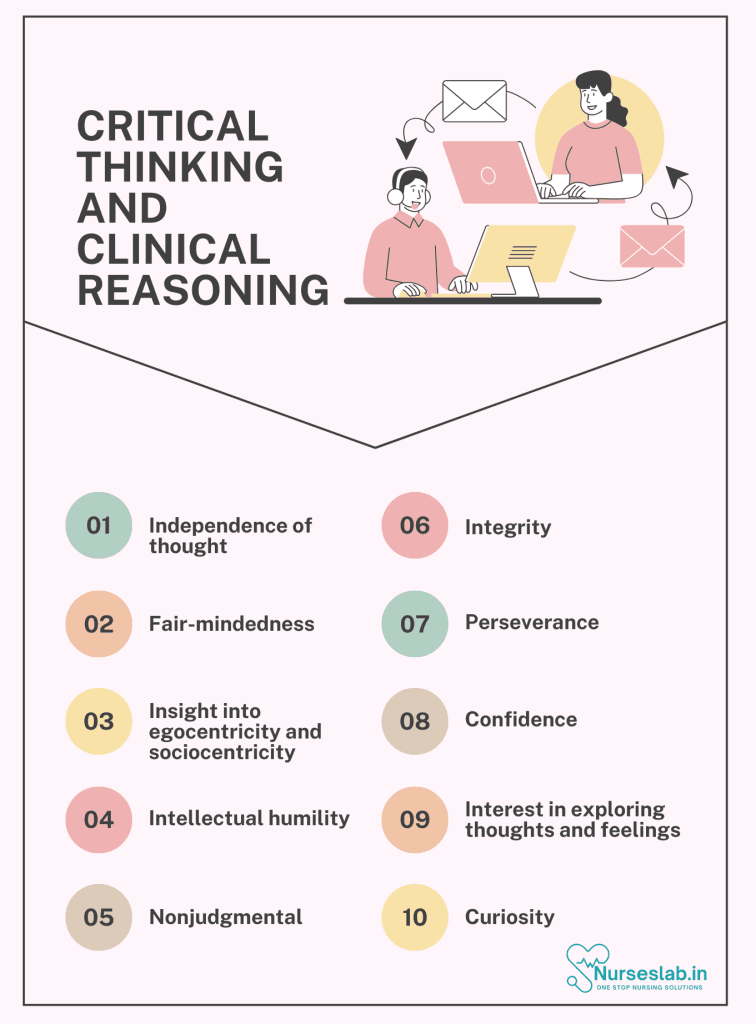
- Independence of thought: Thinking on your own
- Fair-mindedness: Treating every viewpoint in an unbiased, unprejudiced way
- Insight into egocentricity and sociocentricity: Thinking of the greater good and not just thinking of yourself. Knowing when you are thinking of yourself (egocentricity) and when you are thinking or acting for the greater good (sociocentricity)
- Intellectual humility: Recognizing your intellectual limitations and abilities
- Nonjudgmental: Using professional ethical standards and not basing your judgments on your own personal or moral standards
- Integrity: Being honest and demonstrating strong moral principles
- Perseverance: Persisting in doing something despite it being difficult
- Confidence: Believing in yourself to complete a task or activity
- Interest in exploring thoughts and feelings: Wanting to explore different ways of knowing
- Curiosity: Asking “why” and wanting to know more
Important Critical Thinking Skills
Inductive and deductive reasoning are important critical thinking skills. They help the nurse use clinical judgment when implementing the nursing process.

Inductive reasoning involves noticing cues, making generalizations, and creating hypotheses. Cues are data that fall outside of expected findings that give the nurse a hint or indication of a patient’s potential problem or condition. The nurse organizes these cues into patterns and creates a generalization.
Deductive reasoning is another type of critical thinking that is referred to as “top-down thinking.” Deductive reasoning relies on using a general standard or rule to create a strategy. Nurses use standards set by their state’s Nurse Practice Act, federal regulations, the American Nursing Association, professional organizations, and their employer to make decisions about patient care and solve problems.
Clinical judgment is the result of critical thinking and clinical reasoning using inductive and deductive reasoning. Clinical judgment is defined by the National Council of State Boards of Nursing (NCSBN) as, “The observed outcome of critical thinking and decision-making. It uses nursing knowledge to observe and assess presenting situations, identify a prioritized patient concern, and generate the best possible evidence-based solutions in order to deliver safe patient care.”
History of the Nursing Process
The nursing process was introduced in 1958 by Ida Jean Orlando. Today, it continues to be the most widely accepted method of prioritizing, organizing, and providing patient care in the nursing profession.
It’s characterized by the key elements of:
- Critical thinking
- Client-centered methods for treatment
- Goal-oriented activities
- Evidence-based nursing research and findings
Who Developed the Nursing Process?
The nursing process as we know it today is based upon the “Deliberative Nursing Process Theory” developed by Ida Jean Orlando-Pelletier. Ms. Orlando-Pelletier’s version of the nursing process includes five steps: Assessment, Diagnosis, Planning, Implementation, and Evaluation.
Outcome Identification is the third step of the nursing process (and the third Standard of Practice by the American Nurses Association). This standard is defined as, “The registered nurse identifies expected outcomes for a plan individualized to the health care consumer or the situation.”
ADOPIE
- Assessment
- Diagnosis
- Outcome Identification
- Planning
- Implementation
- Evaluation
What is the Nursing Process?
The nursing process is a patient-centered, systematic, evidence-based approach to delivering high-quality nursing care. It consists of six steps: assessment, diagnosis, outcome Identification, Planning, implementation, and evaluation.

The Nursing Process (ADOPIE)
| Assessment | Identify patients’ health needs and collect subjective and objective nursing data about their condition. |
| Diagnosis | Identify any real or potential health problems that the patient is experiencing or may possibly experience. |
| Outcome Identification | The nurse sets measurable and achievable short- and long-term goals and specific outcomes in collaboration with the patient based on their assessment data and nursing diagnoses. |
| Plan | Develop a nursing plan of care, which outlines the actions that will be taken to meet the needs identified to achieve the desired patient outcomes. |
| Implementation | Carry out the plan of care and monitor patients’ progress. |
| Evaluation | Evaluate whether the plan of care was successful. If necessary, the process is then repeated until the patient is discharged or until they reach all their health care goals. |
1. Assessment
To begin the nursing process, assessment involves collecting information about the patient and their health. This information is used to identify any problems, or potential problems, that may need to be addressed while you’re caring for a patient.
Objectives of Assessment Phase?
The assessment phase of the nursing process involves gathering information about the patient which is used to guide planning care, setting goals for recovery, and evaluating patient progress. Nurses can obtain information about the patient by implementing the following objectives.
1. Establish communication with the patient.
The patient is the nurse’s main source of information. Therefore, it is essential to establish rapport with them as soon as possible.
2. Establish communication
with the patient’s family or caregivers when appropriate. Family members, friends, or other caregivers often offer insight into what is going on with the patient. It is important for nurses to listen to the patient’s support people and gather any information available.
3. Conduct a patient interview.
When the patient feels comfortable, it makes it easier to get the necessary information that will be used to establish a plan of care. The patient interview is one of the main sources of information used to plan patient care.
4. Collect objective data.
Any information that is measurable or observable such as vital signs and test results is considered objective data.
5. Collect subjective data.
Subjective data is information gathered from the patient.
Example:
If you’re admitting an older patient who is falling and getting injured at home, you’ll want to do a thorough physical and mental health assessment, including a medical history to try and determine why this is happening.
Some important things you’ll want to find out are:
- What medications and over-the-counter products is the patient taking
- History of alcohol and recreational drug use
- Where the person lives and the layout of their home, including scatter rugs they may be tripping over: clutter, pets, stairs, slippery tubs they’re climbing into or out of, fluid or food spills on floors, lighting, mobility aids they use, etc.
2. Diagnosis
The Nursing Diagnosis is the second step in the nursing process and involves identifying real or potential health problems for a patient based on the information you gathered during the assessment.
Objectives of Diagnosis Phase?
In the diagnosis phase, the nurse follows a set of objectives that end with developing the nursing diagnosis/diagnoses used to establish patient care. These are the main objectives of the diagnosis phase:
1. Identify and Define the Problem(s):
The nurse must identify what problem the patient is experiencing related to the medical diagnosis.
2. Identify Risk Factors:
Any situation or problem that could result because of the patient’s medical diagnosis is a risk factor for a nursing diagnosis and must be addressed.
3. Analyze Data:
All data gathered during the assessment phase of the nursing process must be compiled, validated, and analyzed to support an appropriate nursing diagnosis.
4. Develop a theory/hypothesis:
Nursing theories involve an organized framework of concepts and purposes that guide nursing practices. A nurse’s theory is their unique perspective about the patient’s status and measures needed to improve the patient’s outcome.
5. Establish a nursing diagnosis:
After identifying problems and risk factors, analyzing data, and developing a nursing theory, the nurse can then establish a nursing diagnosis or diagnoses which is used to establish a nursing care plan.
Example:
Using the falls patient example above, you may identify from your assessment that the patient is falling because they’re tripping on things in their environment that they don’t see, like their pet cat lying on the floor and loose scatter rugs.
Based on this, you might form a diagnosis such as “Falls related to poor vision, cluttered environment, unsteady gait, Lt. hip pain due to previous fall.”
3. Outcome Identification
An outcome is a measurable behavior demonstrated response to nursing interventions. Outcomes should be identified before nursing interventions are planned. After nursing interventions are implemented, the nurse will evaluate if the outcomes were met in the time frame indicated for that client.
Outcome identification includes setting short- and long-term goals and then creating specific expected outcome statements for each nursing diagnosis.
Objectives of Outcome Identification Phase?
Outcome statements are always client-centered. They should be developed in collaboration with the client and individualized to meet a client’s unique needs, values, and cultural beliefs. They should start with the phrase “The client will…” Outcome statements should be directed at resolving the defining characteristics the client is exhibiting for the nursing diagnosis. Additionally, the outcome must be something the client would like to achieve.
Outcome statements should contain five components easily remembered using the “SMART” mnemonic
1.Specific
Outcome statements should state precisely what is to be accomplished. See examples of a not specific and a specific outcome in the following box.
2.Measurable
Measurable outcomes have numeric parameters or other concrete methods of judging whether the outcome was met. It is important to use objective data to measure outcomes. If terms like “acceptable” or “normal” are used in an outcome statement, it is difficult to determine whether the outcome is attained.
3.Attainable/Action oriented
Outcome statements should be written so that there is a clear action to be taken by the client or significant others. This means that the outcome statement should include a verb.
4.Relevant/Realistic
Realistic outcomes consider the client’s physical and mental condition; their cultural and spiritual values, beliefs, and preferences; and their socioeconomic status in terms of their ability to attain these outcomes. Consideration should be also given to disease processes and the effects of conditions such as pain and decreased mobility on the client’s ability to reach expected outcomes. Other barriers to outcome attainment may be related to health literacy or lack of available resources.
Outcomes should always be reevaluated and revised for attainability as needed. If an outcome is not attained, it is commonly because the original time frame was too ambitious, or the outcome was not realistic for the client.
5.Timeframe
Outcome statements should include a time frame for evaluation. The time frame depends on the intervention and the client’s current condition. Some outcomes may need to be evaluated every shift, whereas other outcomes may be evaluated daily, weekly, or monthly. During the evaluation phase of the nursing process, the outcomes will be assessed according to the time frame specified for evaluation. If it has not been met, the nursing care plan should be revised.
4.Planning
Planning is the fourth step in the nursing process. This step involves developing a nursing care plan that includes goals and strategies to address the problems identified during the assessment and diagnosis steps.
Objectives of Planning Phase?
The American Nurses Association’s Standards of Clinical Nursing Practice identifies planning as one of the essential principles for promoting the delivery of competent nursing care. The planning phase of the nursing process has five main objectives, all of which focus on nursing interventions to promote positive patient outcomes. The following are the main objectives of the planning phase.
1. Establish Priorities:
The nurse reviews the nursing diagnoses and prioritizes them according to physiological and psychological importance. This step helps the nurse organize the patient’s nursing diagnoses into a format that promotes effective planning.
2. Develop SMART goals:
This objective of the planning phase of the nursing process involves setting goals related to each diagnosis. Goal setting helps to provide guidelines for nursing interventions and establishes criteria by which the care plan’s effectiveness is evaluated.
3. Establish Expected Outcomes:
After goals are established, the nurse can identify expected outcomes based on each goal. Outcomes should be realistic, mutually desired by the patient and nurse, and attainable within a designated amount of time.
4. Identify Interventions:
After goals are agreed upon and established, the nurse then implements decision-making skills to select nursing interventions that are relevant to the nursing diagnoses. Interventions are prioritized in order of planned implementation.
5. Document the Care Plan:
After priorities, goals, outcomes, and interventions are established, the nurse must document the care plan.
Documentation of the care plan includes nursing orders which communicate the interventions the nursing staff will implement for the client. Nursing orders must be well-written and should include the order date, which action will be performed, a detailed description, the time frame in which the intervention will be performed, and the nurse’s signature.
Example:
Continuing with the example above, you will likely recommend that the patient keep their environment,
- Free of scatter rugs
- Check to ensure the cat is not underfoot before they mobilize
- Suggest the patient use a walker for support when mobilizing
- Recommending that the patient schedule an eye exam to get their vision checked if they have not had one in the last year or two would also be a good idea or if they’ve noticed any changes in their vision lately.
4. Implementation
As the fourth step of the nursing process, implementation involves putting the plan of care into action.
Objectives of Implementation Phase?
The implementation phase of the nursing process is an ongoing process in patient care. From the time a plan is established, the implementation process continues in a cycle which includes the five objectives below.
1. Ongoing Assessment:
The nursing care plan is developed based on data from the initial nursing assessment. However, because a patient’s condition can change quickly or nurses may obtain new data, ongoing assessments are necessary to validate the need for proposed interventions. Ongoing observations and assessments provide information supporting adaptations of the nursing care plan to promote improved, individualized care.
2. Establishing Priorities:
Utilizing data from initial and going assessments, the nurse then establishes priorities for implementing care. Prioritization is based upon which problems are considered most important by the nurse, patient, family/significant others, previously scheduled tests/treatments (diagnostic tests, surgery, therapy), and available resources.
3. Allocating Resources:
Before implementing nursing interventions, the nurse must review proposed interventions and determine the skills and knowledge level required to safely and effectively implement them.
Although some interventions require the skills and knowledge of a registered nurse, others are less complex and may be delegated to licensed practical/vocational nurses or assistive personnel. The nurse allocates personnel resources by determining the needs of the client, the type of personnel who are available, and facility protocol for care.
4. Initiating Nursing Interventions:
After verifying priorities and determining resources, the nurse can initiate nursing interventions. Interventions are determined by the cause of the problem and often vary among patients with similar nursing diagnoses depending on expected outcomes for each patient.
When initiating nursing interventions, the patient’s preference and developmental level should be considered. Additionally, nurses must review the physician’s orders which may impact nursing interventions by imposing restrictions on specific factors such as the patient’s allowed activity level or diet.
5. Documenting Interventions and Patient Response:
Nurses are legally obligated to document all interventions and any observations concerning the patient’s response to those interventions. Documentation may be done on checklists, flow sheets, or in narrative form. Any verbal communication between the patient and nurse or among the healthcare team related to interventions and patient responses should be recorded, as well.
Example
In the above example, this would include:
- Making sure the patient’s environment is free of clutter and tripping hazards while in the hospital or a skilled nursing facility.
- Teaching the patient to wear proper footwear before mobilizing.
- Assisting the patient with mobility as needed, including putting proper footwear on the patient if needed.
- Speaking to the patient and family about removing scatter rugs from the patient’s home, scheduling an eye exam, and ensuring proper footwear is worn for mobilizing at home.
- Discussing with the patient and family about getting the patient a walker to assist with mobility on discharge and providing one while the patient is admitted.
5. Evaluation
The last step of the nursing process is evaluation, which involves determining whether or not the goals of care have been met.
Objectives of Evaluation Phase?
The Standards of Clinical Nursing Practice established by the American Nurses Association designates evaluation as a fundamental component of the nursing process. This phase of the nursing process has the following objectives.
1. To determine if nursing interventions are helping clients achieve expected outcomes.
The effectiveness of nursing interventions is determined by evaluating goals and expected outcomes to determine if they provide direction for patient care. It is essential to evaluate nursing interventions because they serve as standards by which patient progress is measured.
2. To verify the quality of nursing care provided.
The evaluation phase is not meant to make nurses feel as if their work is being critiqued or judged. Evaluation allows nurses to verify if the care they are providing meets the standard of care for the patient’s needs.
3. To promote accountability among nurses.
Evaluation involves reviewing all aspects of the patient’s care and determining its effectiveness in helping the patient recover. Because nurses work collaboratively with one another and other members of the healthcare team, the evaluation phase promotes the nurses’ sense of accountability to their patients and to one another.
4. To analyze current data.
In the evaluation phase of the nursing process, nurses compare and analyze data from the time the patient was admitted to care and determine if positive or negative trends are occurring. This data is helpful in deciding the next course of action to take in patient care.
5. To promote continuity of care.
Although the evaluation phase is the fifth and last step in the nursing process, nurses constantly evaluate patient progress. Evaluation allows nurses to establish a pattern of continuous care and attention, which helps promote positive patient outcomes.
Example
Here you would look back at the patient’s medical record to see if the patient has had any further falls since implementing the preventative actions above.
If so, you would repeat the nursing process over and reassess why this is still happening and plan new actions to prevent future falls.
Characteristics of the Nursing Process
The nursing process is also characterized by the following elements.
1. Dynamic and Cyclic
The nursing process is an evolving process that continues throughout a patient’s admission or illness and ends when the problems identified by the nurse are no longer an issue.
2. Patient-Centered and Goal-Directed
The entire nursing process is sensitive to and responsive to the patient’s needs, preferences, and values. As nurses, we need to act as patient advocates and protect the patient’s right to make informed decisions while involving the patient in goal setting and attainment.
3. Collaborative and Interpersonal
This describes the level of interaction that may be required between nurses, patients, families and supports, and the interprofessional healthcare team. These aspects of the nursing process require mutual respect, cooperation, clear communication, and decision-making that is shared between all parties involved.
4. Universally Applicable
As a widely and globally accepted standard in nursing practice, the nursing process follows the same steps, regardless of where a nurse works.
5. Systematic and Scientific
The nursing process is also an objective and predictable process for planning, conducting, and evaluating patient care that is based on a large body of scientific evidence found in peer-reviewed nursing research.
6. Requires Critical Thinking
Most importantly, it’s essential that nurses use critical thinking when planning patient care using the nursing process. This means as nurses, we must use a combination of our knowledge and past experiences with the information we have about a current patient to make the best decisions we can about nursing care.
REFERENCES
- Karttunen M, Sneck S, Jokelainen J, Elo S. Nurses’ self-assessments of adherence to guidelines on safe medication preparation and administration in long-term elderly care. Scand J Caring Sci. 2020 Mar;34(1):108-117.
- Younan L, Clinton M, Fares S, Samaha H. The translation and cultural adaptation validity of the Actual Scope of Practice Questionnaire. East Mediterr Health J. 2019 Apr 25;25(3):181-188.
- Epstein AS, Desai AV, Bernal C, Romano D, Wan PJ, Okpako M, Anderson K, Chow K, Kramer D, Calderon C, Klimek VV, Rawlins-Duell R, Reidy DL, Goldberg JI, Cruz E, Nelson JE. Giving Voice to Patient Values Throughout Cancer: A Novel Nurse-Led Intervention. J Pain Symptom Manage. 2019 Jul;58(1):72-79.e2.
- Shih CY, Huang CY, Huang ML, Chen CM, Lin CC, Tang FI. The association of sociodemographic factors and needs of haemodialysis patients according to Maslow’s hierarchy of needs. J Clin Nurs. 2019 Jan;28(1-2):270-278.
- Toney-Butler TJ, Thayer JM. Nursing Process. [Updated 2023 Apr 10]. In: StatPearls [Internet]. Treasure Island (FL): StatPearls Publishing; 2025 Jan-. Available from: https://www.ncbi.nlm.nih.gov/sites/books/NBK499937/
Stories are the threads that bind us; through them, we understand each other, grow, and heal.
JOHN NOORD
Connect with “Nurses Lab Editorial Team”
I hope you found this information helpful. Do you have any questions or comments? Kindly write in comments section. Subscribe the Blog with your email so you can stay updated on upcoming events and the latest articles.