


Last Updated on January 21, 2026 by Nurseslab.in Editorial Team
A lumpectomy, also known as breast-conserving surgery or wide local excision, is a surgical procedure intended to remove a breast tumor (usually cancerous) along with a small margin of surrounding healthy tissue. Unlike a mastectomy, which removes the entire breast, a lumpectomy aims to excise only the malignant tissue, preserving as much of the breast’s natural appearance and function as possible. Lumpectomy has become a widely accepted treatment for early-stage breast cancer and certain cases of ductal carcinoma in situ (DCIS).
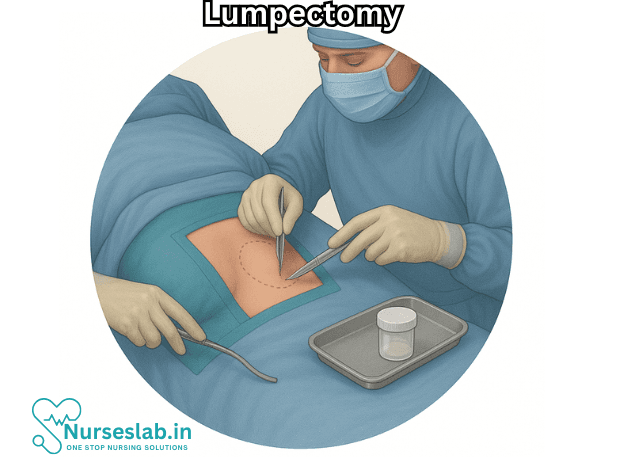
What is a Lumpectomy?
A lumpectomy is designed for patients in whom the breast tumor is small relative to the size of the breast, enabling effective removal of the cancerous tissue without significant cosmetic loss. The primary goal is to eradicate the cancer while maintaining the breast’s shape and appearance. The term “lumpectomy” is often used interchangeably with “breast-conserving surgery,” though the latter may sometimes refer to other procedures as well.
Indications for Lumpectomy
Lumpectomy is typically recommended for:
- Patients diagnosed with early-stage breast cancer (stages I and II).
- Those with small, localized tumors (generally less than 5 cm in diameter).
- Cases of ductal carcinoma in situ (DCIS).
- Patients for whom the tumor can be removed with clear margins, leaving enough healthy breast tissue.
However, lumpectomy may not be suitable for patients with:
- Large tumors relative to the breast size.
- Multiple tumors in different areas of the breast.
- Previous radiation therapy to the breast.
- Certain connective tissue diseases or pregnancy (in some cases).
The Lumpectomy Procedure
Preoperative Preparation
Before the surgery, the patient typically undergoes diagnostic imaging—such as mammography and ultrasound—to precisely locate the tumor. Sometimes, a wire or radioactive seed is placed in the breast to mark the tumor site, especially if the lump cannot be felt easily.
During Surgery
The procedure is usually performed under general anesthesia, though in select cases, local anesthesia with sedation may be used. The surgeon makes an incision over or near the tumor and removes the lump along with a margin of normal tissue to ensure complete removal of cancer cells. The removed tissue is sent to a pathology lab to confirm that the margins are free of tumor cells (clear margins).
A sentinel lymph node biopsy or axillary lymph node dissection may also be performed if there is concern that the cancer has spread to lymph nodes under the arm. The extent of lymph node removal depends on the tumor’s characteristics and staging.
After Surgery
Following tumor removal, the incision is closed with sutures, and a dressing is applied. In most cases, lumpectomy is an outpatient procedure, allowing patients to return home the same day. Occasionally, a drain may be placed to prevent fluid accumulation.
Recovery and Postoperative Care
Recovery from a lumpectomy is generally quick, with most individuals resuming normal activities within a few days to a week. However, healing times can vary based on the extent of surgery, whether lymph nodes were removed, and individual patient factors.
Common postoperative symptoms include:
- Pain or soreness at the surgical site
- Swelling or bruising of the breast
- Temporary numbness or tingling
- Limited arm movement (especially if lymph nodes were removed)
Pain is usually managed with over-the-counter or prescription medications. Patients are advised to avoid strenuous activity and heavy lifting until cleared by their surgeon. Wound care instructions should be closely followed to prevent infection.
Potential Complications
As with any surgery, lumpectomy carries some risks, such as:
- Bleeding and infection at the surgical site
- Hematoma (collection of blood in the tissue)
- Seroma (fluid accumulation)
- Poor wound healing or scarring
- Changes in breast shape, symmetry, or appearance
- Lymphedema (swelling of the arm if lymph nodes are removed)
Pathology Results and Additional Treatment
After the lumpectomy, the removed tissue is examined under a microscope by a pathologist. The report provides critical information, including tumor type, grade, hormone receptor status, and whether the margins are clear. If cancer cells are found at the margins, a re-excision (repeat surgery) may be necessary to achieve clear margins.
Radiation Therapy
Lumpectomy is almost always followed by radiation therapy to the remaining breast tissue to reduce the risk of cancer recurrence. Radiation typically begins several weeks after surgery and can last from three to six weeks, depending on the treatment protocol.
Other Adjuvant Therapies
Depending on the tumor’s characteristics, additional treatments such as chemotherapy, hormone therapy (e.g., tamoxifen or aromatase inhibitors), or targeted therapy may be recommended. The treatment plan is individualized based on the patient’s pathology, preferences, and overall health.
Benefits of Lumpectomy
The primary advantages of lumpectomy include:
- Preservation of most of the breast tissue and natural appearance
- Similar survival rates to mastectomy for early-stage breast cancer (when combined with radiation)
- Shorter recovery time and less extensive surgery
- Lower risk of major complications compared to more aggressive surgeries
Many women report higher satisfaction with body image and quality of life after lumpectomy than mastectomy.
Limitations and Considerations
A lumpectomy may not be appropriate for everyone. Factors influencing eligibility include tumor size, location, breast size, multifocality (more than one tumor), genetic risk factors (such as BRCA mutations), and personal preference. Some patients may opt for mastectomy for peace of mind or to avoid radiation therapy.
Cosmetic Outcomes
While lumpectomy is designed to conserve the breast, some patients may notice changes in shape, contour, or size. Modern oncoplastic techniques can help achieve better cosmetic outcomes, sometimes involving rearrangement of breast tissue or reconstructive surgery performed at the time of lumpectomy.
Long-Term Prognosis and Follow-Up
Long-term studies have shown that, for appropriately selected patients, lumpectomy combined with radiation therapy provides survival rates equivalent to mastectomy. The risk of local recurrence is generally low but does exist, necessitating regular follow-up with physical exams and mammograms.
Most patients maintain a high quality of life after lumpectomy, with good cosmetic outcomes and low rates of complications.
Nursing Care of Patients Undergoing Lumpectomy
The primary goal of a lumpectomy is to eradicate cancer cells while preserving as much of the natural breast as possible. Postoperative nursing care is pivotal in ensuring successful recovery, minimizing complications, addressing psychological needs, and supporting the patient’s overall well-being.
Preoperative Nursing Care
Patient Assessment
- Perform a thorough medical and nursing history focusing on comorbidities, allergies, prior surgeries, and current medications.
- Assess the patient’s understanding of the procedure, clarifying any misconceptions and answering questions.
- Evaluate baseline vital signs and conduct a focused breast examination.
- Screen for risk factors that may complicate surgery or recovery (e.g., bleeding disorders, diabetes, smoking).
Patient Education
- Explain the lumpectomy procedure, expected outcomes, and possible risks or complications in understandable language.
- Discuss the importance of postoperative follow-up, including pathology results and the possibility of adjuvant therapies (radiation, chemotherapy).
- Inform the patient about perioperative fasting and medication management, including which drugs to continue or withhold.
- Alleviate anxiety by encouraging questions and, if available, offering educational materials or resources such as support groups.
Preoperative Preparation
- Ensure signed informed consent is present in the medical record.
- Confirm the surgical site is accurately marked and checked according to hospital protocols.
- Perform necessary preoperative tests (blood work, ECG, chest X-ray if indicated).
- Encourage bathing or showering with antiseptic solution if advised by the surgical team.
- Remove jewelry, nail polish, and provide a hospital gown; secure personal belongings.
Intraoperative Nursing Care
Role in the Operating Room
- Collaborate with the surgical team to maintain a sterile environment and enforce infection control standards.
- Assist in positioning the patient for optimal surgical access and comfort, typically in the supine position with the ipsilateral arm extended.
- Document intraoperative events, specimen handling, and vital signs as per protocol.
- Prepare equipment for possible sentinel lymph node biopsy, if required.
Immediate Postoperative Nursing Care
Initial Assessment and Monitoring
- Monitor vital signs (blood pressure, pulse, respiration, oxygen saturation, temperature) closely per post-anesthesia care unit (PACU) protocols.
- Assess the surgical site for bleeding, drainage, swelling, or signs of hematoma formation.
- Evaluate the dressing for saturation and reinforce as needed; never remove the initial surgical dressing unless instructed.
- Monitor for signs of postoperative complications such as infection, hemorrhage, reaction to anesthesia, or respiratory distress.
Pain Management
- Assess pain frequently using standardized pain scales appropriate for the patient’s age and cognition.
- Administer prescribed analgesics promptly and evaluate their effectiveness.
- Provide non-pharmacological interventions such as positioning, cold packs (if recommended), relaxation techniques, and reassurance.
Wound Care
- Inspect the incision site through the dressing for signs of excessive bleeding or drainage.
- Maintain aseptic technique during dressing changes as ordered by the surgeon.
- Monitor for signs of infection: redness, increased warmth, purulent discharge, foul odor, or fever.
- Educate the patient about keeping the wound clean and dry until follow-up.
Ongoing Postoperative Nursing Care
Physical Assessment and Monitoring
- Continue to observe for late bleeding, hematoma, or seroma formation at the surgical site.
- Monitor for lymphedema, especially if lymph nodes were removed. Teach the patient early signs (swelling, heaviness, tightness in the arm).
- Assess mobility and function of the affected arm and shoulder; encourage gentle movements as tolerated.
- Ensure adequate fluid and nutritional intake to promote healing.
Pain and Comfort Management
- Reassess pain regularly; adjust pain management strategies as needed.
- Encourage use of prescribed medications for breakthrough pain, and monitor for side effects.
- Promote comfort with pillows, positioning, and relaxation techniques.
Prevention of Complications
- Monitor for deep vein thrombosis (DVT) signs, especially if the patient is less mobile. Encourage early ambulation as tolerated.
- Support pulmonary hygiene: deep breathing exercises, incentive spirometry, and coughing to prevent pneumonia.
- Prevent frozen shoulder by teaching and encouraging prescribed arm exercises; refer to physiotherapy if needed.
- Adhere to infection prevention strategies in wound care and general hygiene.
Patient Education and Discharge Planning
- Teach the patient and family about wound care, signs of infection, and the importance of keeping follow-up appointments.
- Review the medication regimen, including pain management, antibiotics, and any other prescribed therapies.
- Demonstrate and encourage gentle range-of-motion exercises to prevent stiffness and lymphedema.
- Advise on activity restrictions: avoid heavy lifting, strenuous activity, and certain movements until cleared by the surgeon.
- Provide information on support bras or camisoles, as recommended.
- Instruct the patient on proper use and care of surgical drains, if present.
- Offer written instructions and contact information for questions or complications after discharge.
Psychosocial Support
Emotional and Psychological Care
- Recognize the emotional impact of breast surgery, including anxiety, depression, and concerns about body image and femininity.
- Allow the patient to express feelings and offer empathetic listening without judgment.
- Facilitate access to counseling services, support groups, and peer support as appropriate.
- Encourage family involvement while respecting the patient’s privacy and autonomy.
- Support the patient in coping with uncertainty about pathology results and future treatments.
Education on Self-Image and Body Changes
- Discuss changes in appearance, scarring, and sensation, and reassure the patient regarding the healing process.
- Provide resources or referrals for prosthesis fitting or reconstructive options if desired.
- Promote positive self-image and acceptance through individualized counseling and support.
Long-Term Follow-Up and Rehabilitation
Ongoing Monitoring
- Coordinate appointments for follow-up with the surgical team, oncologist, and radiologist as needed.
- Reinforce the importance of regular breast self-examinations and routine screening as directed.
- Monitor for late complications such as lymphedema, chronic pain, or psychological distress.
Rehabilitation and Recovery
- Encourage ongoing participation in physical therapy to restore function and prevent long-term disability.
- Support gradual return to daily activities and work based on the individual’s recovery pace and healthcare provider’s advice.
- Provide resources for nutrition, exercise, and wellness tailored to the patient’s needs and preferences.
Special Considerations
Cultural Sensitivity
- Provide culturally sensitive care, respecting beliefs and preferences related to health, healing, and body image.
- Offer interpreter services or translated educational materials as necessary.
Care for Special Populations
- Adapt education and care for elderly patients who may have comorbidities, cognitive impairments, or limited support systems.
- Consider additional resources and support for patients with disabilities, language barriers, or low health literacy.
REFERENCES
- Admoun C, Mayrovitz H. Choosing Mastectomy vs. Lumpectomy-With-Radiation: Experiences of Breast Cancer Survivors. https://www.ncbi.nlm.nih.gov/pmc/articles/PMC8555933/). Cureus. 2021;13(10):e18433.
- American Cancer Society. Breast-Conserving Surgery (Lumpectomy)., https://www.cancer.org/cancer/types/breast-cancer/treatment/surgery-for-breast-cancer/breast-conserving-surgery-lumpectomy.html. Last revised 10/27/ 2021.
- Townsend CM Jr, et al. Diseases of the breast. In: Sabiston Textbook of Surgery: The Biological Basis of Modern Surgical Practice. 21st ed. Elsevier; 2022. https://www.clinicalkey.com.
- Czajka ML, Pfeifer C. Breast Cancer Surgery. https://pubmed.ncbi.nlm.nih.gov/31971717/). 2023 Feb 8. In: StatPearls. Treasure Island (FL): StatPearls Publishing; 2023 Jan.
- Boniface J de, Szulkin R, Johansson ALV. Survival after breast conservation vs mastectomy adjusted for comorbidity and socioeconomic status: a swedish national 6-year follow-up of 48 986 women. JAMA Surg. 2021;156(7):628-637. doi:10.1001/jamasurg.2021.1438
- National Breast Cancer Foundation (U.S.). Lumpectomy. https://www.nationalbreastcancer.org/lumpectomy/. Medically reviewed 6/2023.
- National Cancer Institute (U.S.). Shorter Course of Radiation Is Effective, Safe for Some with Early-Stage Breast Cancer. https://www.cancer.gov/news-events/cancer-currents-blog/2022/early-breast-cancer-shorter-radiation-therapy#:~:text=For%20some%20people%20with%20early,funded%20clinical%20trial%20has%20found.). Published 11/30/2022.
- Cameron JL, et al., eds. Current Surgical Therapy. 14th ed. Elsevier; 2023. https://www.clinicalkey.com.
- Klimberg VS, et al., eds. Breast conservation therapy for invasive breast cancer. In: Bland and Copeland’s The Breast: Comprehensive Management of Benign and Malignant Diseases. 6th ed. Elsevier; 2024. https://www.clinicalkey.com.
Stories are the threads that bind us; through them, we understand each other, grow, and heal.
JOHN NOORD
Connect with “Nurses Lab Editorial Team”
I hope you found this information helpful. Do you have any questions or comments? Kindly write in comments section. Subscribe the Blog with your email so you can stay updated on upcoming events and the latest articles.


