


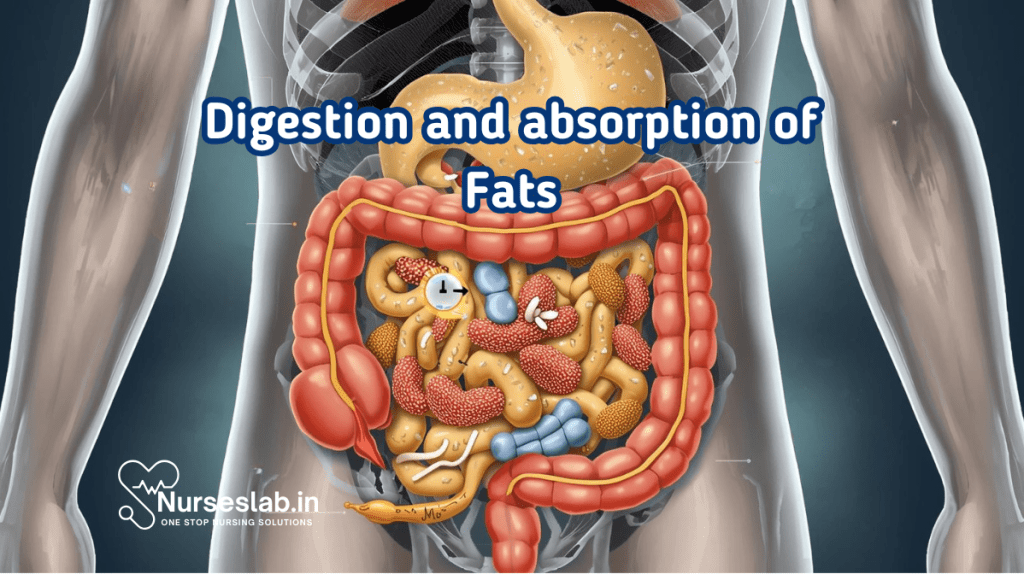
Digestion and absorption of fats begin in the small intestine with bile salts emulsifying lipids and pancreatic lipase breaking triglycerides into fatty acids and monoglycerides. These are absorbed into intestinal cells, reassembled into triglycerides, and transported via lymph for energy and storage.
Introduction
Fats, or lipids, form a crucial component of human nutrition and physiology. Their proper digestion and absorption are essential for energy production, cellular structure, hormone synthesis, and overall health. For nurses, a thorough understanding of the biochemical processes underlying fat digestion and absorption is vital.
Effective digestion of fat is essential for overall health, because it allows for absorption of many essential nutrients, plays an integral role in cellular and structural function, and supplies energy to the body. When this is dysfunctional, disorders of malabsorption can occur.
Overview of Fats
Types of Dietary Fats
Fats are a diverse group of organic compounds generally classified into three main categories:
- Triglycerides (Triacylglycerols): The most common form of dietary fat, composed of three fatty acid chains esterified to a glycerol backbone. Approximately 90-95% of dietary fats are triglycerides.
- Phospholipids: Contain two fatty acids and a phosphate group attached to glycerol. They are essential components of cell membranes.
- Sterols: The most abundant is cholesterol, which plays a role in hormone synthesis and membrane structure.
Sources of Dietary Fats
Dietary fats are found in both animal and plant sources:
- Animal sources: Butter, ghee, lard, fatty meats, eggs, and dairy products.
- Plant sources: Vegetable oils (sunflower, olive, mustard, coconut), nuts, seeds, and avocados.
Biological Roles of Fats
- Energy Storage: Fats provide 9 kcal/g, making them the most energy-dense macronutrient.
- Structural Functions: Integral components of cell membranes and myelin sheaths.
- Insulation and Protection: Adipose tissue cushions organs and provides thermal insulation.
- Absorption of Fat-Soluble Vitamins: Vitamins A, D, E, and K require fats for absorption.
- Hormone Synthesis: Precursors for steroid hormones and prostaglandins.
Biochemistry of Fat Digestion:
Overview of Fat Digestion
Unlike carbohydrates and proteins, fats are insoluble in water, posing unique challenges for digestion. The process involves several steps and requires the coordinated action of enzymes and bile salts to break down large fat globules into absorbable units.
Stepwise Breakdown of Dietary Fats
Mouth:
- Lingual Lipase: Secreted by glands on the tongue, this enzyme initiates the breakdown of triglycerides into diglycerides and free fatty acids, especially in infants. However, its contribution in adults is minimal.
Stomach:
- Gastric Lipase: Produced by chief cells in the stomach lining, this enzyme continues the hydrolysis of triglycerides, acting mainly on short- and medium-chain fatty acids. The acidic environment limits its activity, but it is important in infants and during the early phases of digestion.
- Mechanical mixing in the stomach helps to emulsify fat droplets to a limited extent.
Small Intestine:
- The bulk of fat digestion occurs here, facilitated by bile and pancreatic enzymes.
Role of Bile in Emulsification
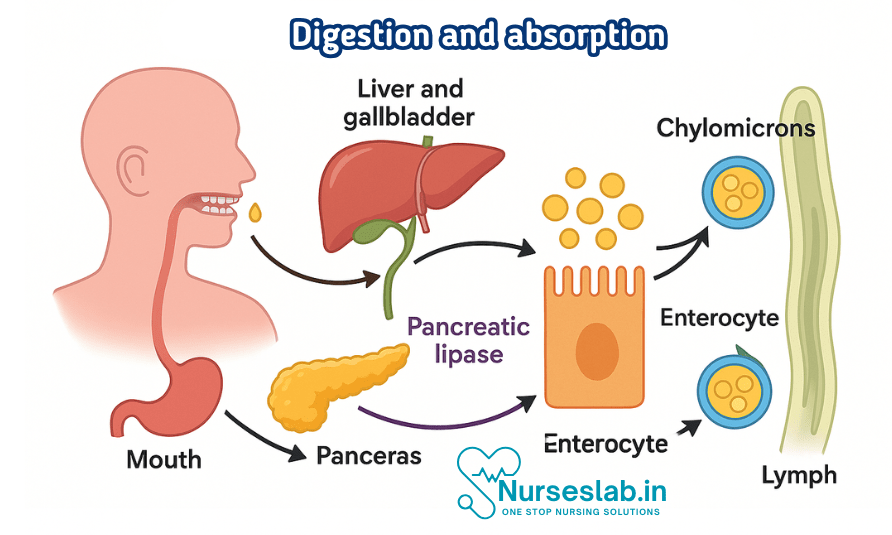
Bile, produced by the liver and stored in the gallbladder, is released into the duodenum in response to the hormone cholecystokinin (CCK). Bile contains bile salts, phospholipids (mainly lecithin), cholesterol, and pigments. Bile salts have amphipathic properties, allowing them to emulsify large fat globules into smaller micelles, increasing the surface area for enzyme action.
Key Enzymes in Fat Digestion
Pancreatic Lipase:
- The principal enzyme responsible for hydrolysing triglycerides into monoglycerides and free fatty acids.
- Requires the presence of colipase (a cofactor secreted by the pancreas) for optimal activity.
- Acts at the oil-water interface of emulsified fat droplets.
Phospholipase A2:
- Hydrolyses phospholipids to lysophospholipids and fatty acids.
Cholesterol Esterase:
- Hydrolyses cholesterol esters into free cholesterol and fatty acids.
Summary of Fat Digestion Steps
- Emulsification by bile salts in the small intestine.
- Hydrolysis of triglycerides by pancreatic lipase into monoglycerides and free fatty acids.
- Further breakdown of phospholipids and cholesterol esters by specific enzymes.
Absorption of Fats
Micelle Formation
After enzymatic digestion, the products (monoglycerides, free fatty acids, lysophospholipids, and cholesterol) aggregate with bile salts and phospholipids to form micelles. Micelles are small, water-soluble aggregates that facilitate the transport of lipids to the brush border of enterocytes (intestinal absorptive cells).
Transport Across Enterocytes
Micelle Interaction with Enterocytes:
- Micelles approach the microvilli of enterocytes in the jejunum and ileum.
- Lipid components diffuse passively across the plasma membrane into the enterocyte cytoplasm, while bile salts remain in the intestinal lumen and are recycled (enterohepatic circulation).
Re-esterification and Chylomicron Formation:
- Within enterocytes, long-chain fatty acids and monoglycerides are re-esterified to form triglycerides.
- These triglycerides, along with cholesterol esters and phospholipids, are packaged into chylomicrons (lipoprotein particles) for transport.
- Chylomicrons are exocytosed into the lacteals (lymphatic capillaries) and eventually enter the systemic circulation via the thoracic duct.
- Short- and medium-chain fatty acids (less than 12 carbons) are absorbed directly into the portal blood without re-esterification.
Chylomicron Transport and Metabolism
- Chylomicrons circulate in the bloodstream, delivering triglycerides to tissues such as adipose, muscle, and liver.
- Lipoprotein lipase (LPL), anchored on capillary endothelium, hydrolyses chylomicron triglycerides for tissue uptake.
- Chylomicron remnants are cleared by the liver.
Regulation of Digestion and Absorption
Hormonal Regulation
Cholecystokinin (CCK):
- Secreted by I-cells of the duodenum and jejunum in response to fatty acids and amino acids.
- Stimulates gallbladder contraction (bile release) and pancreatic enzyme secretion.
Secretin:
- Released by S-cells of the duodenum in response to acidic chyme.
- Stimulates bicarbonate secretion from the pancreas, neutralising gastric acid and optimising pH for enzyme activity.
Gastric Inhibitory Peptide (GIP):
- Inhibits gastric motility and stimulates insulin release in response to fatty acids and glucose.
Neural Regulation
- The enteric nervous system (ENS) and autonomic nervous system coordinate peristalsis, bile flow, and pancreatic secretion.
- Vagal stimulation enhances digestive secretions and motility in anticipation of food intake (cephalic phase).
Factors Affecting Efficiency of Digestion and Absorption
- Bile salt concentration and enterohepatic circulation integrity.
- Pancreatic enzyme secretion and activity.
- Intestinal mucosal health (villi integrity, brush border enzymes).
- Gastrointestinal motility and transit time.
- Presence of dietary inhibitors (e.g., orlistat, which inhibits pancreatic lipase).
Clinical Relevance
Malabsorption Syndromes
Malabsorption refers to impaired absorption of nutrients from the gastrointestinal tract. Fat malabsorption is clinically significant due to the resultant deficiency of essential fatty acids and fat-soluble vitamins.
- Steatorrhoea: Passage of bulky, pale, foul-smelling, and oily stools due to excess fat in faeces. Indicates fat malabsorption.
- Common Causes:
- Pancreatic insufficiency (e.g., chronic pancreatitis, cystic fibrosis) leading to inadequate enzyme secretion.
- Bile salt deficiency (e.g., cholestasis, liver disease, ileal resection).
- Mucosal diseases (e.g., coeliac disease, tropical sprue) affecting the absorptive surface.
- Infections (e.g., giardiasis) or structural abnormalities (e.g., short bowel syndrome).
Pancreatitis
Acute or chronic inflammation of the pancreas impairs enzyme secretion, notably pancreatic lipase, causing maldigestion of fats. Clinical features include abdominal pain, steatorrhoea, weight loss, and nutritional deficiencies.
Cystic Fibrosis
An autosomal recessive disorder common in some populations, cystic fibrosis causes thick, viscous secretions that block pancreatic ducts. This results in insufficient delivery of pancreatic enzymes to the intestine, leading to fat malabsorption and failure to thrive in children.
Symptoms and Diagnosis of Fat Malabsorption
- Steatorrhoea (as above).
- Weight loss and muscle wasting despite adequate intake.
- Deficiency of fat-soluble vitamins (A, D, E, K): night blindness, osteomalacia, coagulopathy, neuropathy.
- Laboratory tests: Faecal fat estimation (72-hour stool fat test), serum vitamin levels, imaging (abdominal ultrasound, CT scan).
Implications for Nursing Practice
Assessment and Monitoring
- Obtain detailed dietary and gastrointestinal history.
- Observe for clinical signs of malabsorption: steatorrhoea, weight loss, vitamin deficiencies.
- Monitor laboratory parameters and report abnormalities promptly.
- Collaborate with dietitians and physicians for comprehensive care.
Patient Education
- Educate patients and families about the importance of dietary fat and sources of healthy fats.
- Advise on the need for enzyme replacement therapy in pancreatic insufficiency.
- Explain symptoms of fat-soluble vitamin deficiencies and the importance of supplementation when indicated.
- Promote adherence to dietary modifications (e.g., low-fat diet in some conditions, MCT oil supplementation).
- Offer guidance on meal planning and label reading to empower patient self-management.
Dietary Management
- Implement dietary interventions tailored to the underlying cause (e.g., low-fat diet, MCT oil).
- Ensure adequate intake of essential fatty acids and fat-soluble vitamins.
- Monitor for intolerance to specific foods and adjust diet accordingly.
Monitoring and Follow-Up
- Regularly assess nutritional status, weight, and growth (in paediatric patients).
- Monitor compliance with enzyme therapy and dietary advice.
- Support ongoing adaptation to chronic conditions through counselling and resources.
REFERENCES
- Harbans Lal, Textbook of Applied Biochemistry and Nutrition& Dietetics 2nd Edition ,November 2024, CBS Publishers and Distributors, ISBN: 978-9394525757
- Suresh K Sharma, Textbook of Biochemistry and Biophysics for Nurses, 2nd Edition, September 2022, Jaypee Publishers, ISBN: 978-9354655760
- Peter J Kennelly, Harpers Illustrated Biochemistry Standard Edition, September 2022, McGraw Hill Lange Publishers, ISBN: 978-1264795673
- Denise R Ferrier, Ritu Singh, Lippincott Illustrated Reviews Biochemistry, Second Edition, June 2024, ISBN- 978-8197055973
- Yadav, Tapeshwar & Bhadeshwar, Sushma. (2022). Essential Textbook of Biochemistry for Nursing.
- Applied Sciences, Importance of Biochemistry for Nursing Practice, November 2, 2023, https://bns.institute/applied-sciences/importance-biochemistry-nursing-practice/
- Xu E, Chen C, Fu J, et al. Dietary fatty acids in gut health: absorption, metabolism and function. Anim Nutr. 2021; 7(4): 1337-1344. doi:10.1016/j.aninu.2021.09.010
- Ensari A. The malabsorption syndrome and its causes and consequences. Pathobiol Human Dis. 2014: 1266-1287. doi:10.1016/B978-0-12-386456-7.03804-1
Stories are the threads that bind us; through them, we understand each other, grow, and heal.
JOHN NOORD
Connect with “Nurses Lab Editorial Team”
I hope you found this information helpful. Do you have any questions or comments? Kindly write in comments section. Subscribe the Blog with your email so you can stay updated on upcoming events and the latest articles.


