


Last Updated on January 10, 2026 by Nurseslab.in Editorial Team
Lipogenesis
Lipogenesis is the biochemical pathway that synthesizes fatty acids and triglycerides from acetyl-CoA derived from glucose. Occurring mainly in the liver and adipose tissue, it stores energy, regulates metabolism, and supports cell membrane and hormone functions.
Introduction
Lipogenesis is the process of producing lipid or fat to store biochemical energy for later metabolic use. It is a biochemical process where, for instance, acetyl-CoA is converted to triglyceride. One such crucial biochemical process is lipogenesis – the synthesis of fatty acids and lipids in the body. This process is intimately linked with nutrition, energy storage, metabolic health, and several clinical conditions.
Basic Concepts
Definition of Lipogenesis
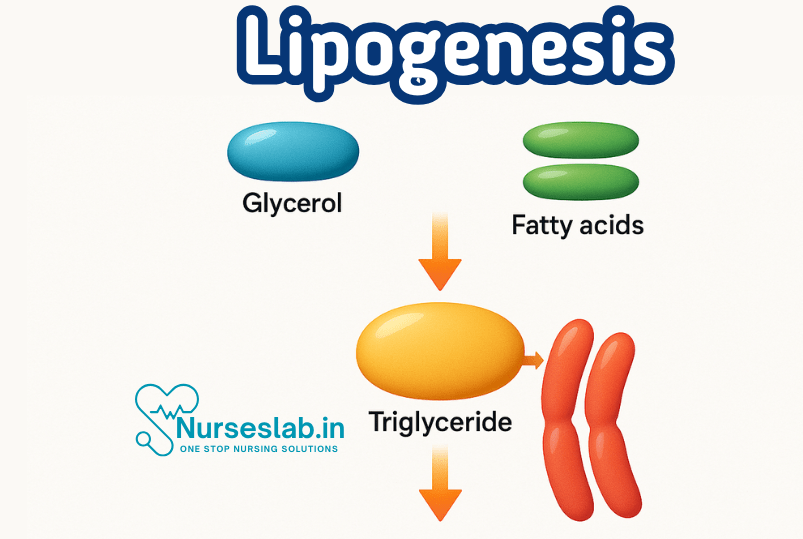
Lipogenesis is the biochemical process by which simple sugars such as glucose are converted into fatty acids, which are then esterified to form triglycerides (fats). In simpler terms, it is the body’s method of storing excess energy as fat. This process is vital for maintaining energy balance and is especially important in contexts of overnutrition, obesity, and metabolic disorders.
Where Does Lipogenesis Occur?
Lipogenesis primarily occurs in the liver and, to a lesser extent, in adipose tissue (fat stores). In humans, the liver is the principal site where carbohydrates are transformed into fatty acids. These fatty acids are then packaged into triglycerides and transported to adipose tissue for storage. This process ensures that the body has a ready supply of energy during periods of fasting or increased demand.
Why Does Lipogenesis Matter?
The significance of lipogenesis extends beyond simple fat storage. It plays a key role in energy homeostasis, regulates blood lipid levels, and is involved in the development of various diseases such as obesity, type 2 diabetes, and non-alcoholic fatty liver disease (NAFLD). For nurses, understanding lipogenesis helps in recognising risk factors, interpreting laboratory results, and educating patients about the importance of diet and lifestyle in managing metabolic health.
Biochemical Pathways of Lipogenesis
Lipogenesis involves a series of enzymatic reactions that convert glucose into fatty acids and ultimately into triglycerides. Here is a step-by-step breakdown of the process:
Step 1: Glycolysis – The Starting Point
The process begins with glycolysis, where glucose is broken down in the cytoplasm of the cell to produce pyruvate. Glycolysis is a universal pathway that provides energy and metabolic intermediates for other biosynthetic processes.
Step 2: Conversion of Pyruvate to Acetyl-CoA
Pyruvate produced from glycolysis enters the mitochondria, where it is converted into acetyl-CoA by the enzyme pyruvate dehydrogenase. Acetyl-CoA is a central molecule in metabolism and serves as the primary building block for fatty acid synthesis.
Step 3: Export of Acetyl-CoA to the Cytosol
Acetyl-CoA cannot cross the mitochondrial membrane directly. Instead, it combines with oxaloacetate to form citrate, which is transported out of the mitochondria into the cytosol. Once in the cytosol, citrate is cleaved back into acetyl-CoA and oxaloacetate by the enzyme ATP-citrate lyase.
Step 4: Fatty Acid Synthesis
The synthesis of fatty acids takes place in the cytosol and consists of a series of reactions catalysed mainly by two key enzymes:
- Acetyl-CoA Carboxylase (ACC): This enzyme converts acetyl-CoA into malonyl-CoA, the first committed step in fatty acid biosynthesis.
- Fatty Acid Synthase (FAS): This multi-enzyme complex elongates the carbon chain by sequentially adding two-carbon units from malonyl-CoA to a growing fatty acid chain, eventually producing palmitic acid (a 16-carbon saturated fatty acid).
Step 5: Triglyceride Formation
Once fatty acids are synthesised, they are esterified with glycerol to form triglycerides. This process mainly occurs in the liver and adipose tissue, and the resulting triglycerides are stored in fat cells or exported as very-low-density lipoproteins (VLDL) to other tissues.
Summary Table: Key Steps in Lipogenesis
| Step | Main Location | Key Enzymes | Major Products |
| Glycolysis | Cytoplasm | Various | Pyruvate |
| Pyruvate to Acetyl-CoA | Mitochondria | Pyruvate Dehydrogenase | Acetyl-CoA |
| Export to Cytosol | Mitochondria/Cytosol | ATP-Citrate Lyase | Acetyl-CoA (in cytosol) |
| Fatty Acid Synthesis | Cytosol | ACC, FAS | Palmitic Acid |
| Triglyceride Formation | Liver, Adipose | Glycerol-3-Phosphate Acyltransferase | Triglycerides |
Enzymes and Regulation of Lipogenesis
Main Enzymes Involved
Several enzymes catalyse the steps in lipogenesis, but two play central roles:
- Acetyl-CoA Carboxylase (ACC): This enzyme adds a carboxyl group to acetyl-CoA, forming malonyl-CoA. It is the rate-limiting step and is tightly regulated.
- Fatty Acid Synthase (FAS): This large enzyme complex synthesises the fatty acid chain by sequentially adding two-carbon units.
Other supporting enzymes include ATP-citrate lyase, malic enzyme, and NADP+-dependent enzymes that provide the reducing power (NADPH) necessary for fatty acid synthesis.
Hormonal Regulation
Lipogenesis is regulated primarily by hormones, especially insulin and glucagon:
- Insulin: Stimulates lipogenesis by increasing the activity of ACC and FAS, and promoting the uptake of glucose into cells. After a meal, when blood glucose and insulin levels are high, the body favours fat synthesis and storage.
- Glucagon and Adrenaline: Inhibit lipogenesis by activating enzymes that break down fat and by reducing the activity of ACC. During fasting, these hormones shift metabolism towards fat breakdown rather than synthesis.
Nutritional Regulation
Dietary composition strongly influences lipogenesis:
- High Carbohydrate Intake: Excess carbohydrates are converted into fatty acids and stored as fat, particularly when energy intake exceeds expenditure.
- Low Carbohydrate or High Fat Intake: Lipogenesis decreases, and the body relies more on fat oxidation for energy.
- Protein: Has a minimal direct effect on lipogenesis, though excess protein can be converted to glucose and subsequently to fats if consumed in large quantities.
Allosteric and Covalent Regulation
Enzyme activity in lipogenesis is also modulated by:
- Allosteric regulation: Molecules such as citrate (activator) and long-chain fatty acyl-CoA (inhibitor) can modulate ACC activity.
- Covalent modification: Phosphorylation (addition of phosphate groups) inactivates ACC, while dephosphorylation (removal of phosphate) activates it.
Physiological Significance of Lipogenesis
Role in Energy Storage
Lipogenesis is the body’s principal method of converting surplus energy into a storable form. Triglycerides, the end products of lipogenesis, are stored in adipose tissue. They provide a dense energy reserve that can be mobilised during periods of fasting, illness, or increased physical activity. For example, during the overnight fast, the body relies on stored fats to maintain blood glucose and energy supply to vital organs.
Metabolic Health and Homeostasis
By regulating the balance between energy intake and expenditure, lipogenesis helps maintain metabolic homeostasis. It also ensures that excess glucose is not left circulating in the blood, which could otherwise be harmful. In this way, lipogenesis is protective in the short term but may become detrimental if chronically overactivated, such as in cases of persistent overnutrition.
Other Physiological Roles
Fatty acids produced via lipogenesis are not only used for energy storage but also serve as building blocks for cell membranes, signalling molecules, and precursors for hormone synthesis. Thus, lipogenesis is essential for growth, repair, and normal cellular function.
Clinical Implications of Lipogenesis
Disorders Related to Lipogenesis
- Obesity: Chronic overactivation of lipogenesis, often due to excessive caloric intake, leads to increased fat storage and obesity. Obesity is a risk factor for numerous health issues, including cardiovascular disease, type 2 diabetes, and certain cancers.
- Non-Alcoholic Fatty Liver Disease (NAFLD): Excessive lipogenesis in the liver can result in the accumulation of fat within liver cells, leading to NAFLD. If left unchecked, this can progress to inflammation, fibrosis, and cirrhosis.
- Hyperlipidaemia: Overproduction of triglycerides and their release into the bloodstream can result in elevated blood lipid levels, increasing the risk of atherosclerosis and cardiovascular events.
- Metabolic Syndrome: A cluster of conditions including insulin resistance, high blood pressure, dyslipidaemia, and central obesity, all of which are linked to alterations in lipogenesis and fat metabolism.
Diagnostic Markers
Several laboratory tests can provide insights into the activity of lipogenesis and related metabolic pathways:
- Blood Lipid Profile: Measures levels of triglycerides, cholesterol, LDL, and HDL. Elevated triglycerides may indicate increased lipogenesis.
- Liver Function Tests: May reveal abnormalities in cases of fatty liver disease.
- Insulin and Glucose Levels: High levels may suggest insulin resistance, which is often associated with increased lipogenesis.
- Imaging Studies: Ultrasound or MRI can detect fat accumulation in the liver or other organs.
Therapeutic Considerations
Interventions aimed at reducing excessive lipogenesis include dietary modification (reducing carbohydrate and total calorie intake), increasing physical activity, and, in some cases, pharmacological agents that target metabolic pathways. For example, medications that improve insulin sensitivity can indirectly reduce lipogenesis.
Relevance to Nursing Practice
Monitoring and Assessment
Nurses play a vital role in monitoring patients at risk of metabolic disorders. This includes:
- Assessing dietary habits and physical activity levels.
- Measuring anthropometric parameters such as body mass index (BMI), waist circumference, and body fat percentage.
- Recording and interpreting laboratory results related to lipid profiles, liver function, and glucose metabolism.
- Identifying early signs of metabolic derangements, such as unexplained weight gain, fatigue, and abnormal blood test results.
Patient Education
Effective patient education is central to the nursing role. Nurses should be able to explain the importance of balanced nutrition, regular physical activity, and the dangers of excessive fat accumulation in an accessible manner. They can also guide patients in understanding their laboratory results and the implications of metabolic health on overall wellbeing.
Implications for Care
Nursing care plans may include:
- Collaborating with dietitians to develop personalised nutrition plans.
- Encouraging adherence to medication regimens aimed at improving metabolic health.
- Monitoring for complications of metabolic disorders, such as cardiovascular events or liver dysfunction.
- Providing emotional support and motivation for patients making lifestyle changes.
Interdisciplinary Collaboration
Nurses often work alongside physicians, dietitians, physiotherapists, and other healthcare professionals to manage patients with metabolic disorders. A clear understanding of lipogenesis allows nurses to contribute meaningfully to interdisciplinary care, advocate for patients, and ensure holistic management.
Summary and Key Takeaways
- Lipogenesis is the process by which the body converts excess glucose into fatty acids and stores them as triglycerides.
- It primarily occurs in the liver and adipose tissue and is regulated by enzymes, hormones (especially insulin), and dietary factors.
- Lipogenesis plays a crucial role in energy storage, metabolic health, and the development of conditions such as obesity and fatty liver disease.
- Nurses must understand lipogenesis to effectively monitor, assess, and educate patients at risk of metabolic disorders.
- Practical knowledge of lipogenesis aids in interpreting laboratory results, developing care plans, and promoting patient health.
REFERENCES
- Harbans Lal, Textbook of Applied Biochemistry and Nutrition& Dietetics 2nd Edition ,November 2024, CBS Publishers and Distributors, ISBN: 978-9394525757
- Suresh K Sharma, Textbook of Biochemistry and Biophysics for Nurses, 2nd Edition, September 2022, Jaypee Publishers, ISBN: 978-9354655760
- Peter J Kennelly, Harpers Illustrated Biochemistry Standard Edition, September 2022, McGraw Hill Lange Publishers, ISBN: 978-1264795673
- Denise R Ferrier, Ritu Singh, Lippincott Illustrated Reviews Biochemistry, Second Edition, June 2024, ISBN- 978-8197055973
- Yadav, Tapeshwar & Bhadeshwar, Sushma. (2022). Essential Textbook of Biochemistry for Nursing.
- Applied Sciences, Importance of Biochemistry for Nursing Practice, November 2, 2023, https://bns.institute/applied-sciences/importance-biochemistry-nursing-practice/
Stories are the threads that bind us; through them, we understand each other, grow, and heal.
JOHN NOORD
Connect with “Nurses Lab Editorial Team”
I hope you found this information helpful. Do you have any questions or comments? Kindly write in comments section. Subscribe the Blog with your email so you can stay updated on upcoming events and the latest articles.


