


The Spurling test is a cervical spine assessment used to detect nerve root compression or cervical radiculopathy. By applying controlled neck extension, rotation, and axial compression, clinicians evaluate whether symptoms reproduce, guiding diagnosis in orthopedic and neuro exams.
Introduction
The Spurling Test, also known as the Spurling’s manoeuvre or Spurling’s compression test, holds a significant place in the clinical assessment of patients presenting with neck pain and radiating symptoms. Commonly utilised by orthopaedic surgeons, neurologists, physiotherapists, and general practitioners, the Spurling Test is a cornerstone in the diagnosis of cervical radiculopathy.
Historical Background
The Spurling Test is named after Dr. Roy Glenwood Spurling, an American neurosurgeon who, along with his colleague Dr. William H. Scoville, first described the manoeuvre in 1944. Their seminal work, “Lateral Rupture of the Cervical Intervertebral Disc: A Common Cause of Shoulder and Arm Pain,” outlined the clinical features and diagnostic challenges of cervical disc disease, laying the foundation for the Spurling Test as we know it today.
Anatomy and Pathophysiology
The cervical spine comprises seven vertebrae (C1–C7) and is responsible for supporting the head’s weight and facilitating a wide range of motion. The spinal cord and cervical nerve roots pass through the vertebral canal, branching out at each level to innervate the upper limbs and parts of the upper trunk.
Cervical radiculopathy refers to dysfunction or irritation of a cervical nerve root, most commonly due to intervertebral disc herniation, osteophyte formation, or foraminal stenosis. This condition leads to pain, numbness, tingling, or weakness radiating from the neck into the shoulder, arm, or hand, following a dermatomal distribution. The Spurling Test is designed to provoke or reproduce these symptoms by narrowing the neuroforamina and increasing pressure on the affected nerve root.
Clinical Indications
The primary indication for performing the Spurling Test is the evaluation of suspected cervical radiculopathy. Patients typically present with:
- Neck pain radiating to the shoulder, arm, or hand
- Numbness or tingling in the upper extremity
- Muscle weakness in the arm or hand
- Loss of reflexes in the affected limb
- History of trauma, degenerative disease, or disc herniation
It is important to note that the Spurling Test is not a screening tool for asymptomatic individuals but rather a provocative test to confirm clinical suspicion based on history and examination.
Contraindications and Precautions
While the Spurling Test is generally safe, certain situations warrant caution or outright avoidance of the test. These include:
- Acute cervical spine trauma or instability (e.g., recent fracture, dislocation)
- Known cervical spine malignancy or infection
- Significant osteoporosis or risk of pathological fracture
- Severe cervical spondylosis with restricted movement
- Symptoms or signs of cervical myelopathy (e.g., gait disturbance, upper motor neuron signs)
- Vascular compromise (e.g., vertebrobasilar insufficiency)
In such cases, alternative diagnostic strategies should be pursued, and imaging studies may be prioritised.
Technique of the Spurling Test
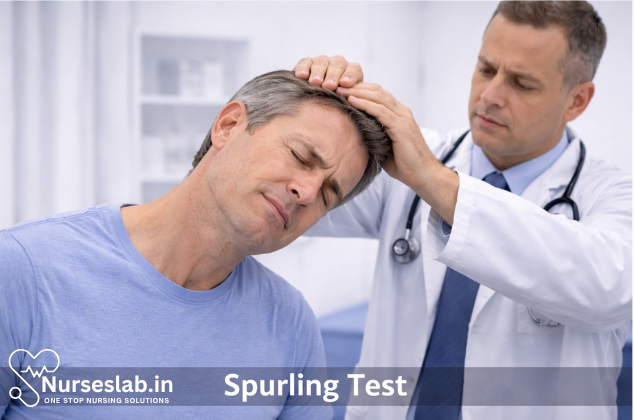
The Spurling Test is performed with the patient seated comfortably, with the head in a neutral position. The examiner stands behind the patient and follows these steps:
- Neck Extension: The patient is asked to gently extend the neck (tilt the head backward).
- Lateral Flexion: The patient’s head is then laterally flexed (bent) towards the side of symptoms (i.e., the side with pain or paraesthesia).
- Axial Compression: The examiner applies a gentle downward force on the top of the patient’s head, compressing the cervical spine.
The test is considered positive if the patient experiences pain, numbness, or tingling radiating into the arm on the side of lateral flexion, reproducing their typical symptoms. Local neck pain without radiation may indicate facet joint or muscular involvement but is not considered a positive Spurling Test.
Variations of the Spurling Test
Several variations exist to increase the sensitivity and specificity of the test:
- Spurling Test A: Combines neck extension and lateral flexion with axial compression.
- Spurling Test B: Begins with axial compression in the neutral position, followed by extension and lateral flexion if initial compression does not reproduce symptoms.
Some clinicians may perform the manoeuvre in different sequences or with varying force, but it is crucial to avoid excessive pressure to prevent injury.
Interpretation and Clinical Relevance
A positive Spurling Test indicates nerve root irritation or compression, most often due to cervical spondylosis, disc herniation, or foraminal stenosis. It does not, however, specify the exact level or cause of compression, necessitating further evaluation with imaging (e.g., MRI, CT scan) and electrodiagnostic studies.
A negative Spurling Test does not rule out cervical radiculopathy, as the test’s sensitivity is moderate. Clinical correlation with the patient’s history, neurological examination, and other special tests (e.g., shoulder abduction relief sign, Lhermitte’s sign) is essential.
Sensitivity and Specificity
Numerous studies have evaluated the diagnostic accuracy of the Spurling Test. Reported sensitivity ranges from 30% to 60%, while specificity is higher, often exceeding 90%. This means that a positive Spurling Test is highly suggestive of cervical radiculopathy, but a negative test does not exclude the diagnosis.
The variability in sensitivity and specificity may be attributed to differences in test technique, patient selection, and reference standards across studies. In clinical practice, the Spurling Test should be interpreted as part of a broader assessment rather than in isolation.
Limitations of the Spurling Test
While valuable, the Spurling Test is not infallible. Its limitations include:
- Low Sensitivity: A significant proportion of patients with cervical radiculopathy may have a negative Spurling Test.
- Non-specific Findings: Local neck pain without radiation may reflect facet joint or muscular pathology rather than nerve root compression.
- Risk of Exacerbation: Overzealous application may provoke severe pain or worsen neurological symptoms.
- Reliance on Patient Reporting: Subjective perception of pain or paraesthesia may be influenced by patient factors, including pain tolerance and communication skills.
Hence, the Spurling Test should be used judiciously and interpreted within the context of the patient’s overall clinical picture.
Comparison with Other Special Tests
Several other clinical manoeuvres are used in the assessment of cervical radiculopathy, each with its own advantages and limitations:
- Shoulder Abduction Relief Sign: Relief of symptoms when the patient places their hand on top of their head, suggesting nerve root tension is reduced.
- Valsalva Manoeuvre: Provocation of symptoms by increasing intrathoracic pressure (bearing down), which may exacerbate nerve root compression.
- Neck Distraction Test: Relief of symptoms with gentle upward traction of the head, reducing nerve root compression.
- Lhermitte’s Sign: Electric shock-like sensation down the spine and into the limbs upon neck flexion, more specific for cervical myelopathy than radiculopathy.
The combination of these tests, along with a thorough neurological examination, improves diagnostic accuracy.
Role of Imaging and Further Evaluation
The Spurling Test is a clinical tool and does not replace imaging studies. In patients with a positive test and persistent or progressive symptoms, further evaluation with MRI is recommended to visualise nerve root impingement, disc pathology, or other structural abnormalities. Electromyography and nerve conduction studies may be indicated in complex or inconclusive cases.
In the Indian context, access to advanced imaging may be limited in rural or resource-constrained settings. Thus, the Spurling Test, combined with a detailed clinical examination, remains an essential part of the diagnostic process, particularly in primary care and government hospitals.
Patient Education and Safety
Before performing the Spurling Test, the patient should be informed about the purpose of the test, the steps involved, and the possible sensations they may experience. Instruct the patient to report any sudden, severe pain, dizziness, or neurological symptoms immediately. The test should be halted if the patient is uncomfortable or develops alarming symptoms.
After the test, explain the findings and the next steps in management. Patients should be reassured that the Spurling Test is not dangerous when performed correctly but is only one part of a comprehensive evaluation.
Case Scenarios
Case 1: Young Office Worker with Neck Pain
A 32-year-old IT professional presents with neck pain radiating into the right arm, numbness in the thumb and index finger, and difficulty gripping objects. The Spurling Test provokes shooting pain down the right arm. MRI confirms a C6-C7 disc herniation compressing the C7 nerve root. The Spurling Test here provides valuable clinical correlation.
Case 2: Elderly Manual Labourer
A 58-year-old manual labourer with a history of chronic neck pain and intermittent tingling in both hands undergoes the Spurling Test, which reproduces his usual symptoms. However, neurological examination reveals brisk reflexes and a positive Hoffmann’s sign, suggesting myelopathy rather than pure radiculopathy. Further imaging reveals cervical spondylotic myelopathy, highlighting the importance of a comprehensive neurological assessment.
Case 3: Young Woman with Acute Trauma
A 25-year-old woman presents after a road traffic accident with neck pain and paraesthesia in the left arm. Given the history of trauma, the Spurling Test is deferred, and imaging is prioritised. X-rays reveal a stable cervical spine, and the Spurling Test is performed only after ruling out instability, demonstrating the importance of contraindications.
Summary and Key Points
- The Spurling Test is a clinical manoeuvre used to assess cervical radiculopathy by reproducing radiating arm symptoms.
- It is performed by extending, laterally flexing, and applying axial compression to the neck.
- A positive test suggests nerve root irritation; however, a negative test does not rule out radiculopathy.
- Contraindications include acute trauma, myelopathy, malignancy, and severe osteoporosis.
- Sensitivity is moderate; specificity is high. The test should be interpreted in the context of the patient’s history and examination.
- The Spurling Test is especially valuable in resource-limited Indian settings where advanced imaging may not be readily available.
- Patient safety, clear communication, and cultural sensitivity are essential for optimal clinical practice.
Nursing Care of Patients Undergoing the Spurling Test Procedure
As nurses play a pivotal role in patient care during diagnostic procedures, understanding the Spurling test and providing comprehensive nursing care before, during, and after the procedure is essential for patient safety, comfort, and optimal outcomes.
Pre-Procedural Nursing Care
Patient Assessment
A thorough assessment is critical prior to the Spurling test. Nurses should review the patient’s medical history, including any previous neck injuries, surgeries, or chronic conditions such as arthritis and osteoporosis. Assessment should include:
- Current symptoms: onset, duration, location, severity, and aggravating or relieving factors
- Neurological status: motor strength, sensation, and reflexes in the upper limbs
- Vital signs and overall physical status
- History of trauma, malignancy, or infection involving the cervical spine
Patient Education and Preparation
Educating the patient about the procedure helps reduce anxiety and promotes cooperation. Key points include:
- Explaining the purpose of the Spurling test and how it is performed
- Describing potential sensations (e.g., mild discomfort or reproduction of symptoms)
- Instructing the patient to communicate immediately if they experience severe pain, dizziness, or other unusual symptoms during the test
- Assuring the patient that the test is brief and that their safety and comfort are priorities
Environmental and Equipment Preparation
- Ensure a quiet, private, and well-lit environment
- Provide a sturdy examination table or chair with adequate support for the patient
- Ensure the presence of emergency equipment if the patient has significant comorbidities or history of adverse reactions
Nursing Care During the Spurling Test
Assisting the Healthcare Provider
Nurses play a crucial role in facilitating the safe and effective performance of the Spurling test. Responsibilities include:
- Positioning the patient comfortably and ensuring correct alignment of the cervical spine
- Supporting the patient’s head and upper body if necessary
- Observing the patient’s facial expressions and body language for signs of discomfort or distress
- Promptly reporting any adverse reactions to the examiner
Monitoring Patient Response
Continuous monitoring is essential throughout the procedure. The nurse should:
- Monitor for onset or worsening of neurological symptoms (e.g., increased pain, numbness, tingling, weakness)
- Watch for non-neurological symptoms such as dizziness, nausea, or shortness of breath
- Be prepared to immediately stop the test if the patient experiences severe pain or alarming symptoms
- Provide reassurance and emotional support to the patient
Post-Procedural Nursing Care
Immediate Assessment
After the test, the nurse should perform a focused assessment to evaluate:
- Changes in pain intensity or character
- New or worsening neurological deficits
- Vital signs, especially in patients with cardiovascular or autonomic concerns
Patient Education and Discharge Instructions
Post-procedure education is vital to ensure patient safety and understanding. Nurses should:
- Advise the patient to report any delayed onset of severe pain, numbness, weakness, or other concerning symptoms
- Provide instructions on activity restrictions if indicated by the healthcare provider
- Reinforce the importance of follow-up appointments for further evaluation or management
- Offer guidance on pain management strategies, such as the use of ice, heat, or over-the-counter analgesics if approved
Documentation
Accurate and thorough documentation is essential for continuity of care. Nursing documentation should include:
- Pre-test assessment findings and patient education provided
- Details of the procedure (positioning, duration, patient tolerance)
- Patient’s response during and after the test, including any adverse reactions
- Post-procedure instructions given to the patient
Special Considerations in Nursing Care
Patients with Comorbidities
- Patients with cardiovascular or respiratory disorders may require additional monitoring due to the risk of vasovagal responses or positional intolerance.
- Patients with cognitive impairment or communication difficulties may need tailored education and closer observation for nonverbal signs of discomfort.
Pediatric and Geriatric Populations
- Pediatric patients may require age-appropriate explanations and the presence of a parent or guardian for reassurance.
- Geriatric patients are at higher risk for osteoporosis and cervical instability; nurses should ensure thorough assessment and communicate any concerns to the provider before the test.
Infection Control and Safety
- Follow standard precautions and infection control protocols during patient contact.
- Maintain a safe environment to prevent falls or injuries during positioning and transfer.
REFERENCES
- Jones SJ, Miller JMM. Spurling Test. 2023 Aug 8. In: StatPearls [Internet]. Treasure Island (FL): StatPearls Publishing; 2025 Jan–. PMID: 29630204.
- Park J, et al. (2017). Diagnostic accuracy ofthe neck tornado test as a new screening test in cervical radiculopathy. DOI:
http://www.medsci.org/v14p0662.htm - American Physical Therapy Association. Spurling Test, Maximal Cervical Compression Test, Foraminal Compression Test, Neck Compression Test, Quadrant Test https://www.apta.org/patient-care/evidence-based-practice-resources/test-measures/spurling-test. Last reviewed 6/7/2020.
- Jones SJ, Miller JMM. Spurling Test (https://www.ncbi.nlm.nih.gov/books/NBK493152/). 2023 Aug 8. In: StatPearls [Internet]. Treasure Island (FL): StatPearls Publishing; 2024 Jan-.
- Cervical radiculopathy (pinched nerve). (2015).
https://orthoinfo.aaos.org/en/diseases–conditions/cervical-radiculopathy-pinched-nerve/ - Wu, W.-T., Chang, K.-V., Lin, T.-Y., Özçakar, L., Tzang, C.-C., & Lin, L.-H. (2025). Diagnostic Performance of Spurling’s Test for the Assessment Subacute and Chronic Cervical Radiculopathy: A Systematic Review and Meta-analysis. American Journal of Physical Medicine & Rehabilitation, 104(8), 717–723. https://doi.org/10.1097/PHM.0000000000002707
Stories are the threads that bind us; through them, we understand each other, grow, and heal.
JOHN NOORD
Connect with “Nurses Lab Editorial Team”
I hope you found this information helpful. Do you have any questions or comments? Kindly write in comments section. Subscribe the Blog with your email so you can stay updated on upcoming events and the latest articles.


