


Last Updated on May 17, 2026 by Nurseslab.in Editorial Team
Hypertension, commonly known as high blood pressure, is one of the most important health conditions affecting adults across the world. It is extremely common, often silent, and potentially dangerous when left untreated. Many people imagine serious diseases as conditions that always produce pain, weakness, or obvious warning signs, but hypertension often works differently.
A person may feel completely normal while increased pressure inside the arteries is slowly damaging the heart, brain, kidneys, eyes, and blood vessels. That quiet and gradual damage is exactly what makes hypertension such a serious disease condition.
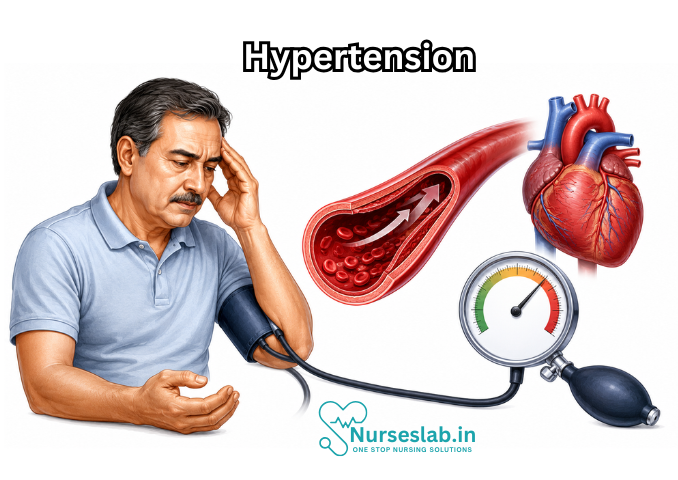
Understanding Hypertension
Blood pressure is the force of blood pushing against the walls of the arteries as the heart pumps blood through the body. It is measured using two values: systolic pressure and diastolic pressure. Systolic pressure is the top number and represents the pressure when the heart contracts. Diastolic pressure is the bottom number and represents the pressure when the heart relaxes between beats.
A normal reading is often around 120/80 mmHg, although interpretation depends on age, health status, and clinical guidelines. Hypertension occurs when this pressure stays elevated over time. The [National Heart, Lung, and Blood Institute] notes that healthy blood pressure is less than 120/80 mmHg, while consistent readings of 130/80 mmHg or higher are considered high in commonly used U.S. guidance.
Hypertension is often called a silent disease because it may not produce symptoms for a long time. During that silent phase, however, the extra force against artery walls can injure the vascular system and place ongoing strain on the heart. Over years, this can contribute to hardening of the arteries, reduced blood flow, enlargement of the heart muscle, and damage to organs that rely on healthy circulation. This is why hypertension should never be dismissed as a minor issue. It is a chronic medical condition with serious long-term implications.
The global burden of hypertension remains very high. The [World Health Organization] reports that an estimated 1.4 billion adults aged 30 to 79 were living with hypertension in 2024, and many remained unaware, untreated, or uncontrolled. This matters because uncontrolled blood pressure is strongly linked to heart attack, stroke, chronic kidney disease, and other major health outcomes. In simple terms, hypertension is common, dangerous, and highly relevant to public health.
Causes and Risk Factors of Hypertension
Hypertension does not always develop from one single cause. In many adults, especially those with primary hypertension, the condition develops gradually due to a combination of genetics, aging, lifestyle, and environmental influences. Blood vessels may become stiffer with age, sodium balance may become less favorable, body weight may increase, and daily habits may place extra burden on the cardiovascular system. In other cases, blood pressure rises because of a specific medical problem, such as kidney disease or a hormonal disorder.
The [World Health Organization]and the [National Heart, Lung, and Blood Institute] identify several major risk factors. These include older age, family history, overweight and obesity, physical inactivity, high salt intake, unhealthy diets low in fruits and vegetables, alcohol use, poor sleep, stress, tobacco use, and co-existing conditions such as diabetes, chronic kidney disease, and sleep apnea. Some medicines may also increase blood pressure, including certain decongestants, hormonal contraceptives, antidepressants, and pain medicines. Because so many risk factors are connected to daily living, prevention and control of hypertension often require long-term lifestyle improvement rather than a short-term fix.
It is also important to understand that some people are more salt-sensitive than others, meaning their blood pressure rises more easily when they consume too much sodium. Others may develop hypertension as part of a larger metabolic pattern involving obesity, insulin resistance, and abnormal cholesterol levels. Social and environmental factors matter as well. Limited access to healthy food, lack of safe places for exercise, chronic psychological stress, and difficulty obtaining regular healthcare can all worsen the risk of developing uncontrolled hypertension.
Types of Hypertension
- Primary (essential) hypertension
- This is the most common type.
- It usually develops slowly over many years.
- It does not have one single identifiable cause.
- It is often linked to age, family history, diet, body weight, and lifestyle habits.
- Secondary hypertension
- This occurs when high blood pressure is caused by another condition or substance.
- Possible causes include kidney disease, endocrine disorders, obstructive sleep apnea, adrenal problems, thyroid disease, and narrowing of the renal arteries.
- Some medicines and stimulants may also contribute.
- White coat hypertension
- Blood pressure is high in a clinic or hospital setting.
- Readings may be normal at home.
- It can complicate diagnosis if office readings alone are used.
- Masked hypertension
- Blood pressure may appear normal during clinic visits.
- Readings outside the clinic, especially at home, may be elevated.
- This form is important because it may delay diagnosis.
- Hypertensive crisis
- This refers to a dangerously high blood pressure level, often above 180/120 mmHg.
- It may occur with or without immediate organ damage.
- It requires urgent medical attention, especially if symptoms are present.
Recognizing the type of hypertension matters because it affects both evaluation and treatment. Primary hypertension usually focuses on risk reduction and long-term control, whereas secondary hypertension may improve if the underlying condition is identified and treated appropriately.
Signs and Symptoms
- Common early pattern
- Most people with hypertension have no symptoms.
- The condition is often discovered during routine screening or a checkup.
- Possible symptoms when blood pressure becomes very high
- Headache
- Dizziness
- Blurred vision
- Nosebleeds
- Chest pain
- Shortness of breath
- Palpitations
- Emergency warning signs that need immediate medical attention
- Severe chest pain
- Confusion
- Trouble speaking
- Weakness on one side of the body
- Severe headache
- Sudden changes in vision
- Severe shortness of breath
The [World Health Organization], the [Centers for Disease Control and Prevention], and the [National Heart, Lung, and Blood Institute] all emphasize that most people with hypertension do not feel symptoms, which is why blood pressure checks are essential. Very high readings may cause headaches, blurred vision, chest pain, or other warning signs, but relying on symptoms alone is unsafe because silent organ damage can occur long before a person feels ill.
Diagnostic Evaluation
- Accurate blood pressure measurement
- Blood pressure should be measured with a validated device and the correct cuff size.
- The patient should be seated comfortably with the arm supported.
- Ideally, the person should rest for at least 5 minutes before the measurement.
- Caffeine, smoking, and exercise shortly before the test may affect results.
- Repeated measurements
- One high reading is usually not enough for diagnosis.
- The [World Health Organization]() states that hypertension is diagnosed when blood pressure is elevated on two different days in standard measurement settings.
- Home blood pressure monitoring
- Useful for confirming persistent hypertension.
- Helps detect white coat hypertension and masked hypertension.
- The [National Heart, Lung, and Blood Institute]() recommends approved home devices for reliable readings.
- Ambulatory blood pressure monitoring
- Measures blood pressure over 24 hours during daily activity and sleep.
- Useful in selected patients when diagnosis is uncertain.
- Medical history and physical examination
- Doctors ask about family history, diet, sleep, medicines, alcohol use, exercise habits, and other diseases.
- The exam may look for signs of secondary causes or organ damage.
- Laboratory and supportive tests
- Blood tests
- Urine tests
- Kidney function assessment
- Blood sugar testing
- Lipid profile
- Electrocardiogram
- Sometimes imaging or hormone-related tests if secondary hypertension is suspected
- Common classification framework
- Normal: less than 120/80 mmHg
- Elevated: systolic 120 to 129 mmHg and diastolic below 80 mmHg
- Stage 1 hypertension: systolic 130 to 139 mmHg or diastolic 80 to 89 mmHg
- Stage 2 hypertension: systolic 140 mmHg or higher or diastolic 90 mmHg or higher
- Hypertensive crisis: above 180/120 mmHg and needs urgent evaluation
Diagnostic evaluation is not only about confirming the numbers. It is also about understanding the patient’s overall cardiovascular risk, looking for causes that can be corrected, and checking whether hypertension has already affected organs such as the heart or kidneys. A thorough evaluation helps guide safe and effective treatment.
Management of Hypertension
- Lifestyle modification
- Reduce dietary sodium intake.
- Follow a heart-healthy eating pattern such as the DASH diet.
- Eat more fruits, vegetables, whole grains, legumes, and low-fat dairy foods.
- Limit saturated fats, trans fats, and highly processed foods.
- Maintain or achieve a healthy body weight.
- Increase physical activity on a regular basis.
- Reduce sedentary behavior.
- Limit alcohol intake.
- Stop tobacco use.
- Improve sleep quality and duration.
- Manage stress through healthy coping techniques.
- Home monitoring and follow-up
- Track blood pressure regularly at home using a validated monitor.
- Keep a written or digital log of readings.
- Attend follow-up appointments to review treatment response.
- Medication therapy
- Medicines may be required when lifestyle measures alone are not enough.
- Common drug classes include diuretics, ACE inhibitors, angiotensin receptor blockers, calcium channel blockers, and beta-blockers in selected cases.
- Some people need one medicine, while others need a combination.
- Treatment choice depends on age, blood pressure level, cardiovascular risk, kidney status, pregnancy status, and other health conditions.
- Management of related conditions
- Control diabetes, kidney disease, high cholesterol, and sleep apnea when present.
- Address obesity and metabolic risk factors.
- Special situations
- Pregnancy-related hypertension needs careful and individualized treatment.
- Secondary hypertension may improve when the underlying cause is treated.
- Hypertensive crisis requires immediate medical care.
- Long-term treatment goals
- Lower blood pressure to a safer target.
- Prevent stroke, heart attack, heart failure, kidney injury, and vascular complications.
- Improve long-term quality of life and survival.
The [World Health Organization]() highlights healthier diet, tobacco cessation, increased activity, and medicines when needed as central parts of treatment. The [National Heart, Lung, and Blood Institute]() also emphasizes heart-healthy eating, physical activity, weight reduction, better sleep, and stress reduction. More recent professional guidance from the [American Heart Association]() continues to support early and individualized treatment, home monitoring, and standardized care pathways for better blood pressure control.
Complications of Uncontrolled Hypertension
One of the most important reasons to take hypertension seriously is that the disease affects multiple organs at the same time. The heart is often the first major organ placed under stress. When blood pressure stays high, the heart must pump harder to move blood through the circulation. Over time, the muscle of the left ventricle may thicken, the heart may enlarge, and the risk of coronary artery disease, heart attack, and heart failure rises significantly. Even before severe symptoms appear, structural and functional damage may already be developing.
The brain is also highly vulnerable. Uncontrolled hypertension is one of the strongest risk factors for stroke, including both ischemic stroke and hemorrhagic stroke. It can also contribute to cognitive decline, memory problems, and forms of vascular dementia. The kidneys, which depend on healthy blood vessels to filter waste and maintain fluid balance, may gradually lose function under persistent pressure. This can lead to chronic kidney disease and, in severe cases, kidney failure. The eyes may suffer damage to their delicate vessels, causing hypertensive retinopathy and vision problems. In addition, hypertension can raise the risk of aneurysm formation, peripheral artery disease, and pregnancy-related complications.
What makes these complications especially concerning is that they often develop gradually and silently. A patient may assume that feeling normal means everything is fine, but silent injury may continue in the background for years. This is why blood pressure control should be viewed as a long-term protective strategy, not merely a response to discomfort.
Can Hypertension Be Prevented?
In many cases, yes. Although not every case of hypertension can be prevented, the risk can often be reduced significantly. Prevention begins with healthy living habits established early and maintained consistently. A diet lower in sodium and richer in plant-based foods, regular physical activity, weight control, good sleep, stress management, and avoidance of tobacco can all make a meaningful difference. Preventive strategies are especially valuable for people with a family history of high blood pressure or other cardiovascular risk factors.
Nursing Care of Patients with Hypertension
Nursing care focuses on early detection, accurate monitoring, medication support, lifestyle modification, prevention of complications, and patient education to promote long-term blood pressure control.
Assessment and Monitoring
- Blood Pressure Measurement: Measure blood pressure accurately using the correct cuff size, proper patient positioning, and repeated readings as needed.
- Cardiovascular Assessment: Monitor heart rate, peripheral pulses, presence of oedema, chest discomfort, and signs of reduced cardiac output.
- Neurological Status: Assess for headache, dizziness, confusion, visual disturbance, or weakness that may indicate hypertensive complications.
- Renal and Fluid Monitoring: Observe urine output, daily weight when indicated, and review laboratory values such as renal function and electrolytes.
Prevention of Complications
- Monitor for Target Organ Damage: Watch for symptoms of stroke, heart failure, kidney dysfunction, and visual changes, and report abnormalities promptly.
- Detect Hypertensive Crisis Early: Be alert for severe headache, chest pain, breathlessness, neurological deficits, or very high blood pressure requiring urgent intervention.
- Promote Adherence: Encourage regular monitoring, follow-up visits, and consistent treatment to reduce the risk of long-term complications.
Medication Management
- Antihypertensive Medicines: Administer prescribed medications such as diuretics, ACE inhibitors, ARBs, calcium channel blockers, or beta-blockers, and monitor therapeutic response.
- Monitor Adverse Effects: Observe for hypotension, dizziness, electrolyte imbalance, bradycardia, cough, or renal impairment depending on the medicine used.
- Medication Education: Teach patients the purpose, dose, timing, and possible side effects of each medicine, and stress that treatment should not be stopped abruptly without medical advice.
Lifestyle and Dietary Management
- Salt Reduction: Advise a low-sodium diet and encourage avoidance of processed and highly salted foods.
- Weight and Activity: Encourage gradual weight reduction when appropriate and promote regular physical activity according to the patient’s condition.
- Risk Factor Modification: Support smoking cessation, moderation of alcohol intake, stress management, and adequate sleep.
Patient Education and Psychosocial Support
- Condition Awareness: Explain the meaning of blood pressure readings, risk factors, and the importance of long-term control even when symptoms are absent.
- Home Monitoring: Teach correct home blood pressure monitoring technique and encourage patients to keep a record of readings.
- Emotional Support: Address anxiety, financial concerns, or barriers to treatment, and involve family members when appropriate to strengthen adherence.
Discharge Planning and Follow-Up
- Home Care Instructions: Reinforce medication adherence, diet control, regular exercise, and avoidance of tobacco use.
- Follow-Up Visits: Stress the importance of regular review for blood pressure checks, adjustment of therapy, and monitoring of renal function and cardiovascular risk.
- Warning Signs: Instruct patients to seek immediate medical care for severe headache, chest pain, shortness of breath, sudden weakness, or visual disturbance.
REFERENCES
- American Heart Association. Health Threats from High Blood Pressure https://www.heart.org/en/health-topics/high-blood-pressure/health-threats-from-high-blood-pressure. Last reviewed 8/14/2025.
- Jacobsen AP, McKittrick M, Daya N, et al. Isolated Diastolic Hypertension and Risk of Cardiovascular Disease: Controversies in Hypertension-Con Side of the Argument https://pubmed.ncbi.nlm.nih.gov/35861748/. Hypertension. 2022 Aug;79(8):1571-1578.
- American Heart Association. Top 10 Things to Know About the New AHA/ACC High Blood Pressure Guideline. https://www.heart.org/en/health-topics/high-blood-pressure/the-facts-about-high-blood-pressure/high-bp-top-10. Last reviewed 8/14/2025.
- McCarthy CP, Bruno RM, Rahimi K, Touyz RM, McEvoy JW. What Is New and Different in the 2024 European Society of Cardiology Guidelines for the Management of Elevated Blood Pressure and Hypertension? https://pubmed.ncbi.nlm.nih.gov/39970254/ Hypertension. 2025 Mar;82(3):432-444.
- World Health Organization. Hypertension https://www.who.int/news-room/fact-sheets/detail/hypertension. 3/16/2023.
- Yano Y, Kim HC, Lee H, et al. Isolated Diastolic Hypertension and Risk of Cardiovascular Disease: Controversies in Hypertension – Pro Side of theArgument (https://pubmed.ncbi.nlm.nih.gov/35861749/). Hypertension. 2022 Aug;79(8):1563-1570.
Stories are the threads that bind us; through them, we understand each other, grow, and heal.
JOHN NOORD
Connect with “Nurses Lab Editorial Team”
I hope you found this information helpful. Do you have any questions or comments? Kindly write in comments section. Subscribe the Blog with your email so you can stay updated on upcoming events and the latest articles.


