


Myxoviruses are RNA viruses responsible for diseases such as influenza, mumps, and measles. Divided into orthomyxoviruses and paramyxoviruses, they spread via respiratory droplets and require vaccination, early diagnosis, and infection control in healthcare.
Introduction
Myxoviruses constitute a group of enveloped, single-stranded RNA viruses that have played a significant role in both human and animal health for decades. The term “Myxovirus” historically refers to a collection of viruses capable of binding to mucins, the glycoproteins found in animal mucus. The most notable members of this group include viruses responsible for widespread and sometimes devastating diseases such as influenza, mumps, and measles. The clinical and public health significance of Myxoviruses is profound, given their potential to cause seasonal epidemics, pandemics, and severe morbidity and mortality across the globe.
Historical Background
The term “Myxovirus” was first introduced in the mid-20th century and was used to describe a group of viruses with affinity for mucoproteins. Over time, advances in virology and molecular biology led to a more precise classification, distinguishing the Orthomyxoviridae (e.g., influenza viruses) and Paramyxoviridae (e.g., parainfluenza, mumps, measles, respiratory syncytial virus [RSV]). Despite the evolution of nomenclature, the impact of these viruses on public health remains immense, as evidenced by the 1918 influenza pandemic, recurrent measles outbreaks, and annual epidemics of RSV.
Significance in Human and Animal Health
Myxoviruses are responsible for a spectrum of diseases affecting the respiratory, nervous, and immune systems. Their ability to infect multiple species, cause zoonotic transmission, and evolve rapidly underscores their significance. Influenza viruses alone are responsible for seasonal epidemics that result in lakhs of hospitalisations and thousands of deaths annually worldwide. Similarly, measles and mumps continue to pose threats, particularly in regions with low vaccination coverage. The economic and social burden of these infections further highlights the need for continued research and control measures.
Classification and Structure
Overview of the Myxoviridae Family
While the term “Myxoviridae” is now obsolete in official taxonomy, it historically encompassed two main families: Orthomyxoviridae and Paramyxoviridae. Each family contains several genera and species with distinct biological and clinical characteristics.
Orthomyxoviridae
- Genera: Includes Influenzavirus A, B, C, D
- Notable Members: Influenza A, B, and C viruses
- Hosts: Humans, birds, pigs, horses, and other animals
- Genome: Segmented, negative-sense, single-stranded RNA (ssRNA), typically 6–8 segments
- Envelope: Lipid bilayer with surface glycoproteins haemagglutinin (HA) and neuraminidase (NA)
Paramyxoviridae
- Genera: Respirovirus (parainfluenza viruses), Rubulavirus (mumps), Morbillivirus (measles), Pneumovirus (RSV)
- Notable Members: Parainfluenza viruses, mumps virus, measles virus, respiratory syncytial virus
- Hosts: Humans, other mammals, birds
- Genome: Non-segmented, negative-sense, ssRNA
- Envelope: Lipid bilayer with fusion (F) and attachment (HN, H, or G) glycoproteins
Viral Structure
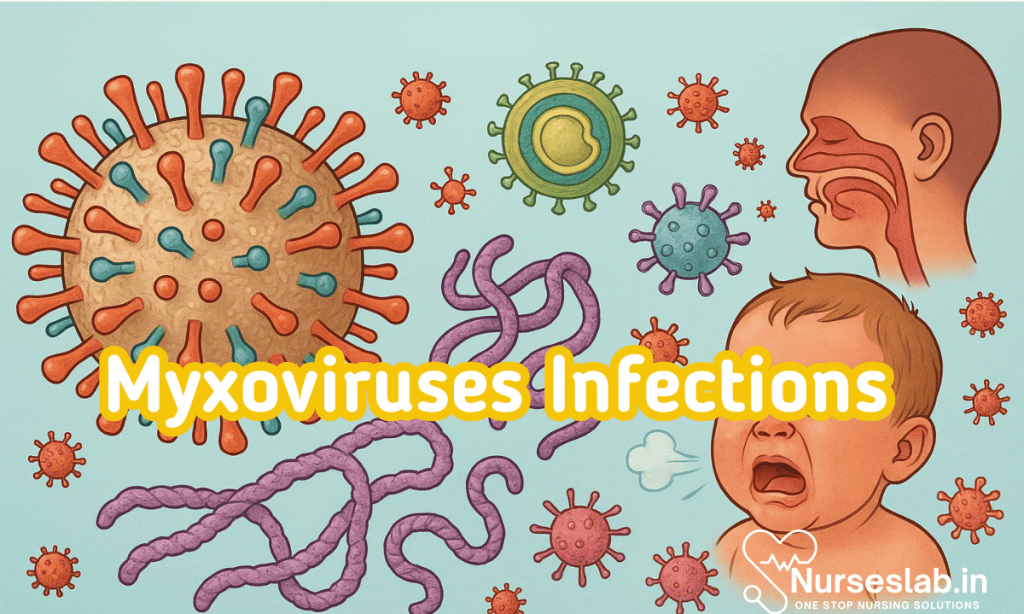
Both Orthomyxoviruses and Paramyxoviruses are enveloped, pleomorphic (spherical or filamentous), and contain a helical nucleocapsid. The envelope is derived from the host cell membrane and is studded with viral glycoproteins essential for attachment, entry, and immune evasion.
- Genome Organisation: Orthomyxoviruses have segmented genomes, allowing for genetic reassortment (antigenic shift), while Paramyxoviruses have non-segmented genomes, leading mainly to antigenic drift.
- Key Proteins: Surface glycoproteins (HA, NA in influenza; F, HN, H, G in paramyxoviruses), matrix proteins, nucleoprotein, polymerase complex.
- Replication: Takes place in the host cell cytoplasm (paramyxoviruses) or nucleus (orthomyxoviruses).
Epidemiology and Transmission
Global Distribution
Myxoviruses have a worldwide distribution, with patterns of infection influenced by climate, population density, vaccination coverage, and host species. Influenza outbreaks occur globally, with seasonal peaks during winter in temperate regions and year-round transmission in the tropics. Measles and mumps have been controlled in many countries through vaccination, but outbreaks still occur due to gaps in immunisation. RSV and parainfluenza viruses are common causes of paediatric respiratory infections worldwide.
Host Range
- Influenza Viruses: Infect humans, birds, pigs, horses, and other mammals. Notably, avian and swine influenza strains can cross species barriers, leading to zoonotic outbreaks.
- Measles, Mumps, and RSV: Primarily human pathogens, though related viruses can infect animals.
- Parainfluenza Viruses: Infect humans and some animals, causing respiratory illness.
Modes of Transmission
- Respiratory Droplets: Most Myxoviruses spread via aerosols generated by coughing, sneezing, or talking.
- Direct Contact: Contact with respiratory secretions or contaminated surfaces can facilitate transmission.
- Zoonotic Transmission: Influenza A viruses can be transmitted from animals (e.g., birds, pigs) to humans, sometimes resulting in novel pandemic strains.
Notable Outbreaks
- 1918 H1N1 Influenza Pandemic: Caused an estimated 5 crore deaths worldwide.
- 2009 H1N1 Pandemic: Resulted from reassortment of swine, avian, and human influenza genes.
- Measles Outbreaks: Occur periodically, especially in areas with declining vaccination rates.
- RSV Epidemics: Annual epidemics, particularly affecting infants and young children.
Pathogenesis and Clinical Manifestations
Mechanisms of Infection
Myxoviruses initiate infection by attaching to host cell receptors via surface glycoproteins. For example, influenza haemagglutinin binds sialic acid residues, while measles H protein attaches to CD150 (SLAM) or nectin-4. Fusion proteins facilitate viral entry by merging the viral envelope with the host cell membrane. Once inside, the viral genome is released, replicated, and transcribed, leading to synthesis of viral proteins and assembly of new virions. Host immune responses are triggered, including interferon production, antibody generation, and cell-mediated immunity.
Immune Response
- Innate Immunity: Interferon response, natural killer (NK) cell activation, and cytokine production limit viral replication.
- Adaptive Immunity: Humoral (antibody-mediated) and cellular (T cell-mediated) responses are crucial for viral clearance and protection against reinfection.
- Immune Evasion: Myxoviruses employ strategies such as antigenic drift and shift (influenza), suppression of interferon signalling (measles), and modulation of host cell apoptosis to evade immune detection.
Symptoms of Major Myxovirus Infections
Influenza
- Incubation Period: 1–4 days
- Symptoms: Sudden onset of fever, chills, headache, myalgia, malaise, sore throat, dry cough, and nasal congestion. Gastrointestinal symptoms (nausea, vomiting) may occur, especially in children.
- Complications: Pneumonia (primary viral or secondary bacterial), myocarditis, encephalitis, exacerbation of chronic illnesses.
Measles
- Incubation Period: 7–14 days
- Symptoms: High fever, cough, coryza, conjunctivitis (“3 Cs”), Koplik spots (enanthem), followed by a maculopapular rash spreading from face to trunk and limbs.
- Complications: Otitis media, pneumonia, diarrhoea, encephalitis, subacute sclerosing panencephalitis (SSPE).
Mumps
- Incubation Period: 12–25 days
- Symptoms: Fever, headache, malaise, parotid gland swelling (unilateral or bilateral), pain on chewing or swallowing.
- Complications: Orchitis, oophoritis, meningitis, pancreatitis, deafness.
Parainfluenza Viruses
- Symptoms: Range from mild upper respiratory tract infection to croup (barking cough, inspiratory stridor), bronchitis, and pneumonia, especially in children.
Respiratory Syncytial Virus (RSV)
- Symptoms: Bronchiolitis (wheezing, difficulty breathing), pneumonia in infants and young children, and cold-like symptoms in older children and adults.
- Complications: Severe disease in premature infants, elderly, and immunocompromised individuals.
Diagnosis
Laboratory Techniques
- Polymerase Chain Reaction (PCR): Highly sensitive and specific; detects viral RNA in respiratory specimens, blood, or cerebrospinal fluid. Reverse transcription PCR (RT-PCR) is widely used for influenza, RSV, measles, and mumps diagnosis.
- Serology: Detection of virus-specific IgM and IgG antibodies; useful for confirming recent or past infections (e.g., measles, mumps).
- Viral Culture: Isolation of virus in cell lines; less commonly used due to time constraints but important for research and epidemiological studies.
- Rapid Antigen Tests: Provide quick results for influenza and RSV, though sensitivity varies.
Clinical Criteria
- History and Examination: Epidemiological context, clinical features (e.g., Koplik spots for measles, parotitis for mumps, croup for parainfluenza).
- Outbreak Investigations: Case definitions and contact tracing are critical for public health responses.
Differential Diagnosis
- Influenza-like Illness: Can be caused by other respiratory viruses (adenovirus, rhinovirus, coronavirus), bacterial infections (Streptococcus pneumoniae), or non-infectious causes.
- Measles: Differential includes rubella, dengue, scarlet fever, drug reactions.
- Mumps: Parotitis may be due to bacterial infection, HIV, or other viruses (e.g., Epstein-Barr virus).
Treatment
Antiviral Drugs
- Influenza: Neuraminidase inhibitors (oseltamivir, zanamivir, peramivir) are effective against influenza A and B if started early. Baloxavir marboxil is a newer agent targeting viral polymerase.
- Measles, Mumps, RSV, Parainfluenza: No specific antiviral therapy is widely available. Ribavirin is sometimes used for severe RSV infection, especially in high-risk infants.
Supportive Care
- Oxygen therapy, hydration, antipyretics, and management of complications (e.g., antibiotics for secondary bacterial infections) are mainstays of treatment.
- Severe cases may require intensive care, mechanical ventilation, or extracorporeal membrane oxygenation (ECMO).
Management of Complications
- Pneumonia: Antimicrobials if bacterial superinfection is suspected; supportive respiratory care.
- Encephalitis: Intensive supportive care, seizure management, and monitoring for neurological sequelae.
- Other Complications: Orchitis (analgesics, cold packs), otitis media (antibiotics if bacterial), dehydration (oral or intravenous fluids).
Resistance Issues
- Emergence of antiviral resistance, particularly among influenza viruses, is a growing concern. Continuous surveillance and development of new drugs are essential.
Prevention and Control
Vaccines
- Influenza Vaccines: Inactivated, live-attenuated, and recombinant vaccines are available. Annual vaccination is recommended due to antigenic drift.
- Measles, Mumps, Rubella (MMR) Vaccine: Combined live-attenuated vaccine provides long-lasting immunity; two doses are recommended for optimal protection.
- RSV Vaccines: Several candidates are in development; monoclonal antibodies (palivizumab) are used in high-risk infants for passive protection.
- Parainfluenza Vaccines: No licensed vaccines yet, but research is ongoing.
Public Health Measures
- Case isolation, contact tracing, and quarantine during outbreaks.
- Promotion of vaccination campaigns and herd immunity.
- Surveillance systems for early detection and response to outbreaks.
- Health education to improve awareness and reduce vaccine hesitancy.
Infection Control in Healthcare Settings
- Use of personal protective equipment (PPE) such as masks and gloves.
- Hand hygiene and respiratory etiquette.
- Environmental cleaning and disinfection.
- Screening and cohorting of patients during epidemics.
Recent Research and Developments
Advances in Vaccine Technology
- Development of universal influenza vaccines targeting conserved viral epitopes to provide broader and longer-lasting protection.
- mRNA vaccine platforms, which have shown promise for influenza and RSV, offering rapid adaptability to emerging strains.
- Live-attenuated and subunit vaccines for parainfluenza and RSV in advanced clinical trials.
Emerging Strains
- Continued evolution of influenza A viruses through antigenic shift and drift, resulting in novel pandemic and epidemic strains (e.g., H5N1, H7N9).
- Genetic variation in measles and mumps viruses leading to vaccine escape and outbreaks among vaccinated populations.
Novel Therapeutics
- Host-targeted therapies that modulate immune responses or interfere with viral replication.
- Broad-spectrum antivirals and monoclonal antibodies with activity against multiple Myxoviruses.
- Gene editing and RNA interference approaches for targeted inhibition of viral genes.
Future Directions
- Integration of genomic surveillance, artificial intelligence, and big data analytics for real-time outbreak prediction and control.
- Improved understanding of host-pathogen interactions to inform vaccine and therapeutic design.
- Addressing challenges of vaccine hesitancy, equitable distribution, and access to diagnostics and treatments, especially in low-resource settings.
Conclusion
Myxoviruses remain a significant threat to global health, causing a wide range of diseases from mild respiratory infections to life-threatening complications. Despite advances in vaccination, antiviral therapy, and public health interventions, challenges persist due to viral evolution, resistance, and gaps in immunisation. Continued research into viral biology, host responses, and innovative prevention and treatment strategies is crucial for reducing the burden of Myxovirus infections. Collaboration between clinicians, researchers, public health authorities, and policymakers is essential to address these challenges and safeguard human and animal health.
REFERENCES
- Apurba S Sastry, Essential Applied Microbiology for Nurses including Infection Control and Safety, First Edition 2022, Jaypee Publishers, ISBN: 978-9354659386
- Joanne Willey, Prescott’s Microbiology, 11th Edition, 2019, Innox Publishers, ASIN- B0FM8CVYL4.
- Anju Dhir, Textbook of Applied Microbiology including Infection Control and Safety, 2nd Edition, December 2022, CBS Publishers and Distributors, ISBN: 978-9390619450
- Gerard J. Tortora, Microbiology: An Introduction 13th Edition, 2019, Published by Pearson, ISBN: 978-0134688640
- Durrant RJ, Doig AK, Buxton RL, Fenn JP. Microbiology Education in Nursing Practice. J Microbiol Biol Educ. 2017 Sep 1;18(2):18.2.43. https://pmc.ncbi.nlm.nih.gov/articles/PMC5577971/
Stories are the threads that bind us; through them, we understand each other, grow, and heal.
JOHN NOORD
Connect with “Nurses Lab Editorial Team”
I hope you found this information helpful. Do you have any questions or comments? Kindly write in comments section. Subscribe the Blog with your email so you can stay updated on upcoming events and the latest articles.


