


Blood cell counts are vital diagnostic tests that evaluate red blood cells, white blood cells, and platelets. They help detect anemia, infections, clotting disorders, and overall health status, guiding evidence-based nursing and medical care.
Introduction
Blood cell counts form the cornerstone of clinical haematology and internal medicine, offering crucial insights into a patient’s health status. The quantitative assessment of red blood cells (RBCs), white blood cells (WBCs), and platelets provides information not only about the haematopoietic system but also about systemic diseases, infections, and immune responses. Abnormalities in blood cell counts—whether elevations or reductions—often signal underlying pathological processes, necessitating a thorough understanding of their causes, mechanisms, and clinical implications.
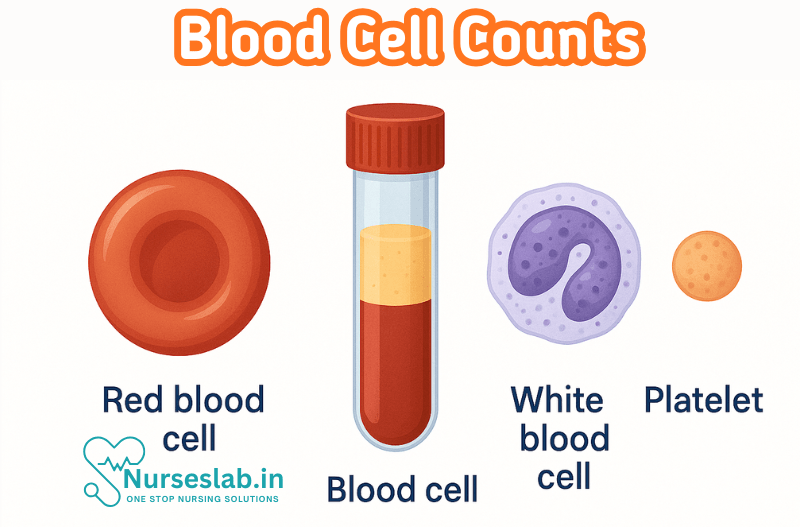
Types of Blood Cells
Red Blood Cells (Erythrocytes)
RBCs are responsible for the transport of oxygen from the lungs to tissues and the removal of carbon dioxide from tissues to the lungs. Each erythrocyte is packed with haemoglobin, the protein that binds oxygen. The number and quality of RBCs are vital for tissue oxygenation.
White Blood Cells (Leukocytes)
WBCs are key players in the immune system and are subdivided into granulocytes (neutrophils, eosinophils, basophils), lymphocytes (T cells, B cells, NK cells), and monocytes. Each subset has distinct roles in defence against pathogens, immune regulation, and inflammation.
Platelets (Thrombocytes)
Platelets are small, anucleate cell fragments essential for haemostasis. They aggregate at sites of vascular injury, initiating clot formation and preventing excessive bleeding.
Normal Ranges and Physiology
Reference Values
Normal blood cell counts vary with age, sex, altitude, and physiological states. Representative adult reference ranges are as follows:
- RBC count: 4.5–5.9 × 10¹²/L (males), 4.1–5.1 × 10¹²/L (females)
- Haemoglobin: 13.5–17.5 g/dL (males), 12.0–15.5 g/dL (females)
- WBC count: 4.0–11.0 × 10⁹/L
- Platelet count: 150–450 × 109/L
Physiological Regulation
Haematopoiesis, the process of blood cell production, occurs primarily in the bone marrow under the influence of growth factors such as erythropoietin (EPO) for RBCs, granulocyte colony-stimulating factor (G-CSF) for neutrophils, and thrombopoietin for platelets. The regulation is tightly controlled through feedback mechanisms involving oxygen tension, cytokines, and cellular interactions.
Pathological Variations in Blood Cell Counts
Definitions of Cytopenias and Cytoses
- Cytopenia: Reduction in the number of a particular blood cell type (e.g., anaemia for RBCs, leukopenia for WBCs, thrombocytopenia for platelets).
- Cytosis: Increase in the number of a particular blood cell type (e.g., polycythaemia for RBCs, leukocytosis for WBCs, thrombocytosis for platelets).
Abnormalities may affect one or multiple cell lines, and their severity can range from mild to life-threatening.
Causes of Abnormal Blood Cell Counts
Genetic Causes
Inherited disorders such as thalassaemias, sickle cell disease, hereditary spherocytosis, and Fanconi anaemia affect the production, structure, or survival of blood cells. Mutations in genes controlling haematopoiesis can result in cytopenias or cytoses.
Acquired Causes
Exposure to toxins (e.g., benzene, radiation), drugs (chemotherapeutic agents, antiepileptics), and nutritional deficiencies (iron, vitamin B12, folate) can impair blood cell production or increase destruction.
Infectious Causes
Viral (HIV, hepatitis, parvovirus B19), bacterial (sepsis, tuberculosis), and parasitic (malaria) infections may cause cytopenias through direct bone marrow suppression, immune-mediated destruction, or sequestration.
Neoplastic Causes
Malignancies such as leukaemias, lymphomas, and myeloproliferative neoplasms disrupt normal haematopoiesis, often resulting in abnormal counts and function of blood cells.
Autoimmune Causes
Autoimmune diseases (systemic lupus erythematosus, autoimmune haemolytic anaemia, idiopathic thrombocytopenic purpura) involve the production of antibodies against blood cell antigens, leading to their destruction.
Mechanisms of Pathology
Production Defects
Bone marrow failure syndromes (aplastic anaemia, myelodysplastic syndromes) and marrow infiltration by malignancies impair the generation of blood cells. Nutritional deficiencies and chronic diseases can also suppress marrow activity.
Destruction of Blood Cells
Haemolytic anaemias, immune-mediated cytopenias, and hypersplenism result in premature destruction of blood cells. Intravascular and extravascular mechanisms may be involved, often detected by laboratory markers (e.g., elevated lactate dehydrogenase, low haptoglobin).
Sequestration
Splenomegaly, as seen in portal hypertension or haematological malignancies, can lead to increased pooling and removal of blood cells from circulation, resulting in cytopenias.
Dilution
Acute or chronic blood loss, massive transfusion, or fluid overload can cause dilutional cytopenias by increasing plasma volume relative to cell mass.
Clinical Manifestations
Symptoms and Signs Associated with Abnormal Blood Cell Counts
- Red Cell Abnormalities: Fatigue, pallor, dyspnoea, tachycardia, jaundice (in haemolysis).
- White Cell Abnormalities: Increased susceptibility to infections (neutropenia), fever, lymphadenopathy, splenomegaly (leukaemia, lymphoma), abnormal bleeding (due to impaired immune regulation).
- Platelet Abnormalities: Mucocutaneous bleeding, petechiae, ecchymoses, prolonged bleeding times, risk of thrombosis (in thrombocytosis).
Clinical presentation often guides further investigation and management.
Diagnostic Approaches
Laboratory Tests
The complete blood count (CBC) is the primary screening tool, providing quantitative data on RBCs, WBCs, and platelets, as well as indices such as mean corpuscular volume (MCV), mean platelet volume (MPV), and differential counts.
Peripheral Blood Smear
Morphological assessment of blood cells under the microscope reveals important clues: anisocytosis, poikilocytosis, blasts, schistocytes, and abnormal granulation point towards specific pathologies.
Bone Marrow Examination
Bone marrow aspiration and biopsy are performed when marrow pathology is suspected. Cellular morphology, cellularity, fibrosis, infiltration, and cytogenetic studies provide definitive diagnosis in many cases.
Additional Investigations
- Immunophenotyping: Flow cytometry for leukaemias and lymphomas.
- Molecular Studies: PCR, next-generation sequencing for genetic mutations.
- Serological Tests: Autoantibody assays in autoimmune cytopenias.
- Imaging: Ultrasound, CT, MRI for organomegaly or tumour assessment.
Common Diseases Associated with Abnormal Blood Cell Counts
Anemia
Anaemia, defined as a reduction in haemoglobin concentration below reference values, arises from decreased production (iron deficiency, marrow failure), increased destruction (haemolysis), or blood loss. Symptoms include fatigue, pallor, and exertional dyspnoea.
Leukemias
Leukaemias are malignancies of haematopoietic stem or progenitor cells, leading to accumulation of immature or abnormal white cells in blood and marrow. Acute leukaemias present with cytopenias and blasts, while chronic leukaemias may manifest with leukocytosis and organomegaly.
Lymphomas
Lymphomas are neoplasms of lymphoid tissue, usually presenting as lymphadenopathy and sometimes associated with abnormal lymphocyte counts. Bone marrow involvement can lead to cytopenias.
Thrombocytopenia
Thrombocytopenia is characterised by a reduction in platelet count, caused by decreased production (marrow failure), increased destruction (immune thrombocytopenia), or sequestration (splenomegaly). Clinical manifestations include bleeding and bruising.
Polycythemia
Polycythaemia refers to an increased RBC mass. Primary polycythaemia (polycythaemia vera) is due to clonal marrow proliferation, while secondary causes include chronic hypoxia and erythropoietin-secreting tumours. Symptoms include headache, plethora, and increased risk of thrombosis.
Management and Treatment
General Principles
Management is guided by the underlying cause, severity, and clinical presentation. Supportive care includes transfusions, antimicrobial therapy, and correction of nutritional deficiency.
Disease-Specific Therapies
- Anaemia: Iron, vitamin B12, or folate supplementation; erythropoiesis-stimulating agents; transfusion; management of underlying disease.
- Leukaemias/Lymphomas: Chemotherapy, targeted therapy, immunotherapy, haematopoietic stem cell transplantation.
- Thrombocytopenia: Immunosuppressive therapy, intravenous immunoglobulin, splenectomy in refractory cases.
- Polycythaemia: Phlebotomy, cytoreductive agents, management of thrombotic risk.
Prevention and monitoring of complications—such as infection, bleeding, and organ dysfunction—are integral to overall care.
REFERENCES
- Ramadas Nayak, Textbook of Pathology and Genetics for Nurses, 2nd Edition,2024, Jaypee Publishers, ISBN: 978-93-5270-031-8.
- Suresh Sharma, Textbook of Pharmacology, Pathology & Genetics for Nurses II, 2nd Edition, 31 August 2022, Jaypee Publishers, ISBN: 978-9354655692.
- Kumar, V., Abbas, A.K., & Aster, J.C. (2020). Robbins and Cotran Pathologic Basis of Disease. 10th Edition. Elsevier.
- McCance, K.L., & Huether, S.E. (2018). Pathophysiology: The Biologic Basis for Disease in Adults and Children. 8th Edition. Elsevier.
- King O, West E, Lee S, Glenister K, Quilliam C, Wong Shee A, Beks H. Research education and training for nurses and allied health professionals: a systematic scoping review. BMC Med Educ. 2022 May 19;22(1):385. https://pmc.ncbi.nlm.nih.gov/articles/PMC9121620/
- Barría P RM. Use of Research in the Nursing Practice: from Statistical Significance to Clinical Significance. Invest Educ Enferm. 2023 Nov;41(3):e12. doi: 10.17533/udea.iee.v41n3e12. PMID: 38589312; PMCID: PMC10990586.
Stories are the threads that bind us; through them, we understand each other, grow, and heal.
JOHN NOORD
Connect with “Nurses Lab Editorial Team”
I hope you found this information helpful. Do you have any questions or comments? Kindly write in comments section. Subscribe the Blog with your email so you can stay updated on upcoming events and the latest articles.


