Explore cognitive processes in nursing: from attention and perception to analysis and judgment, these mental functions shape clinical reasoning, care planning, and ethical decisions. Understanding cognitive processes enhances patient safety, communication, and professional competence in diverse healthcare settings.
Introduction
Nursing is a complex and dynamic profession that demands more than technical skills and medical knowledge. At its core, effective nursing practice relies heavily on cognitive processes—mental operations that enable nurses to perceive, interpret, and respond to the ever-changing needs of patients. Cognitive processes such as attention, sensory processing, perception, learning, memory, thinking, and intelligence underpin every aspect of nursing care, from simple routine tasks to complex clinical decision-making. For nursing students and professionals alike, understanding these processes is essential for delivering high-quality, safe, and compassionate care.
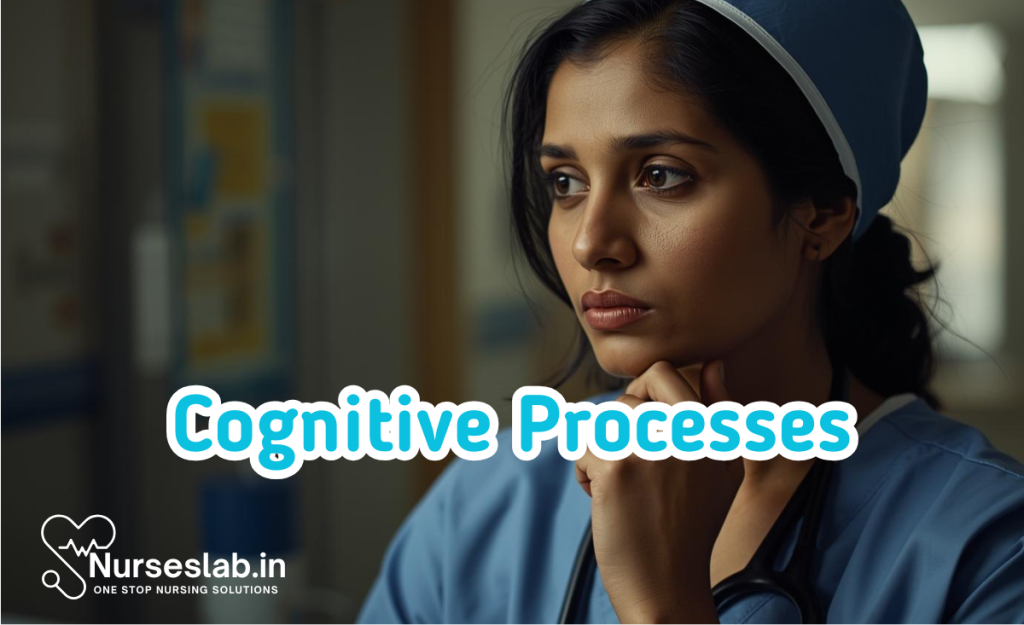
Attention: The Foundation of Safe and Effective Nursing
Definition and Core Concepts
Attention is the cognitive process that involves selectively concentrating on particular information while ignoring other stimuli. It acts as a mental filter, enabling nurses to focus on relevant cues amidst the noise and distractions of the clinical environment.
Role in Nursing Tasks
Nurses are routinely required to monitor multiple patients, respond to alarms, administer medications, and document care—all often simultaneously. Attention allows nurses to prioritise these tasks, detect subtle changes in patient conditions, and avoid errors.
Impact on Patient Safety
A lapse in attention can have serious consequences in nursing. For example, a nurse distracted while preparing medication may administer the wrong dose or drug, leading to adverse patient outcomes. Conversely, the ability to sustain focused attention ensures that vital signs are accurately recorded, protocols are followed, and patients receive timely interventions.
Practical Example
During a busy shift, a nurse may notice a low oxygen saturation alarm while also being called to assist another patient. By prioritising attention to the more urgent alarm, the nurse can intervene quickly, potentially averting respiratory distress.
Implications
- Maintaining attention is critical for error prevention.
- Training in mindfulness and situational awareness can enhance attentional control.
- Effective shift handovers and minimising workplace distractions support sustained attention.
Sensory Process: Gathering Information from the Environment
Explanation of Sensory Processing
Sensory processing refers to the reception and initial interpretation of stimuli through the senses—sight, hearing, touch, taste, and smell. For nurses, sensory input provides the raw data needed to assess patient status and environment.
Relevance in Patient Assessment
Nursing assessments are grounded in sensory observations. Nurses use their eyes to observe skin colour, wounds, or movement; ears to listen for abnormal breath sounds or patient complaints; hands to detect fever or oedema; and even smell to identify infections or metabolic imbalances.
Examples in Clinical Practice
- Detecting cyanosis by observing bluish tinge in lips and fingers.
- Hearing crackles in the lungs during auscultation, suggesting pulmonary oedema.
- Feeling increased warmth at a surgical site, indicating possible infection.
- Noticing the odour of ketones on a diabetic patient’s breath.
Implications
- Accurate sensory processing is vital for early identification of complications.
- Regular training and simulation can sharpen sensory skills.
- Fatigue or sensory overload can compromise assessment accuracy.
Perception: Interpreting Sensory Information
From Sensation to Meaning
Perception is the process by which the brain organises and interprets sensory input, transforming raw data into meaningful information. It is influenced by prior experience, expectations, and context, making it a highly individualised process.
Perception in Nursing Practice
Nurses must interpret a wide range of sensory cues within a clinical framework. For example, a nurse may perceive that a patient’s restlessness and elevated pulse are signs of pain, anxiety, or impending deterioration, depending on the context and patient history.
Clinical Implications
- Perception guides clinical judgement. Two nurses may perceive the same cues differently based on experience.
- Biases and assumptions can affect perception, potentially leading to misinterpretation.
- Reflective practice and team discussions help calibrate perceptions for more accurate assessments.
Example
A nurse perceives subtle facial grimacing and withdrawn behaviour in a postoperative patient. Interpreting these as indications of unrelieved pain, the nurse advocates for additional analgesia, improving patient comfort and recovery.
Learning: The Engine of Professional Growth
Types of Learning in Nursing
- Classical Conditioning: Learning by association, such as associating a certain alarm sound with a specific emergency.
- Operant Conditioning: Learning through consequences, such as adopting hand hygiene practices after positive reinforcement from supervisors.
- Observational Learning: Acquiring skills and behaviours by watching role models or peers.
- Cognitive Learning: Understanding concepts and principles, such as pathophysiology, through study and reflection.
Importance in Skill Acquisition and Continuing Education
Nursing is an evolving field, requiring lifelong learning to stay abreast of new evidence, technologies, and protocols. Formal education, on-the-job training, workshops, and self-study all contribute to a nurse’s knowledge base and skill set.
For example, learning to use a new infusion pump involves cognitive understanding of the device, hands-on practice, and observation of experienced colleagues.
Implications
- Ongoing learning is essential for maintaining competence and ensuring patient safety.
- Mentorship and supportive learning environments facilitate professional growth.
- Reflective practice helps consolidate learning and improve future performance.
Memory: Retaining and Recalling Critical Information
Role of Memory in Clinical Practice
Memory is the cognitive process of encoding, storing, and retrieving information. In nursing, memory enables professionals to recall procedures, patient histories, medication regimens, and institutional protocols.
Application in Nursing Tasks
- Procedural Memory: Remembering how to perform clinical skills, such as inserting an intravenous cannula or conducting a head-to-toe assessment.
- Declarative Memory: Recalling facts, such as drug dosages, normal laboratory values, or diagnostic criteria.
- Working Memory: Holding and manipulating information temporarily, such as calculating medication doses while preparing them.
Examples
A nurse must remember a patient’s allergies before administering medication, recall the steps of cardiopulmonary resuscitation in an emergency, and document care accurately in the patient record.
Implications
- Strong memory supports clinical competence and confidence.
- Checklists, reminders, and electronic health records can aid memory and reduce errors.
- Stress, fatigue, and information overload can impair memory, highlighting the importance of self-care and supportive work environments.
Thinking: Critical Thinking, Clinical Reasoning, and Problem-Solving
Critical Thinking in Nursing
Critical thinking is the active, persistent, and careful consideration of information, evidence, and arguments to make informed decisions. In nursing, it involves analysing data, evaluating alternatives, and anticipating outcomes.
Clinical Reasoning and Decision-Making
Clinical reasoning is the process by which nurses collect cues, process information, come to an understanding of a patient problem, plan and implement interventions, and evaluate outcomes. Effective clinical reasoning is essential for safe and personalised patient care.
Problem-Solving in Practice
- Identifying the underlying cause of a patient’s symptoms.
- Developing and revising care plans based on patient responses.
- Adapting to unexpected changes, such as a sudden drop in blood pressure.
Examples
When a patient develops shortness of breath postoperatively, the nurse must quickly gather information, consider possible causes (e.g., pulmonary embolism, infection, fluid overload), and initiate appropriate interventions while notifying the medical team.
Implications
- Structured frameworks, such as the nursing process (assessment, diagnosis, planning, implementation, evaluation), support critical thinking.
- Simulation exercises and case studies enhance clinical reasoning skills.
- Encouraging a questioning attitude helps prevent complacency and fosters innovation.
Intelligence: Adaptability and Excellence in Nursing Roles
Types of Intelligence Relevant to Nursing
- Analytical Intelligence: The ability to analyse information and solve problems logically.
- Emotional Intelligence: The capacity to recognise, understand, and manage one’s own emotions and those of others—crucial for building rapport, empathy, and teamwork.
- Practical Intelligence: The ability to adapt to changing environments and apply knowledge effectively in real-life situations.
- Cultural Intelligence: The skill to interact effectively with people from diverse backgrounds, respecting cultural differences in healthcare beliefs and practices.
Relevance to Nursing Roles
Nurses must demonstrate various forms of intelligence in their daily practice. For instance, emotional intelligence helps in de-escalating distressed patients or relatives, while analytical intelligence is vital for interpreting diagnostic results. Practical intelligence is displayed when nurses improvise solutions during resource shortages, and cultural intelligence ensures that care is respectful and patient-centred.
Examples
- Using emotional intelligence to comfort a grieving family and facilitate open communication.
- Applying analytical intelligence to identify patterns in laboratory data and anticipate complications.
- Employing practical intelligence to efficiently manage time and resources during a mass casualty incident.
- Demonstrating cultural intelligence by incorporating dietary preferences into care plans for patients from different backgrounds.
Implications
- Nursing education should foster all dimensions of intelligence.
- Self-awareness and feedback from peers can enhance emotional and cultural intelligence.
- Adaptability is key to thriving in diverse and unpredictable healthcare environments.
Integration of Cognitive Processes in Daily Nursing Practice
The cognitive processes described above rarely operate in isolation. In reality, they interact continuously, supporting the nurse’s ability to deliver comprehensive care. For example, attention and sensory processing enable accurate patient assessment; perception and memory inform clinical reasoning; learning and intelligence drive adaptation and skill development; and critical thinking ensures evidence-based, patient-centred decisions.
Consider the scenario of a nurse caring for a postoperative patient. The nurse pays close attention to vital sign monitors (sensory processing), perceives subtle changes in the patient’s condition (perception), recalls relevant protocols and past experiences (memory), applies learned knowledge of postoperative complications (learning), analyses the situation and formulates a care plan (thinking), and adapts communication and interventions to the patient’s cultural and emotional needs (intelligence).
Implications for Patient Care
Enhancing Outcomes through Cognitive Awareness
A deep understanding of cognitive processes enables nurses to provide safer, more effective, and more compassionate care. By consciously developing and applying these skills, nurses can:
- Reduce errors and improve patient safety through focused attention and accurate memory.
- Enhance assessment and early detection of complications via sharp sensory processing and perceptive interpretation.
- Deliver culturally sensitive and empathetic care by leveraging emotional and cultural intelligence.
- Adapt rapidly to changing patient needs and environments using practical and analytical intelligence.
- Promote patient education and empowerment by employing effective communication and teaching strategies.
Examples of Improved Care
- Early identification of sepsis through vigilant attention and pattern recognition.
- Prevention of medication errors using memory aids and double-check systems.
- Resolving conflicts within the healthcare team through emotional intelligence and problem-solving skills.
Professional Development: Strategies to Enhance Cognitive Skills in Nursing
Building Cognitive Competence
- Continuous Education: Engaging in formal courses, workshops, and certifications to update knowledge and skills.
- Simulation and Practice: Participating in simulated clinical scenarios to hone attention, sensory processing, and decision-making.
- Reflective Practice: Regular self-reflection and discussion with colleagues to identify strengths and areas for improvement.
- Mindfulness Training: Practising mindfulness to enhance focus, reduce stress, and improve attention.
- Memory Techniques: Using mnemonics, checklists, and visual aids to support memory retention.
- Mentorship and Peer Support: Learning from experienced nurses and sharing knowledge within the team.
- Emotional Intelligence Development: Attending workshops or engaging in self-study to build self-awareness and empathy.
Creating Supportive Environments
- Fostering a culture that values ongoing learning and cognitive growth.
- Encouraging teamwork and open communication to support perception and problem-solving.
- Implementing systems to minimise distractions and cognitive overload.
Conclusion
Cognitive processes are the unseen engines that drive effective nursing practice. From the moment a nurse steps onto the ward, these mental operations shape every interaction, assessment, and intervention. By understanding and intentionally developing attention, sensory processing, perception, learning, memory, thinking, and intelligence, nurses can enhance patient care, reduce errors, and grow as professionals.
The future of nursing will increasingly depend on the ability to harness cognitive skills, adapt to new challenges, and continue learning throughout one’s career. For nursing students and professionals, investing in cognitive development is not only a pathway to excellence—it is a fundamental responsibility to the patients and communities they serve.
REFERENCES
- R. Sreevani, Applied Psychology for Nurses, 5th Edition, 2024, Jaypee Publishers, ISBN: 978-9356966963.
- Xavier Belsiyal, Applied Psychology for Nurses, 1st Edition, July 15, 2023, Elsevier Publishers, ISBN: 978-8131266366
- Mary F Porter, Applied Psychology for Nurses, 27 October 2022, Legare Street Press, IBSN: 978-1015804302.
- Douglas A. Bernstein, Introduction to Clinical Psychology, 10th Edition, 31 October 2024, Cambridge University Press, ISBN: 978- 1009379298.
- Sailaxmi Gandhi, Basic and Applied Psychology for Nurses, First Edition, January 2023, Wolters Kluwer Publications, ISBN: 978-9395736534.
- Jacob Anthikad, Psychology for Graduate Nurses, 5th Edition, 30 January 2014, Jaypee Publishers, ISBN: 978-9351521549.
- Kumar, Rajesh. (2017). Basic Psychology for Nurses. https://www.researchgate.net/publication/337811601_Basic_Psychology_for_Nurses
Stories are the threads that bind us; through them, we understand each other, grow, and heal.
JOHN NOORD
Connect with “Nurses Lab Editorial Team”
I hope you found this information helpful. Do you have any questions or comments? Kindly write in comments section. Subscribe the Blog with your email so you can stay updated on upcoming events and the latest articles.