


Last Updated on January 12, 2026 by Nurseslab.in Editorial Team
Introduction
A hysterectomy is a surgical procedure that involves the removal of a woman’s uterus. This operation is performed for various medical reasons, including uterine fibroids, endometriosis, chronic pelvic pain, uterine prolapse, and cancer. The procedure can be life-changing and is often considered when other treatments have failed or are not possible.
Types of Hysterectomy
Hysterectomy, the surgical removal of the uterus, can be performed using various techniques depending on the underlying medical condition, the patient’s health, and the desired outcome. Understanding the different types of hysterectomy can help patients make informed decisions about their surgical options.

1.Total Hysterectomy
A total hysterectomy involves the complete removal of the uterus, including the cervix. This is one of the most common types of hysterectomy and is often performed to treat conditions such as uterine fibroids, endometriosis, chronic pelvic pain, and certain types of cancer. Patients who undergo a total hysterectomy will no longer have menstrual periods and will not be able to become pregnant.
2.Subtotal (Partial) Hysterectomy
In a subtotal hysterectomy, only the upper part of the uterus is removed, while the cervix is left intact. This procedure may be recommended for patients with benign conditions where the preservation of the cervix is desired. It is believed that preserving the cervix may help maintain pelvic floor stability and sexual function, though menstrual bleeding can still occur from the retained cervical tissue.
3.Radical Hysterectomy
A radical hysterectomy is a more extensive procedure that involves the removal of the uterus, cervix, the upper part of the vagina, and surrounding tissues, including the pelvic lymph nodes. This type of hysterectomy is typically performed to treat certain gynecologic cancers, such as cervical or endometrial cancer. The goal is to remove as much of the cancerous tissue as possible to prevent the spread of the disease.
4.Hysterectomy with Bilateral Salpingo-Oophorectomy
This procedure involves the removal of the uterus, cervix, both ovaries, and fallopian tubes. It is often performed in cases where there is a risk or presence of cancer in the ovaries or fallopian tubes, or for severe endometriosis that affects these structures. Removing the ovaries will induce surgical menopause, as the body’s primary source of estrogen and progesterone is eliminated.
5.Vaginal Hysterectomy
In a vaginal hysterectomy, the uterus is removed through an incision made in the vagina. This method is less invasive than abdominal hysterectomy and typically results in a shorter recovery time and less postoperative pain. Vaginal hysterectomy is often chosen for patients with a prolapsed uterus or benign conditions that do not require an extensive surgical approach.
6.Abdominal Hysterectomy
An abdominal hysterectomy involves making an incision in the lower abdomen to remove the uterus. This approach may be necessary for patients with large fibroids, extensive endometriosis, or cancer that requires a more comprehensive surgical view. While this method offers the surgeon greater access to the pelvic organs, it usually involves a longer recovery period compared to vaginal or laparoscopic hysterectomy.
7.Laparoscopic Hysterectomy
A laparoscopic hysterectomy is a minimally invasive procedure where the uterus is removed using small incisions and specialized instruments, including a laparoscope—a thin, lighted tube with a camera. This method can be used for total, subtotal, or radical hysterectomy and offers the advantages of reduced scarring, less postoperative pain, and a quicker recovery time. Patients can often return to normal activities faster compared to traditional open surgery.
8.Robotic-Assisted Laparoscopic Hysterectomy
This advanced technique uses robotic technology to assist the surgeon in performing a laparoscopic hysterectomy. The surgeon controls robotic arms that hold the surgical instruments, providing enhanced precision, flexibility, and control. Robotic-assisted hysterectomy is ideal for complex cases that require meticulous dissection and suturing. The benefits are similar to those of standard laparoscopic surgery, with potentially even greater accuracy and fewer complications.
Methods of Surgery
Hysterectomies can be performed using different surgical approaches:
1.Abdominal Hysterectomy:
The uterus is removed through a large incision in the lower abdomen. This method allows for a wide view of the pelvic organs.
2.Vaginal Hysterectomy:
The uterus is removed through the vagina, requiring no abdominal incisions. Recovery time is generally shorter than with abdominal hysterectomy.
3.Laparoscopic Hysterectomy:
This minimally invasive technique uses small incisions and a laparoscope to guide the removal of the uterus. It can be performed as a total or partial hysterectomy.
4.Robotic Hysterectomy:
Similar to laparoscopic surgery, this method utilizes robotic technology for enhanced precision and control.
5.Vaginal laparoscopic hysterectomy
A surgeon inserts a laparoscope (a thin tube with a video camera on the end) into your lower abdomen through the vaginal incision. This allows improved visualization of the pelvic structures.
Reasons for Hysterectomy
Hysterectomy may be recommended for several reasons, including:
- Uterine Fibroids: Non-cancerous growths that can cause pain, bleeding, and other symptoms.
- Endometriosis: A condition where the tissue lining the inside of the uterus grows outside of it, causing pain and irregular bleeding.
- Chronic Pelvic Pain: Persistent pain in the pelvic region that does not respond to other treatments.
- Uterine Prolapse: The uterus descends into or outside the vaginal canal due to weakened pelvic muscles.
- Cancer: Hysterectomy may be necessary to treat cancers of the uterus, cervix, or ovaries.
Risks and Complications
As with any major surgery, hysterectomy carries risks and potential complications:
- Infection
- Excessive bleeding
- Injury to surrounding organs, such as the bladder or intestines
- Blood clots
- Adverse reactions to anaesthesia
Long-term effects may include hormonal changes, especially if the ovaries are removed, and potential emotional or psychological impacts.
Recovery and Aftercare
Recovery times vary depending on the type of hysterectomy performed and the individual’s overall health:
- Hospital Stay: Most patients stay in the hospital for 1 to 2 days after a vaginal or laparoscopic hysterectomy, and up to 4 days after an abdominal hysterectomy.
- Physical Activity: Patients are generally advised to avoid heavy lifting and strenuous activities for at least 6 weeks post-surgery.
- Follow-Up Care: Regular check-ups are necessary to monitor healing and address any complications.
Emotional support and counseling may be beneficial, as the removal of the uterus can be a significant emotional event for some women.
Alternatives to Hysterectomy
Depending on the medical condition, there may be alternatives to hysterectomy:
- Medications: Hormonal treatments and pain relievers may manage symptoms of conditions like fibroids and endometriosis.
- Non-Surgical Procedures: Techniques such as uterine artery embolization or endometrial ablation may be viable options.
- Conservative Surgery: In some cases, less invasive surgeries can address specific issues while preserving the uterus.
It is important for patients to discuss all available options with their healthcare provider to make an informed decision.
Common side effects
Some of the most common side effects of a hysterectomy are:
- Vaginal bleeding and drainage (can last up to six weeks).
- Soreness or irritation at the incision sites.
- Difficulty peeing or pooping in the days following surgery.
- Fatigue and tiredness from surgery.
Nursing Care for a Patient Post-Hysterectomy
Hysterectomy, the surgical removal of the uterus, is a major procedure that requires attentive and informed nursing care to ensure a smooth recovery. This guide outlines the essential aspects of nursing care for a patient who has undergone a hysterectomy.
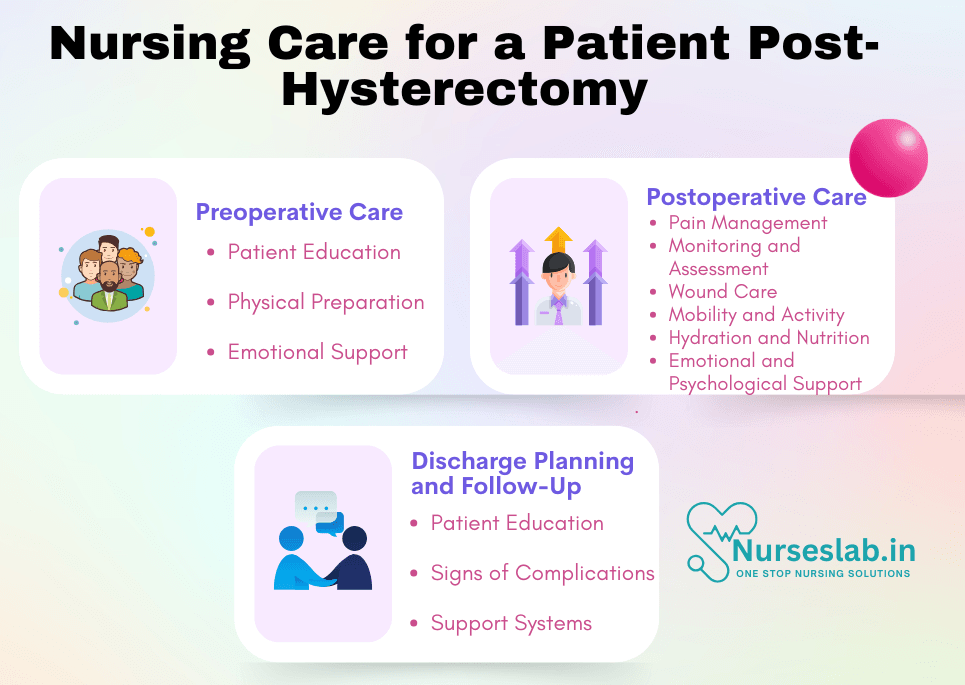
Preoperative Care
Patient Education
- Explain the procedure, potential risks, and expected outcomes.
- Discuss postoperative care and recovery expectations.
Physical Preparation
- Conduct preoperative assessments, including vital signs and lab tests.
- Ensure the patient is fasting as per the surgeon’s instructions.
- Administer preoperative medications as prescribed.
Emotional Support
- Provide reassurance and address any fears or concerns.
- Offer counseling or refer to support groups if needed.
Postoperative Care
Pain Management
- Assess pain levels regularly and administer analgesics as prescribed.
- Utilize non-pharmacological pain relief methods, such as positioning and relaxation techniques.
Monitoring and Assessment
- Monitor vital signs, including temperature, pulse, respiration, and blood pressure.
- Observe for signs of infection, such as fever, redness, or discharge at the incision site.
- Check for excessive bleeding or abnormal discharge.
Wound Care
- Keep the incision site clean and dry.
- Change dressings as needed and follow aseptic techniques to prevent infection.
- Educate the patient on proper wound care at home.
Mobility and Activity
- Encourage early ambulation to prevent complications such as deep vein thrombosis.
- Assist the patient with mobility exercises to improve circulation.
- Advise on activity restrictions and gradual return to normal activities.
Hydration and Nutrition
- Ensure adequate fluid intake to prevent dehydration and promote healing.
- Provide a balanced diet rich in protein, vitamins, and minerals to support recovery.
- Address any dietary restrictions or preferences.
Emotional and Psychological Support
- Offer a listening ear and empathetic support as the patient adjusts to life post-hysterectomy.
- Refer to counseling services if the patient experiences significant emotional distress.
- Encourage participation in support groups for shared experiences and encouragement.
Discharge Planning and Follow-Up
Patient Education
- Provide detailed instructions on wound care, medication management, and activity restrictions.
- Explain the importance of follow-up appointments for monitoring recovery.
Signs of Complications
- Educate the patient on signs and symptoms that require immediate medical attention, such as severe pain, heavy bleeding, fever, or signs of infection.
Support Systems
- Encourage the patient to have a support system in place for assistance at home.
- Arrange for home care services if necessary.
REFERENCES
- Carugno J, Fatehi M. Abdominal Hysterectomy (https://pubmed.ncbi.nlm.nih.gov/33232036/). 2023 Jul 18. In: StatPearls. Treasure Island (FL): StatPearls Publishing; 2024 Jan.
- Committee Opinion No 701: Choosing the Route of Hysterectomy for Benign Disease (https://pubmed.ncbi.nlm.nih.gov/28538495/). Obstet Gynecol. 2017;129(6):e155-e159.
- InformedHealth.org [Internet]. Cologne, Germany: Institute for Quality and Efficiency in Health Care (IQWiG); 2006-. Hysterectomy:surgical removal of the womb). https://www.ncbi.nlm.nih.gov/books/NBK525761/) 2018 Aug 23.
- Kahn RM, Gordhandas S, Godwin K, Stone RL, Worley MJ Jr, et al. Salpingectomy for the Primary Prevention of Ovarian Cancer: A Systematic Review. https://pubmed.ncbi.nlm.nih.gov/37672283/). JAMA Surg. 2023 Nov 1;158(11):1204-1211.
- National Women’s Health Network. Hysterectomy. https://nwhn.org/hysterectomy/). Publication date 11/2022.
- Office on Women’s Health (U.S.). Hysterectomy. https://www.womenshealth.gov/a-z-topics/hysterectomy. Last updated 12/2022.
- Pillarisetty LS, Mahdy H. Vaginal Hysterectomy (https://pubmed.ncbi.nlm.nih.gov/32119369/). 2024 Apr 24. In: StatPearls. Treasure Island (FL): StatPearls Publishing; 2024 Jan.
- The American College of Obstetricians and Gynecologists. Opinion 701. Choosing the Route of Hysterectomy for Benign Disease (https://www.acog.org/clinical/clinical-guidance/committee-opinion/articles/2017/06/choosing-the-route-of-hysterectomy-for-benign-disease). Last updated 11/2021.
- The American College of Obstetricians and Gynecologists. Hysterectomy. https://www.acog.org/womens-health/faqs/hysterectomy. Last updated 1/2021.
Stories are the threads that bind us; through them, we understand each other, grow, and heal.
JOHN NOORD
Connect with “Nurses Lab Editorial Team”
I hope you found this information helpful. Do you have any questions or comments? Kindly write in comments section. Subscribe the Blog with your email so you can stay updated on upcoming events and the latest articles.


