


Cardiac monitoring tracks heart rhythm, rate, and electrical activity to detect abnormalities and guide safe, timely clinical interventions.
Introduction
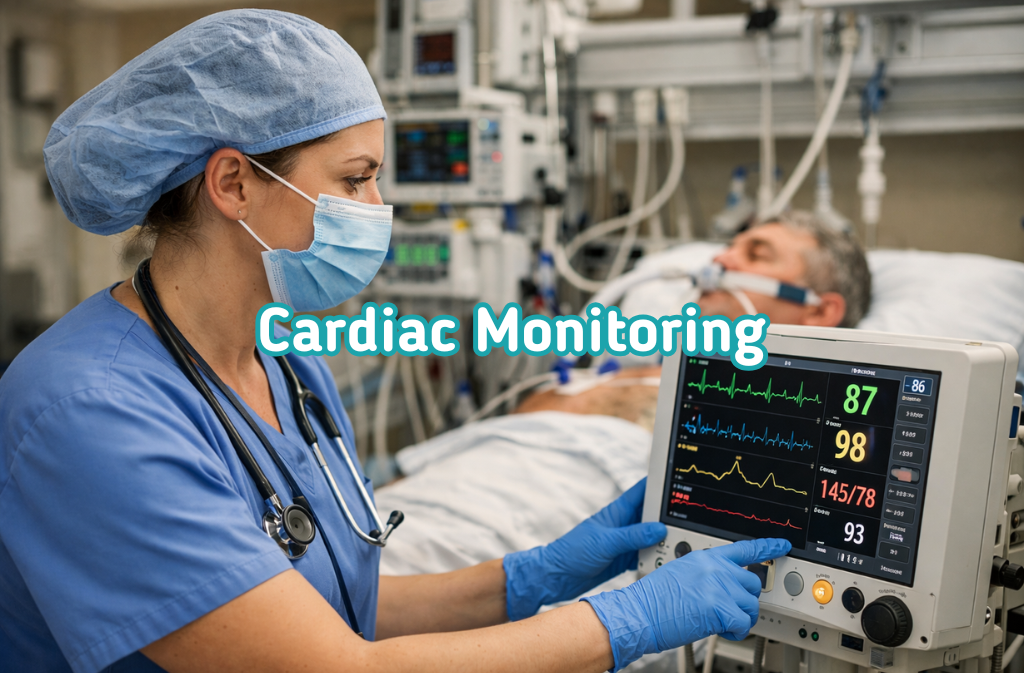
A cardiac monitor is a bedside observation/diagnostic tool that allows continuous electrocardiogram (ECG), respiratory rate (RR), and SpO₂ monitoring while the patient is being attached to it, providing clues for clinical deterioration and helping in planning prompt intervention for reviving the patient.
Definition
Cardiac monitoring is the continuous or intermittent tracking of heart activity to assess a patient’s cardiac rhythm, rate, and electrical conduction. It is essential for detecting arrhythmias, ischemia, and other cardiac abnormalities.
Purposes
- To assess cardiac and respiratory function by continuously tracking the cardiac rhythm, heart rate, BP, RR, and temperature.
- To rule out the presence of functional abnormalities in the circulatory system (hypoxia).
- To evaluate hemodynamic response to disease progression and interventions provided (e.g., pacemaker, automatic implantable cardioverter, defibrillator function).
- To promptly identify and treat any medical or surgical emergencies.
Indications
- Altered level of consciousness.
- Cardiac condition such as acute coronary syndrome (ACS; STEMI/NSTEMI/unstable angina, arrhythmias, heart failure, cardiac arrest, shock.
- Electrolyte abnormalities affecting vital parameters (hypokalemia/hyperkalemia, hypocalcemia/hypercalcemia, hypomagnesemia/hypermagnesemia).
- Respiratory conditions (ARDS, respiratory insufficiency, pneumonia, pulmonary embolism).
- Poisoning.
- Trauma.
- Patients in emergency, critical care, and surgical units (postoperative) and undergoing major invasive therapeutic interventions.
- Patients on inotropic therapy.
Clinical Applications
- Arrhythmia Detection – Identifies atrial fibrillation, ventricular tachycardia, and bradycardia.
- Post-MI Monitoring – Tracks ST-segment changes for ischemia.
- QT Interval Monitoring – Prevents drug-induced QT prolongation.
- Heart Failure Management – Assesses fluid overload and cardiac function.
Contraindications
There are no specific contraindications. However, its use may be limited in the following conditions:
- Severe burns over the chest.
- Major prosthesis for open pleurostomy (POP) over the thorax.
- Skin conditions in which skin integrity is altered.
Types
- Holter monitor: It is a portable external monitor that includes wires with patches that attach to the skin. It continuously measures and records heart activity for 1-2 days.
- Event recorder: It is a recorder worn on the body for up to 30 days. It typically requires activation by pushing a button to record the heart’s activity.
- Mobile cardiac telemetry (MCT): It is a wearable monitor that automatically detects, records, and transmits heart rhythms via mobile network to the physician for up to 30 days.
- Insertable cardiac monitor (ICM): It is a small device placed just under the skin that automatically detects and records abnormal heart rhythms for up to 3 years.
Articles
| Articles | Purpose |
| Cardiac monitor with power cable, earth cable, and ECG cable with five leads and electrodes | To record the parameters. |
| Pressure transducer | |
| Disposable electrodes | To connect the wires. |
| Electrode paste or gel | For adherence. |
| SpO2sensor probe | To record the oxygen saturation. |
| Temperature probe | To record the temperature. |
| NIBP hose pipe | To record BP. |
| NIBP cuff | |
| Alcohol sponges | To cleanse the skin. |
| Gauze | |
| Pillows | To enhance comfort during the procedure. |
| Disposable razor (if needed) | To remove excessive hair as it interferes with adhesion of electrodes on the skin. |
Procedure
| Nursing Action | Rationale | |
| 1. | Explain the procedure and obtain consent from the patient. | Alleviates anxiety and promotes cooperation. Serves as legal evidence and prevents litigation of the staff. |
| 2. | Ensure that all electrical equipment and outlets are grounded. | To avoid shock to the patient/operator and artifacts in recordings. |
| 3. | Arrange and ensure that the monitor is plugged, on power and the cables are connected. | General preparation for the procedure. |
| 4. | Wash hands. | Reduces the transmission of microorganisms. |
| 5. | Provide privacy. | Prevents embarrassment. |
| 6. | Position the patient in a supine and relaxed position and expose the chest. | Provides comfort and ensures accurate recording. |
| 7. | Clean the skin with alcohol swab, rub the skin with gauze to increase capillary blood flow, and ensure that the patient’s skin is clean and dry. | To protect from electrical shock and promote adherence of leads to the chest and extremities by removing moist and oil. |
| 8. | Apply electrode gel and attach electrodes to the chest. | |
| 9. | Attach lead lines to electrodes: White/right arm (RA): In the infraclavicular fossa close to the right shoulder. Black/left arm (LA): In the infraclavicular fossa close to the left shoulder. Red/left leg (LL): Placed below the rib cage on the LUQ of the abdomen. Green/right leg (RL): Placed below the rib cage on the RUQ of the abdomen. Brown/V: Placed below the rib cage in between RL and the xiphoid process. | For accurate positioning of leads. Ensures accurate reading. |
| 10. | Observe the monitor and confirm proper functioning. | |
| 11. | Select the appropriate site for application of pulse oximeter sensor. Ensure that the photodetector and the light-emitting diode on the probe face each other. | |
| 12. | Check the pulse rate detected on the monitor, correlate with the patient’s radial pulse. | |
| 13. | Wrap the BP cuff around the upper arm, above the antecubital fossa. | To measure BP reading. |
| 14. | Set and turn on the alarm limit. | To identify abnormality. |
| 15. | Start NIBP and note the BP reading. | To assess BP. |
| 16. | Replace the articles and wash hands. | Reduces the transmission of microorganisms. |
| 17. | Interpret the readings displayed in the monitor and inform the physician. | Certain changes may require prompt treatment. |
| 18. | Observe for skin breakdown at the electrode placement site. | |
| 19. | Document the date and time when cardiac monitoring was started, its indication, and any significant findings. Note the date and time of any cardiac medication administered, alarm signal, electrode placement, and need for change of electrodes. The electrodes should be changed on a daily basis. In case of telemetry, check the battery status in every shift. | For continuity of care. |
Special Considerations
- Shave excessive hair to improve electrode adhesion.
- Avoid bony prominences or areas with excessive movement.
- Minimize patient movement to prevent baseline wander.
- Secure electrodes properly to avoid signal interference.
- Check for electrical interference from nearby devices.
- Continuous ECG monitoring for high-risk patients (e.g., post-MI, ICU).
- Pediatric patients require adjusted electrode placement.
- Geriatric patients may have fragile skin—use gentle adhesives.
- Pregnant patients need modified positioning to avoid vena cava compression.
- Rapid ECG acquisition in chest pain or suspected MI cases.
- Defibrillator pad placement should not interfere with ECG electrodes.
- Telemetry alarms should be set appropriately to detect critical changes.
REFERENCES
- Annamma Jacob, Rekha, Jhadav Sonali Tarachand: Clinical Nursing Procedures: The Art of Nursing Practice, 5th Edition, March 2023, Jaypee Publishers, ISBN-13: 978-9356961845 ISBN-10: 9356961840
- Omayalachi CON, Manual of Nursing Procedures and Practice, Vol 1, 3 Edition 2023, Published by Wolters Kluwer’s, ISBN: 978-9393553294
- Sandra Nettina, Lippincott Manual of Nursing Practice, 11th Edition, January 2019, Published by Wolters Kluwers, ISBN-13:978-9388313285
- Adrianne Dill Linton, Medical-Surgical Nursing, 8th Edition, 2023, Elsevier Publications, ISBN: 978-0323826716
- Donna Ignatavicius, Medical-Surgical Nursing: Concepts for Clinical Judgment and Collaborative Care, 11th Edition ,2024, Elsevier Publications, ISBN: 978-0323878265
- Lewis’s Medical-Surgical Nursing, 12th Edition,2024, Elsevier Publications, ISBN: 978-0323789615
- AACN Essentials of Critical Care Nursing, 5th Ed. Sarah. Delgado, 2023, Published by American Association of Critical-Care Nurses ISBN: 978-1264269884
- Ernstmeyer K, Christman E, editors. Nursing Fundamentals [Internet]. 2nd edition. Eau Claire (WI): Chippewa Valley Technical College; 2024. PART IV, NURSING PROCESS. Available from: https://www.ncbi.nlm.nih.gov/books/NBK610818/
Stories are the threads that bind us; through them, we understand each other, grow, and heal.
JOHN NOORD
Connect with “Nurses Lab Editorial Team”
I hope you found this information helpful. Do you have any questions or comments? Kindly write in comments section. Subscribe the Blog with your email so you can stay updated on upcoming events and the latest articles.


