


Last Updated on January 16, 2026 by Nurseslab.in Editorial Team
Grounded theory is a qualitative research method used to develop theories directly from data. Unlike other approaches that start with a hypothesis, grounded theory relies on systematic data collection and analysis to generate insights grounded in the data itself. This approach is particularly valuable for exploring new or under-researched areas, allowing researchers to develop theories based on observed patterns and relationships.

This guide covers the core methods, examples, and steps for conducting grounded theory research.
Grounded Theory
Grounded theory was introduced by sociologists Barney Glaser and Anselm Strauss in the 1960s as a way to build theory systematically from the ground up. Grounded theory starts with data collection and employs an iterative process, where data is continuously coded, analyzed, and compared. This method generates concepts and patterns directly from the data, leading to theories that reflect the real-world experiences of participants.
When should you use grounded theory?
Grounded theory research is useful for beginning researchers, particularly graduate students, because it offers a clear and flexible framework for conducting a study on a new topic.
Grounded theory works best when existing theories are either insufficient or nonexistent for the topic at hand.
Since grounded theory is a continuously evolving process, researchers collect and analyze data until theoretical saturation is reached or no new insights can be gained.
What is the final product of a GT study?
The final product of a grounded theory (GT) study is an integrated and comprehensive grounded theory that explains a process or scheme associated with a phenomenon.
The quality of a GT study is judged on whether it produces this middle-range theory
Middle-range theories are sort of like explanations that focus on a specific part of society or a particular event. They don’t try to explain everything in the world. Instead, they zero in on things happening in certain groups, cultures, or situations.
Key Features of Grounded Theory:
- Theory Generation: The aim is to develop a theory rather than test an existing hypothesis.
- Constant Comparison: Data is analyzed in a continuous, comparative manner.
- Iterative Process: Data collection, coding, and analysis occur simultaneously.
- Theoretical Sampling: Sampling decisions are based on emerging patterns in the data.
Methods in Grounded Theory
The following are the Methods used in Grounded Theory
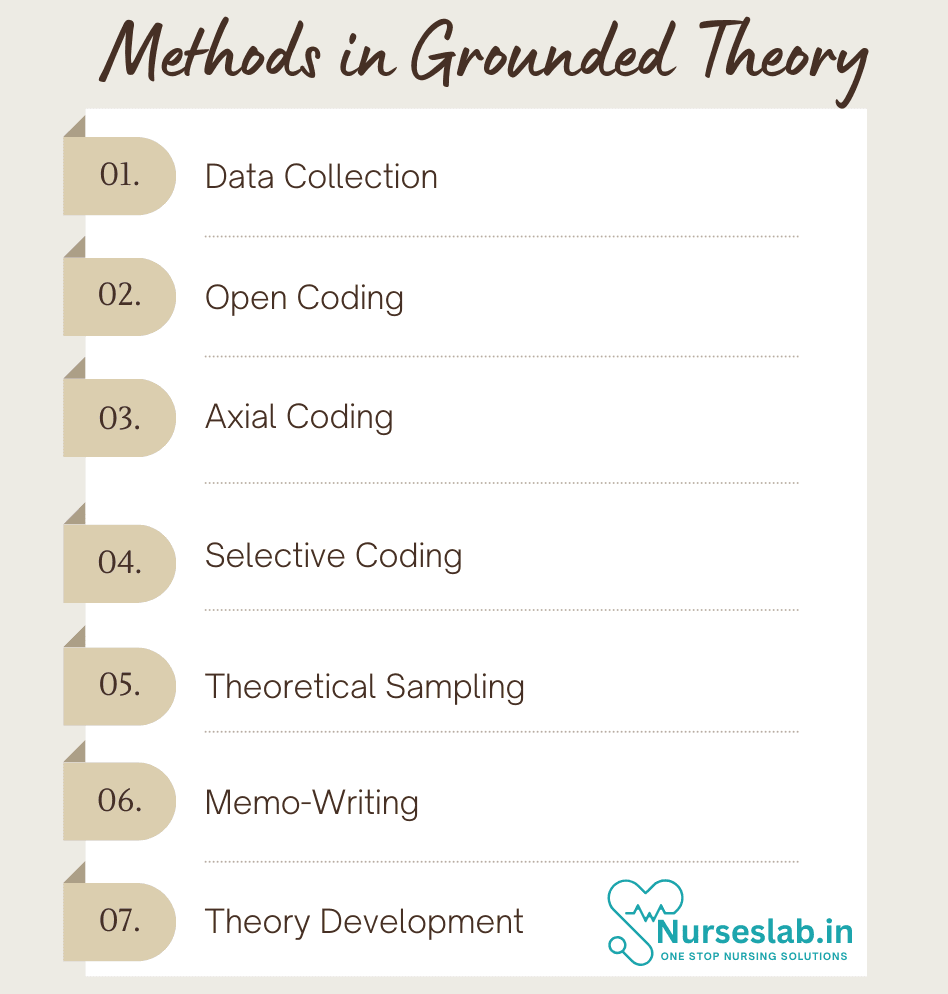
1.Data Collection
Grounded theory typically uses in-depth interviews, observations, and open-ended questionnaires to gather rich, qualitative data. Data is often collected from a relatively small sample to enable detailed analysis.
2.Open Coding
Open coding is the first stage of analysis, where data is broken down into distinct parts, and codes are assigned to label important concepts. During this phase, researchers identify initial categories and themes by segmenting data into meaningful units.
Example: In a study on patient experiences in healthcare, open coding might include labels like “waiting times,” “communication,” and “empathy.”
3.Axial Coding
Axial coding follows open coding and involves identifying relationships among the initial codes. Researchers connect categories to form more complex ideas, such as linking “communication” with “patient satisfaction.”
Example: “Communication” may be linked to both “patient satisfaction” and “trust in healthcare providers,” revealing an interconnected framework.
4.Selective Coding
Selective coding focuses on identifying a central category that represents the main theme of the research. This central concept serves as the foundation for developing the final theory, integrating and refining previous codes.
Example: In a study on job satisfaction, the core concept might be “work-life balance,” with other themes like “workload,” “support from colleagues,” and “flexible hours” linked to it.
5.Theoretical Sampling
Theoretical sampling is used to gather more data specifically on emerging categories. This step is essential to refining and validating the developing theory and ensures that data is gathered based on the emerging concepts rather than a pre-determined sampling plan.
6.Memo-Writing
Memo-writing involves recording insights, interpretations, and connections that emerge during data analysis. Memos serve as a researcher’s notes, helping to develop the emerging theory and clarify ideas.
7.Theory Development
The final stage is synthesizing the codes, categories, and relationships into a cohesive theory. This theory should offer a clear explanation or model based on the data patterns and insights.
Core Components of Grounded Theory
This terminology reflects the iterative, inductive, and comparative nature of grounded theory, which distinguishes it from other research approaches.
1.Theoretical Sampling:
The researcher uses theoretical sampling to choose new participants or data sources based on the emerging findings of their study. The goal is to gather data that will help to further develop and refine the emerging categories and theoretical concepts.
2.Theoretical Sensitivity:
Researchers need to be aware of their preconceptions going into a study and understand how those preconceptions could influence the research. However, it is not possible to completely separate a researcher’s history and experience from the construction of a theory.
3.Coding:
Coding is the process of analyzing qualitative data (usually text) by assigning labels (codes) to chunks of data that capture their essence or meaning. It allows you to condense, organize and interpret your data.
4.Core Category:
The core category encapsulates and explains the grounded theory as a whole. Researchers identify a core category to focus on during the later stages of their research.
5.Memos:
Researchers use memos to record their thoughts and ideas about the data, explore relationships between codes and categories, and document the development of the emerging grounded theory. Memos support the development of theory by tracking emerging themes and patterns.
6.Theoretical Saturation:
This term refers to the point in a grounded theory study when collecting additional data does not yield any new theoretical insights. The researcher continues the process of collecting and analyzing data until theoretical saturation is reached.
7.Constant Comparative Analysis:
This method involves the systematic comparison of data points, codes, and categories as they emerge from the research process. Researchers use constant comparison to identify patterns and connections in their data.
Steps for Conducting Grounded Theory Research
These are the following steps to conduct Grounded Theory Research Effectively.
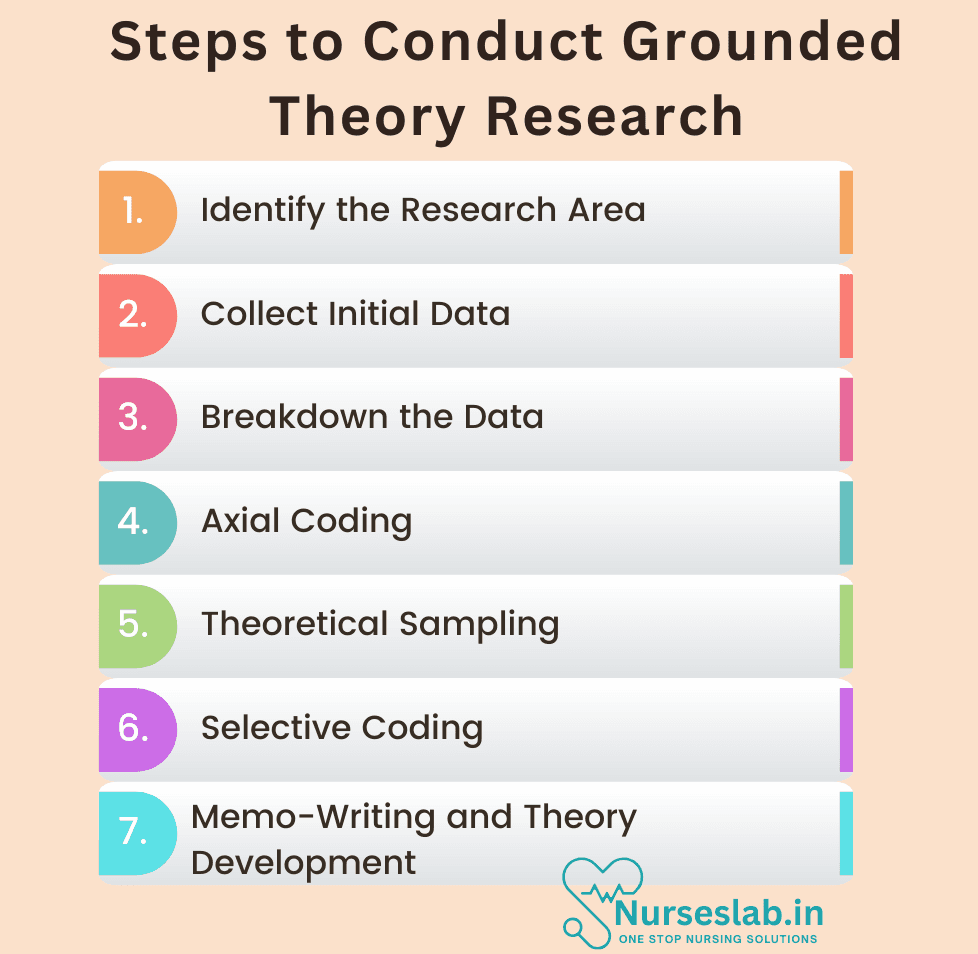
Step 1: Identify the Research Area
Begin by identifying a general area of interest or an under-researched topic that requires exploration. Grounded theory is well-suited to studies without a pre-existing framework, focusing on participants’ lived experiences.
Example: Exploring how remote work impacts employee well-being and productivity.
Step 2: Collect Initial Data
Use interviews, observations, or open-ended surveys to gather initial data. The questions should be broad and open-ended to encourage participants to share their experiences in detail.
Example: Ask remote employees, “What are the biggest challenges and benefits of working from home?”
Step 3: Breakdown the Data
Break down the data into codes, labeling significant phrases, actions, or ideas. Look for recurring words, phrases, or themes that provide insight into participants’ perspectives.
Example: Codes like “isolation,” “work-life balance,” and “communication issues” might emerge in the initial coding phase.
Step 4: Axial Coding
Organize and connect codes to identify broader categories and relationships. Consider how different codes relate to one another to form a cohesive understanding.
Example: Codes related to “work-life balance” and “time management” might be grouped under a larger category, such as “work-life challenges in remote work.”
Step 5: Theoretical Sampling
Based on the emerging categories, collect additional data to further explore or validate certain aspects of the study. Sampling is driven by the need to refine categories or clarify relationships.
Example: Interview additional remote workers specifically about their strategies for managing isolation, based on initial findings.
Step 6: Selective Coding
Identify the main category that encapsulates the primary focus of the study. Develop a theory that explains the relationships among categories and offers insights into the research question.
Example: “Remote work autonomy” could be the central category, with subcategories like “flexibility,” “challenges of isolation,” and “productivity management” contributing to the overall theory.
Step 7: Memo-Writing and Theory Development
Continue writing memos to capture reflections, connections, and theoretical insights. Use these notes to build a comprehensive theory that answers the research question.
Example: The emerging theory might suggest that remote work autonomy enhances job satisfaction but also increases the need for social support to prevent isolation.
Examples of Grounded Theory Research
- Healthcare
- Topic: How patients cope with chronic illness.
- Methods: Interviews with patients dealing with chronic health issues, focusing on how they manage daily life.
- Findings: Theory on coping mechanisms categorizes patient strategies into “support networks,” “self-care routines,” and “mindset adjustments.”
- Education
- Topic: Teacher adaptation to remote learning.
- Methods: Observations and interviews with teachers on their experiences with online teaching.
- Findings: Theory on adaptation reveals themes like “technology proficiency,” “student engagement challenges,” and “resource limitations.”
- Business
- Topic: Factors influencing entrepreneurial success.
- Methods: Interviews with entrepreneurs across industries.
- Findings: Emerging theory identifies categories such as “resilience,” “networking,” “market knowledge,” and “financial planning” as key success factors.
Advantages and Limitations of Grounded Theory
Advantages:
- Flexible and Adaptable: Grounded theory is highly adaptable and allows researchers to follow emerging themes, making it suitable for exploring new or complex areas.
- Data-Driven: Theories developed are grounded in real data, enhancing their relevance and applicability.
- Useful for Theory Building: This method provides a structured way to develop theories directly from data, which can be valuable for areas with limited pre-existing theories.
Limitations:
- Time-Consuming: Grounded theory requires continuous data collection and analysis, which can be lengthy.
- Requires Analytical Skill: Coding and developing theory require skillful interpretation, which can be challenging for new researchers.
- Subjectivity: The researcher’s interpretation plays a significant role, which may introduce bias if not managed carefully.
Tips for Writing a Grounded Theory Research Paper
- Introduce Grounded Theory: Briefly explain grounded theory and why it’s suitable for the study.
- Describe Data Collection and Coding: Provide a clear description of the data collection, coding, and categorization methods.
- Include Examples of Codes and Categories: Use examples of codes and categories to demonstrate the analytical process.
- Explain Theory Development: Describe how the theory emerged from data, supported by specific examples from your analysis.
- Discuss Theoretical Implications: Highlight the broader implications of the theory for research, practice, or policy.
REFERENCES
- Chun Tie Y, Birks M, Francis K. Grounded theory research: A design framework for novice researchers. SAGE Open Med. 2019 Jan 2; 7:2050312118822927. doi: 10.1177/2050312118822927. PMID: 30637106; PMCID: PMC6318722.
- Khan, Shahid. (2024). Qualitative Research Method: Grounded Theory. International Journal of Business and Management. 9. 224-224. 10.5539/ijbm.v9n11p224.
- Charmaz, K. (2014). Constructing Grounded Theory. Sage Publications.
- Glaser, B. G., & Strauss, A. L. (1967). The Discovery of Grounded Theory: Strategies for Qualitative Research. Aldine.
- Corbin, J., & Strauss, A. (2015). Basics of Qualitative Research: Techniques and Procedures for Developing Grounded Theory. Sage Publications.
- Birks, M., & Mills, J. (2015). Grounded Theory: A Practical Guide. Sage Publications.
- Bryant, A., & Charmaz, K. (2007). The Sage Handbook of Grounded Theory. Sage Publications.
- https://www.simplypsychology.org/grounded-theory.html
Stories are the threads that bind us; through them, we understand each other, grow, and heal.
JOHN NOORD
Connect with “Nurses Lab Editorial Team”
I hope you found this information helpful. Do you have any questions or comments? Kindly write in comments section. Subscribe the Blog with your email so you can stay updated on upcoming events and the latest articles.


