


Last Updated on July 10, 2026 by Nurseslab.in Editorial Team
Partial Thromboplastin Time (PTT) test assesses blood clotting pathways to detect bleeding or clotting disorders, guide diagnosis, and monitor heparin therapy for safe and effective treatment.
Introduction
Blood clotting is a vital physiological process that prevents excessive bleeding when blood vessels are injured. Among the various laboratory tests used to evaluate the body’s ability to form clots, the Partial Thromboplastin Time (PTT) test holds a significant position. This diagnostic test is widely employed to assess the functionality of the intrinsic and common pathways of the coagulation cascade. Understanding the PTT test—its methodology, clinical implications, and interpretation—is essential for clinicians, laboratory technicians, and patients alike.
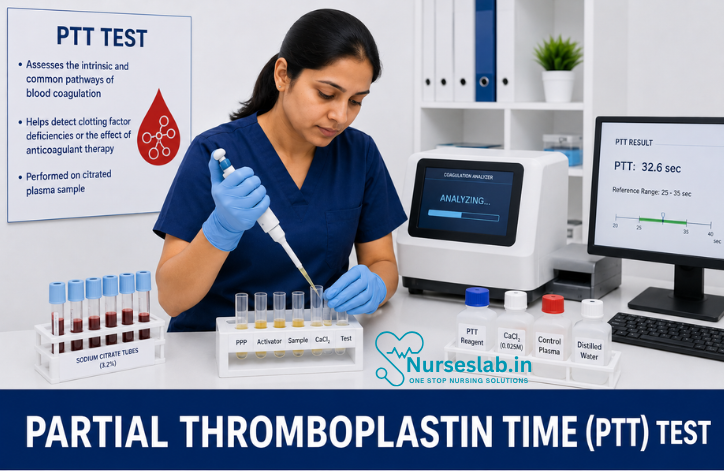
Understanding the Coagulation Cascade
The coagulation cascade is a complex series of enzymatic reactions that culminate in the formation of a stable blood clot. It is traditionally divided into three pathways: intrinsic, extrinsic, and common pathways. The intrinsic pathway is activated by damage inside the vascular system and involves coagulation factors XII, XI, IX, VIII, X, V, II (prothrombin), and I (fibrinogen). The extrinsic pathway is triggered by external trauma that causes blood to escape from the vascular system and involves factor VII and tissue factor. Both pathways converge at the common pathway, leading to the conversion of fibrinogen to fibrin, forming a stable clot.
The Partial Thromboplastin Time test specifically evaluates the intrinsic and common pathways by measuring the time it takes for plasma to clot after the addition of specific reagents. This is distinct from the Prothrombin Time (PT) test, which assesses the extrinsic pathway.
Principle of the PTT Test
The core principle behind the PTT test is to measure the efficacy of the intrinsic and common coagulation pathways. In the laboratory, citrated plasma is mixed with a surface activator (such as kaolin or silica), phospholipid (partial thromboplastin), and calcium chloride. The surface activator initiates the intrinsic pathway by activating factor XII. The time taken for a clot to form after mixing these reagents is recorded as the Partial Thromboplastin Time, typically expressed in seconds.
A prolonged PTT indicates a deficiency or inhibition of one or more clotting factors within the intrinsic or common pathways, while a shortened PTT is less common but may sometimes be seen in certain hypercoagulable states.
Indications for the PTT Test
The PTT test is ordered for several clinical scenarios, including but not limited to:
- Screening for bleeding disorders: To identify deficiencies in intrinsic pathway clotting factors (e.g., haemophilia A and B).
- Monitoring anticoagulant therapy: Especially for patients on unfractionated heparin, which prolongs PTT.
- Preoperative assessment: To ensure normal clotting function before surgical procedures.
- Diagnosis of disseminated intravascular coagulation (DIC): Where both PT and PTT may be prolonged.
- Evaluation of liver disease: As the liver synthesises most clotting factors, its dysfunction may affect PTT.
- Investigation of unexplained bleeding or bruising.
- Assessment of lupus anticoagulant and antiphospholipid syndrome.
Preparation and Procedure
Patient Preparation
No special preparation is generally required for the PTT test. However, patients should inform their healthcare provider about all medications, including herbal supplements and over-the-counter drugs, as some may interfere with test results. Blood is collected via venipuncture, and the sample is mixed with sodium citrate to prevent clotting before analysis.
Laboratory Procedure
- Blood is drawn into a tube containing sodium citrate, which chelates calcium and prevents clotting.
- The sample is centrifuged to separate plasma from cellular components.
- In the laboratory, a measured amount of plasma is mixed with a surface activator and partial thromboplastin reagent (phospholipid).
- Calcium chloride is added to initiate clotting.
- The time taken for clot formation is measured, typically using an automated coagulation analyser.
Normal reference ranges for PTT may vary between laboratories, but generally, the range is about 25–35 seconds. It is important to note that reference values can differ based on the reagents and equipment used.
Factors Affecting PTT Results
Prolonged PTT
A prolonged PTT may result from:
- Deficiency of clotting factors: Factors VIII, IX, XI, XII, X, V, II, or I.
- Presence of inhibitors: Lupus anticoagulant, factor VIII inhibitor.
- Heparin therapy: Unfractionated heparin prolongs PTT.
- Liver disease: Reduced synthesis of clotting factors.
- Vitamin K deficiency: Although mainly affects PT, severe deficiency can prolong PTT.
- Disseminated intravascular coagulation (DIC).
- Von Willebrand disease: May cause mild prolongation.
Shortened PTT
Shortened PTT is uncommon but may be seen in:
- Early stages of disseminated intravascular coagulation.
- Hypercoagulable states, such as pregnancy or certain cancers.
Pre-analytical and Analytical Variables
Several factors may influence PTT results, including:
- Incorrect blood-to-anticoagulant ratio due to underfilling the collection tube.
- Haemolysed samples or lipaemia.
- Delayed testing or improper storage of samples.
- Use of different reagents or equipment across laboratories.
Clinical Applications
Diagnosing Bleeding Disorders
The PTT test is invaluable in diagnosing inherited bleeding disorders such as haemophilia A (factor VIII deficiency) and haemophilia B (factor IX deficiency). Both conditions typically present with a prolonged PTT but a normal PT. Factor assays are required for definitive diagnosis.
Monitoring Anticoagulant Therapy
Unfractionated heparin is commonly used in the management of thromboembolic disorders. Its therapeutic effect is monitored using the PTT test, with target values set at 1.5–2.5 times the normal control value. Low molecular weight heparin (LMWH), in contrast, is monitored using anti-factor Xa assays rather than PTT.
Preoperative Assessment
Preoperative screening with PTT helps identify patients at risk for excessive bleeding during surgery. Any abnormal result warrants further investigation before proceeding with invasive procedures.
Lupus Anticoagulant and Antiphospholipid Syndrome
Patients with antiphospholipid syndrome may present with an unexplained prolonged PTT due to the presence of lupus anticoagulant. Despite prolonged clotting times in vitro, these patients are at increased risk for thrombosis rather than bleeding.
Evaluation of Liver Disease
The liver is responsible for synthesising most clotting factors. Liver dysfunction can lead to multiple factor deficiencies, resulting in prolonged PTT and PT. Assessment of PTT, in conjunction with other liver function tests, aids in the evaluation of hepatic synthetic function.
Interpretation of PTT Results
Interpreting PTT results requires a holistic understanding of the patient’s clinical presentation, medication history, and other laboratory findings. A prolonged PTT should prompt further investigations, including factor assays, mixing studies, and inhibitor screens, to determine the underlying cause.
Mixing studies are performed by mixing patient plasma with normal plasma. Correction of PTT suggests a factor deficiency, while lack of correction indicates the presence of an inhibitor.
Limitations and Challenges
The PTT test, while invaluable, has certain limitations:
- It may not detect mild deficiencies of clotting factors.
- It does not assess the extrinsic pathway (factor VII).
- Interference by anticoagulant therapy or laboratory artefacts may confound results.
- Reference ranges and reagent sensitivity vary between laboratories.
Patient Education and Counselling
Patients undergoing the PTT test should be counselled about the rationale for testing, the procedure, and potential implications of abnormal results. It is important to dispel myths and misconceptions about blood tests and reassure patients about the safety and utility of the procedure.
In India, cultural beliefs and traditional practices may influence patients’ attitudes towards diagnostic testing. Healthcare providers should adopt a patient-centred approach, respecting cultural sensitivities and providing information in local languages whenever possible.
Nursing Care of Patient Undergoing Partial Thromboplastin Time (PTT) Test
Nurses play a pivotal role in ensuring the safety, accuracy, and comfort of patients undergoing this test. Proper nursing care encompasses preparation, patient education, procedural assistance, and post-test management, all of which are vital for optimal patient outcomes.
Pre-Procedure Nursing Care
Patient Identification and Education
Before any diagnostic procedure, nurses must meticulously verify the patient’s identity by cross-checking the name, date of birth, and hospital identification number with the laboratory requisition form. This step prevents errors and ensures the right patient receives the correct test. Patient education is equally important; clear communication about the purpose, process, and significance of the PTT test helps alleviate anxiety and fosters cooperation. In the Indian context, providing explanations in the patient’s preferred language and offering culturally sensitive reassurance can significantly improve patient experience.
Obtaining Informed Consent
Although the PTT test is considered minimally invasive, obtaining informed consent is a recommended practice, especially when patients express apprehension or when multiple tests are being performed simultaneously. The consent process should include an explanation of the procedure, potential risks such as bruising or discomfort, and an assurance of the patient’s rights to refuse or seek clarification. This empowers patients and builds trust between the patient and healthcare team.
Assessment of Patient History
A thorough review of the patient’s medical history is essential prior to the test. Nurses should enquire about any known bleeding disorders, current medications (notably anticoagulants like heparin or warfarin), liver disease, and prior adverse reactions to blood draws. If the patient is on medication that may affect clotting, it is crucial to inform the treating physician and laboratory personnel, as these factors can influence the test results and subsequent management.
Preparation of Equipment and Environment
Ensuring the availability and sterility of blood collection equipment is a fundamental aspect of nursing care. Nurses should prepare vacutainer tubes with the appropriate anticoagulant (usually sodium citrate for PTT), sterile needles, tourniquets, alcohol swabs, gloves, and adhesive bandages. The environment should be quiet, clean, and well-lit to facilitate a smooth procedure. Checking equipment for expiry dates and defects is also important to prevent complications and ensure accurate results.
Intra-Procedure Nursing Care
Patient Comfort and Positioning
Patient comfort is paramount during blood collection. The nurse should ensure the patient is seated or lying down comfortably, with the chosen arm supported on a stable surface. Engaging the patient in light conversation or providing reassurance helps minimise anxiety. If the patient feels faint or anxious, measures such as elevating the legs or providing a cold compress can be implemented.
Strict Aseptic Technique
Nurses must adhere to strict aseptic techniques to minimise the risk of infection. This involves hand hygiene, donning gloves, and using sterile equipment throughout the procedure. The venipuncture site should be cleansed thoroughly with an alcohol swab and allowed to dry before needle insertion. Any breach in asepsis can lead to infection or sample contamination, compromising both patient safety and test accuracy.
Blood Collection Protocol
The nurse should apply a tourniquet above the venipuncture site, select a suitable vein, and perform the blood draw swiftly and efficiently. It is vital to collect the correct volume of blood and ensure that the vacutainer tube is filled to the required mark, as improper filling can alter the blood-to-anticoagulant ratio and affect test results. After collection, gently invert the tube several times to mix the blood with the anticoagulant, avoiding vigorous shaking which can lead to haemolysis.
Observation for Adverse Reactions
During and immediately after blood collection, the nurse must observe the patient for adverse reactions such as dizziness, pallor, excessive bleeding, or allergic responses to latex or antiseptics. Immediate intervention should be provided if any complications arise, such as applying pressure to the puncture site in case of prolonged bleeding or offering supportive care if the patient feels unwell.
Post-Procedure Nursing Care
Site Care and Patient Instructions
After the blood sample is obtained, the nurse should apply gentle pressure to the puncture site for several minutes to prevent bruising and bleeding. An adhesive bandage may be placed once bleeding has stopped. Patients should be advised to avoid heavy lifting or strenuous activity with the affected arm for the next few hours. If the patient experiences excessive bruising or discomfort, they should be encouraged to report these symptoms promptly.
Sample Labelling and Handling
Accurate labelling of the blood sample is critical. The nurse must ensure that the tube is labelled with the patient’s details, date, and time of collection, as per hospital protocol. Prompt transportation of the sample to the laboratory is necessary, as delays can lead to degradation or clotting of the sample, rendering it unusable. Nurses should also complete all relevant documentation, including the test requisition form and nursing record.
Monitoring for Delayed Complications
Some patients, especially those with bleeding disorders or on anticoagulant therapy, may develop delayed bleeding or haematoma at the puncture site. Nurses should instruct patients and caregivers to monitor for such signs and seek medical attention if needed. In hospital settings, regular observation is warranted, and any abnormal findings should be reported to the medical team without delay.
Communication of Results
Once the laboratory results are available, nurses may be involved in communicating these to the physician and, where appropriate, to the patient. Explaining the implications of abnormal results, such as prolonged PTT indicating a coagulation defect, should be done in a sensitive and understandable manner. Nurses should also assist in coordinating further investigations or interventions as per the physician’s orders.
Role of Documentation and Quality Assurance
Meticulous documentation is a hallmark of quality nursing care. All steps of the procedure, patient responses, adverse events, and sample handling should be recorded in the nursing notes. This not only supports continuity of care but also serves as a legal record in case of disputes or complications. Regular audits and adherence to hospital protocols help maintain high standards of care and minimise errors.
REFERENCES
- National Library of Medicine (U.S.) Partial Thromboplastin Time (PTT) Test (https://medlineplus.gov/lab-tests/partial-thromboplastin-time-ptt-test/). Last revised 12/15/2022.
- Rasmussen KL, Philips M, Tripodi A, Goetze JP. Unexpected, isolated activated partial thromboplastin time prolongation: A practical mini-review (https://pubmed.ncbi.nlm.nih.gov/32049377/). Eur J Haematol. 2020 Jun;104(6):519-525.
- Rountree KM, Yaker Z, Lopez PP. Partial Thromboplastin Time (https://www.ncbi.nlm.nih.gov/books/NBK507772/). August 8, 2022. In: StatPearls. Treasure Island (FL): StatPearls Publishing; Jan 2023-.
Stories are the threads that bind us; through them, we understand each other, grow, and heal.
JOHN NOORD
Connect with “Nurses Lab Editorial Team”
I hope you found this information helpful. Do you have any questions or comments? Kindly write in comments section. Subscribe the Blog with your email so you can stay updated on upcoming events and the latest articles.


