


Last Updated on July 10, 2026 by Nurseslab.in Editorial Team
A sono‑hysterogram uses ultrasound with saline infusion to visualize the uterus, helping detect fibroids, polyps, and structural abnormalities affecting fertility and menstrual health.
Introduction
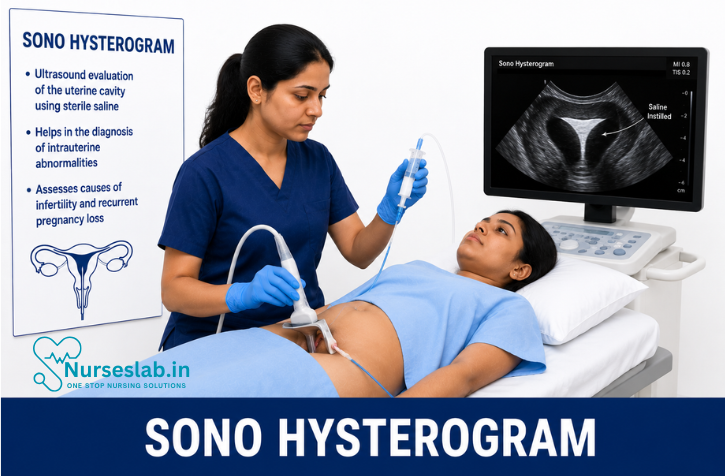
The sono hysterogram, also known as saline infusion sonohysterography (SIS), is a specialised ultrasound-based diagnostic procedure that enables detailed evaluation of the uterine cavity. By introducing sterile saline into the uterus, the procedure enhances visualisation of intrauterine structures, facilitating the identification of abnormalities that may not be apparent on conventional transvaginal sonography. The sono hysterogram has gained prominence in gynaecological practice due to its non-invasive nature, high diagnostic yield, and utility in a variety of clinical scenarios. Its importance lies in providing actionable insights for the diagnosis and management of conditions such as abnormal uterine bleeding, infertility, and suspected intrauterine pathology.
Indications
Common Clinical Scenarios
The sono hysterogram is indicated in several situations where detailed assessment of the uterine cavity is required. Common indications include:
- Abnormal uterine bleeding: To investigate causes such as polyps, submucosal fibroids, or malignancy.
- Infertility evaluation: To detect congenital anomalies, adhesions (Asherman’s syndrome), or endometrial defects that may compromise implantation.
- Recurrent pregnancy loss: To identify structural abnormalities like septate uterus or intrauterine synechiae.
- Suspected intrauterine pathology: In cases where transvaginal ultrasound suggests but does not confirm intrauterine lesions.
- Pre-IVF assessment: To ensure the uterine cavity is suitable for embryo transfer.
- Evaluation post uterine surgery: To assess healing, presence of residual tissue, or complications.
Patient Selection Criteria
Ideal candidates for the procedure are women of reproductive age with unexplained uterine symptoms, those undergoing infertility workup, or patients with abnormal findings on preliminary imaging. Proper patient selection ensures optimal diagnostic yield and minimises unnecessary intervention.
Contraindications
Absolute Contraindications
- Pregnancy: The procedure should never be performed in pregnant women due to risk to the fetus.
- Active pelvic infection: Such as pelvic inflammatory disease (PID), which may be exacerbated by instrumentation.
- Known cervical or uterine malignancy: Risk of dissemination of malignant cells.
Relative Contraindications
- Heavy menstrual bleeding: May obscure visualisation and interfere with interpretation.
- Severe cervical stenosis: Difficulty in catheter insertion.
- Late luteal phase or menstruation: Timing may affect endometrial appearance and procedural tolerance.
Preparation
Patient Preparation
Proper preparation is critical for procedural success and patient safety. Key steps include:
- Clinical assessment: Rule out pregnancy and active infection through history, examination, and laboratory tests as necessary.
- Timing: Schedule during the early proliferative phase (post-menstruation, typically days 6–10 of cycle) to ensure minimum endometrial thickness and absence of bleeding.
- Consent: Obtain informed written consent after explaining risks, benefits, alternatives, and procedural steps.
- Pre-procedure instructions: Advise on abstaining from intercourse for 24 hours prior, and emptying the bladder before the procedure.
- Analgesia: Consider prescribing non-steroidal anti-inflammatory drugs (NSAIDs) 30–60 minutes prior to minimise discomfort.
- Allergy assessment: Ascertain history of allergy to latex or antiseptics used.
Procedure Steps
Equipment and Materials
- High-frequency transvaginal ultrasound probe
- Sterile speculum and gloves
- Flexible intrauterine catheter (e.g., Foley or SIS catheter)
- Sterile normal saline (0.9%)
- Antiseptic solution for vaginal cleansing
- Syringe for saline infusion
- Light source and necessary disposables
Technique and Step-by-Step Guide
- Initial preparation: Position the patient in lithotomy position. Ensure privacy and comfort. Perform pelvic examination to assess vaginal and cervical anatomy.
- Speculum insertion: Insert a sterile speculum to visualise the cervix. Cleanse the cervix and vagina with antiseptic solution.
- Catheter placement: Gently introduce the intrauterine catheter through the cervical canal into the uterine cavity, taking care to avoid trauma.
- Speculum removal: Withdraw the speculum while leaving the catheter in place. This facilitates probe insertion and patient comfort.
- Probe insertion: Insert the transvaginal ultrasound probe. Confirm catheter tip placement within the uterine cavity.
- Saline infusion: Slowly infuse 5–10 mL of sterile saline through the catheter, distending the uterine cavity. Adjust volume as needed for optimal visualisation.
- Image acquisition: Systematically scan and record images in longitudinal and transverse planes, noting the contour, echogenicity, and presence of lesions.
- Completion: Withdraw the catheter and probe. Inspect for complications such as bleeding or discomfort.
Interpretation of Results
Normal Findings
A normal sono hysterogram reveals a smooth, regular endometrial lining with symmetric uterine cavity and no focal lesions. Saline creates an anechoic space, enhancing contrast between endometrium and myometrium.
Abnormal Findings
- Endometrial polyps: Localised echogenic masses protruding into the cavity, often with a stalk.
- Submucosal fibroids: Hypoechoic or mixed echogenic lesions causing cavity distortion.
- Intrauterine adhesions (synechiae): Linear or irregular echogenic bands traversing the cavity.
- Congenital anomalies: Septate, bicornuate, or arcuate uterus distinguished by contour and cavity division.
- Endometrial hyperplasia or malignancy: Diffuse thickening, irregular borders, or focal masses.
Interpretation should always be correlated with clinical findings and, when needed, supplemented by histopathology or further imaging.
Benefits and Diagnostic Advantages
The sono hysterogram offers several advantages over alternative modalities such as hysterosalpingography (HSG) and blind endometrial sampling:
- Non-invasive and well-tolerated: Minimal discomfort, no ionising radiation, and low risk of infection.
- High sensitivity and specificity: Superior detection of intrauterine pathology compared to standard ultrasound.
- Real-time assessment: Dynamic evaluation of cavity shape and lesion mobility.
- Cost-effective: Reduces need for more invasive or expensive procedures.
- Immediate results: Enables prompt clinical decision-making.
Risks and Complications
Potential Adverse Effects
- Discomfort and pain: Transient cramping during or after saline infusion, usually self-limited.
- Vaginal bleeding: Mild spotting can occur, particularly after catheter manipulation.
- Infection: Rare but possible, emphasising the need for strict aseptic technique.
- Vasovagal reaction: Occasional dizziness or fainting, managed by supportive care.
- Uterine perforation: Extremely rare; prevented by gentle technique and proper training.
- Allergic reaction: To antiseptics or latex, necessitating prior assessment.
Management of Complications
Most complications are minor and self-resolving. In case of persistent pain, fever, or heavy bleeding, prompt evaluation and treatment are warranted. Antibiotics may be prescribed for suspected infection, and surgical intervention is reserved for severe cases such as perforation.
Aftercare
Post-Procedure Instructions
- Observation: Monitor for immediate adverse effects such as pain or bleeding.
- Activity: Patients may resume normal activities unless otherwise instructed.
- Signs of complications: Advise to report fever, persistent pain, foul discharge, or excessive bleeding.
- Medication: NSAIDs may be continued for mild cramping.
- Follow-up: Schedule follow-up visit to discuss results and plan further management if needed.
Nursing Care of a Patient Undergoing Sono Hysterogram
Nurses play a pivotal role throughout the entire process—before, during, and after the procedure. Their responsibilities encompass patient assessment, education, psychological support, preparation, intra-procedure assistance, and post-procedure monitoring.
Pre-Procedure Nursing Care
1. Patient Assessment and Education
Before the procedure, nurses must conduct a comprehensive assessment, gathering detailed gynaecological and obstetric history. This includes menstrual cycle details, previous episodes of abnormal uterine bleeding, infertility, history of pelvic infections, known allergies (especially to latex or antiseptics), and current medications. Assessment should also screen for contraindications such as active pelvic infection, pregnancy, or hypersensitivity to procedural materials.
Patient education is paramount. Nurses should explain the purpose, steps, benefits, and possible risks of the Sono hysterogram in clear, non-technical language. Patients should be informed about how the procedure may help in diagnosing their condition and what to expect during and after the test. Visual aids, pamphlets, and native-language explanations are recommended for clarity.
2. Preparation and Consent
It is essential to ensure that the patient is scheduled during the follicular phase of her menstrual cycle, typically between days 6 and 10, to reduce the risk of infection and optimise visualisation. Nurses should instruct the patient to empty her bladder before the procedure for comfort and better imaging.
Obtaining informed consent is a legal and ethical necessity. The nurse should facilitate the process, ensuring the patient understands all aspects and has the opportunity to ask questions. In Indian settings, family members often wish to be involved; nurses should accommodate this while maintaining patient privacy and autonomy.
3. Infection Prevention and Preparation of Equipment
Strict aseptic technique is required to prevent infection. Nurses must prepare the examination room, ensuring all equipment is sterile and ready—this includes ultrasound probes, sterile saline, catheters, speculums, and gloves. Adequate lighting and privacy screens should be in place.
Instruct the patient to wear comfortable, loose-fitting clothing and provide a clean gown. The nurse should verify that necessary laboratory investigations (such as urine pregnancy test, if indicated) have been completed before proceeding.
Intra-Procedure Nursing Care
1. Patient Positioning and Comfort
During the procedure, the nurse assists the patient into the lithotomy position, ensuring comfort and modesty. In Indian healthcare environments, additional draping may be used to respect cultural norms regarding privacy. The nurse should offer reassurance throughout, explaining each step as it occurs.
2. Psychological Support and Communication
Psychological support is crucial, as many patients may feel anxious or embarrassed. Nurses should maintain a calm, supportive demeanour, encouraging the patient to express concerns. If the patient prefers, a female attendant or family member may be present in accordance with hospital policy and the patient’s wishes.
Continuous communication is vital. The nurse should keep the patient informed about sensations she may experience, such as mild cramping or discomfort during saline infusion, and reassure her that these are temporary.
3. Assisting the Physician and Monitoring
The nurse assists the physician by handing over sterile instruments, preparing saline solution, and adjusting the ultrasound equipment as needed. She must monitor the patient’s vital signs—pulse, blood pressure, and respiratory rate—before, during, and immediately after the procedure. Any signs of distress, allergic reaction, or vasovagal response should be promptly addressed.
Pain management is an integral aspect. If the patient reports significant discomfort, the nurse should notify the physician and support with non-pharmacological measures such as deep breathing or distraction techniques.
Post-Procedure Nursing Care
1. Observation and Immediate Care
After the procedure, the nurse monitors the patient for adverse reactions, such as excessive bleeding, severe abdominal pain, signs of infection, or fainting. Vital signs should be checked at regular intervals for at least 30 minutes post-procedure. The patient should be advised to rest in the recovery area until she feels well enough to leave.
2. Patient Instructions and Follow-Up
Patients should receive clear instructions regarding post-procedure care. These include monitoring for vaginal spotting, cramping, or unusual discharge, and reporting any symptoms such as fever, persistent pain, or heavy bleeding. Nurses should provide written and verbal guidance, tailored to the patient’s language and literacy level.
Advise the patient to avoid sexual intercourse, intravaginal douching, or the use of tampons for at least 48 hours post-procedure, or as per physician’s instructions. Schedule follow-up appointments as necessary and ensure the patient knows how to contact the healthcare team in case of complications.
3. Managing Complications
Nurses must be vigilant for potential complications, which, although rare, can include infection, allergic reactions, uterine perforation, or severe pain. Immediate intervention should be initiated if any of these occur, following institutional protocols. Documentation of the procedure, patient response, and any complications is essential for continuity of care.
4. Documentation
Accurate and thorough documentation is a professional responsibility. Nurses should record the patient’s history, assessment findings, informed consent, procedural details, observations, and post-procedure instructions provided. This ensures legal compliance and facilitates effective interdisciplinary communication.
Cultural and Contextual Considerations in Indian Healthcare Settings
Indian healthcare settings present unique cultural considerations. Nurses should be sensitive to issues of privacy and modesty, particularly among female patients. Use of additional draping, presence of female attendants, and ensuring that explanations are given in the patient’s preferred language are recommended.
Family involvement is common and often expected. Nurses should accommodate family members’ wishes for involvement while safeguarding the patient’s dignity and confidentiality. Respect for religious beliefs and practices, such as fasting or prayer, should also be considered in scheduling and conducting the procedure.
Awareness of local practices, dietary customs, and traditional health beliefs can influence patient compliance and comfort. Nurses should foster an environment of respect, offering culturally appropriate reassurance and support.
Conclusion
Nursing care for patients undergoing a Sono hysterogram is multifaceted, encompassing comprehensive assessment, education, procedure preparation, intra-procedure support, vigilant monitoring, and post-procedure care. In Indian healthcare settings, nurses must integrate clinical expertise with cultural sensitivity to ensure patient safety, comfort, and positive outcomes. By adhering to these guidelines, nurses contribute significantly to the diagnostic process and the overall well-being of their patients.
REFERENCES
- Johns Hopkins Medicine, Sonohysterography, https://www.hopkinsmedicine.org/health/treatment-tests-and-therapies/sonohysterography
- Kumar K, Pajai S, Baidya GR, Majhi K. Utility of Saline Infusion Sonohysterography in Gynecology: A Review Article (https://pubmed.ncbi.nlm.nih.gov/36987479/). Cureus. 2023 Feb;15(2):e35424.
- Kumar S, Nepal P, Narayanasamy S, Khandelwal A, Sapire J, Ojili V. Current update on status of saline infusion sonohysterosalpingography (https://pubmed.ncbi.nlm.nih.gov/35112137/). Abdom Radiol (NY). 2022;47(4):1435-1447.
- The American College of Obstetricians and Gynecologists. Sonohysterography (https://www.acog.org/womens-health/faqs/sonohysterography). Last reviewed 4/2023.
Stories are the threads that bind us; through them, we understand each other, grow, and heal.
JOHN NOORD
Connect with “Nurses Lab Editorial Team”
I hope you found this information helpful. Do you have any questions or comments? Kindly write in comments section. Subscribe the Blog with your email so you can stay updated on upcoming events and the latest articles.


