


Last Updated on July 10, 2026 by Nurseslab.in Editorial Team
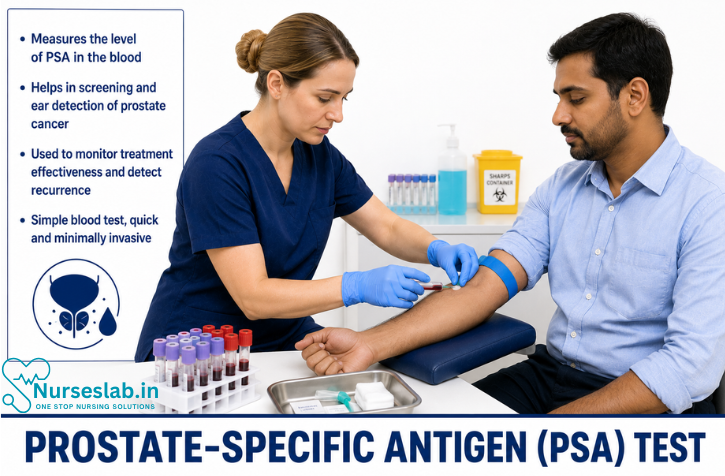
The Prostate‑Specific Antigen (PSA) test measures PSA levels in the blood to screen for prostate cancer, detect prostate disorders, and guide early diagnosis in men’s health.
Introduction
The Prostate-Specific Antigen (PSA) test is a commonly used blood test to screen for prostate issues, most notably prostate cancer, which is one of the most prevalent cancers among men globally. Globally, awareness about prostate health has been steadily increasing, yet misconceptions and lack of information still exist.
What is Prostate-Specific Antigen (PSA)?
Prostate-Specific Antigen (PSA) is a protein produced primarily by the prostate gland, a small walnut-shaped organ located below the bladder in men. The main function of the prostate is to produce seminal fluid, which nourishes and transports sperm. PSA is secreted into this fluid, but small amounts also enter the bloodstream, where they can be measured through a blood test.
While the presence of PSA in the blood is normal, elevated levels can indicate a range of prostate conditions, including benign prostatic hyperplasia (BPH), prostatitis, and prostate cancer. However, PSA levels can also increase due to non-cancerous reasons such as age, infection, or recent medical procedures involving the prostate.
Why is the PSA Test Performed?
- Screening for Prostate Cancer: The most common use of the PSA test is to screen asymptomatic men for early signs of prostate cancer, especially those with risk factors such as age above 50, family history, or certain genetic predispositions.
- Monitoring Prostate Cancer: For men diagnosed with prostate cancer, PSA testing is used to monitor the effectiveness of treatment and detect recurrence.
- Investigating Symptoms: Men with urinary symptoms such as difficulty in urination, frequent urination at night, or blood in urine may undergo PSA testing to help determine the underlying cause.
- Risk Assessment: The test can help assess the risk of developing prostate cancer in men who are at higher risk due to lifestyle or genetic factors.
PSA Test Procedure
The PSA test is a simple blood test that requires minimal preparation. A healthcare professional draws a small amount of blood from a vein, usually in the arm. The blood sample is then analysed in a laboratory to measure the concentration of PSA, typically reported in nanograms per millilitre (ng/mL).
There are two main types of PSA measured:
- Total PSA: The overall amount of PSA in the blood.
- Free PSA: The portion of PSA not bound to proteins in the blood. The ratio of free to total PSA can provide additional information, especially in cases where total PSA is moderately elevated.
Understanding PSA Test Results
Interpreting PSA test results is nuanced and must be done in the context of individual health profiles and risk factors. Generally, the following reference ranges are used:
| Age Group (years) | Normal PSA Range (ng/mL) |
| 40–49 | 0–2.5 |
| 50–59 | 0–3.5 |
| 60–69 | 0–4.5 |
| 70–79 | 0–6.5 |
It is important to note that these ranges are only guidelines. Some men with PSA levels below the upper limit may still have prostate cancer, while others with higher levels may not. Factors influencing PSA levels include:
- Age (PSA levels tend to rise as men get older)
- Prostate size (larger prostates produce more PSA)
- Recent ejaculation (can temporarily increase PSA)
- Prostate infection or inflammation
- Recent prostate manipulation (e.g., digital rectal exam, catheterisation)
PSA Test and Prostate Cancer
PSA testing has become an essential tool in the early detection of prostate cancer. Elevated PSA levels may prompt further investigations such as a digital rectal examination (DRE), imaging studies, or a prostate biopsy. However, PSA is not a cancer-specific marker; non-cancerous conditions can also elevate PSA. As a result, the test is best used as part of a broader assessment rather than a standalone diagnostic tool.
In India, prostate cancer is the second most common cancer among men in metropolitan cities, with increasing incidence due to rising life expectancy and improved diagnostic facilities. Early detection through PSA testing can lead to better outcomes, as prostate cancer is often slow-growing and more amenable to treatment when caught early.
Benefits of PSA Testing
- Early Detection: PSA testing can help identify prostate cancer at an early, potentially curable stage, even before symptoms appear.
- Monitoring: The test is invaluable in tracking the progress of prostate cancer and the efficacy of treatment.
- Risk Stratification: Helps in identifying men at higher risk who may benefit from closer surveillance or preventive interventions.
- Peace of Mind: For many men, a normal PSA result offers reassurance regarding their prostate health.
Limitations and Controversies
Despite its widespread use, the PSA test has several limitations and remains a subject of controversy in the medical community:
- False Positives: Elevated PSA levels do not always indicate cancer, leading to unnecessary anxiety and further invasive testing.
- False Negatives: Some men with prostate cancer have normal PSA levels, potentially delaying diagnosis.
- Overdiagnosis and Overtreatment: PSA testing can detect slow-growing cancers that may never cause harm, leading to treatments that carry risks such as incontinence and impotence.
- Lack of Specificity: PSA is not specific to cancer; benign conditions like BPH and prostatitis can also raise PSA levels.
- Impact on Quality of Life: The psychological effects of a positive PSA test and subsequent procedures can be significant.
Who Should Get a PSA Test?
Deciding whether to undergo PSA testing is a personal choice that should be made in consultation with a healthcare provider. Key considerations include:
- Age: Men above 50 years are generally considered for routine screening. Those with a family history of prostate cancer may start earlier, around 40–45 years.
- Family History: Men with first-degree relatives (father, brother) who have had prostate cancer are at increased risk.
- Ethnicity: Certain ethnic groups, such as African-Caribbean men, have a higher risk, but data on Indian populations is still emerging.
- Existing Symptoms: Men experiencing urinary symptoms should discuss PSA testing with their doctor, regardless of age.
The Indian Urological Society and international guidelines recommend shared decision-making, where the risks and benefits are discussed before testing.
Preparing for a PSA Test
To ensure accurate results, certain precautions should be taken before the PSA test:
- Avoid ejaculation for at least 24–48 hours before the test.
- Refrain from vigorous exercise, especially cycling, which can temporarily raise PSA.
- Inform your doctor about any urinary tract infections or recent procedures involving the prostate.
- Medications such as finasteride or dutasteride, used for BPH, can lower PSA levels and should be reported to the healthcare provider.
What Happens After the Test?
After the blood sample is collected, results are typically available within a few days. The doctor will interpret the results in conjunction with medical history, physical examination, and risk factors. If PSA levels are elevated, possible next steps include:
- Repeating the test to confirm results.
- Performing a digital rectal examination (DRE).
- Imaging studies such as ultrasound or MRI.
- Prostate biopsy to confirm the presence of cancerous cells.
It is crucial to remember that a high PSA does not automatically mean cancer. Many men with elevated PSA will not have prostate cancer, and some with normal levels may still have the disease. Therefore, follow-up and further testing are essential for accurate diagnosis.
Nursing Care Guidelines for Patients Undergoing PSA Test
Nurses not only perform procedural responsibilities but also provide psychological support, education, and advocacy, making them key facilitators in the continuum of prostate health care.
Pre-Test Nursing Responsibilities
1. Patient Identification and Verification
Accurate patient identification is the foundation of safe and effective care. Nurses must verify the patient’s identity using at least two identifiers, such as full name and hospital registration number, as per institutional policy. This step helps prevent errors and builds patient trust, particularly in busy outpatient or community health settings.
2. Patient Education and Informed Consent
Before the PSA test, nurses should provide clear, concise information about the purpose, procedure, and significance of the test. Use simple language, avoiding medical jargon, and ensure the patient understands the need for the test, especially if he is asymptomatic. Explain that the PSA test involves a blood sample and does not cause pain or long-term discomfort.
It is important to discuss potential outcomes and what the results might indicate, emphasising that the test is a screening tool, not a definitive diagnosis of cancer. Obtain informed consent after addressing any questions or concerns. In Indian settings, involving family members in the discussion—when appropriate and with the patient’s permission—can help alleviate anxiety and foster collaborative decision-making.
3. Pre-Test Preparation
Nurses should ensure that patients are aware of any necessary preparations. Advise patients to avoid ejaculation, vigorous exercise, or prostate manipulation (such as digital rectal examination) for at least 24–48 hours prior to the test, as these can influence PSA levels. Confirm whether the patient is on any medications, such as 5-alpha-reductase inhibitors or herbal supplements, which may affect results.
Assess for any bleeding disorders or anticoagulant therapy, as these may require special precautions during venepuncture. Instruct the patient to inform the nurse of any symptoms such as urinary tract infection or recent urinary retention, as these conditions can also impact PSA readings.
4. Cultural Considerations
In India, cultural beliefs about masculinity, cancer, and medical procedures can affect a patient’s willingness to undergo the PSA test. Nurses should demonstrate sensitivity by respecting religious practices, modesty concerns, and family dynamics. Use the patient’s preferred language wherever possible, and provide printed or visual educational materials in regional languages to enhance understanding. Recognise that some patients may feel embarrassed or anxious about discussing prostate health; approach such topics with empathy and discretion.
During Test Support
1. Comfort Measures
During the blood collection procedure, ensure the patient is seated or lying comfortably. Reassure him throughout the process, explaining each step, such as tourniquet application and needle insertion. Use a gentle approach to minimise discomfort, and employ distraction techniques if the patient is anxious or fearful of needles.
2. Monitoring and Safety
Observe the patient for signs of distress, dizziness, or fainting, particularly if he has a history of vasovagal reactions. Maintain aseptic technique to prevent infection, and use appropriate gauge needles to minimise trauma. After blood collection, apply gentle pressure to the puncture site and observe for any bleeding or haematoma formation.
3. Communication and Dignity
Maintain clear and respectful communication throughout the procedure. Address the patient by his preferred name or title, and explain the next steps after the sample is collected. Ensure privacy and dignity, especially in busy or shared clinical environments. If family members are present, involve them appropriately in the process, respecting patient confidentiality at all times.
Post-Test Care
1. Immediate Observation
After the test, observe the patient for a few minutes to ensure he does not experience any adverse reactions such as bleeding, bruising, or dizziness. Provide a clean cotton swab or bandage at the puncture site, and instruct the patient to keep the area clean and dry for a few hours.
2. Patient Guidance and Next Steps
Inform the patient about when and how the test results will be communicated. Advise him to resume normal activities unless otherwise directed. If the patient expresses concern or anxiety about the results, offer reassurance and explain that further evaluation may be needed only if PSA levels are elevated.
3. Emotional Support
Acknowledge the emotional impact that waiting for test results may have. Some patients may worry about the possibility of cancer or feel apprehensive about further investigations. Offer empathetic listening, encourage questions, and provide information about support resources, such as counselling or patient support groups, if available.
Patient Education
Patient education is an ongoing responsibility. After the PSA test, nurses should explain the meaning of the results in clear, non-technical terms. For example, a mildly elevated PSA does not always indicate cancer; it may be due to benign conditions or temporary factors. Encourage patients to discuss the results with their doctor and to attend follow-up appointments as advised.
Address common myths or misconceptions about prostate health and cancer, using culturally relevant examples where appropriate. Provide written instructions or educational pamphlets in the patient’s preferred language, and encourage family involvement in understanding the care plan.
Advise on lifestyle factors that support prostate health, such as a balanced diet, regular exercise, and avoiding tobacco. Inform patients about the importance of regular screening, especially if they have risk factors such as a family history of prostate cancer.
Cultural Sensitivity in Nursing Care
Cultural sensitivity is essential for effective communication and patient trust. In Indian settings, respect for elders, family involvement in health decisions, and religious beliefs can influence patient attitudes towards the PSA test. Nurses should ask about and accommodate dietary restrictions, prayer times, and preferences for male or female caregivers where feasible.
Use interpreters or multilingual staff if language barriers exist. Recognise that some patients may prefer to have family members present during discussions or procedures. Always seek the patient’s consent before involving others, and respect his wishes regarding privacy and disclosure.
Holistic Support: Psychological, Physical, and Social Aspects
Holistic nursing care addresses not only the physical aspects of the PSA test but also the psychological and social needs of patients. Assess for signs of anxiety, depression, or social isolation, especially in older adults who may lack family support. Offer information about community resources, peer support groups, or helplines for patients who require additional assistance.
Encourage open dialogue about prostate health, sexuality, and ageing, recognising that these topics may be sensitive in Indian society. Provide a safe and non-judgemental environment where patients feel comfortable sharing their concerns. Collaborate with other healthcare professionals, such as counsellors, social workers, or dietitians, to deliver comprehensive care.
REFERENCES
- Hackshaw-McGeagh L, Lane JA, Persad R, et al. Prostate Cancer — Evidence of Exercise and Nutrition Trial (PrEvENT): Study Protocol for a Randomised Controlled Feasibility Trial (https://www.ncbi.nlm.nih.gov/pmc/articles/PMC4780152/). Trials. 2016 Mar 7;17(1):123.
- Liu X, Wang J, Zhang SX, et al. Reference Ranges of Age-Related Prostate-Specific Antigen in Men without Cancer from Beijing Area (https://www.ncbi.nlm.nih.gov/pmc/articles/PMC4499062/). Iran J Public Health. 2013 Nov;42(11):1216-22.
- National Cancer Institute (U.S.). Prostate-Specific Antigen (PSA) Test (https://www.cancer.gov/types/prostate/psa-fact-sheet). Last reviewed 3/11/2022.
- National Health Service (U.K.). Should I Have a PSA Test (https://www.nhs.uk/conditions/prostate-cancer/should-i-have-psa-test/)? Last reviewed 10/18/2021.
- National Library of Medicine (U.S.). Prostate-Specific Antigen (PSA) Test https://medlineplus.gov/lab-tests/prostate-specific-antigen-psa-test/. Last updated 8/31/2022.
- Weight CJ, Kim SP, Jacobson DJ, et al. Men (Aged 40-49 years) with a Single Baseline Prostate-Specific Antigen below 1.0 ng/mL Have a Very Low Long-Term Risk of Prostate Cancer: Results from a Prospectively Screened Population Cohort (https://www.ncbi.nlm.nih.gov/pmc/articles/PMC4029421/). Urology. 2013 Dec;82(6):1211-7.
Stories are the threads that bind us; through them, we understand each other, grow, and heal.
JOHN NOORD
Connect with “Nurses Lab Editorial Team”
I hope you found this information helpful. Do you have any questions or comments? Kindly write in comments section. Subscribe the Blog with your email so you can stay updated on upcoming events and the latest articles.


