


Last Updated on November 8, 2026 by Nurseslab Author
Learn why compliance is important in healthcare and how nurses support patient safety, privacy, ethical practice, documentation, and regulatory standards.
What compliance actually means in healthcare
Healthcare compliance is the system by which an organisation — and every clinician within it — meets the legal, regulatory, professional, and ethical requirements that govern patient care.
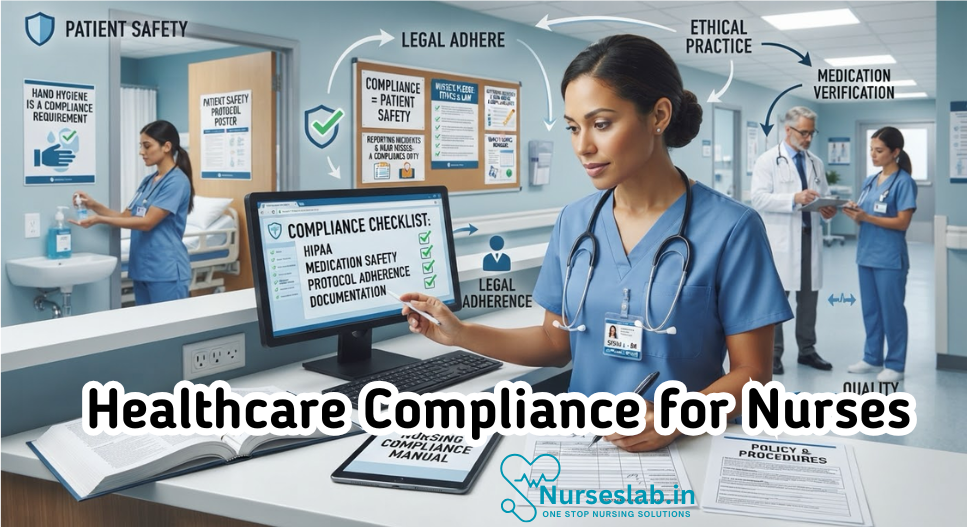
In practice it spans several distinct layers, and conflating them is the source of much confusion:
| Layer | Set by | Examples |
|---|---|---|
| Statutory law | National or state legislature | Data protection law, mandatory reporting statutes, controlled substances law |
| Regulatory requirements | Government agencies and payers | Conditions of participation for public funding, licensing inspections |
| Accreditation standards | Accrediting bodies | The Joint Commission, JCI, NABH, national accreditation schemes |
| Professional regulation | Nursing councils and boards | Licensure, scope of practice, codes of conduct |
| Organisational policy | Your employer | Local protocols, documentation standards, sanctions policies |
Each layer can discipline you, and they operate independently. An action can be permitted by your employer’s policy and still breach your nursing council’s code. A practice can be technically legal and still cost you accreditation. The most common error nurses make is assuming that “my manager said it was fine” settles the question. It does not — your licence is regulated by a body that does not employ your manager.
Why compliance matters: six reasons that hold up
1. The rules exist because people were harmed
Nearly every compliance requirement in healthcare is a scar. Hand hygiene protocols, surgical site marking, two-person verification for high-risk medications, restraint documentation time limits, barcode medication administration — each traces back to identifiable patients who were harmed in identifiable ways.
This matters for motivation. A requirement that looks arbitrary usually looks that way because you did not witness the event that produced it. Site marking seems excessive until you have seen a wrong-side procedure.
2. It protects your licence
This is the reason that should matter most to an individual nurse, and it is the one least emphasised in compliance training.
Your employer can be fined. Your employer cannot lose your licence for you — but a regulatory body can, and compliance breaches are a common route there. Documentation failures, scope-of-practice violations, medication errors involving protocol deviation, and privacy breaches all routinely reach nursing boards and councils.
Serious breaches, particularly those involving gross misconduct, may be reported to the board of nursing, with direct consequences for licensure. The employment consequence and the licensure consequence are separate processes with separate outcomes. You can keep your job and lose your licence. You can lose your job and keep your licence. Both can happen at once.
3. Documentation compliance is your defence
Here is the reframe that changes how nurses feel about charting.
In any adverse event review, complaint investigation, or legal proceeding, the record is the primary evidence of what you did. Care that was delivered but not documented is, for practical purposes, care you cannot prove you delivered.
This cuts both ways, which is exactly why it matters:
- Documented assessment, escalation, and response protects you when an outcome was poor despite appropriate care
- An unexplained gap — a high early warning score with no corresponding assessment, a reported symptom with no follow-up entry — is extremely difficult to defend
Nurses often experience documentation standards as bureaucratic. They are also the single best professional protection most nurses have.
4. Organisational survival and funding
Accreditation and regulatory compliance determine whether institutions can operate and get paid. Loss of accreditation, funding eligibility, or licensing has consequences that reach every nurse in the building — through budgets, staffing, equipment, and in extreme cases closure.
5. Public trust
Healthcare runs on a permission that patients extend reluctantly: to be examined, undressed, questioned about private matters, and to have all of it recorded. Compliance frameworks are the formal guarantee that this permission will not be abused. Each publicised breach withdraws a little of that permission from every clinician, not only the one responsible.
6. Equity and consistency
Standardised requirements reduce the variation that produces unequal care. A protocol applied consistently is harder to apply differently to a patient who is poor, who does not speak the dominant language, or who is not advocating loudly for themselves.
The compliance domains nurses touch every shift
Patient privacy and data protection
The most common source of nurse-specific disciplinary action. Covered in full below.
Documentation and record integrity
- Contemporaneous entries — document when care is given, not retrospectively in bulk
- Accuracy and objectivity — record what you observed, not what you assume
- Corrections made transparently; never alter a record to conceal an error. Altering records converts a defensible clinical mistake into indefensible misconduct, and it is one of the few things that ends careers almost automatically
- Signatures, timestamps, and attribution
- Never document care you did not personally deliver or witness
Scope of practice and licensure
- Practise only within your licence, your training, and your institution’s authorisation
- Maintain current registration and mandatory continuing education
- Know your jurisdiction’s delegation rules — what you may delegate, to whom, and what accountability you retain
- Be particularly careful where local custom exceeds formal scope. “Everyone on this unit does it” is not a legal defence
Medication management
- Rights of administration, independent double-checks for high-risk drugs
- Controlled substance accounting, witnessed wastage, discrepancy reporting
- Verification of orders, including clarification of unclear or inappropriate orders — an obligation, not an option
- Allergy and contraindication checks, including class-level contraindications
Infection prevention and control
- Hand hygiene, PPE, isolation precautions, sharps and waste handling
- Device-related infection bundles
- Outbreak reporting and surveillance cooperation
Consent
- Confirm that valid consent exists before procedures within your role
- Know the difference between your role in witnessing consent and the clinician’s obligation to obtain it after disclosure
- Capacity, surrogate decision-making, and the handling of refusal
- Interpreter provision where language is a barrier — consent obtained through an untrained family member is frequently not valid consent
Mandatory reporting
Obligations vary by jurisdiction and are not optional where they apply:
- Suspected abuse or neglect of children, older people, and vulnerable adults
- Notifiable communicable diseases
- Certain injuries, deaths, and medico-legal cases
- Impaired or unsafe practice by colleagues
Incident and adverse event reporting
- Report errors, near misses, equipment failures, and safety hazards through the formal system
- Near misses matter most, because they reveal system vulnerabilities before anyone is harmed
- Failing to report a known incident is frequently treated more seriously than the incident itself
Billing integrity
Nurses rarely bill directly, but nursing documentation substantiates charges. Documenting care at a level above what was delivered, or recording interventions that did not occur, can constitute fraud regardless of intent. If asked to document in ways that do not reflect reality, that instruction is the problem — escalate it.
Workplace safety and violence reporting
Increasingly a regulated domain in its own right, with mandatory reporting systems, investigation requirements, and anti-retaliation protections appearing in a growing number of jurisdictions.
What changed in 2026: the accreditation shift
If you work in a Joint Commission–accredited organisation, 2026 brought the most significant structural change in years.
National Performance Goals (NPGs) replaced the National Patient Safety Goals for hospital and critical access hospital accreditation, effective 1 January 2026. There are 14 NPGs, each with Elements of Performance, and many are tied directly to Medicare Conditions of Participation. Hospitals surveyed on or after that date are held to them.
This sits inside Accreditation 360, the Joint Commission’s broader overhaul, which removed more than 700 requirements in favour of a streamlined structure.
The item nurses should know specifically is NPG 12, which requires that a hospital be “staffed to meet the needs of the patients it serves” and that “staff are competent to provide safe, quality care.”
That is a notable development. Nurse staffing has historically been treated as a budgetary matter rather than an accreditation standard. Framing it as a performance goal with elements of performance attached makes staffing adequacy a compliance question — which means it can be surveyed, documented, and cited.
Privacy: the domain that ends nursing careers
More nurses face discipline over patient privacy than any other compliance area, and the reason is structural — privacy breaches are easy to commit, easy to detect, and leave permanent evidence.
How nurses actually breach privacy
Drawn from documented patterns, the recurring ones are:
- Accessing records of patients you are not caring for. Curiosity about a colleague, a neighbour, a family member, a local celebrity, an ex-partner. Every access is logged with your credentials, a timestamp, and the record viewed. Audit systems find this routinely.
- Discussing patients where they can be identified — corridors, lifts, cafeterias, or with family and friends
- Posting on social media, including in closed or private groups. A private group is not a private conversation
- Sharing patient photos or videos through messaging applications
- Sharing login credentials, which makes you accountable for everything done under them
- Leaving records visible — unlocked screens, printed handovers, whiteboards
- Improper disposal of documents containing patient information
- Taking patient information to a new employer
What the consequences actually look like
Four separate tracks, which can run simultaneously:
- Employer sanctions. Organisations are required to maintain sanctions policies, typically with three or four tiers — from verbal warning and retraining for minor accidental breaches through written warnings, suspension, and termination for repeated or serious ones.
- Licensure referral. Serious breaches, particularly gross misconduct, may be reported to the nursing board or council.
- Civil enforcement through the relevant regulator.
- Criminal prosecution. Knowing, wrongful acquisition or disclosure of patient information under false pretences, or for personal gain, commercial advantage, or malicious intent, can be a felony offence. Theft of patient information for financial gain can carry up to ten years’ imprisonment, though prosecutions of individual clinicians are rare.
Real cases worth knowing
- 2016: a nursing assistant was dismissed and sentenced to 30 days in jail after sharing videos and photographs of a patient with Alzheimer’s disease being abused on Snapchat.
- A ProPublica investigation identified 35 separate cases of nurses sharing patient photographs on Snapchat, and a further report documented more than fifty patient privacy violations in nursing homes and assisted living facilities.
- May 2025: a nurse was dismissed and placed under investigation by a state board of nursing after livestreaming a medication pass on TikTok. No patient names were spoken — but patient information was visible in the background.
That last case is the one to remember, because it describes an error any nurse could make. The nurse was not malicious and did not name anyone. The breach was in the frame of the shot.
The practical rule: if a photograph, video, or livestream is taken anywhere a patient, a screen, a whiteboard, a chart, or an identifiable room could appear, assume it is a breach. There is no clinical reason to film during a medication pass.
And one detail that catches people out
Failing to report even a minor breach can carry consequences greater than the breach itself. If you accidentally access the wrong record, send information to the wrong recipient, or lose a handover sheet, report it immediately. Self-reported accidental breaches are usually managed with retraining. Discovered, unreported breaches are treated as concealment.
The international picture: same principles, different instruments
The specific statutes differ by country. The obligations they impose on nurses are remarkably consistent.
India: the DPDP Act and NABH
India’s Digital Personal Data Protection Act, 2023 brought hospital data handling under a general data protection regime, with penalties for non-compliance reaching up to ₹250 crore. Its requirements map directly onto daily nursing practice:
- Patient data may be accessed or shared only with explicit patient consent or under specific legal authority
- Patients have rights to access and correct their data
- Requests from patients, clinicians, or government agencies must follow uniform, transparent processes, with disclosures tracked and timestamped
- Role-based access control limits each user to the data their role requires
- Access must be logged, and inappropriate access must be traceable and open to disciplinary or legal review
- Staff require regular training in EHR use, secure data handling, and compliance
NABH accreditation standards add digital health requirements: centralised secured electronic records with encryption, multi-factor authentication, time-stamped entries, access logs, and backup and recovery protocols — plus strict controls for sensitive records such as medico-legal cases and termination-of-pregnancy records, including encrypted storage and tracked disclosures.
Hospitals seeking accreditation must satisfy NABH guidelines and comply with the DPDP Act — two layers, as described earlier, operating simultaneously.
One further detail with real clinical consequence: under the Bharatiya Sakshya Adhiniyam, 2023, scanned or digital records are admissible as evidence only if specific conditions are met, including certificates of authenticity. Record integrity is therefore not only a privacy matter but an evidentiary one.
The transferable principle
Whether the instrument is HIPAA, the GDPR, the DPDP Act, or a Gulf health authority’s data regulation, four obligations recur everywhere:
- Access only what your role requires — the minimum necessary principle
- Disclose only with consent or lawful authority
- Assume every access is logged and attributable to you
- Report breaches immediately
Learn those four and you are substantially compliant in any jurisdiction. The details change; the structure does not.
Practical compliance habits for daily practice
Small behaviours, disproportionate protection:
- Lock the screen every time you step away. Every time
- Never use another person’s credentials, and never lend yours — including to a colleague in a hurry
- Do not open a record unless that patient is your clinical responsibility. If you must for a legitimate reason, document why
- Document contemporaneously. Retrospective bulk charting is both less accurate and less defensible
- Correct errors transparently using the approved method; never overwrite or conceal
- Clarify unclear or concerning orders in writing and record the clarification
- Report every incident and near miss, including your own
- Keep your registration, mandatory training, and competencies current — and keep your own copies, not just the employer’s
- Do not photograph anything in a clinical area
- Discuss patients only where they cannot be identified or overheard
- Know where your policies actually live and read the one that applies before you need it
- Document staffing and resource concerns through formal channels, not only verbally
When you see non-compliance
Nurses are frequently the first to see unsafe or non-compliant practice, and the least sure what to do about it.
A workable escalation sequence:
- Address it immediately if a patient is at risk. Stop the line. This is within every nurse’s authority and is an expectation, not an overreach.
- Raise it with the person directly where it is safe and appropriate to do so — many breaches are inadvertent.
- Escalate to your immediate supervisor, and put it in writing. Verbal reports evaporate.
- Use the formal reporting system — incident reporting, compliance hotline, or patient safety channel. Most organisations are required to provide one.
- Escalate beyond the line — to a compliance officer, quality department, or accreditation contact — if the issue is unresolved or implicates your supervisor.
- Escalate externally — to the regulator, nursing council, or accrediting body — where internal channels have failed and patients remain at risk.
On documentation: keep your own dated, factual note of what you observed and what you reported. Not an accusatory file — a record. Memory degrades and staff move on.
On retaliation: many jurisdictions provide whistleblower and anti-retaliation protections for good-faith reporting of safety and compliance concerns, and several of the newer workplace safety statutes make this explicit. Know whether yours does before you need to rely on it.
And the uncomfortable part: reporting an impaired or unsafe colleague is one of the hardest things in nursing practice, and in most jurisdictions it is also an obligation. The framing that helps is that the alternative to reporting is not protecting your colleague — it is waiting for a patient to be harmed before anyone acts.
Common misconceptions
“If my manager approves it, I’m covered.” Your employer and your licensing body are separate authorities with separate powers.
“I didn’t mean any harm, so it isn’t a violation.” Intent affects the penalty, not whether a breach occurred. Many privacy and documentation breaches require no bad intent at all.
“Nobody will know I looked at that record.” Every access is logged, attributed, and timestamped. Audit tools are designed to find exactly this.
“It’s a closed group, so it’s private.” It is not.
“Compliance is the compliance department’s job.” The compliance department builds the framework. Clinicians execute it, and clinicians are the ones named when it fails.
“If I report an error I’ll be punished.” Self-reported errors are generally handled far more favourably than discovered ones. Non-reporting is the greater exposure.
“The policy is unrealistic, so everyone ignores it.” Sometimes accurate — and the correct response is to challenge the policy formally, not to deviate silently. A policy that every nurse quietly violates is a system failure worth escalating in writing.
For nurse leaders and educators
Three things determine whether compliance functions as safety or as theatre on a unit:
Make the reasoning visible. Nurses comply willingly with rules whose purpose they understand. Teach the harm event behind the requirement, not just the requirement.
Close the loop on reports. Nurses stop reporting when reports disappear. Feeding aggregated incident data and resulting changes back to the floor is the single most effective way to sustain a reporting culture.
Distinguish honest error from misconduct, loudly and consistently. A unit that punishes self-reported mistakes will stop hearing about them — and will keep having them, invisibly. The things that genuinely warrant severe response are narrow and should be named explicitly: falsifying records, deliberate privacy breaches, practising impaired, concealment.
REFERENCES
- Health Data and the DPDP Act: Navigating India’s Healthcare Privacy Frontier — Mondaq
- The Joint Commission’s New Nursing Requirements Effective January 2026 — Norton Rose Fulbright
- Joint Commission to cut more than 700 hospital standards in accreditation overhaul — Fierce Healthcare
- What Happens When a Nurse Violates HIPAA? — HIPAA Journal
- Examples of HIPAA Violations by Nurses: Risks, Penalties, and Prevention — Accountable
- The Digital Shift: How NABH and DPDP Acts Are Shaping Healthcare Compliance — India Law
Stories are the threads that bind us; through them, we understand each other, grow, and heal.
JOHN NOORD
Connect with “Nurses Lab Editorial Team”
I hope you found this information helpful. Do you have any questions or comments? Kindly write in comments section. Subscribe the Blog with your email so you can stay updated on upcoming events and the latest articles.


