


Last Updated on January 13, 2026 by Nurseslab.in Editorial Team
In nursing, veracity is an ethical principle of honesty and truthfulness. For healthcare professionals, this includes being honest about a patient’s diagnosis, prognosis, treatment options, and the risks and benefits of those options.

It also includes being honest about mistakes that are made and avoiding any form of deception or manipulation. Veracity is the binding principle between patients and nurses. Veracity protects patients from harm.
Within the context of nursing ethics, veracity is tethered to trust. For patients, trust allows open and honest dialogue with their nurses, which can lead to better outcomes. It entails an unwavering commitment to convey truthful information that fosters a transparent relationship between the patient and the nurse. Veracity demands honesty even when faced with complex and challenging scenarios.
Nursing Code of Ethics
The nursing code of ethics dictates the highest standards of decision-making and moral imperatives to ensure patients receive competent, compassionate, and ethical care. The code of ethics is not a legal document but a guide. But before we delve into a nurse’s ethical obligations, take time to reflect on your personal healthcare journey.
You will realize that veracity has been a cornerstone of your practice. Your career was built on a culture of trust, respect, and dignity, minimizing the gap between provider and patient, thus enhancing the quality of the care you deliver.
The art of nursing intertwines our ethical obligations with a framework of holistic and compassionate care. Upholding veracity is more than meeting a professional standard, but transcending to a personal level, grounding a nurse’s approach to healthcare in empathy, respect, and honesty.
A steadfast commitment to veracity transforms a nurse into a leader, an advocate, and a symbol of integrity within the healthcare sector. Veracity is not a singular event, but a continuous journey in fostering a healthcare environment that is safe and respectful, truthful, and just. Veracity is more than an ethical obligation; it is a commitment to uphold the truth, ensuring that the dignity and autonomy of every individual is respected, delineating a path that is both righteous and honourable.
Importance of Veracity in Nursing
Veracity is often described as the tie that binds patients and clinicians as they establish relationships and develop treatment plans. There are several reasons why veracity in nursing is essential for patient care. The following are the reasons nurses should demonstrate veracity in daily practice.

1. Demonstrates respect for patients.
Veracity is one of the basic ethical and moral societal principles. When nurses practice veracity, they demonstrate respect for their patients and their right to be treated equally and fairly.
2. Promotes the patient’s right to autonomy.
Patient autonomy is the right of competent adults to make decisions about their medical care. When nurses are honest, they give patients the information they need to choose their care. Exercising patient autonomy helps patients feel more confident in their decision-making abilities. They feel in control of their rights to choose treatment plans, physicians, and make educated decisions.
3. Honesty strengthens nurse-patient relationships.
Patients who have strong relationships with their nurses are more likely to be open about questions, concerns, or issues related to their illness or treatment plans. Their openness makes it easier for nurses to gauge what is or is not working for patients and modify their care plans if needed, which can improve the patient’s health outcome.
4. Promotes honesty from patients.
Veracity binds and strengthens nurse-patient relationships and is essential as patients and healthcare teams seek to establish achievable treatment goals. When patients feel nurses are honest with them, it encourages honesty from the patient to the nurse, which makes it easier to determine a patient’s status and set realistic goals to promote positive outcomes.
5. Essential for strong team building.
No matter what profession a person pursues, professional relationships are stronger when honesty and integrity are demonstrated. Nursing is no different. In fact, the strongest nursing teams demonstrate veracity with patients and one another.
Consequences of Lack of Veracity in Nursing
While the principle of veracity is not a law, it is considered an ethical principle of nursing. Violating ethical principles, including veracity can have severe consequences. Veracity means being completely truthful with clients, families, and coworkers. Nurses should demonstrate veracity, even if the truth may lead to patient distress or anxiety. The following are examples of possible consequences that result from a lack of veracity in nursing.
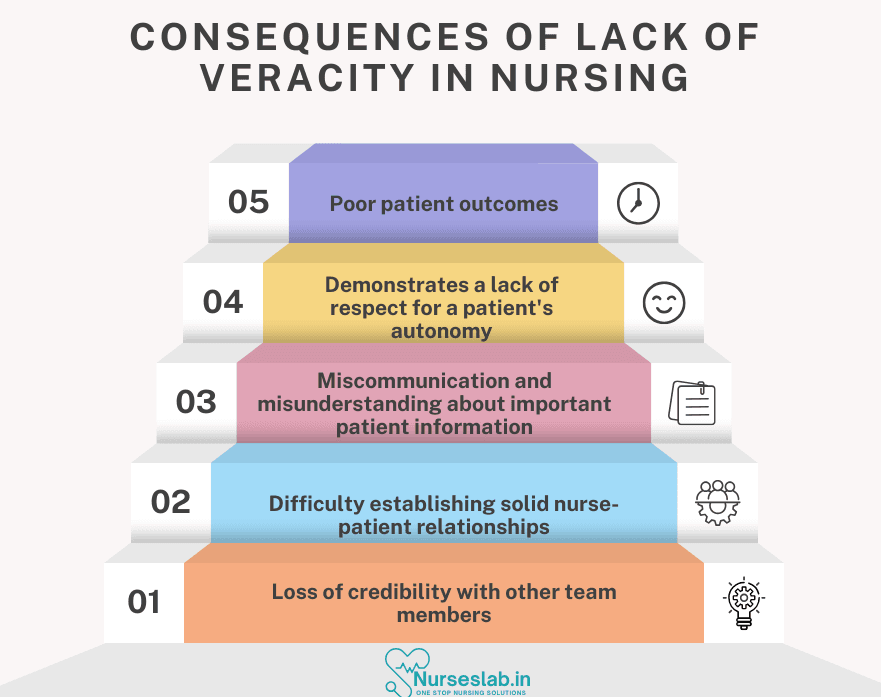
1. Loss of credibility with other team members:
The role of nurses is to provide high-quality patient care, and it takes teamwork to get things done. When nurses are dishonest, it creates an unhealthy work environment including a loss of respect and credibility. Unfortunately, the loss of credibility among team members affects the level of care patients receive and can negatively impact patient outcomes.
2. Difficulty establishing solid nurse-patient relationships:
Illness and disease can leave patients feeling vulnerable. In addition to having a strong non-medical support system, patients need to establish trusting relationships with nurses and other healthcare members. When there is a lack of veracity in nursing, patients often question whether nurses genuinely care for them and have their best interests at heart. As patients examine motives and intent, it can result in the deterioration of otherwise strong nurse-patient relationships.
3. Miscommunication and misunderstanding about important patient information:
When nurses withhold essential information or cloak the truth about a patient’s status with medical jargon the patient or family does not understand, it can lead to patients making misinformed decisions about healthcare.
4. Demonstrates a lack of respect for a patient’s autonomy.
Veracity is a foundation of truthfulness founded on respect for a patient’s individuality and autonomy. When nurses fail to practice veracity, there is a breakdown in the patient’s right to independent decision-making, negatively impacting nurse-patient relationships and patient outcomes.
5. Poor patient outcomes:
The lack of veracity in nursing can have far-reaching consequences related to patient care and outcomes. Patients who feel nurses are not forthcoming or are withholding pertinent information find it difficult to trust, creating communication barriers. Poor communication often leads to improper or incomplete nursing care plans and failed patient compliance, which leads to poor patient outcomes.
Ethical principles that serve as the moral underpinnings for the Code.
The American Nurses Association (ANA) Code of Ethics for Nurses is a set of ethical principles that guide nurses in their practice. The Code of Ethics includes the following ethical obligations:

1. Accountability
To be accountable as a nurse means to take responsibility for your actions and inactions— both professionally and personally. In order to take responsibility for one’s actions, a nurse must be honest and tell the truth.
Veracity, or truth-telling, often applies to a nurse’s personal life as well since many states require nurses to be accountable and self-report their personal actions outside of work such as being convicted.
2. Autonomy
Autonomy in nursing means that patients have the right to make choices about their health care and life, based on their personal values and beliefs.
Even though a nurse may not always agree with their patients’ choices, the nurse is obligated to not interfere with a patient’s right to make their own decisions, regardless of the potential consequences.
3. Beneficence
Nurses demonstrate the principle of beneficence through actions that demonstrate compassion and their desire to do what’s good for their patients.
4. Fidelity
The principle of fidelity refers to nurses being loyal and committed to their patient’s well-being first and foremost above all other interests. This loyalty and commitment are essential for nurses to be able to establish a trusting and caring relationship with their patients.
5. Justice
Justice means being impartial and fair. Nurses making impartial medical decisions demonstrate this, whether it relates to limited resources or new treatments regardless of economic status, ethnicity, sexual orientation, etc.
Being fair and impartial with patients also requires that a nurse practice veracity and tell the truth, regardless of whether they agree with the potential outcome or not.
6. Nonmaleficence
Nonmaleficence means to “do no harm” and is based on the Hippocratic Oath. It promises that a nurse will not cause any injury to their patients, physically or otherwise. This requires that nurses do everything in their power to protect their patients from anything that could harm them physically or in any other way.
Examples of Veracity in Nursing
As a nurse, it is imperative to ensure that patients receive the best medical care possible and are fully aware of all options available. The following are some examples to ensure that veracity is being maintained:
- Ensuring that patients receive comprehensive and truthful information before consenting to a procedure. By doing so, the nurse respects their autonomy and promotes a relationship built on trust.
- Being honest about a difficult diagnosis and helping to prepare the patient and their family to make informed decisions, while emphasizing the necessity of being truthful even in difficult circumstances.
- Being compelled to admit mistakes and with transparency, focusing on the corrective measures and learning from the errors to prevent future occurrences.
- You are caring for a patient who is dying. The patient asks you if they are going to die. You tell the truth, even though the conversation is difficult.
- You are caring for a patient who is allergic to a certain medication. You make sure to check the patient’s chart before administering any medication, to avoid harmful medication errors.
“Doing no harm” to patients also requires a nurse to not purposely withhold information from a patient and to tell patients the truth (veracity) about their medical conditions, treatments, and potential side effects of medications and outcomes of treatments.
REFERENCES
- Darby Faubion, Veracity in Nursing – What is it, Why is it Important & Examples, https://www.nursingprocess.org/veracity-in-nursing.html
- Anna Curan, NurseStudy.Net, Veracity in Nursing, Last Updated on: January 22, 2025, https://nursestudy.net/veracity-in-nursing/
- ANA, What Is Veracity in Nursing?, February, 09 2024, https://www.nursingworld.org/content-hub/resources/workplace/veracity-nursing/
- Leona Werezak, Veracity in Nursing Explained, Published August 25, 2022, https://nurse.org/education/veracity-nursing/
Stories are the threads that bind us; through them, we understand each other, grow, and heal.
JOHN NOORD
Connect with “Nurses Lab Editorial Team”
I hope you found this information helpful. Do you have any questions or comments? Kindly write in comments section. Subscribe the Blog with your email so you can stay updated on upcoming events and the latest articles.


